General Economic Updates

Speaking at the launch, Chief Minister Maryam Nawaz Sharif said: “Punjab is ready to move towards a new model of economic growth—one driven by industry, innovation, value addition and exports. Our objective is to create an environment where businesses can invest with confidence, industries can expand and our people can access better employment and livelihood opportunities.”

So far post 2009 18th amendment disaster, all provinces have done is increase their loyal govt employees and even ghost employees. The result? Provinces current expenditure have ballooned. With little left for development. With no resources going towards GDP growth sectors.

Maryam Nawaz is exception.
 
So far post 2009 18th amendment disaster, all provinces have done is increase their loyal govt employees and even ghost employees. The result? Provinces current expenditure have ballooned. With little left for development. With no resources going towards GDP growth sectors.
Maryam Nawaz is exception.

Theories sound good until the implementation time. The 18th Amendment was a nice idea about the 'devolution of power'. Results were not good: Provinces flushed with money, leaving too much for the Center to take care of and of course the provinces were ran inefficiently except for Punjab. I think recently the Federal govt even had to ask the Provinces to help with the Federal expenses.
This what happens when political decisions affect critical policies. Sri Lanka, an island nation, went bankrupt not long ago despite the highest human resources, and with no civil war, no terrorism, no foreign enemy but a stupid leadership. Imagine if Pakistan had such stupid leadership given Pakistan's geopolitics.

The funny thing is these people talk about distribution of "resources" as if NFC is anything but that. Its tax collected from economic activity. What happens when GDP growth average 3% since 2010?

Why any system but hybrid will be the rule going forward?

Federal govt collect 90% of taxes, give it away 60% to provinces. Federal govt have to make politically unpopular decision like collecting levy on petrol, etc The other option is Sri Lanka like bankruptcy like Imran Khan tried in early 2022.

The provinces are not worried about GDP growth or debt, they chill with money collected by federal govt, mustly from Punjab/Karachi. In this setup there will always be hybrid regime who isn't worried about getting votes.
 
Interest rates need to rise to 20 % or higher.

Economy is worse than during or after covid era.

28th Ammendment needs to be passed quickly.

New provinces need to be created swiftly for any meaningful relief to trickle down to the common man.

Or else, this happens if you prefer democracy and feudal elites:

 
So far post 2009 18th amendment disaster, all provinces have done is increase their loyal govt employees and even ghost employees. The result? Provinces current expenditure have ballooned. With little left for development. With no resources going towards GDP growth sectors.

Indeed, the 18th Amendment has caused some major issues. The situation for the Federal govt is so bad that recently the provinces contributed to the Federal expenses on voluntary basis. It was 'in theory' a good idea to 'devolve power' but didn't trickle down enough.
Still, when the Local govts are given whatever funds and the local leadership is sincere and dedicated, they can deliver meaningful results. Look at what Jamaat e Islami doing in parts of Karachi:


SBP transfers record Rs1.93tr surplus profit to govt​


Against budgetary projection of Rs1.435tr for FY27, SBP provided nearly Rs500bn more to national exchequer, officials confirm​


ISLAMABAD: The State Bank of Pakistan (SBP) has transferred a surplus profit of Rs1.932 trillion to the federal government as non-tax revenue (NTR), significantly exceeding its budgetary target for the entire financial year 2026-27, according to senior Finance Division officials.

Against the budgetary projection of Rs1.435 trillion for FY27, the central bank has provided nearly Rs500 billion more to the national exchequer, officials confirmed while talking to The News here on Thursday. The SBP had transferred Rs2.619 trillion to the Finance Ministry as non-tax revenue during the last financial year 2025-26, against an initial budgetary estimate of Rs2.4 trillion.

Following the latest amendments to the SBP Act approved by parliament, the surplus profit generated during the previous fiscal year was transferred to the Finance Ministry at the beginning of the new financial year.

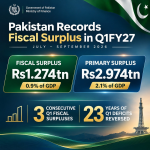
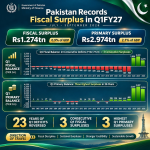
Overall, the federal government collected Rs2.36 trillion in non-tax revenue during the first two months of the current fiscal year against the full-year target of Rs5.33 trillion for FY27. The SBP remained the largest contributor, accounting for Rs1.932 trillion of the receipts.

The petroleum levy emerged as the second-largest contributor, generating Rs220.2 billion during the first two months of the current fiscal year.

Other major sources of non-tax revenue included Rs25.85 billion in royalties on oil and gas, Rs18.83 billion in markup on loans to state-owned enterprises (SOEs) and others, and Rs16.8 billion in markup from provincial governments.

The Pakistan Telecommunication Authority (PTA) contributed Rs16.07 billion, while the Natural Gas Development Surcharge generated Rs12.61 billion. Revenue from passport fees stood at Rs7.279 billion during the first two months against the annual target of Rs73 billion. The government also collected Rs3.47 billion under the defence-related head.

Other receipts included Rs3.71 billion from the discount related to crude oil prices, Rs5.1 billion through the windfall levy on crude oil, Rs634 million from the petroleum levy on liquefied petroleum gas (LPG), Rs881 million in receipts from the United Nations and Rs224 million through the Gas Infrastructure Development Cess. The government also collected Rs2.096 billion in dividends during the period.

Among other revenue heads, the Climate Support Levy generated Rs27.58 billion, while the New Energy Vehicle (NEV) Adoption Levy contributed Rs7.22 billion. The government received Rs34.8 billion in grants from provincial governments for the federal government, while other taxes generated Rs21 billion. Receipts under other taxes of the Islamabad Capital Territory (ICT) stood at Rs8.278 billion, while airport tax collections amounted to Rs10 million.

The Off-the-Grid (Captive Power Plant) levy, against an annual target of Rs15.7 billion, had yet to generate any revenue during the period.

The petroleum levy has an annual budgetary target of Rs1.676 trillion, while the government has projected Rs140.5 billion in royalties on oil and gas and Rs70.81 billion from the Natural Gas Development Surcharge for FY27.
 

Users who are viewing this thread

Latest Posts

Back
Top