General Mountaineering Thread


Rockfall at Trango Tower peak base camp injures 3 foreign climbers


Jamil Nagri
July 25, 2026
1784985518509.png

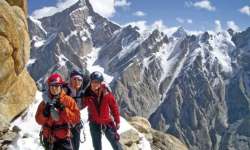
The file photo shows Trango Tower peak. — photo courtesy Alpinist website

GILGIT: Three foreign climbers were injured after a rockfall struck them at the base camp of Trango Tower peak, while a local tourist died after falling into Kachura Lake in Skardu while taking selfies.

The condition of one of the climbers is said to be critical as he suffered a head injury, while bad weather has hampered the helicopter rescue operation.

According to sources, Mr Markel De La Fuente, Mr Gorka Prieto and their colleague had reached the base camp of Trango Tower to attempt the climb.

The Trango Towers are a family of dramatic granite spires located north of the Baltoro Glacier in the Karakoram mountain range of Gilgit Baltistan.

Sources said the climbers were waiting for a weather window to begin their summit attempt. On Wednesday, a rockfall hit their camp, resulting in head and shoulder injuries to the three climbers. The climbers’ camp was also destroyed in the incident.

Mr Gorka Prieto sustained a serious head injury, following which the tour operator requested a helicopter rescue operation for the injured climbers.

General Secretary Alpine Club of Pakistan Ayaz Shigri told Dawn that the helicopter rescue operation could not be started due to bad weather conditions.

He said helicopters could not fly over mountains during adverse weather.

“Unfortunately, weather conditions across the North are not clear for flying for at least the next two to three days,” he said. Sources said the injured climbers were being shifted to Shigar through a ground rescue operation.

It takes at least a week to trek from the base camp to the nearest town of Shigar or Skardu.
 

KP mountaineers scale 6,050m Thalo Zom peak

Our Correspondent
July 30, 2026

1785407778760.png

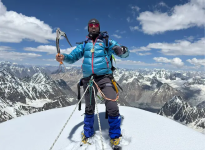
One of the mountaineers at the summit. — Dawn

CHITRAL: A nine-member mountaineering team from Khyber Pakhtunkhwa has successfully summited the perilous 6,050-meter (19,850 feet) Thalo Zom peak in the Hindukush mountain range.

The expedition, sponsored by Khyber Pakhtunkhwa Culture and Tourism Authority (KPCTA), conquered the treacherous peak on the eighth day of the mission, marking only the fifth successful ascent of the mountain in recorded history.

The specialised expedition was led by veteran climber Roohullah and comprised an experienced nine-member team consisting of Umer Khan, Intikhab Khan, Numan Sami, Izzatullah Shah, Saeed Akhtar, Naeem Khan, Fawad Khan and Raza Ali.

The assistant director of KPCTA, Saad bin Awais, told Dawn that the climbers hailed from various districts of Khyber Pakhtunkhwa. He added that they launched their expedition from the scenic Kumrat Valley in Upper Dir district.

He said that upon reaching the base camp, the team spent a gruelling week acclimatising to the thin air and high-altitude conditions.

On the final push, the team battled extreme vertical terrain, taking exactly eight hours to navigate from the high camp to the summit and hoist the national flag, he added.

Thalo Zom sits isolated on the boundary between Chitral and Upper Dir districts. Despite its modest 6,000-meter stature compared to Pakistan’s 8,000-meter giants, its extreme topography has historically repelled the world’s finest climbers.

“The physical features of the mountain have always kept mountaineers away from it,” Mr Awais said. He added that the KP team had to successfully negotiate a highly perilous approach to the base camp, which was heavily defended by shifting glaciers and deep, hidden crevasses.

“Fortunately, perfectly clear weather throughout the expedition window mitigated some of the risks, making the final climb smoother than anticipated,” he said.

Sahib Irfan, a tour operator from Chitral, underscored the immense difficulty of the peak and said that after an Australian team recorded the historic first ascent of Thalo Zom in 1971, the mountain remained untouched for nearly five decades and it took 48 years for an Italian expedition to finally secure the second successful summit in 2019.

He said that in 2025, a group of local Chitrali climbers under the banner of Shabdaraz Alpine Group successfully scaled it, paving the way for KPCTA-sponsored team’s historic multi-district triumph this July.
 

4 bodies found as search continues for climbers missing after Broad Peak avalanche


Jamil Nagri
July 31, 2026

1785495110098.png
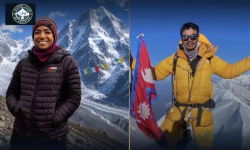
This combo photo shows Oman’s Nadhira Ahmed Abdullah Al Harthy and Nepal’s Pur Bahadur Gurung. — Photo courtesy Alpine Club of Pakistan

GILGIT: Four bodies were found on Friday as a search operation was underway to locate climbers who went missing on Broad Peak a day earlier after an avalanche struck around midday.

The Alpine Club of Pakistan (ACP) said that the 10-member team included six Nepalese climbers, a Pakistani, an Omani, an American and a climber from China. The climbers from Nepal were identified as renowned mountaineer Nirmal Purja, Pur Bahadur Gurung, Kili Pemba Sherpa, Nima Sherpa, Nawang Thindu Sherpa and Gyalu Sherpa.

It identified the remaining climbers as Nadhira Ahmed Abdullah Al Harthy from Oman, Pakistani climber Sohail Sakhi, Wang Zhong from China and Mallory Geis from the United States.

ACP President Major General Irfan Arshad told Dawn on Friday that four bodies had been found. He identified two of the dead as Oman’s Nadhira Ahmed Abdullah Al Harthy and Nepal’s Pur Bahadur Gurung.
 

Rescue operation​

In a statement issued earlier in the day, ACP Senior Vice President Karrar Haidri said two Pakistan Army Aviation rescue helicopters, carrying rescue personnel and additional specialised equipment, had been dispatched to support the ongoing search and rescue operation.

The statement said the ACP president, along with the club’s senior leadership, remained in constant contact with the highest government authorities and relevant agencies to facilitate the rescue operation.

“Every possible effort is being made to ensure that helicopter support and all available rescue resources are mobilised at the earliest opportunity, subject to weather and operational conditions,” it added.

The club said it was closely monitoring the situation and coordinating with all relevant stakeholders while expressing solidarity with the climbers’ families and the international mountaineering community.

ACP’s General Secretary Ayaz Shigri told Dawn that several expedition teams had jointly begun their summit push before the incident.


He said GPS locations received from some of the missing climbers indicated that the avalanche had swept the group about 1,000 metres downhill, leaving them trapped.

Shigri said helicopter-assisted rescue operations were expected to begin on Friday morning. He said there were also fears that some local high-altitude porters might have been affected by the avalanche.

“We pray for the safety of all the climbers. It is a big incident,” he said.
 
Purja, 43, who served with Britain’s Brigade of Gurkhas before joining the Special Boat Squadron of the Royal Marines, has broken multiple climbing records since becoming a full-time mountaineer and tour guide.

He climbed all 14 “eight-thousanders” (peaks above 8,000 metres, or 26,000 feet) in six months and six days between April and October 2019 — then a record. In 2021, Purja completed the first winter ascent of K2 along with a team of nine other Nepalese climbers.

Separately, in a post on X, the UK Embassy in Pakistan expressed concern at the incident. Seemingly referencing Purja, it also took note of a British-Nepali national missing in the expedition.

“We are concerned by reports that several climbers have gone missing during a Broad Peak expedition, including a British-Nepali national,” the embassy said, adding that it remained in contact with Pakistani authorities.

Sakhi, who hails from Hunza, had successfully summited Kanchenjunga (8,586m), the world’s 3rd highest mountain, in Nepal earlier in May. He had previously scaled K2, Nanga Parbat, Gasherbrum I and Gasherbrum II without supplemental oxygen, establishing himself among the country’s strongest high-altitude climbers.
 

Tributes in Oman to deceased mountaineer

We have reported that one of the four people who have been confirmed dead is Nadhira Ahmed Al Harthy from Oman.

A few years ago, she did several interviews in Oman after being the first woman from the country to climb to the top of Mount Everest.

Tributes to her are starting to be posted on X.

Oman's Civil Defence and Ambulance Authority has sent condolences, adding that Al Harthy was an "exemplar" on sticking to safety standards and supporting safety awareness programmes.

The country's Olympic Committee separately pays tribute to her work as president of the Oman School Sports Federation, while wishing for solace for her family.
 

Two of the deceased mountaineers named by Alpine Club of Pakistan

Two of the four people who have been confirmed dead have been now named by the Alpine Club of Pakistan as Nadhira Ahmed Abdullah Al Harthy from Oman and Pur Bahadur Gurung from Nepal.

The identities of the other two have not been released.

As a reminder, ten mountaineers in total had been declared missing late on Thursday.
 

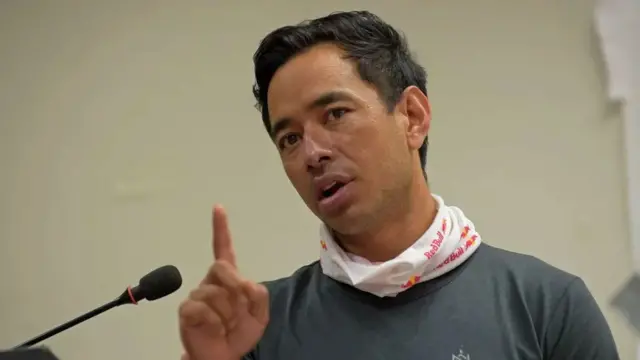
Nirmal Purja - one of the most recognised figures in mountaineering


Nirmal Purja speaks into a microphone


Image source, AFP VIA GETTY IMAGES

Among those reported to be missing is Nirmal Purja - one of the most recognised figures in mountaineering.

The British-Nepali climber holds multiple records and was awarded an MBE in 2018.

His most famous feat was in 2019, when he climbed the world's 14 tallest peaks in just over six months setting a record at the time for the fastest anyone had scaled all 14 mountains.

The 43-year-old was born in a small village in Nepal's mountainous Myagdi district, located around 1,600m above sea level.

In his most recent post on X, published on Monday, Purja said that he had not intended to climb Broad Peak.

"Initially, the plan was to climb just G2," he wrote, referring to Gasherbrum II, another peak located in the Karakoram mountain range.

"This wasn't planned," Purja wrote.

"But opportunities don't scream: they whisper to those already working in silence."

"Broad Peak, I ask for nothing but safe passage up and back down. I take zero mountains for granted."
 
What we know so far

Six climbers are missing and four bodies have been found following an avalanche on one of the world's tallest mountains, authorities say.

If you're just joining us, here's what you need to know:

The avalanche hit, Broad Peak, an 8,047m (26,400 ft) peak in the Pakistan-administered Gilgit-Baltistan region, at around midday on Thursday
Four bodies have been recovered, according to police - though their identities have not been confirmed

The expedition comprised six Nepali climbers, one American, one Pakistani, one Omani and one Chinese national. This was US woman Mallory Geis' first attempt at a 8,000m mountain, and Pakistani mountaineer Sohail Saki's last in Pakistan, according to their travel company.

Among the missing is Nirmal Purja, known as Nims Dai, one of the most recognisable faces of the modern mountaineering community. He's best known for setting a world record in 2019 for climbing the world's tallest 14 peaks in just six months.

Purja was also a prominent member of the Nepalese community in south England's Eastleigh Borough.

Since the first ascent of Broad Peak was recorded in 1957, many more have attempted to conquer the 8,051m (26,414 ft) peak - though dozens have also lost their lives in the process

Details about the deceased and missing remain unclear: "This is an unprecedented incident," a Nepal Tourism Department spokesperson told the BBC. "However, there are still some tiny hopes, with some conflicting information."
 

Broad Peak was US woman's first attempt at 8,000m mountain

Carrie Davies
BBC Pakistan correspondent

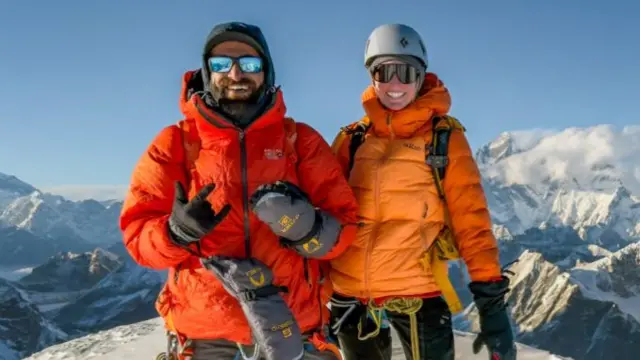
Two people wearing orange puffer coats smiling at the camera on a mountain


Moving Mountains/Instagram

Sohail Saki (left) and Mallory Geis are among the climbers who went missing on Broad Peak on Thursday.

We are starting to learn more about the climbers missing after an avalanche hit Broad Peak, the world's 12th highest mountain, yesterday.

Among them, according to the Alpine Club of Pakistan, is Mallory Geis.

Mallory posted on her social media page in mid-June that she had new boots ready for what she called "her first big kid climbing expedition in Pakistan".

She is tagged in a post from a travel company, Moving Mountains. The post says that Mallory would be with Sohail Saki. This would be his last 8,000m peak in Pakistan, and Mallory’s first attempt, it added.

Saki, a Pakistani national, is also listed among the missing.

His social media page shows pictures of multiple previous climbs, including a post from 2025 of him summiting K2. On his descent, the post says, Saki helped bring down an injured mountain guide.
 
To view this content we will need your consent to set third party cookies.
For more detailed information, see our cookies page.
 

MOUNTAINEERING: THE LAST DESCENT

Saeed Husain
July 5, 2026

1785587422113.png

Austrian Markus Kronthaler’s remains being brought down from Broad Peak. Six Pakistani and two Austrian mountaineers collaborated in the 2007 recovery mission | Photo courtesy Georg Kronthaler

In the past few decades, Pakistan’s mountains have become more and more accessible. A better-equipped airport at Skardu, improved road networks and social media exposure have transformed Pakistan’s adventure tourism industry from being engaged by a select few into one that is attracting hundreds of climbers and trekkers each season, to climb some of the world’s most difficult peaks and cross the highest passes.

By any metric, Pakistan’s mountain tourism industry and its local mountaineering culture have seen remarkable success in recent years.

But the rapid expansion has also led to some catastrophic consequences, and one that mountaineers know all too well: people do not always return. Fatal accidents claim climbers every season, including those with a lifetime of experience and those who are starting out.

What happens when tragedy strikes at the roof of the world? When the climbers are still believed to be alive, both ground and aerial rescue operations are launched to find them. However, if they have died, retrieving a body is an arduous task that few attempt.

Every climbing season, Pakistan’s highest mountains claim the lives of mountaineers. Bringing climbers down alive is difficult. Bringing back the dead is even harder. Yet a handful of Pakistanis have quietly taken on one of the world’s most dangerous jobs: recovering bodies from above 7,000 metres

As commercial mountaineering expands across Pakistan’s highest peaks, some individuals and small teams have found themselves performing a mission for which there is limited institutional support: bringing back the bodies of those who never returned.

In a country that lacks a dedicated private high-altitude rescue and recovery service — the army’s aviation unit is the primary agency for such interventions — these missions often become an improvised system of last resort for grieving families.
 
1785587473582.png

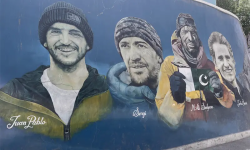
Mural in Skardu commemorating the four mountaineers who lost their lives in the 2021 K2 winter ascent. The bodies of Muhammad Ali Sadpara, John Snorri and Juan Pablo Mohr still remain on the mountain, while that of Sergi Mingote was recovered | By the writer

THE RECOVERY THAT CHANGED MINDS

Austrian Georg Kronthaler is making mountaineering and skiing safer. He developed the Local Avalanche Risk Assessment (LARA) app and also conducts courses on predicting avalanches. For him, making mountains safer is a personal mission. But his most lasting contribution might be in changing a long-held view.

In July 2006, his younger brother, Markus Kronthaler, tragically lost his life on Broad Peak (8,051 metres) in the Karakoram Range of Gilgit-Baltistan. The 39-year-old had successfully climbed the peak, but the mountain was unforgiving. His body lay just a few metres below the summit but could not be recovered. Markus’ expedition was being recorded and Georg could even listen to the final radio messages that his brother sent.

“When my brother died in 2006, I couldn’t accept the idea that he would remain up there forever. My mother would probably have waited her whole life for him to come home,” says Georg Kronthaler, speaking to Eos via WhatsApp.

At the time, the accepted opinion amongst the mountaineering community was that if one were to need assistance or die in those altitudes, they could not be helped by other mountaineers. High altitude rescues for the living are not only costly, but also far more technical and dangerous than an expedition to climb a summit. For reference, out of the over 340 people who have died on Mt Everest, nearly 200 bodies remain on the mountain.

“I wanted my brother’s death not to have been in vain, but rather to bring about a change in the mindset among mountaineers,” Georg says. “The notion that ‘you can’t help climbers who get into trouble at high altitudes, and under no circumstances can you bring deceased people down from there’ no longer holds true.”

Georg set about to recover this brother’s body.

“Because this belief was so deeply ingrained among mountaineers, I was even threatened with prosecution in Austria before the expedition,” says Georg. “The prevailing opinion was that no human life should be risked to recover a body, since such a recovery was impossible anyway.”
 

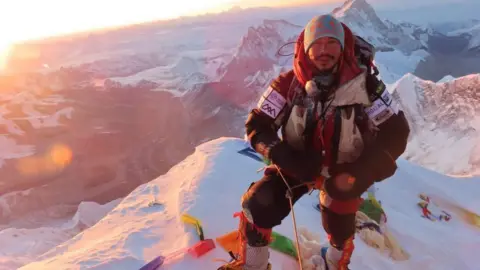
Mountaineer Nirmal Purja killed in Pakistan avalanche, his company says​


Tinshui Yeung
AFP Nirmal Purja at the summit of Mount Everest


AFP

Nirmal Purja became known internationally following a 2021 Netflix documentary
Renowned British-Nepali mountaineer Nirmal Purja is among 10 people killed in an avalanche on Broad Peak in Pakistan, his company has said.

Elite Expeditions said it confirmed with "profound sadness and immense heartbreak" that Purja, 43, had died in Thursday's avalanche. His brother Kamal later wrote: "We will miss you every single day".

Purja, who was born in Nepal and later served in the British army, was known for scaling the world's 14 highest peaks in just over six months in 2019.

Pakistani officials earlier said the bodies of three climbers from his expedition - American Mallory Geis, Nadhira Ahmed Abdullah Al Harthy from Oman and Pur Bahadur Gurung from Nepal - had been recovered.

Purja's death was also confirmed by Nepal's Prime Minister Balendra Shah, who said that "the tragic death of six Nepalese and four other foreign climbers, including world record holder Nirmal Purja, in the Karakoram mountain range of Pakistan, has shocked us".

"The history of their courage, dedication, and contributions will always remain inspiring," the prime minister added.

In a statement, Purja's older brother Kamal wrote: "It is with the heaviest heart that I share the devastating news that my beloved younger brother, Nirmal 'Nimsdai' Purja, and the other climbers are no longer with us.

"Although our hearts are broken, we are incredibly proud of you. Your legacy will live forever," he added.

UK Defence Secretary Wes Streeting said in a post on X: "Incredibly sad to learn of the passing of Nirmal (Nims) Purja and those he was climbing with.

"He was an inspirational man who served in our Armed Forces for many years - and whose incredible mountaineering adventures are known the world over."

Naila Kiani, a spokesperson for the Alpine Club of Pakistan which is involved in the rescue efforts, told BBC's Newshour programme that Purja had led many expeditions that she was on.

Praising his leadership skills, she described him as a "very experienced climber and fearless".

Kiani said the Alpine Club would only announce his death once the body has been recovered - but she added that "we are fearing them all dead".

She also said rescuers had seen some bodies - but were yet to reach them.

Teams in Pakistan have been searching for the climbers on the world's 12th-highest summit after an avalanche on the 8,047m (26,400ft) peak in the Karakoram range.
 
The multinational climbing group was being led by Purja. Also known as Nims, he rose to prominence in 2019 when he climbed all 14 of the world's mountains with peaks above 8,000m in 189 days - smashing the previous record by more than seven years.
He became widely known following a Netflix documentary chronicling his journey, 14 Peaks: Nothing Is Impossible, released two years later.

At the time, he said: "It has been a gruelling but humbling six months, and I hope to have proven that anything is possible with some determination, self-belief and positivity."
 

Users who are viewing this thread

Back
Top