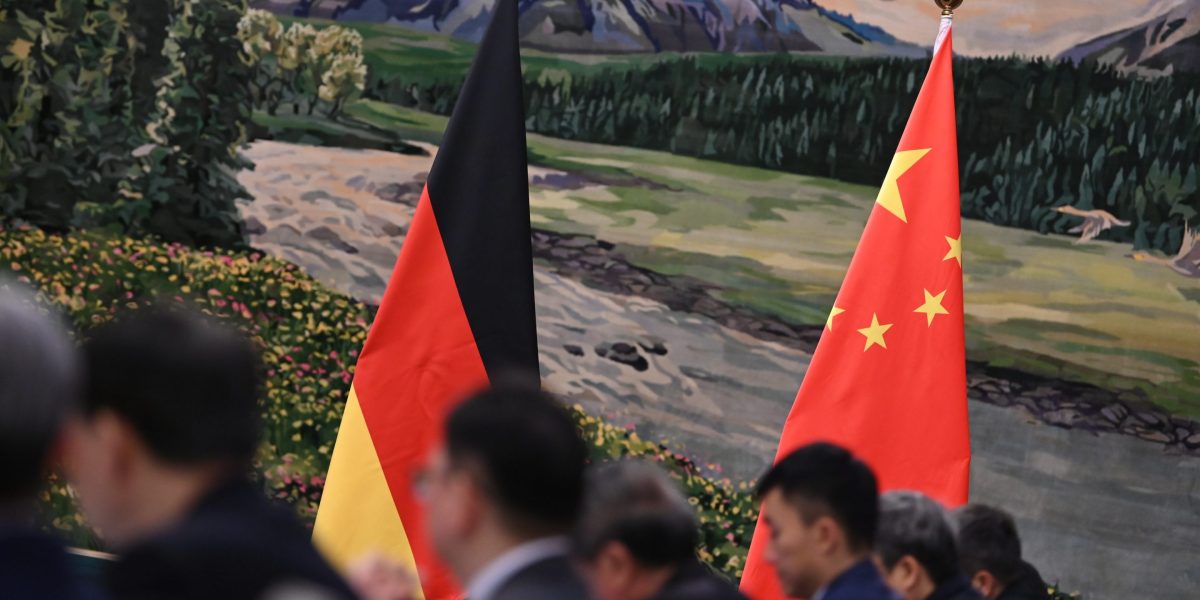
China is beating Germany at its own game of making highly engineered machinery and Europe is struggling to keep up
By
The Associated Press
September 2, 2026, 9:03 AM ET
The heart of the German economy is making and exporting the big-ticket, complex goods that make global business run: everything from
cars and
locomotives to factory machinery, aircraft and construction equipment.
That model for growth is under serious pressure from a new competitor whose exports can often match or approach Germany’s in quality and sell for far less: China.
The China shock — as economists call it — is emerging as a key reason for Germany’s chronic economic stagnation since the COVID-19 pandemic. The sluggish economy has helped make Chancellor Friedrich Merz’s governing coalition unpopular ahead of
an election Sunday in the eastern region of Saxony-Anhalt in which the far-right Alternative for Germany has its best chance yet of getting its first state governor.
German companies once reaped fat profits selling to China. But the tables have turned as Beijing supports companies in targeted sectors — often where German companies make competing goods. China’s goods cannot find enough buyers in China’s currently tepid economy, so they are shipped to foreign markets, including Europe.
Economic stagnation sours the mood ahead of regional elections
The German economy — Europe’s biggest — has stagnated for several years, shrinking in 2023 and 2024 and
showing only 0.2% growth last year. Although the unemployment rate of 4% is lower than the EU average, Germans can see the unsettling headlines about job reductions at companies that have defined the German economy for decades: 50,000 at
Volkswagen, with media reports of plans for more, 8,000 buyouts at
BMW by the end of next year, a reduction of 13,000 at auto technology firm Bosch by 2030. And inflation has run ahead of wage increases after the pandemic, with last year’s real wages only just catching up to where they were in 2019.
Costs must come down “in an environment where the Chinese total market is down by 20%, and Chinese competitors are increasing exports and thereby competitive pressure in Europe,” said Volkswagen’s finance chief, Arno Antlitz.
Of the world’s major economies, Germany has been hit the hardest
Germany’s economy relies on exports that are similar to the kind of manufactured goods that Beijing is now targeting for support. Other major economies such as Britain, Italy and France have smaller manufacturing sectors, while
U.S. tariffs block many Chinese goods, above all autos.
Germany now buys more from China than it sells in precisely the categories where German companies once dominated: cars, trucks, buses and trains, aircraft, factory machinery and medical devices. “China has already eaten much of German industry’s lunch and is preparing to start on dinner,” wrote economists Brad Setser and Sander Tordoir.
One answer: If you can’t beat them, join them.
Jungheinrich AG, a German maker of forklifts and warehouse vehicles, is partnering with Chinese manufacturer EP Equipment to make AntOn, an entry-level forklift that can match competitors on price. The partnership is taking advantage of EP’s large scale and lower production costs in China, and pairing it with Jungheinrich’s global sales force and reputation as one of the world’s three leading makers of warehouse vehicles.
AntOn’s lineup may not quite match the features available in strictly German-made vehicles — but they’re good enough and half the price. So AntOn, painted a bright purple color to differentiate it from Jungheinrich’s high-end yellow machines, has a simple, robust design with basic levers instead of a joystick, no compartment for a phone or wallet and an uncushioned seat. They sell for much less than typical Jungheinrich machinery, but are aimed at customers who may not need to run them 24/7.
“The challenge is, there comes a massive wave with Chinese products and Chinese offerings into Europe, but also into the international markets. And the key question is, how do you react?” said Chief Sales Officer Nadine Despineaux at the company’s plant in Moosburg near Munich.
She views the demand for entry-level or “mid-tech” vehicles as a business opportunity to reach new customers and markets. AntOn “is a good combination of German engineering, market access and customer proximity, which we bring to the table, and highly efficient production sites, which we use in China.”
Volkswagen has adopted an “in China, for China” approach, setting up
a vehicle development center in Hefei to design vehicles for the local market.
German policymakers are attempting to avoid a repeat of what happened with the country’s solar industry. Germany pioneered solar panel adoption in the early part of this century, but lower-priced Chinese products drove several German manufacturers into bankruptcy. Now, most solar panels in the country are imported from China.
Chinese companies do get help, but must survive ferocious competition at home
Chinese industrial policy means key sectors get many different kinds of support, including easy credit, inexpensive raw materials, cheap land and, in some cases, “made in China” requirements. Chinese workers earn less than those in Europe and economists say China works to keep its currency artificially low, making its goods more competitive overseas.
But China’s export prowess is based on more than government help. Chinese companies face brutal competition on price in a sluggish economy at home, forcing companies to keep costs down while racing to adopt new technology.
China
rejects the criticism of its trading partners. A recent Ministry of Commerce report titled “China’s Position on the So-Called Excess Capacity Issue” says discussions surrounding a China shock “falsely” describe China’s industrial development as a threat to Western economies.
From its end, the German government has sought to improve growth by enacting a 500 billion euro ($579 billion) fund to pay for new infrastructure such as roads, bridges and rail lines. A package
proposed in July includes income tax cuts for mid- and lower-income taxpayers and reductions in red tape.
The solution for German companies may be in Brussels
But Setser, the economist and a senior fellow at the Council on Foreign Relations, says the trade statistics show that the China shock is a dominant reason for Germany’s economic malaise. And the answer for Germany may be out of the hands of German industry — and the ultimate responsibility of EU trade policy run by the European Commission in Brussels. The Commission has imposed narrowly tailored tariffs, or import taxes, on some Chinese goods such as electric autos and platforms that lift workers at construction sites.
“We do think that Europe needs a tougher trade policy, that it needs to insulate its market from some of the spillovers from China’s own industrial policies,” said Setser. “There has to be a bit more symmetry … that the rest of the world will not remain open to a China that itself is not open to new imports.”
Manufacturers faced intensifying Chinese competition in cars, machinery and other traditional German strongholds

fortune.com