
Feroze
Trusted Member


First of 8 Hangor-class submarines arrives from China
Shazia Hasan Published June 12, 2026
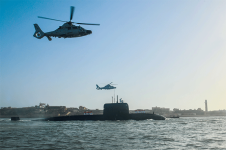

HELICOPTERS hover over the Hangor submarine upon its arrival in Karachi on Thursday.—Dawn
comments

Join our Whatsapp Channel
Add Dawn as a trusted source
KARACHI: The Hangor Class submarine, PNS/M Hangor — the first of a new fleet of Chinese-built diesel-electric attack submarines — arrived in Karachi from China on Thursday evening.
The PNS/M Hangor marks a transformative step towards Pakistan Navy’s modernisation and reflects the strong strategic defence cooperation between Pakistan and China.
ADVERTISEMENT
The sight of it emerging in the vastness of the Arabian Sea upon its arrival was not just the arrival of a submarine, it was a new symbol of Pakistan’s naval power, defensive self-confidence and modern military capabilities.
According to experts of naval warfare, by joining the Pakistan Navy fleet, this submarine will not only further strengthen the country’s maritime defence, but will also play an important role in the balance of power and maritime security in the region.
The name ‘Hangor’ is a symbol of courage, skill and professional excellence in Pakistan’s naval history. In the 1971 India-Pakistan war, PN’s submarine Hangor made history by sinking the Indian Navy’s warship Khukri, while severely damaging another warship, the Kirpan.
Continuing this historic and proud tradition, the new Hangor-class submarines have been given this name.
This modern submarine, manufactured in China, is equipped with the latest combat systems, sensors, sonar, radar and weapons. It has advanced stealth technology that gives it the ability to operate effectively while remaining hidden from enemy’s sight.
In addition, this submarine is capable of carrying long-range torpedoes and cruise missiles.
A prominent feature of the PNS/M Hangor is its Air Independent Propulsion (AIP) system, and enhanced stealth features, which will augment Pakistan Navy’s combat capability.
Upon its arrival, a reception ceremony was held at the Pakistan Navy Dockyard where the submarine was accorded a traditional naval welcome. Commander Pakistan Fleet, Vice Admiral Abdul Munib, graced the occasion as the chief guest.
The ceremony was also attended by senior naval officers, families of the crew, and Pakistan Navy personnel. Cadets of Pakistan Naval Academy presented a ceremonial salute to the incoming submarine and its crew, accompanied by a fly-past by PN Z9EC helicopters.
The submarine was commissioned in the Chinese city of Sanya on April 30 during a ceremony, which was also attended by the President Asif Ali Zardari and the Chief of Naval Staff Admiral Naveed Ashraf.
Pakistan had signed an agreement with China for the acquisition of eight Hangor-class submarines, under which four submarines are being built in China, while the remaining four will be built in Pakistan by Karachi Shipyard and Engineering Works.
President, premier congratulate PN
President Asif Ali Zardari and Prime Minister Shehbaz Sharif on Thursday congratulated the Pakistan Navy on the inclusion of PNS/M Hangor submarine in its fleet, APP adds.
Describing it as a significant milestone in strengthening Pakistans maritime defence capabilities, the president thanked the government and people of China for their valued cooperation.
“The Hangor project reflects the strong strategic cooperation between Pakistan and China in the defense sector,” President Zardari said, adding that Pakistan remains committed to promoting peace, stability, and balance in the region while strengthening its defence capabilities.
Prime Minister Shehbaz Sharif described the Hangor fleet as a significant achievement for the country’s maritime defence.
He said the Hangor Submarine Project was a manifestation of the longstanding friendship between Pakistan and China and reflected the strong strategic cooperation between the two countries in the defence sector.
He said the induction of the PNS/M Hangor marked an important milestone in Pakistan’s journey towards defence and self-reliance.
Held out the assurance that his government would continue to provide all possible resources to enhance the capabilities of the country’s security forces.
Published in Dawn, June 12th, 2026
Our readers are at the heart of everything we do.
Do you have a thought to share or a way we can improve? We’d love to hear it. Reach out to us at [email protected].
Newspaper
Shazia Hasan is a senior staff reporter for Dawn. Her reporting covers human interest stories, the armed forces, Railways, education, and fishing communities.


First of 8 Hangor-class submarines arrives from China
KARACHI: The Hangor Class submarine, PNS/M Hangor — the first of a new fleet of Chinese-built diesel-electric...
www.dawn.com


