History of Pakistan Army

1749331803149.png

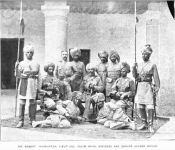
Colonel Sir Robert Warburton, Lieutenant Colonel Sir Aslam Khan Sadozai, Officers And Sowars Of Khyber Rifles, Circa 1890's.

The First Commandant Of The Khyber Rifles Was Sir Robert Warburton, Son Of An Anglo-Irish Soldier Robert Warburton Of The Bengal Artillery And His Wife Shah Jehan Begum, An Afghan Princess. Sir Robert Remained The Commandant Until His Retirement In 1899. His Deputy, Colonel Sir Aslam Khan Sadozai, The First Muslim Commandant, Succeeded Him.

Source - Eighteen Years In The Khyber 1879-1898 "With Portraits, Map, And Illustrations".
Author - By Colonel Sir Robert Warburton.
Publisher - Jhon Murray, London, 1900.
 
1749331874215.png


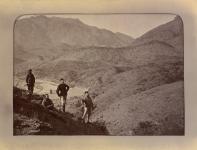
General Appleyard and his staff at the Khyber Pass, Circa 1878 - 1879.

Photograph of General Appleyard and his staff at the Khyber Pass. General Appleyard is seated on a steep hillside to the left. A soldier wearing a turban and holding a gun is standing behind him and two soldiers wearing western military uniform are standing on the hillside beside him to the right. A fort can be seen in the valley behind and mountains extend into the distance.

The photographer John Burke travelled with the Peshawar Valley Field Force during the Second Anglo-Afghan War (1878-80)

© John Burke / Royal Collection Trust
 
1749332049590.png


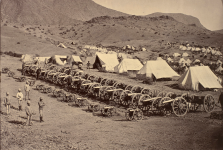
The Aftermath Of The Battle Of Ali Masjid, 2nd Anglo-Afghan War, 1878 To 1880, Taken By John Burke.

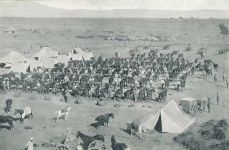
Photograph Showing A View Of The British Army Camped On The Shagai Heights Of The Khyber Pass, With Captured Afghan Guns From Ali Masjid In The Foreground.

Brigadier General Frederick Appleyard, CB, VC (1829 - 1911) And Four Of His Staff Stand To Left, Near The Cannons In The Centre. Some Soldiers Stand Next To The Cannons. Tents, Horses And men On The Right, Surrounding The Cannons, And Beyond.
 
1749332112714.png

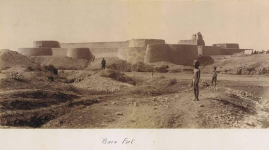
Bara Fort "A Frontier Outpost", Circa 1898.

The Photograph Shows The Bara Fort And The Photograph Was Taken From Across The Bara River Looking Westward. This Is A Place Whose Name Will Be Very Familiar To Our Readers, For It Was Some Time Head Quarters Of General Hammond And The Peshawar Column Of The Tirah Field Force.
 
1749332217350.png


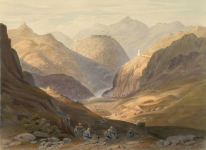
Fortress Of Alimasjid And The Khyber Pass "A Lithograph By James Rattrat, 1848".

This lithograph was taken from plate 13 of 'Afghaunistan' by Lieutenant James Rattray. Rattray was part of a combined force known as the Army of the Indus. He helped man the rear-guard during the army's march from Kabul to Peshawar.

The wild mountain scenery of Afghanistan suddenly surrounded them on entering the Khyber Pass from Jamrud. Their mission was to take the fortress of Ali Masjid, popularly known as the Key of the Pass, which dominated the road and was garrisoned by Dost Mohammed's troops.

Rattray had taken this sketch, "and had scarcely completed it, when suddenly a report was heard, and, to my utter astonishment, walls and bastions composing the fortress blew up simultaneously in the air, like a whirlwind of sand; and so completely was it swept off from the summit of the mountain, that when the dense cloud cleared away not a vestige of the building remained."

© British Library
 
1749332277664.png

The 57th Field Regiment, Royal Artillery "Stables" In Camp At Bara, Circa 1897.

The Picture Is Taken From The Top Of Bara Fort. In Background One Can See Besai Feature Or Besai Wali Ghar. The Location Of Stable Is Now Bara Water Reservoir In District Khyber.

57th Field Battery At“ Stables” Under The Walls Of Fort Bara. The Battery Belongs To The Peshawar Column, And It Is More Than Likely That, By The Time These Lines Are In Print, It Will Have Been Heavily Engaged.

Incidentally It Maybe Remarked That Among The Most Striking Features Of These Frontier Operations Has Been The Free Use Of Field Artillery.

In Most Of Our Little Indian Wars It Has Been The Fashion To Use Mountain Guns, Which, Although Able To Climb The Most Difficult Hills And To Come Into Action From Apparently Impossible Nooks And Crannies , Have Not, Of Course, The Range Of The Beautiful 12 Pounder, And Only Half The Explosive Effect.

On Several Occasions During The Past Four Months, Field Batteries Have Been Employed, With Brilliant Results, And, In Addition To Pulverising The Enemy, Have, By Covering The Infantry Attack, Rendered Our Own Losses Much Less Heavy Than They Might Have Been.

Source - Navy & Army Illustrated, Issue December 24th, 1897.
 
1639174285559.png


Ist Armoured Motor Bridge, Peshawar, 3rd Anglo-Afghan War, 1919 (c)
 
Shagai Fort, Khyber Pass, 1946-48 (c).


1640639885340.png


Quaid-e-Azam Muhammad Ali Jinnah With Colonel Mohammad Sharif Khan Afridi Kuki khel, Commandant Khyber Rifles. Standing Beside Him At The Parade Ground Of Shagai Fort, Literally In The Khyber Pass. Colonel Sharif Was The First Commissioned Officer In 1936 From Khyber.
 
View Of No. 8 (British) Mountain Battery In Action Near Maidan During Attack Of November 9th On Saran Sar Pass, Tirah Valley, North-West Frontier, 1897-98 (c).


1640746491865.png


The Tirah Campaign proved the most difficult and protracted military operation during the rising costing the Army in India 287 dead and 853 wounded, despite initial expectations in many quarters that British and Indian troops would only be opposed by lashkars still reliant on hand-to-hand combat supported by limited jezail or occasional rifle fire.

3 In his final report dated 24th February 1898 Major-General Sir William Lockhart summed up the difficulties encountered by imperial troops, "No campaign on the frontiers of India has been conducted under more trying and arduous circumstances than those encountered by the Tirah Expeditionary Force".
 
Miranshah Aerodrome, Waziristan, 1930 (c).

1640806661919.png


Weapons Line Up For Westland Wapiti Biplane At Miranshah, (RFC 230, 112 And 20lb Bombs; BIB - Baby Incendiary Bombs, Lewis And Vickers Guns And Ammunition).
 
1641051517472.png


Brigadier Amir Abdullah Khan Niazi, commander of the 14ᵗʰ Parachute Brigade, receives General Yahya Khan, the new C-in-C, at Sialkot.
 
Circa 1944

1641656881531.png


The 1/1ˢᵗ Punjab (62ⁿᵈ Punjabis) at Kohima, during the Burma Campaign. it had previously been in action in North Africa.
Probably the oldest infantry unit from the Raj lineage.
Lives on in the Pakistan Army as the 1ˢᵗ Punjab.
 
1641779808139.png


British officers and orderlies of the South Waziristan Scouts at lunch during a partridge shoot near Dhana in February 1936.

© Imperial War Museum
 

Users who are viewing this thread

Pakistan Defence Latest

Back
Top