Navigation
Install the app
How to install the app on iOS
Follow along with the video below to see how to install our site as a web app on your home screen.
Note: This feature may not be available in some browsers.
More options
Style variation
You are using an out of date browser. It may not display this or other websites correctly.
You should upgrade or use an alternative browser.
You should upgrade or use an alternative browser.
History of Pakistan Army
- Thread starter ghazi52
- Start date
More options
Who Replied?



AZ_HighCountry
INT'L MOD
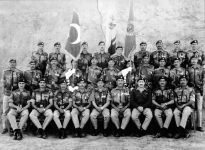
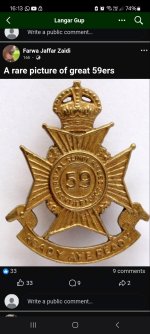
Photo looks odd. Was this originally a black & white photo they attempted to colorize? Look at the arms and hands of most of them.View attachment 179070
Raising Day Ceremony of 19th Battalion of Frontier Force Regiment.
View attachment 179071

Tremain
Registered Member
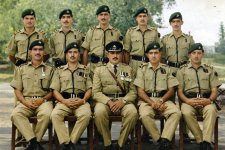
Gemini (google's AI) confirms it was used to colorize this pic.Photo looks odd. Was this originally a black & white photo they attempted to colorize? Look at the arms and hands of most of them.
Which is why I use ChatGPT for my colorizations (better colors). Like so.

ghazi52
THINK TANK: CONSULTANT
- Thread starter
- #381
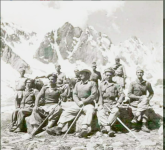
Captain Sahibzadgul later was decorated with the SJ in 1965 and embraced Shahadat in the defence of the Country.
This snapshot is in Kargil 1951. They walked from Gilgit and walked back after inspecting various outposts Riaz, father as The Commandant of the Northern Scouts in Kargil 1951.!!!! Moeen Jan Naim ;
It was a requirement in the good old days for officers to be out on tour in the field at least 21 days every month.
What a glorious life it must have been in the pristine North. !!!!! Riaz Sidiqui ; Hamid Zeb Khan Wow ! He's done a yeoman's service in the Army in the hard areas. So much dedication! Bless his soul !!!! Kalim Ullah Kh , Grana , that was a different breed of officers . I heard from my late father that as a young officer he escorted Gen Mian Haya ud Din to Broghal on foot / horse back but mostly on foot . It was after that visit that the GHQ , recommended by General Haya-ud- Din, Established a Permanent Post of Chitral Scouts at Broghal, With A line of Supply from Chitral !!!!! Hamid Zeb Khan ; Haider Arbab . Father as The Commandant of the Northern Scouts visiting his outposts at Kargil and Dras in 1951.
He walked from Gilgit to Kargil and back visiting and inspecting the outposts. Sitting on his right is Captain Sahibzadgul later was decorated with the SJ in 1965 , embraced Shahadat. A road is named after him in the Peshawar Cantonment. !!!!!
ghazi52
THINK TANK: CONSULTANT
- Thread starter
- #383
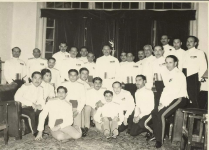
Raja Qaiser Zulqarnain ; Azhar Ahmed Sahibzada ; Looks like a Guides dinner night.

Sitting in sofa left is late General Fazl-e-Haq. At his feet is Major Ziauddin Abbasi Shaheed. My late father, Captain Iftikhar Ahmad Sahibzada is head only visible near Ayub Khan's right arm. Also in picture seated right is General Shahid Hamid. Late General Jehanzeb at right far back; Colonel Pir Abdullah Shah is standing at right of Ayub Khan. !!!! Syed Ali Hamid ; This pic was taken at the Guides Mess in Rwp.....There are many other famous personalities in this pic... 2nd from the right at the back is Miangul Aurangzeb.....on the left of Gen Ayub is Yahya...and two faces fruther left wiht the big mushtash is Brig Gul Mawaz...father of Saqib Saquib Mawaz-Khan 4th to the right from Ayub is Gussy haider...... to the left of the officer sitting in the middle is Sahibzada Siddi Mustapha who was from Hyderabad Deccan and was married to Bhuttos Sister. he was with Probyns in Burma and commanded the Guides after Independence !!!! Azhar Ahmed Sahibzada ; Zehra I belong to the family of Nawab Sir Sahibzada Abdul Qayum, founder of Islamia College Peshawar.
My grandfather, Sahibzada Khurshid was one of the first Muslim officers in the British Indian Army and from the 14th Punjab Regiment and Governor NWFP just after Partition. In fact Ayub Khan served under him for a while when he joined the army.
When 3rd Armd Bde moved to Rwp from Risalpur, 19L was at Westridge and its Mess was 274 Peshawar Road....13L was located near RA Bazaar and its mess was located also on Peshawar Road next to the Race Course.
Guides which arrived from Kohat got the best bulding for its mess which was located where the courts are now at the begining of Peshawar Road and the lines were next to where the Nurses hostel is opposite the AFIC..Probyns was located at Ojhri Camp !!!!! Jabbar Khan ; Behind Col Pir Abdullah shah is Baba Khan "Brig Abdul Rahim Khan"
ghazi52
THINK TANK: CONSULTANT
- Thread starter
- #384
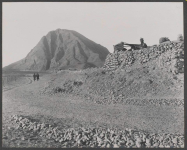
Raja Qaisar Zulqarnain ; Indian Army picquet at Rogha Kot, Waziristan, 1920 (c).
Photograph by Randolph Bezzant Holmes (1888-1973), India, North West Frontier, 1920 (c).
Frontier picquets were usually oval in shape with dry-stone walls of four feet six inches in height that allowed a soldier to stand and fire over them. There were also loopholes at ground level to counter the tribal tactic of employing snipers to pin down the heads of the defenders while swordsmen crept up close and scaled the wall.
At the end of each picquet was a machine-gun nest and in the centre an area for supplies and ammunition. Ground sheets would be stretched inwards to provide some relief from the sun.
From an album of 42 photographs mostly of which are produced by R B Holmes from the series 'With the Derajat Column in Waziristan', 1919-1920. The photographs were collected by Colonel G H Russell of the South Waziristan Scouts. !!!!
ghazi52
THINK TANK: CONSULTANT
- Thread starter
- #388
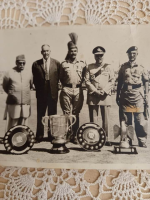
Lt to Right Mir Jam Ghulam Qadir Khan, Chief Minister Baluchistan, General (Retd) Muhammad Musa, Governor Baluchistan. Major Arif Shaheed Khan, FC Baluchistan. General Muhammad Zia ul Haq, President of Pakistan. Major General Muhammad Shafiq, IGFC Baluchistan
ghazi52
THINK TANK: CONSULTANT
- Thread starter
- #389
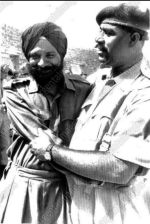
Subedar Ghulam Muhammad, 15 Punjab regiment (Pakistan Army) greets Lt Col Anant Singh, CO 4 Sikh regiment (Indian Army), as he arrives at prisoner of the war camp near Lahore in 1965.
It was the first meeting of the two since they fought together in World War II.
They didn’t meet as Pakistani or Indian soldiers first , they met as old soldiers who remembered who they were before 1947.
They were forged together in the jungles of WWII—most likely Burma—where survival mattered more than religion or flags, and that bond outlived Partition, borders, and even war itself.
ghazi52
THINK TANK: CONSULTANT
- Thread starter
- #390
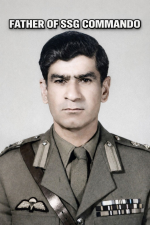
Aboobaker Osman Mitha (AO Mitha)
Major General Abu Bakr Usman Mitha, commonly known as AO Mitha, was an exceptional and courageous figure in the history of Pakistan Army. He is one of the founders of the Special Services Group (SSG) and is duly referred to as the “Father of S. It is called SG. In 1956, he founded a commando force in the mountainous area of Charat, Khyber Pakhtunkhwa, which later proved to be Pakistan's most talented and dangerous mission carrying out unit.
Under his leadership, the SSG received modern-style training in collaboration with US Special Forces, which brought new dimension to the concept of special operations in the Pakistani Army. Metha was not only a staunch military officer but also an inspirational leader for his juniors. تھے۔
---
The early life
Abu Bakr Usman Mitha was born on 1st June 1923 in Malabar Hill, Posh area of Mumbai (present-day Mumbai) into a prosperous Memon business family family. His childhood was spent in a prestigious but traditional family environment.
He had the opportunity to study in higher educational institutions and full of luxuries Life was easy, but they chose a military career by abandoning the business life.
This decision was not an easy one because the family wanted trade for them and an arranged marriage, but Mitha chose her own path. This self-confidence and stubbornness later became a prominent description of her military life.
---
British services in Indian Army.
He passed out from the Indian Military Academy, Dehradun in 1942 and was commissioned in the British Indian Army. During World War II he was stationed on the Burma Front and joined the Parachute Regiment and took part in dangerous missions against the Japanese forces. Dropped behind key lines where they displayed extreme daring.
In his book Unlikely Beginnings, he also mentions the racial prejudice of British officers, showing that they were dignified and self-sufficient personalities not only on the battlefield but also on theoretical level.
---
Character after the establishment of Pakistan.
After partition of India in 1947, they chose Pakistan and served at General Headquarters Rawalpindi in the early days. There was severe shortage of resources during this period, wooden boxes were used as desks in offices and even paper was not available.
In 1954, he was given the responsibility of establishing an elite commando unit. He chose Charat as a training center and founded the Special Services Group through the most rigorous physical and mental training. His famous phrase was:
“Be proud of your poverty.”
This philosophy became the identity of SSG.
He was the head of the SSG from 1954 to 1960. Later, he was appointed Commandant of Pakistan Military Academy and then Commander of 1 Armed Division.
---
East Pakistan and the conditions of 1971
He held important military positions during the 1965 War and subsequent deployment to East Pakistan. He was present as Deputy Corps Commander in the 1971 crisis. The events of this era, especially Operation Search Light, are a controversial and sensitive part of Pakistani history. It's Bob.
He was later appointed Quartermaster General at GHQ, but in December 1971 he was suddenly retired. He was only 48 years old at that time. His dismissal caused surprise in military circles as a formal court marshal was applied to him. Didn't happen.
---
The honors and the afterlife
He was given several honors including Hilal-e-Jarat, Star Quaid-e-Azam and Pakistan Medal, but later his medals and privileges were withdrawn. Nevertheless, his popularity did not diminish, instead he became more respected among his junior officers.
After retirement, he lived in difficult conditions, but never lost his dignity and self-respect. He died in Islamabad in December 1999.
---
Personal life
He married Indu Chatterjee in 1951, who belonged to a Bengali Christian family. Despite differences in religion, language and culture, their marriage was successful. His wife specialised in classical dance Indian Natam, but due to social pressure in Pakistan, they were forced to. Had to give up dancing in public.
Life of Mitha is the story of a soldier who left a comfortable life and chose the battlefield and national service, and who etched his identity in history forever by founding the most prestigious commando force of Pakistan Army.
---
Users who are viewing this thread
Total: 1 (members: 0, guests: 1)
Pakistan Defence Latest


Country Watch Latest
-
Iran - Israel/US War: Israel-US declare war on Iran, Iran responds (78 Viewers)
- Latest: ChineseTiger1986
-
Bangladesh Keen To Join Saudi-Pak-Turkey Defence Alliance, Says PM's Top Aide (13 Viewers)
- Latest: Owaiz
-

-

-

