𝐃𝐢𝐝 𝐲𝐨𝐮 𝐤𝐧𝐨𝐰, 𝐭𝐡𝐞 𝐥𝐚𝐫𝐠𝐞𝐬𝐭 𝐦𝐚𝐬𝐬 𝐞𝐱𝐞𝐜𝐮𝐭𝐢𝐨𝐧 𝐨𝐟 𝐭𝐡𝐞 𝐖𝐚𝐫 𝐨𝐟 𝐈𝐧𝐝𝐞𝐩𝐞𝐧𝐝𝐞𝐧𝐜𝐞 𝐢𝐧 𝟏𝟖𝟓𝟕 𝐭𝐨𝐨𝐤 𝐩𝐥𝐚𝐜𝐞 𝐚𝐭 𝐏𝐞𝐬𝐡𝐚𝐰𝐚𝐫? This fact remains unknown to many.
10 June, 2026, marks the 169th anniversary of an important day in our history when 40 freedom fighters (or "Mutineers" in the eyes of the East India Company) were blown from the mouths of cannons in Peshawar. It was the largest mass execution of the War of Independence in 1857 anywhere in India. Unfortunately, no memorial stands in Peshawar today to honour and remember those forgotten martyrs.
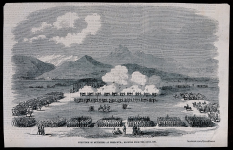
The execution was carried out publicly in the old parade ground (the present-day tarmac inside Peshawar airport). Charges of open mutiny were brought against sepoys of the 55th Native Infantry and other regiments.
To secure the North West Frontier from further rebellions and to set an example, most of them were ruthlessly blown from guns, while the remaining were hung from gallows as native sepoys watched.
Illustrated London News published a sketch of the scene of execution. It shows the parade ground with Khyber Hills in the background and Jamrud Fort in the distance. Similar executions were conducted in Ferozepore in Punjab a couple of days later, but the Peshawar execution remained the single largest mass execution of the War of Independence 1857.
Officers of the East India Company who supervised the punishment included John Nicholson, Sydney Cotton, Neville Chamberlain and others.
John Nicholson, who first heard the news of the sepoy rebellion in Peshawar, after quenching the rebellion in Peshawar, headed out on 14th June 1857 to break the rebellious siege in Delhi.
Differing opinions emerged in the aftermath of the execution. Some criticised the ghastly manner in which the East India Company carried out the punishment, while others justified it unabashedly. However, after 1857, East India Company's general conduct in India raised much questions. As a consequence, with the passage of the Act of Parliament the British crown officially took over the administration of India, establishing the British Empire in 1858.
The following report is from an extract published in Blackwood's Magazine by an eye witness. Like the execution's perpetrators, it shows no mercy for the style of execution; however, at the same time it cannot conceal its admiration for the religious faith of the natives:
𝐄𝐱𝐞𝐜𝐮𝐭𝐢𝐨𝐧𝐬 𝐚𝐭 𝐏𝐞𝐬𝐡𝐚𝐰𝐮𝐫 (𝟏𝟎 𝐉𝐮𝐧𝐞 𝟏𝟖𝟓𝟕)
That there has been some hot work at Peshawur the following extract, which so minutely describes the terrible punishment inflicted on the mutineers, will demonstrate:
"And now commenced the work of retribution at Peshawur. Courts-martial were 'Bitting all day, and after all that occurred here and down country, you may be sure that the officers composing them were in no very merciful mood. The first for trial were the Sepoys who deserted during the night after the disarming.
They were let off rather easily, only one native officer and twelve non-commissioned officers and men being sentenced to death. These were accordingly hung in presence of the whole force. The remainder were sentenced to various terms of transportation and imprisonment.
The next for trial were the mutineers of the 55th, who had been taken in the very act with arms in their hands; of course no court-martial could arrive at any but one decision regarding them; they were all sentenced to be blown away from guns.
A very proper sentence, and one that, in my humble opinion, should have been at once confirmed and carried out. Remember these men were soldiers-had all solemnly sworn fidelity, loyalty, and obedience to their officers-and now they had been guilty of rank open mutiny, the worst crime a soldier can commit. Guilty too of robbery and of what further atrocities they would have been guilty, had they been successful we can only judge too surely by the acts of their brethren down country.
Remember, too, that there were 5000 men in Peshawur ready and willing to break out in the same way the moment they could get a chance, and to whom it was, of course, a subject of some interest to see how we were going to treat the crime of open mutiny.
These men required an example-a terrible example-that would have struck fear into their souls, and effectively suppressed all ideas of committing the same crime, and incurring the same penalty. One would have thought that, taking these points into consideration, the just sentence passed on these men would have been carried out on all of them, without a single exception.
But no-Exeter Hall ideas and a dread of public opinion in England, were powerful even up here at the Khyber, and it was decided that two out of three of these justly forfeited lives should be spared, and that only one in three should be executed. I gladly acquit the Peshawur authorities of this grand mistake; this squeamishness in inflicting due punishment on murderous mutineers emanated from a higher authority than any here. Well, then forty men were to be blown away. I presume, Ebony, that this is a sight which, in your manifold experience through the world, you have never witnessed.
It was an awfully imposing scene. All the troops, European and native, armed and disarmed, loyal and disaffected, were drawn up on parade, forming three sides of a square; and drawn up very carefully, you may be sure, so that an attempt on the part of the disaffected to rescue the doomed prisoners would have been easily checked. Forming the fourth side of the square were drawn up the guns (9 pounders), ten in number, which were to be used for the execution.
The prisoners, under a strong European guard, were then marched into the square-their crimes and sentences read aloud to them, and at the head of each regiment; they were then marched round the square and up to the guns. The first ten were picked out, their eyes were bandaged, and they were bound to the guns, their backs leaning against the muzzle, and their arms fastened to the wheels.
The port-fires were lighted and at a signal from the Artillery Major, the guns were fired. It was a horrid sight that then met the eye; a regular shower of human fragments of heads, of arms, of legs, appeared in the air through the smoke, and when that cleared away, these fragments lying on the ground-fragments of Hindoos, and fragments of Mussulmans all mixed together, were all that remained of those ten mutineers.
Three times more was this scene repeated; but so great is the disgust we all feel for the atrocities committed by the rebels, that we had no room in our hearts for any feeling of pity, perfect callousness was depicted on every European's face; a look of grim satisfaction could even be seen in the countenances of the gunners serving the guns. Far different was the effect on the native portion of spectators, their black faces grew ghastly pale as they gazed breathlessly at the awful spectacle. You must know that this is nearly the only form in which death has any terrors for a native. If he is hung, or shot by musketry, he knows that his friends or relatives will be allowed to claim his body, and will give him the funeral rites required by his religion; if a Hindoo, that his body will be burned with all due ceremonies; and if a Mussulman, that his remains will be decently interred, as directed in the Koran. But if sentenced to death in this form, he knows that his body will be blown into a thousand pieces, and that it will be altogether impossible for his relatives, however devoted to him, to be sure of picking up all the fragments of his own particular body: and the thought that perhaps a limb of some one of a different religion to himself might possibly be burned or buried with the remainder of his own body, is agony to him. But notwithstanding this, it was impossible for the mutineers diarest fiater (? sic) not to feel some degree of admiration for the way in which they met their deaths. Nothing in their lives became them like the leaving of them. Of the whole forty, only two showed any signs of fear, and they were bitterly reproached by the others for so disgracing their race. They certainly died like men
. After the first ten had been disposed of, the next batch, who had been looking on all the time, walked up to the guns quite calmly and unfalteringly and allowed themselves to be blindfolded and tied up without moving a muscle, or showing the slightest signs of fear, or even concern.
Whence had these men this strength? Their religion, bad as it may be and is, in all other points, at least befriends them well at the very hour of death; it teaches them well that great and useful lesson, how to die. It is their religion that supports them, for there is no native, however low in the scale of humanity, however deeply sunk in vice, in debauchery, and in crime, but acknowledges and practices the form of some sort of religion.
Even in the midst of his crimes he acknowledges a God, and calls on that God to sustain him at the hour of his death. We had several execution parades after this, but all on a smaller scale. At one of these, a havildar, native sergeant, who had been convicted of seditious correspondence with one of the hill tribes, and sentenced to be blown away, was tied up to the gun, and then offered his life if he would turn Queen's evidence, and give up the names of the other traitors in his regiment. With his back leaning against the cold muzzle of the gun which he knew was loaded for his death, and with the smell of the lighted port fire in his nostrils, he hesitated for a short time, and was almost giving in; but no-the feeling of honour, of loyalty to his comrades, to his fellow traitors, was stronger in him than fear of death. Faithless as he had been to us, he was faithful to them; he refused to reveal anything, and met his doom with a firmness worthy of a better cause." -
Blackwood's Magazine... Nov 1858