History of Pashtuns

1767307421457.png

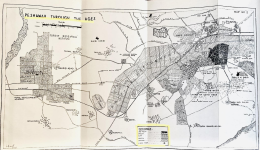
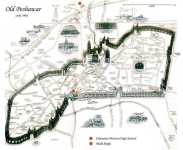
Map of Peshawar ‘Through the Ages’.

The index references the different areas of the city as they were established and developed under different ruling entities:
Pre Muslim Era
Muslim Era
Sikh Era
British Era
Pakistan Era

Source: Ahmad Hassan Dani’s “Peshawar -
 
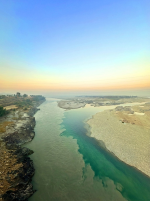
"About sixty miles from Islamabad, I found myself on a bridge, on the Grand Trunk Road to Peshawar.

Downstream was the Attock Fort...Upstream was a confluence of two great rivers: the Kabul, which had travelled some two hundred and fifty miles from its source, in the mountains west of the Afghan capital; and the Indus, one of the legendary rivers of Asia, which begins high in the Tibetan Himalayas.

The two rivers grudgingly accommodated each other. The Kabul was a sludgy burnt-sugar colour, the Indus a brilliant blue-green, like a child's painting of a mountain stream.

Below the confluence, the two colours remained clearly visible, one river with two distinct streams, as though geography as well as history wished to make a point about this place and the boundary that it marks—between the land of the Pashtun and the Punjab, the heartland of Pakistan."

(Isabel Hilton - The Pashtun Code - Newyorker Dec 2001).

1768861414364.png
 
1772311280003.png


Humayun Akund ; The Peshoris ; history ❤️The 16 Gates❤️

Rampura Gate, Reti, Kachehri, Asamai, Kabuli, Bajouri, Dabgari, Ramdas, Beriskian, Sard Chah, Sirki, Kohati, Yakka Thoot, Ganj, Lahori, Hashtnagri

According to historians, Sikhs captured Peshawar in 1818 before ruling it until 1849. The old city wall was built during the reign of Sikh Governor General Avitabile, who was basically an Italian mercenary and remained in office from 1838 to 1842. It was made of mud, which was later replaced with bricks by Britishers after they took over the city in 1849.

The original wall ran around the old city and had 16 gates. Two of them exist in original form, Sir Asia Gate and Thund Khui Gate (Sard Chah Gate), while others have been rebuilt on the government orders. !!!!!
 
1775400068458.png

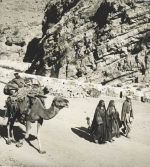
Afghan nomads in the Khyber Pass, 1939 (c).

Picture Courtesy:- Tarikh-i-Pakhtunkhwa
 
1785529764791.png

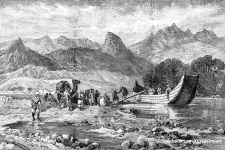
"𝐒𝐰𝐚𝐭 𝐑𝐢𝐯𝐞𝐫 𝐅𝐞𝐫𝐫𝐲 𝐚𝐭 𝐀𝐛𝐚𝐳𝐚𝐢" (Illustrated London News, April 1895)

This sketch was published in the ILN in April 1895 during the Chitral Campaign. It was drawn by 𝐆𝐞𝐧 𝐒𝐢𝐫 𝐌𝐢𝐜𝐡𝐚𝐞𝐥 𝐀. 𝐁𝐢𝐝𝐝𝐮𝐥𝐩𝐡 𝐊𝐂𝐁, an accomplished artist, who had previously contributed numerous sketches to the Illustrated London News during both the Crimean War and the Second Anglo Afghan War.

The sketch was produced against the backdrop of the 𝐂𝐡𝐢𝐭𝐫𝐚𝐥 𝐂𝐚𝐦𝐩𝐚𝐢𝐠𝐧 𝐨𝐟 𝟏𝟖𝟗𝟓. Following the death of the Mehtar of Chitral, the ambitious Umra Khan of Jandol Dir intervened in the succession dispute and advanced into Chitral. The British garrison at the Chitral Residency came under siege for nearly seven weeks, prompting the Government to mount two relief expeditions.

At the time this sketch was published in April 1895, the northern relief column starting from Gilgit under Col James Kelly had reached Ghizer but was temporarily halted by heavy snow blocking the route through Mastuj. Meanwhile, Sir Robert Low's main relief force, advancing from Nowshera, had fought its way through the Malakand and Shahkot passes and secured the Swat River crossings on its march towards Chitral.

Biddulph's sketch was published to help readers in Great Britain visualise the terrain and one of the key crossing points on the route taken by Sir Robert Low's relieving force.
 
1785530520563.png

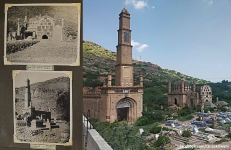
𝐊𝐨𝐡𝐚𝐭'𝐬 𝐃𝐮𝐫𝐫𝐚𝐧𝐢 (𝐒𝐚𝐝𝐝𝐨𝐳𝐚𝐢 𝐑𝐨𝐲𝐚𝐥) 𝐆𝐫𝐚𝐯𝐞𝐲𝐚𝐫𝐝 is the ancestral burial ground of the Saddozai branch of the Durrani dynasty, whose members settled in Kohat after the rise of the Durrani Empire in Afghanistan in the 18th century and later served as governors and rulers of the district.

Once enclosed within a walled complex, it also featured a gathering area and an underground basement, both used during family commemorations. The basement has since been filled with debris and much of the site's former character has disappeared despite its historical significance.

𝐶𝑜𝑚𝑝𝑎𝑟𝑖𝑠𝑜𝑛: 1930𝑠 𝑝ℎ𝑜𝑡𝑜𝑔𝑟𝑎𝑝ℎ 𝑎𝑛𝑑 𝑎 𝑟𝑒𝑐𝑒𝑛𝑡 𝑣𝑖𝑒𝑤 𝑏𝑦 𝐹𝑎𝑟𝑟𝑢𝑘ℎ 𝐻𝑢𝑠𝑎in.
 

Users who are viewing this thread

Pakistan Defence Latest

Latest Posts

Back
Top