History & Operations of Wars of Pakistan Air Force

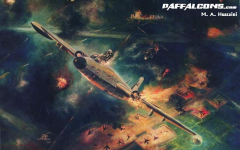
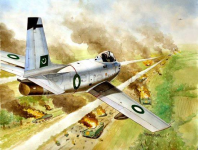
The painting depicts F-86 Sabres of PAF’s No.19 Squadron, led by S/L S Sajad Haider, attacking the Indian Army, which had just crossed into Pakistan territory near Attari village close to Lahore.

According to Indian accounts 3 Jats lost 5 out of 6 RCL guns, 3 mortar carriers and a number of Sherman tanks along with its men. Their CO Lt. Col Desmond Hayde ran back with his one sock and one shoe followed by his 2-I-C who ran back on bicycle and took refuge in Amritsar Fort.

Even Indian Airforce didn’t show up for their support. Their Amritsar airbase was some miles away. Throughout the war Indian Army was not able to move an inch forward to capture Lahore city which was their main objective.

Picture courtesy: Rehan Siraj
1757355696266.png
 
Is there a way for someone having knowledge about Wot ops by army to share details of important battles, how they where fought, which unit fought, supporting elements etc etc.

Something like this:
To view this content we will need your consent to set third party cookies.
For more detailed information, see our cookies page.
 
1757358306877.png


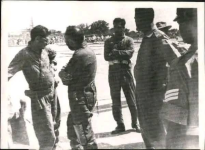
Indian Air Force pilot Squadron Leader Brijpal Singh Sikand surrendered to the Pakistan Air Force. In this photo, he is seen discussing with Flight Lieutenant Saad Hatmi at Pasrur Airfield.

On 3 September 1965, the skies over Pasrur witnessed one of the most remarkable episodes of the Indo-Pak aerial conflict.

Squadron Leader Brijpal Singh Sikand of the Indian Air Force, while flying a Folland Gnat, came face-to-face with a Pakistan Air Force F-104 Starfighter piloted by Flight Lieutenant Hakimullah—a young officer who would one day rise to become Chief of the Air Staff.

At approximately 1105 hours, the Starfighter engaged with such overwhelming dominance that Sikand, deprived of options, was compelled to surrender in mid-air. In an unprecedented act, he landed his Gnat intact at Pasrur Airfield, effectively handing over both himself and his aircraft to Pakistan.

Captured as a prisoner of war, Squadron Leader Sikand remained in custody until January 1966, when he was released by the Government of Pakistan as a goodwill gesture. Following his return to India, he continued to serve in the IAF, ultimately attaining the rank of Air Marshal before retiring in October 1986.

The captured Gnat was test-flown by Flight Lieutenant Saad Hatmi, a PAF officer with prior experience on Gnats in the UK, before being moved to Sargodha for detailed evaluation. Preserved thereafter as a prized war trophy, the aircraft now rests at the PAF Museum in Karachi—a powerful symbol of that extraordinary moment and an enduring reminder of the dramatic surrender of 1965.
 
To view this content we will need your consent to set third party cookies.
For more detailed information, see our cookies page.
 
To view this content we will need your consent to set third party cookies.
For more detailed information, see our cookies page.
 
To view this content we will need your consent to set third party cookies.
For more detailed information, see our cookies page.
 
To view this content we will need your consent to set third party cookies.
For more detailed information, see our cookies page.
 
To view this content we will need your consent to set third party cookies.
For more detailed information, see our cookies page.
 
DGPR (AIR FORCE)
@DGPR_PAF

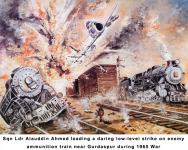
Today in HistoryOn 13 September 1965, Squadron Leader Alauddin Ahmed Shaheed, Commanding Officer of No 18 Squadron, displayed extraordinary courage and leadership while striking the enemy in Chawinda–Narowal sector, destroying numerous tanks and guns that halted the advance of No 1 Armoured Division of Indian Army. After rearming at Sargodha, he led a daring low-level attack with his formation over Batala and Gurdaspur, targeting an enemy ammunition train near Gurdaspur at around 1030 hours.

The attack caused a massive explosion that disrupted enemy logistics at a critical juncture of war. During this mission, his F-86 Sabre was severely damaged by debris and though he attempted to eject, he embraced martyrdom. Squadron Leader Alauddin’s supreme sacrifice and gallant courage earned him Sitara-e-Jurat from the Government of Pakistan, etching his name in glory. His unwavering devotion stands as a shining chapter in the proud legacy of Pakistan Air Force.

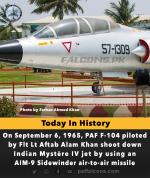
During another noticeable episode on the same day, Squadron Leader Mervyn Leslie Middlecoat Shaheed, commanding No 9 Squadron’s F-104 Starfighters, achieved a landmark night interception. Guided solely by Sakesar radar in total darkness, he executed a daring blind intercept and unleashed a Sidewinder missile, bringing down Indian Air Force’s Canberra bomber with precision. The feat showcased exceptional courage, skill and coordination, marking a defining moment in Pakistan Air Force’s night interception history.

For his gallantry and leadership, Sqn Ldr Middlecoat was awarded Sitara-e-Jurat by Government of Pakistan, honouring his selfless service during a critical phase of the conflict.

These legendary feats etched the names of PAF pilots into the annals of aerial warfare, a testament to the courage, precision and unshakable resolve of our Shaheens. Their valor in September 1965 continues to inspire generations, reflecting a legacy of steadfast commitment, selfless sacrifice and an indomitable spirit that seeks victory against all odds.

1757795839034.png
 
A B-57 IS LOST OVER ADAMPUR
SEPTEMBER 14, 1965Flight Lieutenant Altaf Sheikh had pulled up his B-57 after his dive bombing run over the heavily defended Adampur airfield when it received direct hits from the IAF's medium ack ack guns.

1757949505527.png
 
To view this content we will need your consent to set third party cookies.
For more detailed information, see our cookies page.
 
Today in History

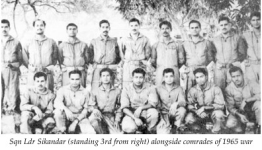
On 16 September 1965, Squadron Leader Sikandar Mahmood Khan led a courageous two-ship bombing mission against the heavily defended Halwara airfield. Employing a fuel-conserving Hi-Lo-Hi flight profile, Sqn Ldr Sikandar flawlessly executed a precise bombing run under intense enemy fire.

Despite challenging conditions on the return journey, he skillfully navigated back to Pakistan, exemplifying exceptional bravery and airmanship. PAF sustained its relentless offensive by destroying twenty Indian tanks, military vehicles and artillery across key sectors including Sialkot-Jammu and Wagah-Attari, while also shooting down two Indian Air Force Hunter jets, effectively weakening enemy combat power.

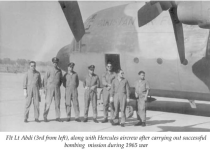
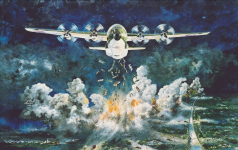
In another groundbreaking operation, Pakistan Air Force deployed its C-130 Hercules transport aircraft for live bombing missions in direct support of ground forces. Navigated by Flight Lieutenant Viqar Abidi, the heavily loaded Hercules took off from Peshawar and executed precise bombing runs that reduced enemy armor to smoldering wreckage. Later that evening, a second mission struck the retreating enemy Engineering Brigade near Deg Nullah in Chawinda, devastating trucks, troops and bridging equipment. Despite poor visibility, Flt Lt Abidi’s flawless navigation and timing made these missions highly effective, epitomizing PAF’s tactical innovation and unwavering resolve.

These bold operations by PAF warriors showcased exceptional skill, strategic innovation and unwavering resolve. Reflecting the highest standards of professionalism and resilience, their actions significantly contributed to mission success and national defence.

1757970777141.png


1757970805455.png


1757970826160.png
 
To view this content we will need your consent to set third party cookies.
For more detailed information, see our cookies page.
 

Users who are viewing this thread

Back
Top