Hunters Down Strikes Against Sargodha.
By:
Sarmad Hassan Sharif
Date: September 07, 1965
Time: 0551 Hours
Sector: Sargodha Air Base
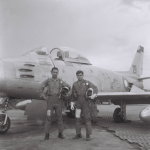
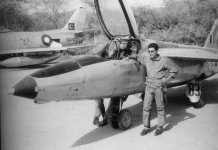
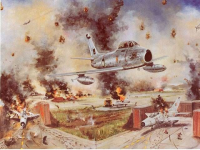
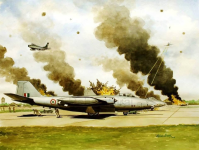
As soon as the threat posed by the Mystères was over, two sections of two F-86F Sabres each and one single F-104 Starfighter were scrambled for an airfield patrol. The first aircraft which took to the air were Squadron Leader Alam along with his wingman. Flight Lieutenant Imtiaz Bhatti with his wingman followed suit. Both the Sabre formations were told to orbit at 15,000 ft. in the 10 miles arc and 15 miles arc South-West of the base. The F-104A Starfighter flown by Squadron Leader Arif Iqbal was perched higher as a top cover for the two F-86F Sabre formations. Action was not over yet when the outer belt of the MOU reported six Hunters at 0551 Hours. According to Fricker, “From the first warning from the outer belt at 0551 Hours, Sargodha had 14 minutes to prepare for action before the inner belt reported the Hunters overhead at 0605 Hours. ‘Killer Control’ was soon reporting four Hunters pulling up for the attack, but despite the long period of warning, the IAF aircraft were not intercepted until they reached Sargodha.”
The fact was that the Sabres were vectored eastwards to intercept the incoming raid at 15,000 ft. however they were told to turn back because the IAF aircraft were overhead Sargodha. These Hunters in fact had attacked Chota Sargodha, which was a disused WWII vintage deserted airfield. Describing this attack, Jagan Mohan in India-Pakistan Air War of 1965 states, “Pulling up at their target, the formation found no aircraft on the tarmac.” Searching for any worthwhile target the Hunters ended up targeting ‘a factory-like installation’ which was known as Sultan Textile Mills albeit to the locals. Dodging the AAA fire, the Hunters headed home but the mission was not quite over.
Recounting the details of this mission the mission leader of the first Sabre CAP narrates, “As we were vectored back towards Sargodha, Akhtar called, ‘Contact – four Hunters’ and I saw the IAF aircraft diving to attack our airfield. So I jettisoned my drops to dive through own ack-ack after them.”
This is confirmed by the account stated by Jagan Mohan, “They flew on to find another airfield, this time with Sabres parked on the runway. Rathore dove into the first attack and opened up with his guns. His high-speed approach caused him to overshoot the airfield; the result of the attack was not clear, as light conditions were still poor. The AA was already alerted and opened up on the attackers. Then, ‘all hell broke loose’. A couple of Sabres on combat air patrol pounced on the Hunters.” It’s noteworthy that this Flight Lieutenant Rathore was the one who shot the PAF ace Rafiqui. His inability to attack an airfield by overshooting is noteworthy of his competence as a fighter pilot. Consequently his shooting Sarfraz Rafiqui remains an enigma.
The Sabre mission leader further narrates, “I saw two more Hunters about 1000 ft. to my rear so I forgot the four in front and pulled up to go after the pair behind. The Hunters broke off their attempted attack on Sargodha, and the rear pair turned into me. I was flying much faster than they were at this stage – I must have been doing about 500 knots – so I pulled up to avoid overshooting them and then reversed to close in as they flew back towards India” Owing to my experience of combat flying simulation, there is a question that two Hunters reported by the Sabre pilot behind him and then in the same breath he pulled up to avoid overshooting is a paradox.
Explaining this maneuver Jagan Mohan states, “A Sabre dove from above and around Rathore’s starboard side, opening fire on Chaudhary’s Hunter. Rathore turned towards the Sabre, which broke off the attack and turned into Rathore’s path. Both aircraft crossed each other’s path, narrowly avoiding a collision in midair.”
Up till here the accounts from both sides match each other, with just one exception. The Sabre Leader is counting one Hunter extra in this five-ship formation. However from here the accounts differ from both sides.
The Sabre mission leader further narrates, “I took the last man and dived behind him, getting very low in the process. The Hunter can out-run the Sabre – it’s only 50 knots faster, but has a much better acceleration, so it can pull away very rapidly. Since I was diving, I was going much still faster, and as he was out of gun range, I fired the first of my two GAR-8 Sidewinder air-to-air missiles at him (The Sidewinder homes on the heat radiations from the target aircraft’s jet engine but is sometimes affected by ground returns if fired in a dive at low altitudes). In this case, we were too low and I saw the missile hit the ground short of its target.
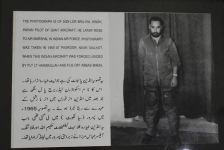
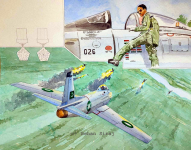
This area east of Sargodha, however, has lots of high tension wires, some of them as high as 100-150 ft. and when I saw the two Hunters pull up to avoid one of these cables, I fired my second Sidewinder. The missile streaked ahead of me, but I didn’t see it strike. The next thing I remember was that I was overshooting one of the Hunters and when I looked behind, the cockpit canopy was missing and there was no pilot in the aircraft. He had obviously pulled up and ejected and then I saw him coming down by parachute. This pilot (Squadron Leader Onkar Nath Kakar, commander of an IAF Hunter Squadron) was later taken prisoner.”
However, the Indian version by Jagan Mohan differs from what the Sabre Leader has to say. He differs because he is narrating the episode reported by Squadron Leader Onkar since he returned back after the war. According to Jagan after the first clash between the Hunters and the Sabres, “The Sabres disappeared, and the Hunters found themselves alone in the sky. Jog was relieved to find all four Hunters still present. Rathore joined them after shaking off his pursuer and noticed Kacker losing speed. Sabres or AA fire had hit Kacker’s fuel tanks, resulting in severe loss of fuel. It could also have been a notorious problem with the Hunter’s fuel transfer system. A glance at the fuel indicators told Kacker that there was no chance of making it over the border. Then the fuel ran out, turning on the warning lights. As the fuel starved engine flamed out, Kacker knew he had to eject. As the Hunter’s nose dropped, Kacker pulled the ejection handle and floated down on his parachute, but not before the R/T was thick with the choicest Punjabi expletives being thrown around by Kacker about his fate and that of his aircraft!”
Although a Hunter had crashed 25 miles SE of Sargodha, its pilot ejected and later taken as POW, both sides have a different story to tell. While the Sabre Leader himself never claimed that he had shot down the Hunter using a Sidewinder Missile nor does he mentioned the use of his six guns which is the prime weapon of air to air combat by the Sabre. It’s very important to note what the pilot says, “I saw two Hunters pull up to avoid one of these cables. I fired my second sidewinder. The missile streaked ahead of me, but I did not see it strike”. The Indian pilots reported that Kacker ejected due to fuel starvation and that there was no Sabre nearby when he ejected.
Being a student of Aerial Warfare, I have my doubts about the narration of the Sabre pilot. I have also talked with veterans who have actually fired the AIM-9B missile under actual combat conditions. They have categorically confirmed that the first generation AIM-9B missile had to be fired at around at a range of 5000 ft. The target aircraft must be 700-1000 ft. above the horizon to allow a clear above-the-horizon lock-on. If the egressing aircraft is even at 500 ft. above ground from a distance of 5000 ft. the launch aircraft has to be almost, below ground level.
The reason behind my assertion is that I have to view these missions while assuming that I’m actually in the cockpit of the Sabre (going by the narrations provided in the History books) in this case, chasing a Hunter, which is flying at deck level at maximum power. Being outside gun range, I will select the AIM-9B Sidewinder, as theoretically the missile was the gold standard for medium range air-to-air combat. However in this case I will not be able to achieve the ideal firing parameters for the AIM-9B Sidewinder missile (which clearly states that my aircraft has to be behind and below the target aircraft, and there has to be no secondary heat emissions from any alternate source). With me diving behind the Hunter already flying at deck level, I have no option to go below my target, and with the ground just a few meters below, the ground returns would be strong enough to divert my missile from its target.
Even then, going by the Sabre pilot’s statement, I’ll get a growl in my headset and will fire my first missile which will go into the ground (due to stronger heat emissions). Then going by the narrative, when I’ll see the Hunter pull up to avoid a power-line, I’ll fire my second missile and there is no possibility that I could miss the missile hitting the Hunter, or miss the ejection sequence, because flying at deck level with maximum power requires me to focus straight ahead.
However the Sabre pilot has missed these events, which has caused some raised eyebrows in the aviation fraternity. The events which I would likely miss would be to notice a Hunter without canopy which I have just overshot flying at 500 knots, neither I could see a pilot coming down by parachute who has ejected between 150-200 ft. Hence this part of the narrative is doubtful for any reader who is well acquainted with the Sabre and the AIM-9B Sidewinder missile. Similarly I will hit the air brakes and switch to guns, my primary weapon for combat, but for certain I will never 'overshoot' an enemy aircraft in war. The Sabre Leader might have witnessed the last moments of this Hunter, as well as a parachute descending, from a distance and a height offering better vantage point, as he was vectored on the escaping Hunters in that direction. But if we go by his narrative, he could never have downed that Hunter using Sidewinder missile at ultra low level. This part of narrative lacks tactical veracity. It would not however make any difference to the outcome because the IAF lost a Hunter.
This episode gets more confusing when a well reputed retired PAF officer and an excellent narrator of air combats provides his version pertaining to the sequence of events indicating the possibility of a near proximity blast of a Sidewinder (while the pilot himself does not at any stage claims the Hunter being hit; leave alone on fire and blowing up). During both wars, PAF jets have fired numerous Sidewinders at IAF jets but none of the Indian jets have been lost to a 'near proximity blast'. Either it was a hit or a miss.
The IAF Historian clearly mentions that it was a five shipper where the four exited at full power and only Squadron Leader Onkar was the fifth and lone Hunter. Now it’s up to the reader to figure out the credibility of the pilot ejecting and the testimony of his comrades, the narrative of the Sabre Leader and the Version of the Author of 'Great Air Battles of Pakistan'.
After overshooting the doomed Hunter, the Sabre mission leader narrates further, “I had lost sight of the other five Hunters, but I pressed on thinking maybe they would slow down. I had lots of fuel so I was prepared to fly 50-60 miles to catch up with them. We had just crossed the Chenab River when my wingman called out; “Contact – Hunters 1 o’clock,” and I picked them up at the same time – five Hunters in absolutely immaculate battle formation.” The question which comes in my mind after reading this is that why would the Sabre Leader think that the enemy exiting after been spotted by the Sabres would reduce their speed. Apparently the Sabre Leader is suggesting that these are the five of the six Hunters exiting and had slowed down so much so that he could catch up with them, which means that the Hunters were at standstill!
The fact was that this was another formation of three Hunters along with two fighter escorts were on their way to attack Sargodha. These Hunters belonged from the Halwara based No. 7 Squadron. Wing Commander Toric Zachariah, led the three-aircraft strike armed with T-10 rockets. Two Hunters made up of Squadron Leader S.B. Bhagwat and Flying Officer J.S. Brar provided fighter escort to the strikers (The Sabre Leader’s statement suggested it’s the five Hunters that he had let go to engage the supposed two Hunters. Now these Hunters were heading west for Sargodha, the previous Hunters were heading east. How could you reconcile that the Hunters heading in opposite direction are from the same formation)?
The India Pakistan Air War of 1965 has described that the four Hunters (No. 27 Squadron) who were making good their escape at deck level saw the five Hunters (No. 7 Squadron) about a mile apart when they flew past each other’s port sides. The leader of the exiting formation was unable to provide a warning about their pursuers as both formations were separate R/T frequencies.
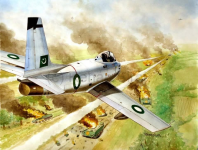
The Indian Air Force Hunters of No. 7 Squadron were speeding inside enemy airspace, when they observed PAF Sabres 11 o’clock high coming in for them. The Sabre Leader narrates, “They all broke in one direction, climbing and turning steeply to the left, which put them in loose astern. This, of course was their big mistake. If you are bounced, which means a close range approach by an enemy fighter to within less than about 3000 ft, the drill is to call a break. This is a panic maneuver to the limits of the aircraft’s performance, which splits the formation and both gets you out of the way of an attack and frees you to position yourself behind your opponent. But in the absence of one of the IAF sections initiating a break in the other direction to sandwich our attack, they all simply stayed in front of us.
It all happened very fast. We were all turning very tightly – in excess of 5G or just about on the limits of the Sabre’s very accurate A-4 radar ranging gun sight. And I think before we had completed more than about 270 degrees of the turn, at around 12 degrees per second, all four Hunters had been shot down. In each case, I got the piper of my sight around the canopy of my Hunter for virtually a full deflection shot. Almost all our shooting throughout the war was at very high angles off – seldom less than 30 degrees.”
Talking to a war veteran, I asked this question that if a leader of formation is pulling five Gs the radius of turn won’t be more than 2 miles thus as the Sabre Leader says, he took on the last aircraft of the five the leading two aircraft of the Hunters should have been forming on the wing of Sabre No. 2. However this feat indeed is possible with two aircraft in front, which is exactly what happened.
The Sabre Leader continues his statement and categorically states, "NONE OF THESE FOUR PILOTS EJECTED, AND ALL OF THEM WERE KILLED." It all sounded very well for the ‘Theatre’ and Sargodha Station Commander since traumatic botching of 6th September pre-emptive strike and unsubstantiated claims by the same pilot, shooting down of four Hunters in quick succession within thirty seconds, was wallowed as great reprieve, even though figment of pilot’s imagination to turn two kills in to five. However this narrative has a major discrepancy, there were only two wreckages recovered along with the bodies of two Indian pilots who were identified as Squadron Leader Bhagwat and Flying Officer Brar. Both these pilots belonged to the unfortunate No. 7 Squadron which by this time had lost five Hunters and three pilots. It shall be noted that no other aircraft of this formation was even scratched, while the 27 Squadron Hunters that were intercepted over Sargodha did not reported any combat over Sangla Hills because they had already crossed the border by this time. The fact was that the Squadron Leader Zachariah ordered a hard break and called formation to head back for base. The two escort aircraft however continued turning back towards the Sabres and engaged them getting shot down in quick succession, a great tally if it was not exaggerated.
This is also confirmed by the Flight Commander of No. 11 Squadron who has witnessed the gun camera film of his Officer Commanding shooting down two aircraft (this fact was recently revealed to me by his close family member). The wreckage of two Hunters was recovered with the dead bodies of two pilots, a Hindu and a Sikh.
Explaining the Indian version of this combat the authors of The India Pakistan Air War of 1965 narrates, “Halfway through the flight across Pakistani territory Lamba observed three fighters at 11 o’clock, above 4000 ft. altitude. Lamba alerted Zach over the R/T about the jets, now identified as Sabres. As standing orders were not to engage fighters when laden with ordinance, Zachariah put the formation into a hard turn to port. As Lamba followed Zachariah in his turn, he could see Bhagwat and Brar on his left to go into the turn, as did ‘Rusty’ Sinha to his right. Halfway through the turn, Zachariah fired his rockets into the grounds and punched his drop tanks, Lamba’s drop tanks refused to jettison. In spite of the asymmetric handling he followed Zachariah down to the ground level. Lamba called out to Zach to find out whether they were headed for home, but received no response on the R/T. As Zachariah and Lamba completed the 180 degree turn to head for Indian airspace, Lamba was horrified to see Bhagwat and Brar continued their turn beyond 180 degree, straight back into Pakistani airspace. Lamba called out on the R/T: ‘Straighten out, we are heading home!” but received no acknowledgement. When we saw them last, both Hunters were continuing with the turn that would have led them to engage the Sabres head-on. Both Zach and Lamba lost sign of Sinha, who was also in the turn at the beginning. Zachariah now led Lamba’s Hunter back to the base, skimming over Pakistani territory at low level…………………...........Bhagwat and Brar had engaged the Sabres and were shot down near Sangla Hill. PAF Squadron Leader M.M. Alam was credited with shooting down both the Hunters. This ended the disappointing raids by the Hunters; in ten sorties they had lost three Hunters; in ten sorties, they had lost three Hunters to AA and prowling Sabres.”
Air Commodore Kaiser Tufail narrates, “Obviously pleased with himself, Alam announced to the radar controller that he had shot down five Hunters. An ace-in-a-mission must have sounded like a splendid achievement and, the news spread like wildfire right up to the highest echelons. Alam had barely stepped back in the squadron when Radio Pakistan announced the unparalleled feat of jet combat. The die had been cast; confirmation of the kills was now of little consequence. Alam’s prolific shooting in the war had, however, left a tidy balance in his account. Besides the ‘damages’ which, in the heat of combat got overestimated as kills, Alam went on to bag five aircraft in just three dogfights, including the speed-shooting classic at Sangla Hill. For his superb performance in that mission, Alam was awarded a ‘Bar’ to the Sitara-i-Jur’at that he had already earned a day earlier for his first successful encounter with the Hunters.”
Going by this narration although, it has been confirmed that the Sabre mission leader had downed two Hunters over Sangla Hill. However when it came to validating the claims as kills in the heat of the combat, I have a different viewpoint. According to me, damages and probable are counted as kills in the heat of the combat, but after verification by the competent authorities, should be revised (which PAF actually did in 1971 war very diligently by high powered team led by Air Commodore Pat Callaghan supported by Brigadier General Chuck Yeager). Such tall claims actually overshadows the performance of those pilots who have actually performed in that conflict and can have negative effect in the Air Force as an institution.
It will be astonishing that neither the History of 1988, nor Air Commodore Kaiser Tufails credit the Sabe Leader with downing five Hunters in a single mission. While the History of 1988 credits Sabre Leader with three Hunters, Air Commodore Kaiser Tufail also credits him with three Hunters, however he explains that he had fired upon two more Hunters of No. 27 Squadron which escaped him with minor damage.
However, I have a different viewpoint. According to my research, one Hunter went down due to fuel starvation while two were gunned down in quick succession by the Sabre Leader, a feat in itself. This story of shooting down four aircraft within thirty seconds and an ace in a mission has done injustice to the actual outcome of the mission, which was as follows:
1. The reality was that Sabres were pitted against two IAF five ship formations with a total of ten IAF Hunters;
2. While the first IAF Hunter formation was intercepted after weapons release, they were forced to flee by the PAF defenders, losing one Hunter in progress owing to technical failure;
3. The second IAF Hunter formation, upon spotting the Sabres made a hasty retreat;
4. Both the Hunters of the second IAF formation were shot down in quick succession by the Sabre Leader.
I have placed all the facts, which includes statements of pilots involved, aircraft wreckages recovered, names of the pilots killed and simple aviation facts. It's up to the reader to believe what they think is right.
By the time the sun was up Sargodha had faced five attacks, in which PAF lost one F-104 Starfighter in air to air combat, while IAF lost three Hunters (Two Hunters shot down by M.M. Alam, One Mystère aircraft was shot down by Amjad Hussain, for the loss of his own F-104).
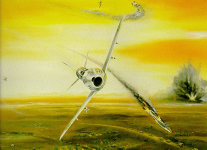
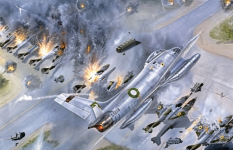
Aviation Art of Rehan Siraj