History & Operations of Wars of Pakistan Air Force

1788026354563.png

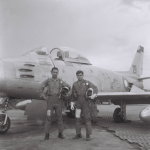
L–R: Flight Lieutenant Mazhar Abbas, Flight Lieutenant Fazal Elahi.

The aircraft in the background is a North American F-86F Sabre, the primary day fighter of the Pakistan Air Force during the 1960's.

Flight Lieutenant Mazhar Abbas took part in the first strike on Pathankot airbase during the 1965 war and later retired as an Air Commodore. Flight Lieutenant Fazal Elahi was KIA during the 1971 war when his Sabre was hit by anti-aircraft artillery while flying a close air support mission.

The photograph was taken on a hardstand (pierced-steel planking is visible underfoot) in front of an operational F-86F. Both officers are in full flying kit, indicating that the picture was most likely taken just before or after a sortie.

Picture Courtesy:- Usman Shabbir
 
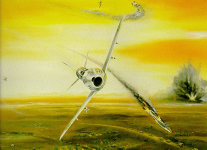
On the evening of 1 September 1965, the skies over Chhamb marked the opening of the air war between Pakistan and India.

That morning Pakistan launched Operation Grand Slam, a major armoured thrust towards Akhnoor. Indian ground forces urgently requested air support. The Indian Air Force responded by launching twelve de Havilland Vampire fighter-bombers from Pathankot in three formations of four.

Two Pakistan Air Force F-86F Sabres, flown by Squadron Leader Sarfaraz Ahmed Rafiqui (No. 5 Squadron) and Flight Lieutenant Imtiaz Bhatti (No. 15 Squadron), were already on patrol. Directed by radar, they intercepted a formation of Vampires in the fading light.

Rafiqui quickly shot down two with his six .50-calibre machine guns; Bhatti destroyed the remaining pair. Four Vampires were downed within minutes. Three Indian pilots Squadron Leader Aspi Bhagwagar, Flight Lieutenant Vijay Joshi and Flight Lieutenant Satish Bharadwaj were killed. Flying Officer S.V. Pathak ejected and survived. The brief engagement had far-reaching consequences.

The Indian Air Force immediately withdrew its remaining Vampires and older Ouragans from front-line service. For the Pakistan Air Force it delivered the first confirmed air-to-air victories of the war and an early boost in confidence. Both pilots were awarded the Sitara-e-Jurat.

The dogfight over Chhamb on 1 September 1965 remains one of the clearest early demonstrations of PAF skill in the conflict.

© Gp Capt S M A Hussaini

1788268216150.png
 
1788519807653.png


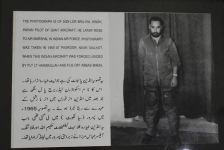
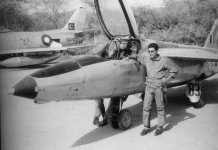
Picture shows a smiling Hakimullah with the IAF Gnat at Sargodha. There were two F-104s in the air during that engagement.

The first F-104A (already airborne) was flown by Abbas Mirza and the second F-104A launched from Sargodha was piloted by Hakimullah.

Note: PAF F-86F Sabre parked behind it under a clear sky with trees in the background.

Source: Eagles of Destiny, Volume 2, by Usman Shabbir and Yawaz Mazhar.

Picture Courtesy: Usman Shabbir
 
1788638146118.png


Title: PATHANKOT STRIKE
By: Sarmad Hassan Sharif

Date: September 06, 1965
Time: 1630 Hours
Target: Pathankot Air Base

On 6th September Peshawar base had a single squadron, equipped with F-86 Sabres, which was enhanced to 18 aircraft as war establishment. The Station Commander Peshawar received the flash signal soon after 1200 hours, delivered by hand by the Senior Signals Officer, Wing Commander M.S. Khan.

The orders were handed to OC 19, Squadron Leader Sajad Haider, (famously described by John Fricker in Battle for Pakistan as ‘universally referred to as Nosey Haider, for his magnificently patrician proboscis’) soon after. The squadron had flown 2 sorties with 6 aircraft and formation had landed after the Wagah mission, transiting through Sargodha, at around 1130 hours. 2 F-86s were said to be on CAP and four were on ADA stand-by duties.

The major change in target was a surprise as in the original plan of June 1965; the target given to No. 19 Squadron had been Am..bala. It is of special mention that the heavily defended complex at Ambala was at the extreme range of the F-86F Sabre aircraft. Peshawar had been given Ambala as their primary target on D-Day and H-Hour.

Originally eight aircraft were to fly from Peshawar to Lahore (abandoned as an active base in peacetime owing to its vulnerability, was to be reactivated for occasional use during war, as stated in History of PAF 1988), where they were to be joined by eight more aircraft originating from Mauripur led by Squadron Leader Waqar Azim.

The Mauripur Sabres were to form the second element behind the Peshawar Sabres. These aircraft were to move in there at six hours’ notice a couple of days or so before for the anticipated strikes. From there, they were to launch deep strike mission targeting Ambala and were to initially recover at Lahore in near darkness.

After refueling the Peshawar’s Sabres were to return back to Peshawar while the Mauripur Sabres were to head for Sargodha. Peshawar was to be given a new target the next day (possibly Srinagar, depending upon the attrition suffered during the attack on the highly defended Ambala airfield).

In a tête-à-tête, with retired Air Commodore Sajad Haider about few years ago, it transpired that No. 19 Squadron had practiced their assigned task with realistic simulation. This included simulating night landing on a 6000 foot Lahore runway, practiced at their Peshawar base. Upon achieving the exercise results the Director of Plans was sent by AHQ to endorse the squadron recovery capability. The outlines of the Ambala runway were drawn at the Jamrud firing range, where the Sabres from Peshawar used to carry out attacks at dusk and sometimes well after dusk in pitch darkness. Use of flares and napalm bombs to illuminate the target was also practiced and perfected with permission from ACAS (Operations). The concept was somewhat utopian but it showed the spirit of determination, motivation and seriousness by the squadron to be fully prepared to deliver, if the war came.

The change of target from Ambala to Pathankot had its own significance, as Pathankot has been creating a lot of problems for the PAF since 1 September 1965, and had to be sorted out. However, the target allocation came as a big surprise for No. 19 Squadron. Pathankot had not been assigned as a target in June or later. Consequently, they had little information about its layout, the dispersal areas and aircraft shelter complex or even the runways direction which was an absolute pre-requisite for an airfield attack.

This information was indispensable for the success of the attack, especially because the Sabres would be operating at the outer most fringes of their operational radius of action, 220 miles to the target and would have little fuel for loitering around to familiarize with the lay-out down below.

As mentioned Peshawar had one squadron with 18 F-86 aircraft at the start of war and luckily remained with 18 at the end of war. The change of target from Ambala to Pathankot came as a surprise for No. 19 Squadron and its pilots who had relentlessly trained to take down Ambala. In a detailed discussion with Air Commodore ® Sajad Haider some years ago, after some persuasion he recounted the details of this mission which is as follows:

“Soon we realized that this was a second change of target on 6th September, and would entail a re-appraisal of attack plan from the Ambala base, which the squadron had perfected as close to the possibility of achieving success in this complex assigned mission. Although to my reckoning Pathankot would be an easier target, but for its success we required maximum intelligence about the target base.

Another issue to be factored-in was the distance to the target (that was more than 220 miles), and the fuel management had to be considered, which might restrict the number of attacks. The complete change of target for the second time in one morning was a minor challenge for which 19 Squadron had been well trained.

You must remember that our pilots had been trained through planning to fly long range composite missions ending at Jamrud Range for a single attack on the Ambala simulated airfield painted below. They were trained to land with as little as 400 Ibs of fuel, so as never to panic when fuel state was low.

This paid great dividends in war as I exploited this good honing to maximum. Ironically, PAF historians 1988 have wrapped me on the knuckles and drubbed it as imprudent for such an initiative which I considered prerogative of the combat commander in a real combat environment. So be it.

The results of the 1965 war performance of Zambos of 19 Squadron remain incomparable in perpetuity. The joie de verve amongst our squadron was indescribable and uplifting. Most pilots despite having flown 2 sorties till midday were hankering to be on this mission.
 
Today in History

On this day, 06 September, Pakistan Air Force honours the supreme sacrifice of Sqn Ldr Sarfraz Ahmed Rafiqui (Shaheed), HJ, SJ and Flt Lt Yunus Hussain (Shaheed), SJ, whose courage and selfless devotion were immortalized in a fierce aerial battle over enemy territory during the 1965 War.

As the last rays of daylight faded, three PAF Sabres led by Sqn Ldr Rafiqui pressed towards Halwara airfield despite warnings of enemy interceptors in the area. With visibility rapidly deteriorating, the formation was soon engulfed by a swarm of IAF Hunters. Undeterred by overwhelming odds, Rafiqui struck down an enemy Hunter, while Yunus Hussain manoeuvred into position and destroyed another.

As more Hunters poured into the battle, the skies above Halwara became a cauldron of steel and fire, where the three Sabres fought with extraordinary courage against a numerically superior enemy. When Rafiqui’s guns jammed, he refused to abandon his formation. Instead, he handed the lead to then Flt Lt Cecil Chaudhry and remained behind his wingmen in a defensive position, shielding them as they continued to engage the enemy. With unwavering resolve and supreme devotion to duty, Sqn Ldr Rafiqui embraced Shahadat with his boots on, standing between his comrades and the enemy in defence of the motherland.

Moments later, Flt Lt Yunus too made the ultimate sacrifice after continuing the fight with exceptional gallantry. Left alone, then Flt Lt Cecil Chaudhry fought his way out against pursuing Hunters and returned to Sargodha.

For their exceptional flying skill, courage and devotion to duty, Sqn Ldr Sarfraz Rafiqui Shaheed and Flt Lt Yunus Hussain Shaheed were awarded Hilal-e-Jurat and Sitara-e-Jurat, respectively. Their final battle remains an immortal chapter of PAF history — a story of fearless leadership, indomitable courage and sacrifice in the face of overwhelming odds.
 
Today in History

On 06 September 1965, as India launched its offensive against Pakistan, PAF responded with a day of extraordinary courage and relentless action in the skies. From blunting the enemy advance towards Lahore to striking deep inside enemy territory, PAF air warriors carried the fight to the adversary with determination and precision. In the morning, then Sqn Ldr Sajad Haider led a Sabre formation against Indian Army columns advancing along the Amritsar–Wagah road.

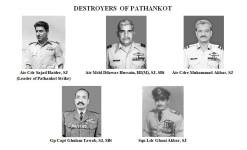
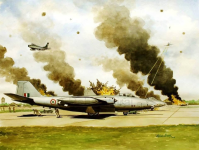
Armed with rockets and guns, the formation made repeated low-level attacks that left behind burning tanks, armour, guns and ammunition vehicles, effectively blunting enemy’s advance towards Lahore. Later that afternoon, in PAF’s first offensive strike against an Indian air base, Sqn Ldr Sajad Haider led eight Sabres of No 19 Squadron towards Pathankot, with Flight Lieutenants M Akbar, Dilawar Hussain and Ghani Akbar among the attacking pilots, while Sqn Ldr Tawab provided tied escort.

Achieving complete surprise, the formation plunged through intense anti-aircraft fire & unleashed repeated rocket and cannon attacks on aircraft in pens and on the tarmac. The base was engulfed in flames & smoke as 13 enemy aircraft were destroyed. The formation’s determination under relentless defensive fire turned the strike into one of the most remarkable operations of the opening day of the war.

In another daring mission, Sqn Ldr M M Alam led three F-86 Sabres, along with Sqn Ldr Alauddin Ahmed (Shaheed) and Flt Lt Syed Saad Hatmi, towards Adampur, only to encounter numerous IAF Hunters near Tarn Taran. In a fierce low-level engagement, Alam destroyed two Hunters while his formation damaged three others.

06 September 1965 remains immortalized as a day when PAF answered the enemy's aggression with fire, audacity & an unyielding will to defend the motherland.
 
A Pakistan Air Force F-86F Sabre jet over Jammu during the Indo-Pak War of 1965.

A single-engine jet fighter, identified in the narration as a Pakistan Sabre jet, is shown flying across the sky. The aircraft appears as a dark silhouette against a plain, overcast sky. It banks and turns at times, with its swept wings and tail clearly visible in several frames. Tree branches and foliage occasionally enter the frame in the foreground, especially in the middle portion, partially obscuring the view as the camera follows the plane.

Toward the end, the jet becomes smaller and more distant as it flies away. The narration states, “Watch this plane, a Pakistan Sabre jet over Jammu,” followed by a partial line: “The mission to bomb, bomb…”

Note: The post is dedicated to our respectful followers Mr. Usman Shabbir Mr. Sarmad Hassan Sharif Mr. Rehan Siraj Aviation Art of Rehan Siraj who always provide valuable insights and information when it comes to Pakistan Air Force history, with photographs, aviation art, articles, and much more.

It is also dedicated to all our followers for providing positive responses and love from the very beginning.
May Allah Almighty accept the sacrifices of all our Armed Forces shuhada.

 
Strike Against A Bomber Base Of IAF.
7th September, 1965.

1788953689474.png

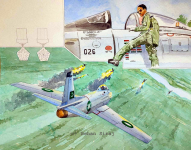
The painting shows 2 of the 5 Dhaka-based F-86 Sabres attacking the IAF bomber station at Kalaikunda.

The Tail Choppers
🗡


The concentration of air, sea and land power lay in the western wing of the country, and East Pakistan had only a single squadron of 12 F-86F aircraft at Dhaka. This was all that could be spared, in the hope that it would be sufficient for the comparatively limited air defence requirements of East Pakistan. Offensive operations from that wing had not been seriously contemplated, although the station commander, Group Captain Ghulam Haider, had been cautioned to have all planning and preparations completed.

The primary target was the big IAF base at Kalaikunda, with Rampurhat radar as the secondary. At Kalaikunda one could expect a good concentration of fighters and bombers set aside for tasks in the east. In fact it actually had over 80 aircraft: 1 Canberra squadron, 1 Hunter squadron, 1 Mystere squadron, 1 Vampire or Ouragon squadron and a number of miscellaneous aircraft. Of the other targets, Baghdogra had 2 Vampire/Ouragon squadrons, Tezpur and Chabwa I Hunter squadron each.

On the 6th, the Dhaka-based pilots were at standby from 0430 hours when Theatre ordered 6 aircraft to be ready for immediate strikes. There was a flash warning at 0830 announcing the start of the war. A CAP was accordingly flown overhead Dhaka all day. When Theatre decided upon the overall airfield strike plan later that morning, it was appreciated that a dusk strike in the east could not be synchronised with those in the west because of a one hour difference in local times. The mission order of 14 Squadron, therefore, prescribed a TOT at dawn on the 7th. IAF Canberras from Kalaikunda penetrated into East Pakistan air space as far as Dhaka during the night of 6/7 September, and dropped bombs at random without much effect in the way of damage or casualties. On the morning of 7 September the Indians launched a pre-dawn offensive consisting of widespread attacks against several targets in East Pakistan - the airfields at Chittagong, Jessore, Lalmunirhat, Shibganj, Thakurgaon and Kurmitola, as well as the Pak Army headquarters at Rangpur.

Hampered by the low cloud and the natural cover which the country afforded, the Indian aircraft failed to locate Dhaka airfield, from where the Sabres were, operating. Instead, they attacked Kurmitola, an abandoned airfield nearby, where the PAF's SOC was located. Here, a barrack was hit by rockets, and there were two casualties, one Sergeant A R Choudhry, and a child.

Kurmitola was still under attack when the strike element of the squadron started up, in anticipation of clearance from Theatre for counter offensive action. This clearance was some time in coming, and it was not until 0635 hours that the mission was on its way to Kalaikuncla. It consisted of 5 aircraft with Squadron Leader Shabbir H Syed, the squadron commander, in the lead. The other members were Flight Lieutenant Baseer Khan, Flight Lieutenant Tariq Habib Khan, Flying Officer Afzal Khan, and Flight Lieutenant Abdul Haleem.

Under difficult visibility conditions, the strike mission flew on, just managing to stick together, often without any visual contact. However, it was not long before the leader reported the target in sight; there were, four confident calls of 'contact' from his team, and as they pulled up for the attack, Shabbir's formation was rewarded by the sight of Canberras and Hunters lying mostly unguarded on the airfield. The surprise, it seems, was complete; the Indians had probably never imagined that such a small force could react with such speed and audacity against odds so heavily weighted against it, and that, too, at the very limits of its reach into Indian territory.

The raiders put in three attacks, and when they exited, the airfield lay ablaze behind them. Ten aircraft were estimated to have been destroyed, while several aircraft and a number of installations were damaged. The mission landed back at Dhaka at 0744 hours.

Not content, however, with having delivered this significant blow to draw first blood, the-squadron pursued the initiative further, and at 1030 hours a second strike mission was ready to leave for Kalaikuncla, led this time by Flight Lieutenant Haleem. Later it was thought that it might have been wiser not to send this second strike.

Take off was at about 1030 hours and the approach was made at low level as before, although in fairly poor visibility; but this time the Indians were ready. As the F-86s pulled up for their attack, No 4 called on the radio "Nine Hunters, 12 o'clock high", and heavy ack ack fire was simultaneously encountered from the airfield. From their battle formation, the F-86s split into two pairs as the leader ordered his No 3 and 4 not to follow him into the attack, but during their single pass, the first two Sabres each strafed a Canberra. Before this strike, the remaining Indian bombers had been removed from the tarmac into protected dispersals, presumably on the principle of better late than never.

All 4 F-86s then turned to engage the Indian aircraft, and Flight Lieutenant Tariq Habeeb, who was leading the second pair of Sabres, called, ','Lead, I have four Hunters behind me". He also told his No 2, Afzal Khan, to jettison his tanks and break. With four drop tanks beneath the wings, the Sabres were very sluggish, and before Afzal could release them a Hunter had closed in to about 600 ft and opened fire. The F-86 burst into flames, and rolled straight into the ground. Tariq Habeeb had in the meantime jettisoned three of his tanks, but the fourth hung up and with this handicap he was cornered by 3 Hunters for a good ten minutes. With remarkable coolness and presence of mind, he twisted and turned at low altitude to evade his pursuers, popping out his speed brakes and lowering flap to improve his low speed manoeuvreability.

Even after his flap stuck down at 20 degrees he managed to continue breaking into the Hunters, as well as firing at a couple of them, before he succeeded in shaking them off and returning safely to Dhaka, several anxious minutes after the other 2 Sabres had landed. For his courage and skill in fighting his way clear of the larger and better equipped enemy force, Tariq Habeeb was awarded a well deserved Sitara-e-Jurat. 14 Squadron earned the nickname of the 'Tail Choppers', alluding to the swath of bullets they used at Kalaikuncla to cut through the tails of IAF's neatly lined up Canberras. In West Pakistan, the PAF had cut off the head of the Indian Air Force, and in their two sorties on 7 September, the pilots of 14 Squadron did an equally good job with the tail.

This second raid is estimated to have bagged 4 to 6 aircraft, mainly Canberras, for the loss of one Sabre. Thus the day's toll on the IAF in the east was about 14-16 aircraft destroyed, and 6-8 aircraft damaged. The losses, on the other hand, were one Sabre destroyed with its pilot Flying Officer Afzal lost, and one Sabre - Flight Lieutenant Tariq Habeeb's -rendered permanently unserviceable for want of spares. Though this in itself was not much, the aircraft strength of the squadron was now reduced to 8 [this included two air accidents due to bad weather conditions since the war started.

By the end of 7th September 1965, the PAF achieved an outstanding measure of success in both its immediate objectives. The significance of this soon became apparent: after the 7th of September, except for occasional air skirmishes over the international border, the IAF never seriously challenged the PAF for control of the air. Having achieved a healthy measure of air superiority, it now became necessary for the PAF to review its strategy for the foreseeable future. Since there was no political or army guidance available as to the probable duration of the war, nor was there any prospect of replenishment of lost aircraft, it was now of paramount importance to adopt a 'conservation' policy. It was, therefore, decided to halt daylight counter air operations altogether as they were likely to produce the highest attrition rate; henceforth attacks against IAF installations would be done exclusively by B-57s at night. The Sabres would be employed primarily on air defence and army support operations
 
"Kalaikunda Attack - 7th September 1965"

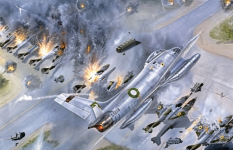
The painting depicts F-86 Sabres of PAF’s No. 14 Sqn attacking IAF Base Kalaikunda. The attack was led by Squadron Leader Shabbir Hussain Syed with four other members.

The sabre formation achieved complete surprise and destroyed Canberras and Vampires parked and fully fuelled. It was a dangerous mission by the squadron, having four drop tanks with guns as their only armament. This attack earned the squadron, a nickname, “The Tail Choppers”.

Battle of Kalaikunda (Tail Choppers)

Among the great ages of heroes who blazed trails of daring and valor during the 17-day Indo-Pakistan War, the story of PAF Pilots in East Pakistan stands as a symbol of professional perfectionalism, cool courage and dedication to duty. Those handfuls of men accepted the gauntlet thrown by the numerically much superior IAF in west Bengal and assam with calm boldness and gave such a befitting reply to the enemy that they were nicknamed as “Indian Tail Choppers”.

The day after the Indians started the undeclared war against Pakistan and marched troops across the international frontiers, they escalated the hostilities in the eastern wing when, in the early hours of September 7, the IAF bombers and fighters attempted raids on Dacca and Chittagong Airfields.

The PAF fighters were scrambled but the Indians retreated back to their territory. The challenge was thrown and The PAF decided to strike back. They were comparatively so few that their action reminds one of the exploits of Bakhtiar Khilji, the Muslim Hero of medieval ages, who, with a strength of 18 men, conquered the Hindu state of Bengal.

the target was the huge IAF base at Kalaikunda where the enemy had based a large number of fighters and bombers, posing a threat to the security of East Pakistan.

It was still morning the sun wasn’t yet up when five sabre fighter bombers of the paf, fully loaded with their lethal cargo, rose majestically from the paf airfield and handed south-west towards their target. Led by cambellpur born Sqn Ldr Shabir Hussain, who was later awarded Sitara-e-Juraat for “Exceptional Flying Skills, outstanding valor and determination”, the formation which included Flt Lt Baseer, Flt Lt Farooq, Flt Lt Asghar and Flg Off Saleem, roared through the cumulous-studded September sky and leveled off at the planned height. As the border drew closer they started a deep decent looking like hawks going in for their prey.

a few second later the fighter-bombers were skimming tree tops at 500 miles an hour; their eyes skinned looking for the enemy in the skies and on the ground simultaneously. Now they were well inside Indian Territory and as the jets roared passed. A flurry of excitement was felt in the cockpits when the leader’s voice boomed on R|T:

“All pilots, check your firing switches; hot; one minute to target”.

As the seconds dragged on, they reached the pull up point and the Sabres climbed steeply into the sky like darts getting ready for attack.

In his description of the attack Sqn Ldr Shabir relates; “When I reached at 2000 feet the sprawling airfield of Kalaikunda presented an inviting look at them. It appeared as if I had seen this thousand of times. On the R|T I reported to my formation the position of airfield together with large number of Canberra bombers and Hunter fighters parked on the tarmac. I heard four clear, determined and confident calls of ‘contact’.

“I rolled in for the first attack for the beautifully lined up canberras and called out the position of aircraft pens which were on west of the airfield. I lined up the first Canberra in my Gun Sight and streaked down the tarmac. As I pressed the trigger, the guns thundered and fifty caliber incendiary and armour piercing bullets spattered the ground in front of the enemy bombers. They raced towards them and the parked aircrafts were concentrated barrage of bullets which started boring holes in their wings and fuselages. By the time I pulled out of the attack the canberras were already burning and big mushrooms of fire had covered the tarmac.

“I looked back and saw my comrades giving the airfield a plastering. I was so engrossed in looking at the burning aircraft that for some time I forgot I had to go for another attack.

“we lined up for another attack when my No.2, Flt Lt Baseer, reported three enemy hunters circling the airfield. We got ready for the fight but the seemed to have no intention to get involved. Probably they were so shocked that they did not dare to engage us.”

“as we rolled down for the second attack, enemy ack-ack, which was silent up till now, started booming the shells screamed up at us, bursting in flashes of livid color. However this didn’t deter us and we dashed down again, releasing streams of rockets and bullets which slammed in to the fuselages of the canberras and hunters. It was first and accurate gunnery at its devastating best. The six machine guns of each sabre were spitting bullets at a rate of 120a second, smashing the enemy aircrafts to pieces. As we left more than fourteen columns of fire and smoke marked the death of Indian planes on airfield.

“I asked the formation to ‘check in’. Four similar voices called ‘contact’ and we headed back on our homeward journey. The weather was turning bad and visibility was poor but we came back over the airfield with the help of familiar voice of Khokhar, the Air Traffic Control Officer, who was waiting for the past half an hour to hear a call from steer.”

The formation landed back at 0744 hours, only one hour and thirteen minutes after they had left on their mission. During this brief period, the PAF Sabres had destroyed as many as eleven Canberras, and damaged four canberras and two hunters.

At the time when paf sabres were raking the IAF base of Kalaikunda, a large numbers of IAF aircraft were spotted at Jesore heading towards Dacca. An interception mission was scrambled but the Indians turned about and flew back to their territory.

The plastering Indians were given in first attack wasn’t considered enough and two hours later another strike mission was arranged for Kalaikunda. The formation of four sabres led by Flt Lt Haleem roared in to skies at 1030 hours and headed towards enemy base.

The weather en-route had worsened and visibility was getting poorer as the formation including Sir Haleem, Sir Baseer, Sir Tariq and Sir Afzal entered the enemy territory. As they approached Kalaikunda they pulled up when suddenly enemy ack-ack much heavier and intenser this time, opened up and filled the sky with tracers and shell bursts.

Undaunted the Gallant Fighters dived in for attack on the remaining aircrafts parked in the pens. On the runway two hunters seemed to be getting ready for scramble when Afzal’s bullets found them as he made a low level strafing run. Both of them were damaged. All the fighters had their share in IAF aircraft as they clobbered the airbase with bullets and rockets.

Haleem was pulling up after an attack when saw three hunters one behind the other with their leader closing in on him. He looked round and found big swarm of hunters coming in from all sides. Being low on fuel and ammunition the sabres were in critical situation. Fighting their way they headed for home. One of the Hunter zoomed in for attack on Haleem and as it came nearer, the Hunter did a Split-S but, being very low, couldn’t recover and hit the ground. Turning, twisting and fighting the sabres moved on.

At the same moment Flt Lt Tariq Habib saw four hunters attacking him from behind, he pressed the lever to jettison his tanks but one of them malfunctioned and failed to release. In the combat his aircraft was hit and his flaps got jammed. His was a crippled aircraft now but the fast maneuvering and violent jinxing, the gallant officer managed to throw off the enemy from his tail.

Skimming tree tops he flew home safe and sound. With his calm thinking and superior handling he saved his aircraft and his life. It was the striking testimony to the fine training of paf pilots.

Flt Lt Tariq was awarded Sitara e Juraat for displaying exceptional flying skills and bravery in fighting; and warding off four Indian hunters superior in performance and number and one C119 on the ground.

In one day the gallant pilots in Dacca destroyed as many as 14 Canberras and one C119and damaged four Canberras and three Hunters at the cost of one aircraft in aerial combat over Kalaikunda. It was the great for these men who for the loss of one pilot had destroyed the image of Indian air might. While the enemy’s ‘spearhead’, the fighting knights of East Pakistan had twisted the Indian air force’s tail at Kalaikunda and earned the nick name of #TailChoppers.

Article Source: From Story of PAF Heroes by Mohammed Afzal

Picture Courtesy: Aviation Art of Rehan Siraj

1788953795678.png
 
1788953917182.png

Hunters Down Strikes Against Sargodha.
By: Sarmad Hassan Sharif

Date: September 07, 1965
Time: 0551 Hours
Sector: Sargodha Air Base

As soon as the threat posed by the Mystères was over, two sections of two F-86F Sabres each and one single F-104 Starfighter were scrambled for an airfield patrol. The first aircraft which took to the air were Squadron Leader Alam along with his wingman. Flight Lieutenant Imtiaz Bhatti with his wingman followed suit. Both the Sabre formations were told to orbit at 15,000 ft. in the 10 miles arc and 15 miles arc South-West of the base. The F-104A Starfighter flown by Squadron Leader Arif Iqbal was perched higher as a top cover for the two F-86F Sabre formations. Action was not over yet when the outer belt of the MOU reported six Hunters at 0551 Hours. According to Fricker, “From the first warning from the outer belt at 0551 Hours, Sargodha had 14 minutes to prepare for action before the inner belt reported the Hunters overhead at 0605 Hours. ‘Killer Control’ was soon reporting four Hunters pulling up for the attack, but despite the long period of warning, the IAF aircraft were not intercepted until they reached Sargodha.”

The fact was that the Sabres were vectored eastwards to intercept the incoming raid at 15,000 ft. however they were told to turn back because the IAF aircraft were overhead Sargodha. These Hunters in fact had attacked Chota Sargodha, which was a disused WWII vintage deserted airfield. Describing this attack, Jagan Mohan in India-Pakistan Air War of 1965 states, “Pulling up at their target, the formation found no aircraft on the tarmac.” Searching for any worthwhile target the Hunters ended up targeting ‘a factory-like installation’ which was known as Sultan Textile Mills albeit to the locals. Dodging the AAA fire, the Hunters headed home but the mission was not quite over.

Recounting the details of this mission the mission leader of the first Sabre CAP narrates, “As we were vectored back towards Sargodha, Akhtar called, ‘Contact – four Hunters’ and I saw the IAF aircraft diving to attack our airfield. So I jettisoned my drops to dive through own ack-ack after them.”

This is confirmed by the account stated by Jagan Mohan, “They flew on to find another airfield, this time with Sabres parked on the runway. Rathore dove into the first attack and opened up with his guns. His high-speed approach caused him to overshoot the airfield; the result of the attack was not clear, as light conditions were still poor. The AA was already alerted and opened up on the attackers. Then, ‘all hell broke loose’. A couple of Sabres on combat air patrol pounced on the Hunters.” It’s noteworthy that this Flight Lieutenant Rathore was the one who shot the PAF ace Rafiqui. His inability to attack an airfield by overshooting is noteworthy of his competence as a fighter pilot. Consequently his shooting Sarfraz Rafiqui remains an enigma.

The Sabre mission leader further narrates, “I saw two more Hunters about 1000 ft. to my rear so I forgot the four in front and pulled up to go after the pair behind. The Hunters broke off their attempted attack on Sargodha, and the rear pair turned into me. I was flying much faster than they were at this stage – I must have been doing about 500 knots – so I pulled up to avoid overshooting them and then reversed to close in as they flew back towards India” Owing to my experience of combat flying simulation, there is a question that two Hunters reported by the Sabre pilot behind him and then in the same breath he pulled up to avoid overshooting is a paradox.

Explaining this maneuver Jagan Mohan states, “A Sabre dove from above and around Rathore’s starboard side, opening fire on Chaudhary’s Hunter. Rathore turned towards the Sabre, which broke off the attack and turned into Rathore’s path. Both aircraft crossed each other’s path, narrowly avoiding a collision in midair.”

Up till here the accounts from both sides match each other, with just one exception. The Sabre Leader is counting one Hunter extra in this five-ship formation. However from here the accounts differ from both sides.

The Sabre mission leader further narrates, “I took the last man and dived behind him, getting very low in the process. The Hunter can out-run the Sabre – it’s only 50 knots faster, but has a much better acceleration, so it can pull away very rapidly. Since I was diving, I was going much still faster, and as he was out of gun range, I fired the first of my two GAR-8 Sidewinder air-to-air missiles at him (The Sidewinder homes on the heat radiations from the target aircraft’s jet engine but is sometimes affected by ground returns if fired in a dive at low altitudes). In this case, we were too low and I saw the missile hit the ground short of its target.

This area east of Sargodha, however, has lots of high tension wires, some of them as high as 100-150 ft. and when I saw the two Hunters pull up to avoid one of these cables, I fired my second Sidewinder. The missile streaked ahead of me, but I didn’t see it strike. The next thing I remember was that I was overshooting one of the Hunters and when I looked behind, the cockpit canopy was missing and there was no pilot in the aircraft. He had obviously pulled up and ejected and then I saw him coming down by parachute. This pilot (Squadron Leader Onkar Nath Kakar, commander of an IAF Hunter Squadron) was later taken prisoner.”

However, the Indian version by Jagan Mohan differs from what the Sabre Leader has to say. He differs because he is narrating the episode reported by Squadron Leader Onkar since he returned back after the war. According to Jagan after the first clash between the Hunters and the Sabres, “The Sabres disappeared, and the Hunters found themselves alone in the sky. Jog was relieved to find all four Hunters still present. Rathore joined them after shaking off his pursuer and noticed Kacker losing speed. Sabres or AA fire had hit Kacker’s fuel tanks, resulting in severe loss of fuel. It could also have been a notorious problem with the Hunter’s fuel transfer system. A glance at the fuel indicators told Kacker that there was no chance of making it over the border. Then the fuel ran out, turning on the warning lights. As the fuel starved engine flamed out, Kacker knew he had to eject. As the Hunter’s nose dropped, Kacker pulled the ejection handle and floated down on his parachute, but not before the R/T was thick with the choicest Punjabi expletives being thrown around by Kacker about his fate and that of his aircraft!”

Although a Hunter had crashed 25 miles SE of Sargodha, its pilot ejected and later taken as POW, both sides have a different story to tell. While the Sabre Leader himself never claimed that he had shot down the Hunter using a Sidewinder Missile nor does he mentioned the use of his six guns which is the prime weapon of air to air combat by the Sabre. It’s very important to note what the pilot says, “I saw two Hunters pull up to avoid one of these cables. I fired my second sidewinder. The missile streaked ahead of me, but I did not see it strike”. The Indian pilots reported that Kacker ejected due to fuel starvation and that there was no Sabre nearby when he ejected.

Being a student of Aerial Warfare, I have my doubts about the narration of the Sabre pilot. I have also talked with veterans who have actually fired the AIM-9B missile under actual combat conditions. They have categorically confirmed that the first generation AIM-9B missile had to be fired at around at a range of 5000 ft. The target aircraft must be 700-1000 ft. above the horizon to allow a clear above-the-horizon lock-on. If the egressing aircraft is even at 500 ft. above ground from a distance of 5000 ft. the launch aircraft has to be almost, below ground level.

The reason behind my assertion is that I have to view these missions while assuming that I’m actually in the cockpit of the Sabre (going by the narrations provided in the History books) in this case, chasing a Hunter, which is flying at deck level at maximum power. Being outside gun range, I will select the AIM-9B Sidewinder, as theoretically the missile was the gold standard for medium range air-to-air combat. However in this case I will not be able to achieve the ideal firing parameters for the AIM-9B Sidewinder missile (which clearly states that my aircraft has to be behind and below the target aircraft, and there has to be no secondary heat emissions from any alternate source). With me diving behind the Hunter already flying at deck level, I have no option to go below my target, and with the ground just a few meters below, the ground returns would be strong enough to divert my missile from its target.

Even then, going by the Sabre pilot’s statement, I’ll get a growl in my headset and will fire my first missile which will go into the ground (due to stronger heat emissions). Then going by the narrative, when I’ll see the Hunter pull up to avoid a power-line, I’ll fire my second missile and there is no possibility that I could miss the missile hitting the Hunter, or miss the ejection sequence, because flying at deck level with maximum power requires me to focus straight ahead.

However the Sabre pilot has missed these events, which has caused some raised eyebrows in the aviation fraternity. The events which I would likely miss would be to notice a Hunter without canopy which I have just overshot flying at 500 knots, neither I could see a pilot coming down by parachute who has ejected between 150-200 ft. Hence this part of the narrative is doubtful for any reader who is well acquainted with the Sabre and the AIM-9B Sidewinder missile. Similarly I will hit the air brakes and switch to guns, my primary weapon for combat, but for certain I will never 'overshoot' an enemy aircraft in war. The Sabre Leader might have witnessed the last moments of this Hunter, as well as a parachute descending, from a distance and a height offering better vantage point, as he was vectored on the escaping Hunters in that direction. But if we go by his narrative, he could never have downed that Hunter using Sidewinder missile at ultra low level. This part of narrative lacks tactical veracity. It would not however make any difference to the outcome because the IAF lost a Hunter.

This episode gets more confusing when a well reputed retired PAF officer and an excellent narrator of air combats provides his version pertaining to the sequence of events indicating the possibility of a near proximity blast of a Sidewinder (while the pilot himself does not at any stage claims the Hunter being hit; leave alone on fire and blowing up). During both wars, PAF jets have fired numerous Sidewinders at IAF jets but none of the Indian jets have been lost to a 'near proximity blast'. Either it was a hit or a miss.

The IAF Historian clearly mentions that it was a five shipper where the four exited at full power and only Squadron Leader Onkar was the fifth and lone Hunter. Now it’s up to the reader to figure out the credibility of the pilot ejecting and the testimony of his comrades, the narrative of the Sabre Leader and the Version of the Author of 'Great Air Battles of Pakistan'.

After overshooting the doomed Hunter, the Sabre mission leader narrates further, “I had lost sight of the other five Hunters, but I pressed on thinking maybe they would slow down. I had lots of fuel so I was prepared to fly 50-60 miles to catch up with them. We had just crossed the Chenab River when my wingman called out; “Contact – Hunters 1 o’clock,” and I picked them up at the same time – five Hunters in absolutely immaculate battle formation.” The question which comes in my mind after reading this is that why would the Sabre Leader think that the enemy exiting after been spotted by the Sabres would reduce their speed. Apparently the Sabre Leader is suggesting that these are the five of the six Hunters exiting and had slowed down so much so that he could catch up with them, which means that the Hunters were at standstill!

The fact was that this was another formation of three Hunters along with two fighter escorts were on their way to attack Sargodha. These Hunters belonged from the Halwara based No. 7 Squadron. Wing Commander Toric Zachariah, led the three-aircraft strike armed with T-10 rockets. Two Hunters made up of Squadron Leader S.B. Bhagwat and Flying Officer J.S. Brar provided fighter escort to the strikers (The Sabre Leader’s statement suggested it’s the five Hunters that he had let go to engage the supposed two Hunters. Now these Hunters were heading west for Sargodha, the previous Hunters were heading east. How could you reconcile that the Hunters heading in opposite direction are from the same formation)?

The India Pakistan Air War of 1965 has described that the four Hunters (No. 27 Squadron) who were making good their escape at deck level saw the five Hunters (No. 7 Squadron) about a mile apart when they flew past each other’s port sides. The leader of the exiting formation was unable to provide a warning about their pursuers as both formations were separate R/T frequencies.

The Indian Air Force Hunters of No. 7 Squadron were speeding inside enemy airspace, when they observed PAF Sabres 11 o’clock high coming in for them. The Sabre Leader narrates, “They all broke in one direction, climbing and turning steeply to the left, which put them in loose astern. This, of course was their big mistake. If you are bounced, which means a close range approach by an enemy fighter to within less than about 3000 ft, the drill is to call a break. This is a panic maneuver to the limits of the aircraft’s performance, which splits the formation and both gets you out of the way of an attack and frees you to position yourself behind your opponent. But in the absence of one of the IAF sections initiating a break in the other direction to sandwich our attack, they all simply stayed in front of us.

It all happened very fast. We were all turning very tightly – in excess of 5G or just about on the limits of the Sabre’s very accurate A-4 radar ranging gun sight. And I think before we had completed more than about 270 degrees of the turn, at around 12 degrees per second, all four Hunters had been shot down. In each case, I got the piper of my sight around the canopy of my Hunter for virtually a full deflection shot. Almost all our shooting throughout the war was at very high angles off – seldom less than 30 degrees.”

Talking to a war veteran, I asked this question that if a leader of formation is pulling five Gs the radius of turn won’t be more than 2 miles thus as the Sabre Leader says, he took on the last aircraft of the five the leading two aircraft of the Hunters should have been forming on the wing of Sabre No. 2. However this feat indeed is possible with two aircraft in front, which is exactly what happened.

The Sabre Leader continues his statement and categorically states, "NONE OF THESE FOUR PILOTS EJECTED, AND ALL OF THEM WERE KILLED." It all sounded very well for the ‘Theatre’ and Sargodha Station Commander since traumatic botching of 6th September pre-emptive strike and unsubstantiated claims by the same pilot, shooting down of four Hunters in quick succession within thirty seconds, was wallowed as great reprieve, even though figment of pilot’s imagination to turn two kills in to five. However this narrative has a major discrepancy, there were only two wreckages recovered along with the bodies of two Indian pilots who were identified as Squadron Leader Bhagwat and Flying Officer Brar. Both these pilots belonged to the unfortunate No. 7 Squadron which by this time had lost five Hunters and three pilots. It shall be noted that no other aircraft of this formation was even scratched, while the 27 Squadron Hunters that were intercepted over Sargodha did not reported any combat over Sangla Hills because they had already crossed the border by this time. The fact was that the Squadron Leader Zachariah ordered a hard break and called formation to head back for base. The two escort aircraft however continued turning back towards the Sabres and engaged them getting shot down in quick succession, a great tally if it was not exaggerated.

This is also confirmed by the Flight Commander of No. 11 Squadron who has witnessed the gun camera film of his Officer Commanding shooting down two aircraft (this fact was recently revealed to me by his close family member). The wreckage of two Hunters was recovered with the dead bodies of two pilots, a Hindu and a Sikh.

Explaining the Indian version of this combat the authors of The India Pakistan Air War of 1965 narrates, “Halfway through the flight across Pakistani territory Lamba observed three fighters at 11 o’clock, above 4000 ft. altitude. Lamba alerted Zach over the R/T about the jets, now identified as Sabres. As standing orders were not to engage fighters when laden with ordinance, Zachariah put the formation into a hard turn to port. As Lamba followed Zachariah in his turn, he could see Bhagwat and Brar on his left to go into the turn, as did ‘Rusty’ Sinha to his right. Halfway through the turn, Zachariah fired his rockets into the grounds and punched his drop tanks, Lamba’s drop tanks refused to jettison. In spite of the asymmetric handling he followed Zachariah down to the ground level. Lamba called out to Zach to find out whether they were headed for home, but received no response on the R/T. As Zachariah and Lamba completed the 180 degree turn to head for Indian airspace, Lamba was horrified to see Bhagwat and Brar continued their turn beyond 180 degree, straight back into Pakistani airspace. Lamba called out on the R/T: ‘Straighten out, we are heading home!” but received no acknowledgement. When we saw them last, both Hunters were continuing with the turn that would have led them to engage the Sabres head-on. Both Zach and Lamba lost sign of Sinha, who was also in the turn at the beginning. Zachariah now led Lamba’s Hunter back to the base, skimming over Pakistani territory at low level…………………...........Bhagwat and Brar had engaged the Sabres and were shot down near Sangla Hill. PAF Squadron Leader M.M. Alam was credited with shooting down both the Hunters. This ended the disappointing raids by the Hunters; in ten sorties they had lost three Hunters; in ten sorties, they had lost three Hunters to AA and prowling Sabres.”

Air Commodore Kaiser Tufail narrates, “Obviously pleased with himself, Alam announced to the radar controller that he had shot down five Hunters. An ace-in-a-mission must have sounded like a splendid achievement and, the news spread like wildfire right up to the highest echelons. Alam had barely stepped back in the squadron when Radio Pakistan announced the unparalleled feat of jet combat. The die had been cast; confirmation of the kills was now of little consequence. Alam’s prolific shooting in the war had, however, left a tidy balance in his account. Besides the ‘damages’ which, in the heat of combat got overestimated as kills, Alam went on to bag five aircraft in just three dogfights, including the speed-shooting classic at Sangla Hill. For his superb performance in that mission, Alam was awarded a ‘Bar’ to the Sitara-i-Jur’at that he had already earned a day earlier for his first successful encounter with the Hunters.”

Going by this narration although, it has been confirmed that the Sabre mission leader had downed two Hunters over Sangla Hill. However when it came to validating the claims as kills in the heat of the combat, I have a different viewpoint. According to me, damages and probable are counted as kills in the heat of the combat, but after verification by the competent authorities, should be revised (which PAF actually did in 1971 war very diligently by high powered team led by Air Commodore Pat Callaghan supported by Brigadier General Chuck Yeager). Such tall claims actually overshadows the performance of those pilots who have actually performed in that conflict and can have negative effect in the Air Force as an institution.

It will be astonishing that neither the History of 1988, nor Air Commodore Kaiser Tufails credit the Sabe Leader with downing five Hunters in a single mission. While the History of 1988 credits Sabre Leader with three Hunters, Air Commodore Kaiser Tufail also credits him with three Hunters, however he explains that he had fired upon two more Hunters of No. 27 Squadron which escaped him with minor damage.

However, I have a different viewpoint. According to my research, one Hunter went down due to fuel starvation while two were gunned down in quick succession by the Sabre Leader, a feat in itself. This story of shooting down four aircraft within thirty seconds and an ace in a mission has done injustice to the actual outcome of the mission, which was as follows:

1. The reality was that Sabres were pitted against two IAF five ship formations with a total of ten IAF Hunters;
2. While the first IAF Hunter formation was intercepted after weapons release, they were forced to flee by the PAF defenders, losing one Hunter in progress owing to technical failure;
3. The second IAF Hunter formation, upon spotting the Sabres made a hasty retreat;
4. Both the Hunters of the second IAF formation were shot down in quick succession by the Sabre Leader.

I have placed all the facts, which includes statements of pilots involved, aircraft wreckages recovered, names of the pilots killed and simple aviation facts. It's up to the reader to believe what they think is right.

By the time the sun was up Sargodha had faced five attacks, in which PAF lost one F-104 Starfighter in air to air combat, while IAF lost three Hunters (Two Hunters shot down by M.M. Alam, One Mystère aircraft was shot down by Amjad Hussain, for the loss of his own F-104).

Aviation Art of Rehan Siraj
 
1788954098944.png

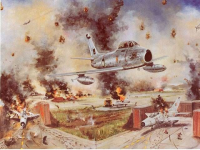
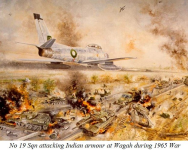
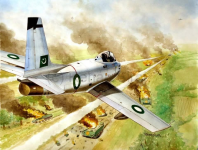
The painting depicts F-86F Sabres of PAF’s No. 19 Squadron, led by Squadron Leader Sajjad Haider, attacking Indian Army forces that had just crossed into Pakistani territory near Attari village, close to Lahore.

According to Indian accounts, the 3rd Jats lost five of their six RCL guns, three mortar carriers, several Sherman tanks, and many men. Their CO, Lt. Col. Desmond Hayde, fled wearing one sock and one shoe, while his second-in-command escaped on a bicycle to Amritsar Fort.

The Indian Air Force provided no support despite its nearby Amritsar base, and the Indian Army failed to advance even an inch toward its main objective of capturing Lahore.

Title:- GT Road Disaster
Date:- September 06, 1965
Launch Time:- 0945 Hours

At Peshawar Airbase, around more then two hundred miles away from Lahore, six F-86s of No 19 Squadron were ready to be airborne, armed with guns and rockets since September 5th as per specific instructions of Air Marshal Nur Khan. As soon as, a call was received from Air Headquarters of launching the first air strike by the No 19 Squadron under the command of Squadron Leader Sajjad Haider , the Sabres took off.

Sajjad recalls “Though the sun was up in the morning of 6th September, the air was still bracingly cool at our airbase. The news of Indian military attacks against Lahore came as a thunderbolt to all of us and it worked up the fighter pilots into a vicious mood. Everyone was urged to go forward to safeguard his nation and country".

As we were ordered to launch air strike mission on the Indian Armour units advancing to wards Lahore along the Amritsar-Wagah GT Road, a jubilant mood prevailed among pilots for the first mission in the morning. Those who joined me on the mission were Flt Lt Arshad Sami, Mohammad Akbar, Khalid Latif, Dilawar Hussain and Ghani Akbar.”

“Our F-86s were armed with rockets in addition to the six guns. We took off and leveled off at the pre-planned height before heading towards, Wagah, Lahore.Shortly afterward we were over the target area and went in as far as Amritsar. Turning back we spotted enemy vehicles of all sorts moving along the road crossing Wagah border, covered by the Sherman tanks. I also saw the now famous Omni Bus parked at the Wagah Custom Post which the Indian Army later paraded that day in the streets of Amritsar as the war trophy from Lahore. For a while the enemy did not see us orbiting overhead. But when they did it was a sight to see the soldiers and drivers jumping out to take cover leaving vehicles to fate.”

“ All pilots check your firing switches; hot; target in sight.”

As the second dragged on the Haider formation reached the pull up point and the six F-86s climbed steeply into the sky like darts getting ready for attack.

“I had by now dived in for attack and let go my first burst of rockets. My formation followed. I all we made six attacks each, as our formation orbited over the targets at tree top level. By the time we had expended our guns and rockets and returning to our Airbase. We saw a litter of bonfires destroying dozens of Sherman tanks, cannons and army vehicles. “

It was an armour brigade task force group trying to cross the BRB Canal at Batapur bridge. The war diary of 10 Division defending Lahore led by Major General Sarfaraz Khan , recorded that “ at this crucial juncture appeared 6 PAF s’ F-86s and for 15-20 minutes wrought havac on enemy armour and infantry, who were advancing in the open road trying to cross the BRB canal.

Dawn of 6th September, 1965 saw a formation of 6 F-86s of No 19 Squadron fully loaded with 5 inch rockets (a last minute premonition the night before, by Air Marshal Nur Khan the C-in-C, which paid rich dividends) flying on “Hot Patrol’. The moment the Air Defence Commander learnt of Indian Army’s advance towards Lahore, the 19 Squadron formation was diverted to stop the advancing Indian armour columns at Wagah. In twenty minutes of action, the Grand Trunk Road was littered with scores of burning tanks, armoured and soft vehicles. The 5 inch rockets had a devastating effect on the enemy armour. The formation led by Squadron Leader Sajad Haider with Flight Lieutenants M Akbar, Dilawar Hussain, Ghani Akbar and Flying Officers Khalid Latif, and Arshad Chaudhry brought the Indian attack to a dead halt.

Picture Courtesy: Aviation Art of Rehan Siraj
 

Users who are viewing this thread

Back
Top