Date: September 06, 1965
Time: 1630 Hours
Target: Pathankot Air Base
On 6th September Peshawar base had a single squadron, equipped with F-86 Sabres, which was enhanced to 18 aircraft as war establishment. The Station Commander Peshawar received the flash signal soon after 1200 hours, delivered by hand by the Senior Signals Officer, Wing Commander M.S. Khan. The orders were handed to OC 19, Squadron Leader Sajad Haider, (famously described by John Fricker in Battle for Pakistan as ‘universally referred to as Nosey Haider, for his magnificently patrician proboscis’) soon after. The squadron had flown 2 sorties with 6 aircraft and formation had landed after the Wagah mission, transiting through Sargodha, at around 1130 hours. 2 F-86s were said to be on CAP and four were on ADA stand-by duties.
The major change in target was a surprise as in the original plan of June 1965; the target given to No. 19 Squadron had been Am..bala. It is of special mention that the heavily defended complex at Ambala was at the extreme range of the F-86F Sabre aircraft. Peshawar had been given Ambala as their primary target on D-Day and H-Hour. Originally eight aircraft were to fly from Peshawar to Lahore (abandoned as an active base in peacetime owing to its vulnerability, was to be reactivated for occasional use during war, as stated in History of PAF 1988), where they were to be joined by eight more aircraft originating from Mauripur led by Squadron Leader Waqar Azim. The Mauripur Sabres were to form the second element behind the Peshawar Sabres. These aircraft were to move in there at six hours’ notice a couple of days or so before for the anticipated strikes. From there, they were to launch deep strike mission targeting Ambala and were to initially recover at Lahore in near darkness. After refueling the Peshawar’s Sabres were to return back to Peshawar while the Mauripur Sabres were to head for Sargodha. Peshawar was to be given a new target the next day (possibly Srinagar, depending upon the attrition suffered during the attack on the highly defended Ambala airfield).
In a tête-à-tête, with retired Air Commodore Sajad Haider about few years ago, it transpired that No. 19 Squadron had practiced their assigned task with realistic simulation. This included simulating night landing on a 6000 foot Lahore runway, practiced at their Peshawar base. Upon achieving the exercise results the Director of Plans was sent by AHQ to endorse the squadron recovery capability. The outlines of the Ambala runway were drawn at the Jamrud firing range, where the Sabres from Peshawar used to carry out attacks at dusk and sometimes well after dusk in pitch darkness. Use of flares and napalm bombs to illuminate the target was also practiced and perfected with permission from ACAS (Operations). The concept was somewhat utopian but it showed the spirit of determination, motivation and seriousness by the squadron to be fully prepared to deliver, if the war came.
The change of target from Ambala to Pathankot had its own significance, as Pathankot has been creating a lot of problems for the PAF since 1 September 1965, and had to be sorted out. However, the target allocation came as a big surprise for No. 19 Squadron. Pathankot had not been assigned as a target in June or later. Consequently, they had little information about its layout, the dispersal areas and aircraft shelter complex or even the runways direction which was an absolute pre-requisite for an airfield attack. This information was indispensable for the success of the attack, especially because the Sabres would be operating at the outer most fringes of their operational radius of action, 220 miles to the target and would have little fuel for loitering around to familiarize with the lay-out down below.
As mentioned Peshawar had one squadron with 18 F-86 aircraft at the start of war and luckily remained with 18 at the end of war. The change of target from Ambala to Pathankot came as a surprise for No. 19 Squadron and its pilots who had relentlessly trained to take down Ambala. In a detailed discussion with Air Commodore ® Sajad Haider some years ago, after some persuasion he recounted the details of this mission which is as follows:
“Soon we realized that this was a second change of target on 6th September, and would entail a re-appraisal of attack plan from the Ambala base, which the squadron had perfected as close to the possibility of achieving success in this complex assigned mission. Although to my reckoning Pathankot would be an easier target, but for its success we required maximum intelligence about the target base. Another issue to be factored-in was the distance to the target (that was more than 220 miles), and the fuel management had to be considered, which might restrict the number of attacks. The complete change of target for the second time in one morning was a minor challenge for which 19 Squadron had been well trained. You must remember that our pilots had been trained through planning to fly long range composite missions ending at Jamrud Range for a single attack on the Ambala simulated airfield painted below. They were trained to land with as little as 400 Ibs of fuel, so as never to panic when fuel state was low. This paid great dividends in war as I exploited this good honing to maximum. Ironically, PAF historians 1988 have wrapped me on the knuckles and drubbed it as imprudent for such an initiative which I considered prerogative of the combat commander in a real combat environment. So be it. The results of the 1965 war performance of Zambos of 19 Squadron remain incomparable in perpetuity. The joie de verve amongst our squadron was indescribable and uplifting. Most pilots despite having flown 2 sorties till midday were hankering to be on this mission.
I asked the Station Commander to find us a photo of the airfield with its layout, aircraft dispersal pens and information pertaining to the deployment of AAA. He replied that he will try to get it from the Air Intelligence. Meanwhile, I asked my Flight Commander to detail the team from those who had been practicing the attack plan. The only change I made was to include Ghani Akbar as No.7 and asked Wing Commander M.G. Tawab acted as escort, with Arshad Sami as wingman. Having done that I requested my batch mate and friend, Squadron Leader Iqbal, O.C. of the secret No. 24 Squadron which flew the fabled RB-57D/F, to allow my pilots couple of hours in their state of the art crew room, for them to rest before launch. I also asked my buddy Iqbal to detail his highly adept navigators to help us prepare the flight plan and that I will give him the navigation profile to the ‘Initial Point’ and the ‘Target’, so that he can do all the calculus and mark check points along the way on my map.
With that taken care, the pilots for the strike were woken up from deep slumber of days of fatigue from days of waiting as well as the sorties already flown. All the formation members were raring to go. The spirit to get on with the mission was magnificent. In absence of even sliver of information about the target made my brief simple, like ‘Follow me and I will take you to the target and unleash you, as I see the lay of the ground and air environment. No one asked any questions to the simple brief. To embalm the overflowing confidence of the young Zambo Formation, I asked each one to pick up the ice cold towellets from the fire bucket dowsed with 4711 cologne, with comments that those who may be fortunate to get Allah’s highest reward of martyrdom, should be smelling good as houris receive the lucky ones. That mood and moment shall remain etched in recesses of my memory eternally. The escort was told to remain 4000 ft. astern but level till I call one minute to pull-up, both must zoom up to 12,000-14,000 ft. to avoid AAA and protect our six. (He didn’t do that and stayed at a high level listening to Pathankot Radio as he confessed and was picked up by Amritsar radar. Only Allah protected us as he had given away the surprise element in our flight plan).
The amazing fact was that it was the third sortie for the squadron besides 6 missions flown in Air defense. All 10 aircraft took off with a thundering roar on runway 17 (with one stand-by reserve to replace any abort till formation changed channel to Air Defense frequency, was SOP for such missions). We left behind 8 aircraft out of which 4 were on ADA and 2 were on CAP, only 2 on maintenance and repair. 90 % serviceability of our aircraft was a miracle of engineering led by Squadron Leader A.G. Khan and his ground crews, and in equal measure the super supervision (No Interference) by our Station Commander in our planning and execution throughout the war. He was consumed by manning Operations Room, ensuring availability of aircraft with appropriate weapons for the missions as they came. Perfect harmony existed at the base in spite of 6 B-57s and several C-130s operations from Peshawar. There was never a moment of confusion to our knowledge.”
Meanwhile at IAF Base Pathankot, the Indian Air Force High Command was still unable to take any decision pertaining to carry out any strikes over Pakistan. In his memoir, ‘The day the PAF got away’, Air Marshal S. Raghavendran, who was the Gnat Squadron Commander at Pathankot of the Indian Air Force states, "I went to the Station Commander, Group Captain Roshan Suri, and asked him for permission to take up a four aircraft Combat Air Patrol over the airfield at 1700 hours. He said he would think about it. I kept going to him, phoning him or intercepting him when he visited the squadrons during the day. At first he said he would let me know. Then he said that the ORP aircraft were not to be touched and so I must get eight aircraft on the line before he could authorize it. I had only about ten aircraft altogether, available in Pathankot at that time, but managed to get eight serviceable and went back to him in the afternoon. He said he would let me know.
I had in mind that the other three would be Johnny Greene, Trevor Keelor and "Ajax" (aka "Kala") Sandhu, all of whom had a very high rating as determined and capable combat pilots. I was pretty sure of myself too. And we were all supremely confident of the maneuverability of the Gnat aircraft and the punch of its two 30mm cannons.
When I went to the Station Commander around 1530 hours, he floored me with a different plan. At this time the first MiG-21 squadron was just becoming operational, and two of their aircraft, with their Commanding Officer, Wing Commander MSD "Mally" Wollen, and his flight commander "Laddu" Sen had been allocated to Pathankot for operational duties. The plan was that they would get airborne around, climb to 40,000 ft. altitude and do supersonic runs in the vicinity. Obviously these tracks would be picked up by Pakistani radar. This was expected to put the fear of God into the Pak commanders, who would then not attack our airfield.”
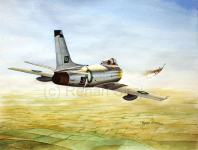
The Sabres by now (after carrying out a diversionary maneuver) had crossed the border, flying at deck level. As the fighters neared Pathankot, Squadron Leader Haider spotted a pair of enemy fighters, about four miles at 2 o’clock position turning left. However, keeping a vigilant eye on the enemy fighters which were identified as Mystères, the leader pressed on maintaining complete radio silence. Luckily, the enemy aircraft perched at a higher altitude, passed right above the Sabres, missing them completely.
The Sabres were now within seconds of striking their target. The leader called, “Zambos, one minute to attack.” All the pilots prepared themselves as this was the time to make or break. Thirty seconds later the leader again called: “Re-check circuit-breakers IN, Guns HOT, 30 seconds to pull-up.” After reciting “Allah-o-Akbar (Allah is the Greatest), the leader commenced pull-up. The Sabres had arrived bang on the target; with the sprawling field of Pathankot lay a mile to their left, precisely as planned. Pathankot was buzzing with activities, and was not expecting any visitors. Some Mystères had just returned back after a ground attack mission at Akhnur along with their Gnat escorts. The Sabres had achieved complete surprise and Pathankot Airfield lay at their mercy.
Describing the ground situation, Air Marshal S. Raghavendran states, “Those were the days when the MiG-21 was very new, and we had not learned to exploit it as we did later. It was strictly a high level interceptor and the pilots flew with the kind of gear meant for high altitude, including a helmet that resembled an astronaut's. It carried only two K-13 missiles and no guns.
The Mystère and Gnat squadron commanders, their flight commanders, and senior pilots were ordered to attend the briefing of the MiG formation, which we all did. After an impressive briefing the pilots picked up their space helmets, tucked them under their arms and walked out towards their aircraft, which had been pushed out of their blast pens for start-up and take-off. I am not sure of the exact time but I have a vague memory that it was just about 1700 hours.”
As the first four Sabres pulled up for attack the first aircraft to be spotted were two MiG-21s which were parked in front of their pens, next to each other in the northern dispersal area, their bare metal finish sparkling in the descending sunlight. The leader called out on the RT, “There are MiG-21s around and plenty other aircraft too, let’s get them all.” He then instructed his flight commander Flight Lieutenant Mohammad Akbar, who was leading the second four, to climb up to 6000 ft. above light AAA range and loosen out to the right and make a shallow 90-270 turn to let the his formation get in two attacks. Positioning himself for the first attack, he dived in as he called, “Leader is in,” and went for the first MiG-21. A streak of bullets left his Sabre and plastered the MiG-21. That announced the commencement of the raid.
During the entire course of the 1965 war, validation of performance of pilots and squadrons for either side is the acceptance by the adversary of damage inflicted by the antagonists. This attack has been well recorded by the official History of IAF as well as IAF Air Historians which includes both serving and retired officers as well as Defense Analysts. Renowned Indian War Historians, P.V.S Jagan Mohan & Samir Chopra records this scene as follows, “The ATC was frantically announcing, "Incoming Raid, Incoming Raid." Murdeshwar (a Gnat pilot) who had just landed and was taxiing into a blast pen cursed himself on his fuel state. If he had enough fuel, he could have taken off and intercepted the incoming aircraft. Flying Officer Janak Kapur who had already landed had just climbed out of his Gnat, when a fellow officer yelled, "Sir, look up, they are attacking." Kapur looked up to see the Sabres pulling up for the attack. Murdeshwar's Gnat was noticed by the Sabres as it was making its way to the blast pen. A volley of bullets straddled the Gnat just as Murdeshwar jumped out of the aircraft and out of the blast pen. Within seconds the bullets destroyed the Gnat.”
These accounts provide the most credible information how this attack proceeded through eye witness accounts of IAF fighter pilots. Indisputably the IAF was caught by surprise. Meanwhile all hell broke loose on the ground. Air Marshal S. Raghavendran recounted in recent years, “There was pandemonium. Bullets were flying all around. We all rushed to the nearest trench and dived in, not sitting and crouching as we should have been but piling ourselves flat on top of each other!! We could hear and see the Pakistani Sabres going round and round, as though in range practice, and picking off all the possible aircraft, including the two MiG-21s, in spite of the anti-aircraft guns blazing away. The rest is history. We were told that four Sabres had attacked, but since they were going round and round we couldn't count them accurately whenever we put our head up in the trench.”
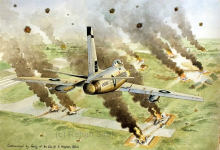
The Sabres were attacking the Pathankot airfield, as they were on a shooting range. Their attacks were unusually swift, in a constant 3-4 ‘G’ pattern, pulling-off and re-entering within a 90 degree arc. Below on the base, total annihilation was in progress. The Sabres strafed aircraft on the ground. While AAA had opened up, the sounds of machine guns strafing the airfield was like exploding thunder.
No. 19 Squadron’s Sabres carried out 22 attacks in all (instead of the planned 16). The first four aircraft after completing their attacks had started to ex-filtrate into friendly airspace. Pathankot was in flames.
The Sabre pilots had a booming welcome by all in Peshawar. The ground crew thanked Allah S.W.T. that all the pilots had returned safely. Everyone was curious to know about the results. After debriefing and interrogation, the Pathankot strike element were credited with 7 MiG-21s, 5 Mystères and 1 Fairchild C-119 destroyed on the ground, plus damage to the Air Traffic Control building. Later assessments by the PAF inclined to consider the number of MiGs as slightly optimistic, while the Indians claimed they were not MiG-21s at all, but Mystères. Officially, Indians accepted losing ten aircrafts during this strike including two MiG-21s and three aircraft severely damaged.
The IAF Official History figures published and reiterated by authors of the award winning ‘India-Pakistan War of 1965’ stated in their graphic four pages detail of the Pathankot Strike, “As the Sabres left, there were 10 columns of smoke rising in the air. Ten aircraft (each with tail number and other details is described) were completely destroyed and three were damaged. The raid was highly successful.”
By . Sarmad Hassan Sharif.
Painting By:
Aviation Art of Rehan Siraj