History & Operations of Wars of Pakistan Air Force

1791036066250.png

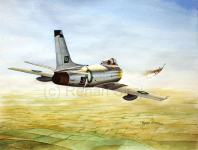
“Shooting down of Beechcraft – 1965 war ” 1545hrs PST


On 19th Sep 1965, F/O Qais M Hussain was scrambled to intercept an aircraft flying south west of Bhuj. The pilot reported back that it is a twin tailed, twin engined aircraft with four side windows. He was ordered to stand by while the controller referred to higher authorities. As both India and Pakistan utilized the civilian aircrafts for military purposes during the war, so presumably, with this in mind; the pilot was given a green light to shoot down the plane.

F/O Qais Hussain, fired a short burst and saw its left wing hit, then he readjusted himself and fired a long burst. The right engine of Beechcraft got hit and seconds later it went into a vertical dive and hit the ground. It was later learnt from All India Radio that the aircraft was flying Chief Minister of Gujrat, Balwantrai Mehta, his wife and personal staff and news reporter.

Indian Inquiry report says that the aircraft drifted well off its course. The crash site was 40NM north of its intended destination.

Courtesy: Aviation Art of Rehan Siraj
 
1791121204539.png

Date: September 06, 1965
Time: 1630 Hours
Target: Pathankot Air Base

On 6th September Peshawar base had a single squadron, equipped with F-86 Sabres, which was enhanced to 18 aircraft as war establishment. The Station Commander Peshawar received the flash signal soon after 1200 hours, delivered by hand by the Senior Signals Officer, Wing Commander M.S. Khan. The orders were handed to OC 19, Squadron Leader Sajad Haider, (famously described by John Fricker in Battle for Pakistan as ‘universally referred to as Nosey Haider, for his magnificently patrician proboscis’) soon after. The squadron had flown 2 sorties with 6 aircraft and formation had landed after the Wagah mission, transiting through Sargodha, at around 1130 hours. 2 F-86s were said to be on CAP and four were on ADA stand-by duties.

The major change in target was a surprise as in the original plan of June 1965; the target given to No. 19 Squadron had been Am..bala. It is of special mention that the heavily defended complex at Ambala was at the extreme range of the F-86F Sabre aircraft. Peshawar had been given Ambala as their primary target on D-Day and H-Hour. Originally eight aircraft were to fly from Peshawar to Lahore (abandoned as an active base in peacetime owing to its vulnerability, was to be reactivated for occasional use during war, as stated in History of PAF 1988), where they were to be joined by eight more aircraft originating from Mauripur led by Squadron Leader Waqar Azim. The Mauripur Sabres were to form the second element behind the Peshawar Sabres. These aircraft were to move in there at six hours’ notice a couple of days or so before for the anticipated strikes. From there, they were to launch deep strike mission targeting Ambala and were to initially recover at Lahore in near darkness. After refueling the Peshawar’s Sabres were to return back to Peshawar while the Mauripur Sabres were to head for Sargodha. Peshawar was to be given a new target the next day (possibly Srinagar, depending upon the attrition suffered during the attack on the highly defended Ambala airfield).

In a tête-à-tête, with retired Air Commodore Sajad Haider about few years ago, it transpired that No. 19 Squadron had practiced their assigned task with realistic simulation. This included simulating night landing on a 6000 foot Lahore runway, practiced at their Peshawar base. Upon achieving the exercise results the Director of Plans was sent by AHQ to endorse the squadron recovery capability. The outlines of the Ambala runway were drawn at the Jamrud firing range, where the Sabres from Peshawar used to carry out attacks at dusk and sometimes well after dusk in pitch darkness. Use of flares and napalm bombs to illuminate the target was also practiced and perfected with permission from ACAS (Operations). The concept was somewhat utopian but it showed the spirit of determination, motivation and seriousness by the squadron to be fully prepared to deliver, if the war came.

The change of target from Ambala to Pathankot had its own significance, as Pathankot has been creating a lot of problems for the PAF since 1 September 1965, and had to be sorted out. However, the target allocation came as a big surprise for No. 19 Squadron. Pathankot had not been assigned as a target in June or later. Consequently, they had little information about its layout, the dispersal areas and aircraft shelter complex or even the runways direction which was an absolute pre-requisite for an airfield attack. This information was indispensable for the success of the attack, especially because the Sabres would be operating at the outer most fringes of their operational radius of action, 220 miles to the target and would have little fuel for loitering around to familiarize with the lay-out down below.

As mentioned Peshawar had one squadron with 18 F-86 aircraft at the start of war and luckily remained with 18 at the end of war. The change of target from Ambala to Pathankot came as a surprise for No. 19 Squadron and its pilots who had relentlessly trained to take down Ambala. In a detailed discussion with Air Commodore ® Sajad Haider some years ago, after some persuasion he recounted the details of this mission which is as follows:

“Soon we realized that this was a second change of target on 6th September, and would entail a re-appraisal of attack plan from the Ambala base, which the squadron had perfected as close to the possibility of achieving success in this complex assigned mission. Although to my reckoning Pathankot would be an easier target, but for its success we required maximum intelligence about the target base. Another issue to be factored-in was the distance to the target (that was more than 220 miles), and the fuel management had to be considered, which might restrict the number of attacks. The complete change of target for the second time in one morning was a minor challenge for which 19 Squadron had been well trained. You must remember that our pilots had been trained through planning to fly long range composite missions ending at Jamrud Range for a single attack on the Ambala simulated airfield painted below. They were trained to land with as little as 400 Ibs of fuel, so as never to panic when fuel state was low. This paid great dividends in war as I exploited this good honing to maximum. Ironically, PAF historians 1988 have wrapped me on the knuckles and drubbed it as imprudent for such an initiative which I considered prerogative of the combat commander in a real combat environment. So be it. The results of the 1965 war performance of Zambos of 19 Squadron remain incomparable in perpetuity. The joie de verve amongst our squadron was indescribable and uplifting. Most pilots despite having flown 2 sorties till midday were hankering to be on this mission.

I asked the Station Commander to find us a photo of the airfield with its layout, aircraft dispersal pens and information pertaining to the deployment of AAA. He replied that he will try to get it from the Air Intelligence. Meanwhile, I asked my Flight Commander to detail the team from those who had been practicing the attack plan. The only change I made was to include Ghani Akbar as No.7 and asked Wing Commander M.G. Tawab acted as escort, with Arshad Sami as wingman. Having done that I requested my batch mate and friend, Squadron Leader Iqbal, O.C. of the secret No. 24 Squadron which flew the fabled RB-57D/F, to allow my pilots couple of hours in their state of the art crew room, for them to rest before launch. I also asked my buddy Iqbal to detail his highly adept navigators to help us prepare the flight plan and that I will give him the navigation profile to the ‘Initial Point’ and the ‘Target’, so that he can do all the calculus and mark check points along the way on my map.

With that taken care, the pilots for the strike were woken up from deep slumber of days of fatigue from days of waiting as well as the sorties already flown. All the formation members were raring to go. The spirit to get on with the mission was magnificent. In absence of even sliver of information about the target made my brief simple, like ‘Follow me and I will take you to the target and unleash you, as I see the lay of the ground and air environment. No one asked any questions to the simple brief. To embalm the overflowing confidence of the young Zambo Formation, I asked each one to pick up the ice cold towellets from the fire bucket dowsed with 4711 cologne, with comments that those who may be fortunate to get Allah’s highest reward of martyrdom, should be smelling good as houris receive the lucky ones. That mood and moment shall remain etched in recesses of my memory eternally. The escort was told to remain 4000 ft. astern but level till I call one minute to pull-up, both must zoom up to 12,000-14,000 ft. to avoid AAA and protect our six. (He didn’t do that and stayed at a high level listening to Pathankot Radio as he confessed and was picked up by Amritsar radar. Only Allah protected us as he had given away the surprise element in our flight plan).

The amazing fact was that it was the third sortie for the squadron besides 6 missions flown in Air defense. All 10 aircraft took off with a thundering roar on runway 17 (with one stand-by reserve to replace any abort till formation changed channel to Air Defense frequency, was SOP for such missions). We left behind 8 aircraft out of which 4 were on ADA and 2 were on CAP, only 2 on maintenance and repair. 90 % serviceability of our aircraft was a miracle of engineering led by Squadron Leader A.G. Khan and his ground crews, and in equal measure the super supervision (No Interference) by our Station Commander in our planning and execution throughout the war. He was consumed by manning Operations Room, ensuring availability of aircraft with appropriate weapons for the missions as they came. Perfect harmony existed at the base in spite of 6 B-57s and several C-130s operations from Peshawar. There was never a moment of confusion to our knowledge.”

Meanwhile at IAF Base Pathankot, the Indian Air Force High Command was still unable to take any decision pertaining to carry out any strikes over Pakistan. In his memoir, ‘The day the PAF got away’, Air Marshal S. Raghavendran, who was the Gnat Squadron Commander at Pathankot of the Indian Air Force states, "I went to the Station Commander, Group Captain Roshan Suri, and asked him for permission to take up a four aircraft Combat Air Patrol over the airfield at 1700 hours. He said he would think about it. I kept going to him, phoning him or intercepting him when he visited the squadrons during the day. At first he said he would let me know. Then he said that the ORP aircraft were not to be touched and so I must get eight aircraft on the line before he could authorize it. I had only about ten aircraft altogether, available in Pathankot at that time, but managed to get eight serviceable and went back to him in the afternoon. He said he would let me know.

I had in mind that the other three would be Johnny Greene, Trevor Keelor and "Ajax" (aka "Kala") Sandhu, all of whom had a very high rating as determined and capable combat pilots. I was pretty sure of myself too. And we were all supremely confident of the maneuverability of the Gnat aircraft and the punch of its two 30mm cannons.

When I went to the Station Commander around 1530 hours, he floored me with a different plan. At this time the first MiG-21 squadron was just becoming operational, and two of their aircraft, with their Commanding Officer, Wing Commander MSD "Mally" Wollen, and his flight commander "Laddu" Sen had been allocated to Pathankot for operational duties. The plan was that they would get airborne around, climb to 40,000 ft. altitude and do supersonic runs in the vicinity. Obviously these tracks would be picked up by Pakistani radar. This was expected to put the fear of God into the Pak commanders, who would then not attack our airfield.”

The Sabres by now (after carrying out a diversionary maneuver) had crossed the border, flying at deck level. As the fighters neared Pathankot, Squadron Leader Haider spotted a pair of enemy fighters, about four miles at 2 o’clock position turning left. However, keeping a vigilant eye on the enemy fighters which were identified as Mystères, the leader pressed on maintaining complete radio silence. Luckily, the enemy aircraft perched at a higher altitude, passed right above the Sabres, missing them completely.

The Sabres were now within seconds of striking their target. The leader called, “Zambos, one minute to attack.” All the pilots prepared themselves as this was the time to make or break. Thirty seconds later the leader again called: “Re-check circuit-breakers IN, Guns HOT, 30 seconds to pull-up.” After reciting “Allah-o-Akbar (Allah is the Greatest), the leader commenced pull-up. The Sabres had arrived bang on the target; with the sprawling field of Pathankot lay a mile to their left, precisely as planned. Pathankot was buzzing with activities, and was not expecting any visitors. Some Mystères had just returned back after a ground attack mission at Akhnur along with their Gnat escorts. The Sabres had achieved complete surprise and Pathankot Airfield lay at their mercy.

Describing the ground situation, Air Marshal S. Raghavendran states, “Those were the days when the MiG-21 was very new, and we had not learned to exploit it as we did later. It was strictly a high level interceptor and the pilots flew with the kind of gear meant for high altitude, including a helmet that resembled an astronaut's. It carried only two K-13 missiles and no guns.

The Mystère and Gnat squadron commanders, their flight commanders, and senior pilots were ordered to attend the briefing of the MiG formation, which we all did. After an impressive briefing the pilots picked up their space helmets, tucked them under their arms and walked out towards their aircraft, which had been pushed out of their blast pens for start-up and take-off. I am not sure of the exact time but I have a vague memory that it was just about 1700 hours.”

As the first four Sabres pulled up for attack the first aircraft to be spotted were two MiG-21s which were parked in front of their pens, next to each other in the northern dispersal area, their bare metal finish sparkling in the descending sunlight. The leader called out on the RT, “There are MiG-21s around and plenty other aircraft too, let’s get them all.” He then instructed his flight commander Flight Lieutenant Mohammad Akbar, who was leading the second four, to climb up to 6000 ft. above light AAA range and loosen out to the right and make a shallow 90-270 turn to let the his formation get in two attacks. Positioning himself for the first attack, he dived in as he called, “Leader is in,” and went for the first MiG-21. A streak of bullets left his Sabre and plastered the MiG-21. That announced the commencement of the raid.

During the entire course of the 1965 war, validation of performance of pilots and squadrons for either side is the acceptance by the adversary of damage inflicted by the antagonists. This attack has been well recorded by the official History of IAF as well as IAF Air Historians which includes both serving and retired officers as well as Defense Analysts. Renowned Indian War Historians, P.V.S Jagan Mohan & Samir Chopra records this scene as follows, “The ATC was frantically announcing, "Incoming Raid, Incoming Raid." Murdeshwar (a Gnat pilot) who had just landed and was taxiing into a blast pen cursed himself on his fuel state. If he had enough fuel, he could have taken off and intercepted the incoming aircraft. Flying Officer Janak Kapur who had already landed had just climbed out of his Gnat, when a fellow officer yelled, "Sir, look up, they are attacking." Kapur looked up to see the Sabres pulling up for the attack. Murdeshwar's Gnat was noticed by the Sabres as it was making its way to the blast pen. A volley of bullets straddled the Gnat just as Murdeshwar jumped out of the aircraft and out of the blast pen. Within seconds the bullets destroyed the Gnat.”

These accounts provide the most credible information how this attack proceeded through eye witness accounts of IAF fighter pilots. Indisputably the IAF was caught by surprise. Meanwhile all hell broke loose on the ground. Air Marshal S. Raghavendran recounted in recent years, “There was pandemonium. Bullets were flying all around. We all rushed to the nearest trench and dived in, not sitting and crouching as we should have been but piling ourselves flat on top of each other!! We could hear and see the Pakistani Sabres going round and round, as though in range practice, and picking off all the possible aircraft, including the two MiG-21s, in spite of the anti-aircraft guns blazing away. The rest is history. We were told that four Sabres had attacked, but since they were going round and round we couldn't count them accurately whenever we put our head up in the trench.”

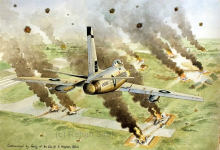
The Sabres were attacking the Pathankot airfield, as they were on a shooting range. Their attacks were unusually swift, in a constant 3-4 ‘G’ pattern, pulling-off and re-entering within a 90 degree arc. Below on the base, total annihilation was in progress. The Sabres strafed aircraft on the ground. While AAA had opened up, the sounds of machine guns strafing the airfield was like exploding thunder.

No. 19 Squadron’s Sabres carried out 22 attacks in all (instead of the planned 16). The first four aircraft after completing their attacks had started to ex-filtrate into friendly airspace. Pathankot was in flames.

The Sabre pilots had a booming welcome by all in Peshawar. The ground crew thanked Allah S.W.T. that all the pilots had returned safely. Everyone was curious to know about the results. After debriefing and interrogation, the Pathankot strike element were credited with 7 MiG-21s, 5 Mystères and 1 Fairchild C-119 destroyed on the ground, plus damage to the Air Traffic Control building. Later assessments by the PAF inclined to consider the number of MiGs as slightly optimistic, while the Indians claimed they were not MiG-21s at all, but Mystères. Officially, Indians accepted losing ten aircrafts during this strike including two MiG-21s and three aircraft severely damaged.

The IAF Official History figures published and reiterated by authors of the award winning ‘India-Pakistan War of 1965’ stated in their graphic four pages detail of the Pathankot Strike, “As the Sabres left, there were 10 columns of smoke rising in the air. Ten aircraft (each with tail number and other details is described) were completely destroyed and three were damaged. The raid was highly successful.”

By . Sarmad Hassan Sharif.

Painting By: Aviation Art of Rehan Siraj
 
1791286241659.png

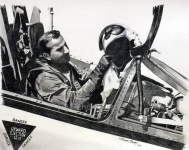
WHERE EAGLES DARE (A TRIBUTE TO WING COMMANDER MERVYN LESLIE MIDDLECOAT SHAHEED) By Sarmad Hassan Sharif.

1971 war is full of mysterious incidents which have been penned down but never discussed in great detail. May it be the mysterious sinking of PNS Ghazi, crash of a PIA Boeing 707 in China, crash of a PIA Fokker F-27 on a maritime surveillance mission or unconfirmed status of ejected pilots of both PAF and IAF, we cannot find enough to figure out that what actually happened.

While things remained in the iron curtain after the war, information was limited up to the controlled print media and one could not access to the story present on other side of the border. It wasn't the advent of the internet, that information started pouring in but in some cases that information was also not conclusive.

Being a keen air war historian, I was quite impressed with the performance of the Lockheed F-104A Starfighter in PAF service, especially its role in the 1965 war. However I had very limited information regarding its service history in 1971 war. While details remained moot in the Official PAF History of 1982 and Fiza'ya (By Pushpinder Singh and Ravi Rikheye) it was not until I stumbled across BHARAT RAKSHAK, the premier Indian defense related website, about the air combat at Jamnagar, in which one of our F-104 was shot down by an IAF MiG-21FL. When I came across the PAF pilots involved in the mission, I was startled to find the name of Wing Commander Mervyn Leslie Middlecoat, as he was one of the most experienced F-104 pilot in PAF. He was one of the most experienced and the most respected pilots in the air force and had led No. 9 Squadron bravely, in the 1965 war.

Keeping in mind the war propaganda (from both sides) I was not satisfied with the details provided by BHARAT RAKSHAK and decided to search more about the last mission of Wing Commander Mervyn Leslie Middlecoat.

BACKGROUND

Mervyn Leslie Middlecoat was a brilliant officer right from the beginning. On his graduation with the 16th GD(P) course in 1954, he was awarded the trophy for best performance in Ground Subjects. Soft spoken and mild mannered, Middlecoat was the epitome of an officer and a gentleman besides being an outstanding pilot. Flying different aircraft in his service career, he came to master the F-104 Starfighter.

Flt. Lt. Middlecoat was amongst the first three pilots to undergo type conversion in the United States for the F-104 Starfighter. He along with Flt. Lt. Allaudin 'Butch' Ahmed, served with the ANG (Air National Guards) unit flying the Starfighter, in South Carolina.

Both Middlecoat and Butch trained extensively as they had to form the nucleaus of the training core of Starfighters in the PAF.

This training paid off well, when the No. 9 Squadron performed exceptionally well in the 1965 war. Under the leadership of Squadron Leader Middlecoat, the Squadron recorded history in its own unique way. The milestones achieved by the squadron are:

1. First air arrest of the type anywhere in the world (F-104 vs. Gnat)
2. First air to air kill of the type anywhere in the world (F-104 vs. Mystere)
3. First missile kill of the type anywhere in the world (F-104 vs. Canberra)
4. First confirmed night kill of the type anywhere in the world (F-104 vs. Canberra)
5. First utilization of the F-104B Model for Photo Reconnaissance

During the seventeen days conflict, he kept his squadron's spirits high with firm conviction of a commander who leads from the front. He performed an impressive 17 Air Defence Sorties and 3 Photo Reconnaissance Missions. For his bravery, professional leadership and selfless contribution in the war, Squadron Leader Middlecoat was awarded with Sitara-e-Jura'at.

The 1965 war ended with 9 Squadron flying 254 sorties of which 246 were day and night defence, 4 escort and 4 counter air. PAF lost two Starfighters during the 17 day conflict with India. These losses were not replaced by the US given the arms embargo imposed o Pakistan.

Therefore No. 9 Squadron was left with only 8 F-104As and 2 F-104Bs after the hostilities. In addition PAF faced the problem of dwindling spare parts stocks for the aircraft which were also embargoed and had to be sourced from a third party sources and black market.
 
During the war, new lessons were learned. Squadron Leader Middlecoat devised new strategies and tactics and added them in the training curriculum. With the induction of Mirages and F-6s, and both types being stationed at Sargodha, it was not long when F-104 was pitted against these aircraft in DACT (Dissimilar Air Combat Training). However, within PAF it was assessed that F-104 was inferior in all flight regimes by the increasingly numerous MiG-21s with the Indian Air Force but superior to the Su-7s, also inducted by IAF in large numbers. Especially in a close in dogfight the Starfighter was considered to be outmatched by the MiG-21 given its superior manoeuvrability and similar speed and acceleration. However, Squadron Leader Middlecoat was confident that the tactics of the PAF F-104 made use of the aircraft's high speed to hit targets quickly, ideally using AIM-9B Sidewinder and quickly egress at high speed and low level. Turning with more nimble fighters was not considered advisable.

Slowly but surely, the arms embargo on Pakistan started effecting the F-104 flying, with the result that the aircraft were practically cocooned starting December 1969. PAF also lost two Starfighters in accidents during this time period.

Wing Commander Middlecoat was posted in No. 26 Squadron (Black Spiders) at Peshawar where he commanded an F-86F Squadron. His stint at Peshawar was equally exciting as he incorporated new tactics in the training curriculum. A detachment of Hunters from the Royal Air Force visited Peshawar and were damned impressed when they met Wing Commander Middlecoat in a training dogfight mission. For the junior pilots (both No. 9 Squadron and No. 26 Squadron), he was somewhat like an invincible ray of beacon, who guided them in this time of darkness. Amongst his colleagues he was regarded amongst the most respected pilots of his time.

It was the results of his training that both No. 26 Squadron and No. 9 Squadron had performed exceptionally well in the 1971 war. While the vintage F-86F Sabres faced the Hunters in the opening round of the war, the Starfighters chalked up three confirmed air to air kills in their tally.

As India-Pakistan tensions mounted around mid-1971, Wing Commander Middlecoat was ordered to lead a contingent of pilots with previous F-104 experience, as a PAF detachment to Jordan from where they had to regain experience on the aircraft. This was a gifted oppurtunity as PAF F-104s required some time to be brought to an airworthy state with essential spares being shipped in from the Unites States. Led by Wing Commander Middlecoat, the PAF pilots immediately started an extensive training program in Jordan in which Jordanian pilots were also included.

King Hussein of Jordan, a keen aviator, was a regular visitor of the Starfighter Squadron, and was damned impressed by the proficiency of PAF pilots. He was amazed to see Starfighters being used for airfield attacks with their Vulcan Gatling Guns (notorious for their deadly punch) utilizing their high speed. He personally admired Wing Commander Middlecoat and always asked him for anything he required during his stay in Jordan. Such was the relationship between both the air forces that King Hussein promised to send these aircraft to Pakistan if the need arises.
 
THE 1971 WAR
No. 9 Squadron was ready for action on the onset of 1971 war. F-104s participated in the opening raids by attacking Faridkot and Bernala Radar Sites. In the following couple of days the Starfighters carried out SEAD missions against Amritsar Radar and shot down two enemy aircraft in the process. However, a specially modified F-104 equipped with SLARD/RALOR (specially equipped radar locating sensors) was shot down by enemy ground based air defenses on 5th December, after which the radar busting campaign was brought to a halt.

The news of the war reached Jordan, and all pilots were instructed to return back as soon as possible. Wing Commander Middlecoat knew that the time has come to show the enemy again the meaning of war, as he prepared to come back and join his squadron. As the December war progressed, PAF HQ decided to strengthen the already weak Southern Air Command. In a strategic move PAF shifted 7 F-104s of No.9 Squadron to Masroor Air Base on 6th December.

The basis of bringing the Starfighters in this area was to:
1. All weather day/night air defence with a primary emphasis on intercepting IAF Canberra Bombers at night, which till before their arrival, would arrive over Karachi at night and bomb any target of their choice with impunity;
2. Intercept Indian Navy Maritime/ASW aircraft and locate Indian Naval vessels;
3. Carry out daylight blitz strikes against IAF and IN installations as they had the range and speed to carry out such missions;
4. Fly CAP over the war zone and intercept any incoming IAF strike element.

Though they were introduced late in this sector, their arrival however boosted the morale of the PAF Southern Air Command. IAF also now behaved in a cautious manner because before 6th December, they wrecked havoc on important installations which included the Keamari Oil Farm as well as PAF Base Masroor. After the arrival of the Starfighters, IAF restrained itself against the raids against Karachi and was restricted to close support of their army.

BATTLE OVER JAMNAGAR
Wing Commander Middlecoat arrived back on December 10, 1971. His arrival was delayed as initially he was to lead the RJAF Starfighter contingent to Masroor, but due to the impending delay of the transfer of RJAF aircraft he had to hurry back to participate in the war. Immediately after his arrival, he started to fly his missions with such enthusiasm, that the morale of the squadron was highly lifted.

The result of this morale was clearly visible when PAF F-104s struck Okha and destroyed an IN Alize ASW aircraft on December 10, 1971, while the next day PAF F-104s struck Utterlai and destroyed an IAF HF-24 Marut while damaging the other one. A similar mission was planned for the December 12, 1971 in which two F-104 Starfighters were to fly a similar strike mission against the heavily defended Jamnagar Air Field. Intel had confirmed the presence of MiG-21FL and Hunter aircraft at Jamnagar. This particular enemy base had to be sorted out as it supported the majority of the strikes against Karachi and Badin areas. While the B-57s visited Jamnagar on regular basis, no worthwhile damage had been done. The F-104 Starfighter was the only aircraft available with the Southern Air Command to conduct a blitz daylight strike deep inside the enemy territory.

The Indians on the other hand were quite annoyed on their reaction time at Utterlai and Group Captain Pete Wilson, Station Commander of Jamnagar Airbase had issued a warning to the detachment of the MiG-21 pilots at his base, that if anyone cannot scramble in less than 2 minutes, he can leave the base and go back. The IAF MiG-21 pilots at Jamnagar practiced hard to scramble in less than 2 minutes and somewhat succeeded. The Indian Station Commander anticipated a PAF attack after the Utterlai strike. He was sure that PAF will attempt a similar daylight raid on his base and was keeping his fingers crossed as he knew that he will be facing a major challenge. Coming in a long way to attack a fully alert enemy base is not a simple task. Six years back, he had witnessed the PAF raid against Kalaikunda and was well aware of the capabilities of his adversary.

Wing Commander Arif Iqbal had been leading from the front in the absence of Wing Commander Middlecoat. Since this was a highly dangerous mission, he decided to lead this mission with Squadron Leader Tariq Habib as his wingman. It was at this instance that Wing Commander Middlecoat intervened and said, "Arif, I'm taking this one," as he took the mission briefing papers from him. While Wing Commander Arif Iqbal insisted that he is supposed to lead this mission, Wing Commander Middlecoat stood firm in his stance that this is a dangerous mission and he himself will lead the mission, owing to his confidence backed by experience. At the end, Wing Commander Arif Iqbal had to step back and let Wing Commander Middlecoat lead this mission.

Following the successful strike against Utterlai, Wing Commander Middlecoat worked on the mission profile along with his wingman.
They had to fly ~ 500 km from their base towards Jamnagar Airfield at low level i.e. below 250 ft AGL skimming the sea;

As soon as they neared their target they had to pull up to 2-3000 feet with target offset to their right by 2-3 miles in order to line up for their strafing runs;

Once in line they had to attack the aircraft exposed on the runway/taxiway with a single pass each;
 
Exit at high speed and low level.

While both the Starfighters were equipped with Sidewinders, it was not advisable to indulge in any dogfight as it could eat up the meager fuel reserves which was required for a safe egress and recovery.

After pre-flight mission briefing, both the pilots bade farewell to their colleagues as they headed towards their mounts. Both F-104 Starfighters took off and set their course towards Jamnagar Base at low level. They were configured with wingtip fuel tanks and underwing pylons equipped with Sidewinders for self defence. Skimming the Arabian Sea, both Starfighters approached undetected till they crossed the Saurashtra sea coast. They were picked by Indian MOUs which immediately informed the base.

The long awaited hooter at Jamnagar finally blew as Squadron Leader Guni Sehgal and Flight Lieutenant Bharat Bhuhsan Soni ran towards their MiGs. Within less than two minutes both the MiGs took off at breakneck speed at the same time when the Starfighters appeared overhead and took a readjustment turn for a strafing run. The MiGs were ordered to set up their CAP orbit pattern, while two way R/T contact was established between the Killer Control and the MiGs.

Wing Commander Middlecoat while proceeding according to the mission plans had lined up along runway 24 going straight for the ORP. His aircraft was picked up by Flight Lieutenant I.J.S. Boparai, who was monitoring the interception as the Killer Control. Quick as a flash Boparai directed the lead MiG piloted by Guni Sehgal to take on against Middlecoat, as he was in the right position for the fast attack. "Guni, one bandit over Jamnagar Town running low level along runway 24, 3-4 kms away. Soni, the second F-104 is now turning trail, far behind". Arriving at high speed and low level, Wing Commander Middlecoat pulled up for a strafing run, and upon noticing a couple of aircraft on the ORP, fired his Vulcan Gatling Gun. The bullets hit the targets but no smoke or explosion was observed. They were decoys placed strategically by the Station Commander. As he was pulling up, Wing Commander Middlecoat noticed a couple of MiG-21s on the ground. While he was justified to leave the area as he had completed his attack, he conducted a teardrop turn and decided to dive back and carry out another attack on the MiGs. This maneuver frustrated Guni's attack as he expected the F-104 to pull up and exit after completing its attack.

By now, the second MiG had acquired visual contact and dived in. Squadron Leader Tariq Habib who was coming in for the attack, noticed a silver MiG diving towards him with an intent to kill. Immediately sensing danger, he abandoned his attack, broke hard towards right, separating his distance from the MiGs and flew NW (general direction of Pakistan) at high speed. This was witnessed by Flight Lieutenant Bharat Bhuhsan Soni, the Indian MiG-21 pilot.
 
Wing Commander Middlecoat by now had aligned for a second attack on the airfield. He dropped his speed to get a better aim and dived towards a parked MiG-21FL firing his gun. "Soni, the bandit has gone into a hard right to get that MiG-21 on the ground. He has dropped his speed. Get him. Soni confirm contact?" yelled Boparai.

Guni by now had settled behind Middlecoat while Soni also confirmed contact and dived to get him. Both the MiGs were perched above and behind the F-104 waiting for it to clear the 'guns free' area of the airbase. By this time Middlecoat had also spotted both the MiGs and after realizing that he is sharing the airspace with them alone, engaged reheat and disengaged.

However the MiGs were determined to bag a kill and that too of a Starfighter. Guni closed in to get a positive missile tone and was about to press his missile firing button, when Soni overtook him at an amazing speed and was dead set on Middlecoat’s Starfighter. All this was happening in milliseconds at a very high speed and Guni was unable to stop himself in firing the missile. He yelled on his R/T, “Bops, Soni has come right in front of me, I have pressed the missile firing button”. The missile streaked straight at Soni’s MiG but later deflected at the sun’s reflection in the Arabian Sea. As soon as Soni saw a missile going past his aircraft he stammered on his R/T, “Firing Red at me……….. Missile has missed.”

Boparai knew the fact that if he relayed the true information to Soni that he has survived a near fratricide, it could un-nerve him and Soni might give up his chase of the Starfighter (IAF had lost a MiG-21 last night in a fratricide while intercepting a Mirage-IIIR). He then told Soni that the F-104 might have deployed IR Flares and at the same time ordered Guni to hold fire and provide cover to Soni. Determined to bag a kill, Soni got a positive missile tone and fired his K-13 Atoll missile at the F-104.

Instinctively the Starfighter broke right, in a high G turn, engaging maximum dry thrust. This manoeuvre was enough to evade the early generation IR missile, but Soni also broke right, engaged reheat and closed in fast. As the MiG-21 (using afterburners) could sustain a tighter turn and better rate of closure than the Starfighter (without afterburners), he rapidly closed in and fired a two second burst of his 23mm gun. With bright flashes all around the Starfighter, the aircraft started to get out of control. Wing Commander Middlecoat, as reported by Soni, pulled up the Starfighter with the remaining energy left in the aircraft, and ejected at high speed. The stricken aircraft crashed inverted in the sea.

Meanwhile the Indian Killer Control ordered Soni to ‘Return to Base’ and asked Guni to orbit overhead. He noticed that Middlecoat had neither separated from his ejection seat nor he had waved to the orbiting MiG after ejection. An ejection at a speed of more than 950km/hr and at a very low level can prove near fatal at times and it was assumed that Middlecoat had been injured in this process.

Guni was replaced by an slower orbiting Hunter which tried its best to communicate with Middlecoat but never got any response. Since there was no boat in the area, nor IAF could muster any heliborne search, Middlecoat according to the Indian accounts was not rescued and his exact fate remains unknown till to date.

Back at Masroor, the Squadron was anxiously waiting for both their pilots when they learnt that only one F-104 has returned back from the mission. In the debriefing session, Squadron Leader Tariq stated that since they were intercepted by enemy MiGs, they had to abort and return back. However Wing Commander Middlecoat got tangled with the enemy MiGs and in the ensuing air combat he was shot down by a missile. Wing Commander Arif Iqbal was really upset, as he was supposed to go on this mission. Not only he lost his squadron commander, but also a friend whom he served with No. 9 Squadron for almost a decade. Other pilots were also in a state of shock.

Wing Commander Middlecoat was an outstanding officer and sportsman and a king pin on the F-104. He was a role model for the youngsters and when they heard that he had got into a dogfight over Jamnagar and went missing, they fully expected him to swim the Gulf of Kutch and return.
 
AFTERMATH
Upon his martyrdom, he was awarded the Sitara-e-Juraat for the second time. Wing Commander Middlecoat's loss was a huge one, both for No. 9 Squadron and PAF. He was amongst the pioneers who trained PAF to go and fight supersonic. He was well aware about the flight characteristics of the F-104 and was well prepared to take his chances. He was justified to leave the area after conducting his first strafing attack but upon spotting some real targets decided to take his chances and that too in the presence of enemy interceptors. This displayed his leadership to lead from the front and his commitment to complete his mission.

His wingman on the other side, preferred personal safety as he extricated himself out of the battle and disengaged (as witnessed by the Indian MiG-21 pilots). Had he conducted a diversionary maneuver, he could have sandwiched both the MiGs and shoot down the trailing MiG-21 (since both MiGs were focused on Middlecoat's Starfighter) forcing Soni to disengage, but personal safety got the better of him.

As an analyst, I will never say that it was an even battle. The Starfighters were operating deep inside enemy territory on the heels of their endurance. Indulged in any sort of dogfight could easily eat up their fuel reserves which could also subsequently lead to loss of the aircraft.

The MiG-21 though short legged was operating at its own turf. More nimble than the Starfighters, the MiG-21 could use afterburner for longer spells due to close proximity of its home base. The Starfighters had to maintain a constant speed and use of afterburners was strictly limited.
 
Luck also favoured the Indians which enabled them to down their first F-104 in air combat.
1. The MiGs at Jamnagar had been recently equipped with GP-9 Gondola packs, and were amongst the handful of MiGs equipped with guns. A gunless MiG would had bleak chances of carrying out a successful interception;
2. Bharat Soni was almost shot down by his own leader, when he survived a near fratricide. However it was the vile of I.J.S. Boparai who convinced Soni that it was not a missile but IR Flares deployed by the Starfighter. Had he told Soni the truth, Soni might have disengaged from the combat;
3. Had Wing Commander Middlecoat exited after the first attack, the MiGs would never get him;
4. Had Squadron Leader Tariq carried out a diversionary maneuver and sandwiched the MiGs, it could end up with the Griffins shooting down a supersonic MiG-21. Why he did not turned back and re-engaged the MiGs to keep his leader's tail clear, will remain one of the 'ifs' of the war.

A clean getaway by Wing Commander Middlecoat was still possible, but dedication to complete a mission was deemed important as he never believed in failure. From Air Cdre. ® I.J.S. Boparai’s account, it has been confirmed that Middlecoat’s Starfighter slowed down in his second pass, as he spotted a parked MiG-21, which was the reason that both the Indian MiGs were able to catch up with him. A few days back Squadron Leader Amjad was shot down over Amritsar by AAA, when he conducted a second pass to locate and destroy Amritsar Radar. However he was lucky enough to survive the ejection.

Both sides lost extremely talented and senior pilots in this war. The same MiG-21 squadron which rejoiced the shooting down of the Starfighter was brooding over the loss of their commander the very next day, when Wing Commander H. S. Gill was shot down over Badin and went missing in action. Similarly Flight Lieutanent Samad Changezi (the youngest pilot of the Starfighter Squadron) was struck hard by the loss of his leader that he developed a hatred for the Indian MiGs which claimed his life later on, when he himself was shot down (in another uneven dogfight) in order to even the score against the Indian MiGs. Such are the harsh realities of war.

There are many myths and untold facts of the 1965 and 1971 war which after a lapse of 30-40 years came in the public domain. It is still to be verified by the Indians that did Middlecoat got the MiG-21 parked on ORP, before he himself was attacked by the two MiG-21s which were airborne to intercept the Starfighters? If he succeeded in destroying the Mig-21 on the ground then this mission can be regarded as successful.
 

Users who are viewing this thread

Latest Posts

Back
Top