Indos
INT'L MOD

- Thread starter
- #286
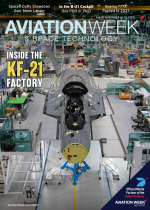
South Korea Breaks Cover On KF-21 Production
Steve TrimbleNovember 03, 2025
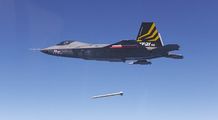
The fourth KF-21 prototype, still showing the original design for the inboard tail boom, is among six development test aircraft that have completed nearly 1,500 flights collectively through late October.
Credit: KAI
A single-seat KF-21 Boramae, engine shrieking, inched forward out of the Korea Aerospace Industries’ flight-line hangar on a late October afternoon. A spin-recovery system sat high on top of the airframe between the fighter’s canted tails, suggesting that sortie’s test card would be full of induced stalls and other departures from controlled flight.
A second single-seater quickly emerged from the hangar onto the flight line, but with no spin chute assembly on the tail. Its sortie would be focused on validating an undisclosed performance metric somewhere within the required capabilities of the exclusive air-to-air mission for the initial version of the KF-21 for the Republic of Korea Air Force (ROKAF).
Meanwhile, a third KF-21 prototype sat motionless in the hangar next door. A team of Korea Aerospace Industries (KAI) engineers surrounded the aircraft, performing early system checks on the software for the Boramae’s promised air-to-ground capabilities, which remain in development.
This vignette from an exclusive tour of KAI’s flight line in Sacheon, South Korea, came within two months of the 10th anniversary of the contract award that launched the KF-21 development program.
A decade after kicking off the engineering and manufacturing development (EMD) phase, South Korea’s homegrown combat aircraft program can make a rare boast. The 11-year EMD phase continues right on schedule, having weathered industrywide supply chain disruptions after the COVID-19 pandemic, a fraction of the promised financial support from co-development partner Indonesia and recent uncertainty about the future of the company’s leadership.
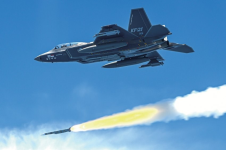
The original completion date for the initial version of the KF-21, which comes armed with MBDA Meteor and Diehl IRIS-T air-to-air missiles, is still on track for mid-2026. A three-year gauntlet of flight tests is scheduled to wrap up by the end of this year, a program that dates back to the first flight on July 19, 2022. About 200 more sorties by the KF-21 prototypes remain scheduled, flights that will validate the operational readiness of the air-to-air configuration, KAI officials say.
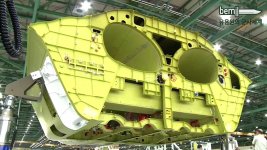
Meanwhile, the first eight production models of the KF-21 are lined up on KAI’s cavernous final assembly line, including the first seven two-seat versions of the Boramae.
Three years after flight testing began, only one design change is observable between the six flight-test prototypes and the first eight KF-21 production models now in various stages of final assembly.
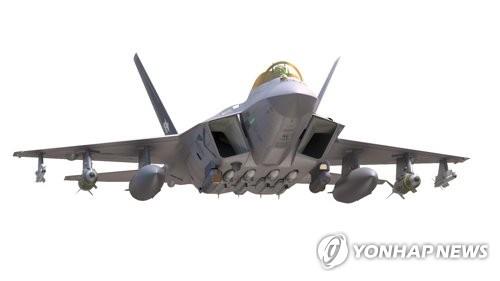
The sharp, angular sides of the inboard tail booms on either side of the two GE Aerospace F414 engine nozzles are now flattened. The tweak corrects a minor vibration detected by test pilots operating the prototype aircraft in certain areas of the flight envelope. Otherwise, the design of South Korea’s first twin-engine fighter, which KAI finalized with its critical design review on Sept. 24, 2019, remains unchanged.
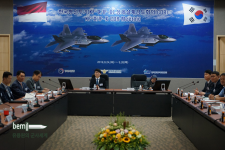
Ilwoo Lee, the KF-21’s chief designer, offers a quick answer when asked to comment on the program’s scheduling success in an industry known for costly setbacks and delays during development.
KAI used “only proven technology” in the KF-21 design, said Lee, who retired in late 2021 but returned to KAI shortly afterward as a senior advisor.
That simple response covers a multitude of discrete decisions since 2015, in which South Korean military and industry officials sacrificed desired capabilities due to pragmatic realities.
Knowing that South Korea’s stealth technology was not yet mature, the program’s decision-makers—including KAI executives, Defense Acquisition Program Administration (DAPA) officials and ROKAF leaders—lowered the threshold requirement to a reduced-observable signature from low-observable and very-low-observable.
When the U.S. government delayed export approval for Raytheon AIM-120 Amraam and AIM-9X Sidewinder air-to-air missiles, the KF-21 program switched to European-made alternatives. The swift pivot to new sources of armaments for ROKAF was possible only because of a close collaborative relationship forged between KAI and DAPA, Lee said.
The KF-21 also built on South Korea’s hard-won experience as a combat aircraft developer. The government launched the KF-21 program in 2015 on the heels of the F/A-50 light attack fighter’s service entry. The F/A-50 itself is derived from the T-50 Golden Eagle advanced jet trainer, which celebrated the 20th anniversary of its service entry on Oct. 19. KAI has delivered 240 aircraft combined, with 72 orders still in backlog and several international sales campaigns ongoing.
KAI also received crucial technical support on the KF-21 program from Lockheed Martin. The U.S. manufacturer faced the prospect of helping KAI launch a direct competitor to the F-16, which remains in production, but South Korea had mandated a Lockheed role in KF-21 development as part of a 2014 acquisition of 40 F-35As. Still, Lockheed limited its participation in the Boramae program. After leading the design of the T-50 in collaboration with KAI in the 1990s, Lockheed owns no design rights to the KF-21, but the company did offer KAI’s engineers guidance through development and testing.
South Korea also faced other new technology challenges with the KF-21 program. The U.S. government denied a request from Seoul in 2015 to transfer four key technologies, forcing KAI to seek indigenous alternatives to U.S.-made active, electronically scanned array (AESA) radars; infrared search and track systems; electro-optical targeting systems; and self-protection jammers. South Korea’s defense supply chain stepped in to fill the gap. Hanwha Aerospace, South Korea’s largest defense company, created a family of AESA-based fire control radars featuring gallium-nitride components. LIG Nex1, a maker of missiles, avionics and sensors, produced a jammer for the KF-21.
That entire package has come together on the production aircraft in final assembly, but it is only a first step.
The completion of the EMD phase ushers the KF-21 program into the follow-on development stage. KAI engineers now turn their focus to certifying new air-to-ground capabilities, which include new munitions, sensor fusion modes and, possibly, the introduction of a new class of Korean-made collaborative combat aircraft (CCA).
South Korea’s defense industry put the upgrade options on full display Oct. 20-24 during the Seoul International Aerospace and Defense Industry Exhibition 2025.
LIG Nex1 and Hanwha unveiled concepts for six new missiles for future KF-21 fighters, building on the previously approved homegrown Korean Air-Launched Cruise Missile that is slated to enter development in 2028.
- The hypersonic air-to-ground missile (HAGM), with its prototype produced by Hanwha, is a derivative of Hanwha’s existing ground-launched Korean tactical surface-to-surface missile. Hanwha confirmed to Aviation Week that the HAGM’s specifications remain classified.
- The supersonic air-to-surface missile (SASM) flies at Mach 2.5 or higher using ducted rocket propulsion. The SASM is equipped with an inertial navigation system, GPS, a radar and an infrared seeker, and it boasts a range exceeding 300 km (186 mi.).
- The short-range air-to-air missile, led by the Agency for Defense Development with LIG Nex1 performing system integration, is similar in length and weight to the Diehl IRIS-T but features a different canard design.
- The long-range air-to-air missile is scheduled for completion by 2033, with LIG Nex1 handling system integration. It has ducted rockets similar to the MBDA Meteor missile but features two additional wings near the air intakes.
- Unlike the state-led programs, the 250-lb. Modular Smart Missile and the 1,000-lb. Multi-Purpose Cruise Missile are to be developed by LIG Nex1 by 2030 using internal funding.
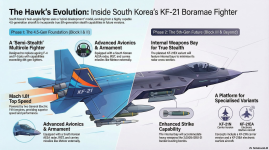
Meanwhile, the outlook remains uncertain for a stealth technology makeover of the KF-21. KAI’s original concept called for a “Block 3” configuration, featuring an internal weapon bay, stealth enhancements and upgraded sensors and onboard computer processors, with a notional fielding timeline in the late 2030s or early 2040s.
South Korean President Lee Jae Myung, who took office on June 4, promised during his campaign to support the stealthy KF-21 upgrade program. So far, no action has been taken, and the abrupt governmental transition—triggered by the removal of former President Yoon Suk Yeol following his declaration of martial law last December—has put KAI in an awkward position. Former KAI CEO Kang Goo-young, a Yeol appointee, resigned on the same day that Jae Myung took office. The company, which is treated as a publicly owned enterprise by the state, still awaits the appointment of a new CEO, which has created a six-month leadership vacuum at a critical time.
—With Minseok Kim in Seoul

Steve Trimble
Steve covers military aviation, missiles and space for the Aviation Week Network, based in Washington, DC.
South Korea Breaks Cover On KF-21 Production | Aviation Week
A decade in the making, Korea Aerospace Industries is preparing to deliver the first production versions of the KF-21 Boramae on time by the end of this year.
 aviationweek.com


.jpg)