Navigation
Install the app
How to install the app on iOS
Follow along with the video below to see how to install our site as a web app on your home screen.
Note: This feature may not be available in some browsers.
More options
Style variation
You are using an out of date browser. It may not display this or other websites correctly.
You should upgrade or use an alternative browser.
You should upgrade or use an alternative browser.
IFX Indonesian Fighter Experiment (KF21/IFX program)
- Thread starter Indos
- Start date
More options
Who Replied?

Indos
INT'L MOD
- Thread starter
- #257
Malaysia as the potential buyer of KF21 set their MRCA acquisition in 2035 where KF21 is expected to be pretty matured and has been upgraded into 5 generation version (block 3).
While the sales of KF21 in South East Asia will also likely be supported with MRO facility in Indonesian Aerospace
Indonesian variant (IF21) could be marketed for countries needed longer range and short runway operation

 thedefensepost.com
---------------------------
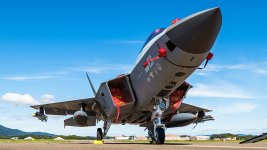

 m.news.nate.com
While the sales of KF21 in South East Asia will also likely be supported with MRO facility in Indonesian Aerospace
Indonesian variant (IF21) could be marketed for countries needed longer range and short runway operation


South Korea to Upgrade Indigenous KF-21 Into Stealth Fighter
South Korea has announced a phased plan to future-proof its KF-21 Boramae fighter jet, including the integration of stealth-like features.
thedefensepost.com
---------------------------
Refined Executive Summary – KF-21 Prototype No. 5 and Indonesia
- Delivery Plan: South Korea’s KF-21 prototype No. 5 is slated for delivery to Indonesia’s PTDI in 2026, where it will be converted into the IF-21 prototype for airworthiness certification.
- Beyond License Production: Unlike simple license manufacturing, PTDI is expected to co-develop the IF-21 variant, meaning Indonesia plays a role in adapting, certifying, and potentially evolving the KF-21 design — not just assembling jets.
- Cost Sharing & Disputes: Indonesia committed ₩1.6 trillion (20% of development) but has paid only ₩400 billion, leading Korea to forgive ₩1 trillion. This has raised doubts about how much real development work can be sustained.
- Strategic Motives: For Indonesia, co-development of IF-21 secures long-term fighter design know-how and guarantees aerospace workloads at PTDI, while for Korea, Indonesia provides economies of scale (48 aircraft) and a Southeast Asian MRO hub.
- Geopolitical Context: Turkey’s Kaan, France’s Rafale, and China’s J-10 offer limited or no development involvement. The KF-21/IF-21 program remains Indonesia’s only realistic path to gain indigenous fighter development experience.
[오동룡의 밀리터리 인사이드] [단독] KF-21 시제 5호기, 인도네시아 보낸다 : 네이트 뉴스
한눈에 보는 오늘 : 홈 - 뉴스 : [서울=뉴스핌] 오동룡 군사방산전문기자= 국산 전투기 KF-21 보라매 시제 5호기가 내년 인도네시아에 인도된다는 소식이 인도네시아 현지에서 흘러나왔다. 최근 인도네시아 군사저널리스트 알만 헬바스 알리(Alman Helvas Ali)는 X(트위터)를
Indos
INT'L MOD
- Thread starter
- #258
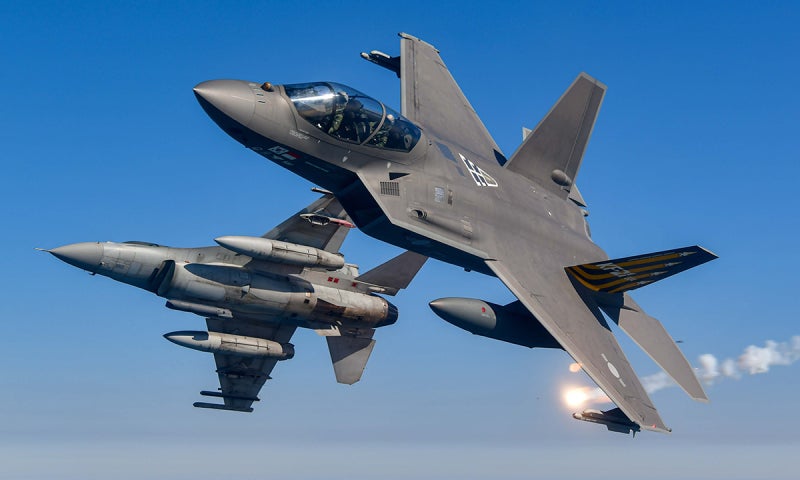
KF-21, the ‘F-35 Lookalike,’ Now Aims for Full Stealth [Park Suchan’s Military Column]
입력2025.09.07. 오전 9:02
Segye Ilbo | Naver – 4–6 minutes
President Lee Jae-myung’s campaign pledge to develop a follow-up next-generation fighter jet and aircraft engine to the KF-21 is now moving forward in earnest.
According to the government’s recently released 2026 defense budget draft, investment in future innovative technologies is being expanded to build the foundation for developing a fifth-generation fighter.
The budget for KF-21 development and production has been increased from 1.3 trillion won to 2.4 trillion won, and new projects for missile and engine development to be used in the KF-21 have been added.
For the first time, 8.6 billion won has been allocated in next year’s defense budget for advanced aircraft engine development. Meanwhile, 63 billion won will be invested in stealth-related technologies such as structures, materials, and sensors as part of the Future Challenge Defense Technology program.
If the government’s plans become reality, the KF-21 will undergo performance upgrades and evolve into a fifth-generation stealth fighter, like the F-35, with internal weapons bays.
Development of an indigenous long-range air-to-air missile for the KF-21 has also been allocated 5.4 billion won in next year’s budget. In addition, 178.8 billion won has been set aside for runway construction at the Air Force’s 18th Fighter Wing in Gangneung and 16th Fighter Wing in Yecheon to support KF-21 operations.
Together with mass production, the KF-21 program prepares both the present and future of South Korea’s air power and aviation industry.
Potential Emergence of a Stealth-Upgraded KF-21
Currently, Block I development and production of the KF-21, focused on air-to-air armaments, is underway. Despite political turbulence such as the December 12 coup anniversary and impeachment fallout, work to bring Block I into service has continued.
In February, the second aerial refueling flight test was completed, and in March, integration and operational testing of KF-21 support systems began.
Operational evaluations of the Active Electronically Scanned Array (AESA) radar’s integrated logistics support system—essentially the KF-21’s “eyes”—were conducted from March through June.
KAI (Korea Aerospace Industries), the KF-21’s developer, and the Defense Acquisition Program Administration plan to complete Block I development by the second half of next year, followed by additional weapons tests through 2028 to quickly acquire air-to-ground capabilities for Block II.
The subsequent Block III variant will undergo major performance upgrades, with reinforced stealth to minimize radar detection.
Toward a Fully Stealth KF-21 Block III
The KF-21, though initially limited in stealth, was designed in the early 2010s with potential for stealth development in mind.
KAI has leveraged this potential, introducing conceptual designs and required technologies for a fully stealth-capable KF-21 Block III at seminars since 2023.
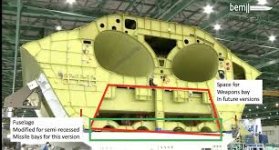
Block III will feature internal storage for weapons and sensors, like the F-35, greatly reducing radar signature. An internal weapons bay beneath the fuselage will carry four Meteor long-range air-to-air missiles or precision-guided bombs, requiring removal of semi-recessed pylons and rearrangement of internal wiring.
Electronic warfare sensors will also be internalized. The infrared search and track (IRST) system and electro-optical targeting pod (EO TGP) will be replaced by an F-35-style embedded Electro-Optical Targeting System (EOTS).
Block III is also expected to incorporate manned-unmanned teaming, allowing the KF-21 to control swarms of drones. High-speed, high-capacity datalinks will enable drones to relay battlefield data and conduct high-risk missions, increasing pilot survivability.
In offensive missions, the options multiply: with precision-guided bombs in the KF-21’s internal bay and drones carrying long-range missiles, the system can simultaneously carry out both air-to-air and air-to-ground missions in a single operation.
Engine and Missile Development—Opportunities and Risks
Reliance on foreign suppliers for fighter engines leads to price, export, and technological limitations. This is why both the Moon and Yoon administrations have emphasized the need to develop indigenous engines for fighters and drones.
In December, the Ministry of Trade, Industry, and Energy designated advanced aircraft engine materials and components as national strategic technologies.
The advanced engine project aims to develop a 16,000 lbf turbofan suitable for next-generation fighters, while also building mid-to-large drone engines. By gradually scaling thrust and building testing experience, South Korea seeks to eventually replace the GE F414 engine currently used in the KF-21 with an equivalent domestic engine.
Hanwha Aerospace and Doosan Enerbility are leading the effort. A 5,500 lbf turbofan for medium drones has been under development since 2019, with prototype assembly to begin later this year and completion targeted for 2027. A 10,000 lbf engine for large stealth drones began development this year after a feasibility study was completed in 2023.
Meanwhile, development of long-range air-to-air missiles—“the spear” of the KF-21—is also progressing, with 753.5 billion won allocated through 2033.
The KF-21 will carry four European MBDA Meteor missiles, which fly at Mach 4.5 and can intercept targets 200 km away. The Meteor’s advanced ducted-ramjet engine maintains thrust until fuel runs out, providing longer range and better terminal acceleration than U.S. AMRAAM missiles.
South Korea’s indigenous missile is expected to adopt similar concepts, with enhanced target detection and faster, more precise datalinks.
Challenges and Global Context
While stealth technology, engines, and missiles are vital for defense capability, there are concerns about costs and risks.
The Meteor took 25 years to develop, even with European nations pooling expertise. Fighter-grade turbofan development is also highly challenging, mastered only by a handful of nations such as the U.S., Russia, China, the U.K., and France. It requires advanced materials capable of withstanding extreme heat and pressure.
Turkey, which is developing the KAAN fifth-generation fighter, has decades of experience in designing drone and fighter engines since 1985. Still, it had to seek technical assistance from Rolls-Royce for the KAAN’s high-thrust engines.
If South Korea pursues advanced engine development independently, inevitable trial and error will mean increased time and costs. Experts suggest that to reduce risks and optimize resources, the government should secure foreign partners for technology cooperation in missiles, engines, and stealth.
Some argue that Korea must also actively engage with aerospace and defense development programs in the U.S. and Europe, making government policy direction a subject of keen interest.
‘F-35 닮은’ KF-21, 이젠 완전 스텔스로 간다 [박수찬의 軍]
이재명 대통령이 대선 시절 공약했던 KF-21 후속 차세대 전투기와 항공기 엔진 개발이 본격화하고 있다. 정부가 공개한 2026년도 국방예산안에 따르면, 5세대 전투기 개발 기반환경 구축을 위한 미래혁신형 기술 투자
 n.news.naver.com
Indos
INT'L MOD
- Thread starter
- #259
Here’s a 1-paragraph executive brief:
South Korea is accelerating its KF-21 fighter jet program with expanded funding to transform it into a fully stealth, fifth-generation aircraft. The roadmap moves from the current Block I to Block III, which will feature internal weapons bays, advanced sensors, and manned-unmanned teaming. Alongside, Seoul is investing in indigenous long-range missiles and turbofan engines to reduce reliance on foreign suppliers. While these projects strengthen air power and the defense industry, experts warn of high costs, technical risks, and the need for international cooperation to meet ambitious goals.
n.news.naver.com
South Korea is accelerating its KF-21 fighter jet program with expanded funding to transform it into a fully stealth, fifth-generation aircraft. The roadmap moves from the current Block I to Block III, which will feature internal weapons bays, advanced sensors, and manned-unmanned teaming. Alongside, Seoul is investing in indigenous long-range missiles and turbofan engines to reduce reliance on foreign suppliers. While these projects strengthen air power and the defense industry, experts warn of high costs, technical risks, and the need for international cooperation to meet ambitious goals.
‘F-35 닮은’ KF-21, 이젠 완전 스텔스로 간다 [박수찬의 軍]
이재명 대통령이 대선 시절 공약했던 KF-21 후속 차세대 전투기와 항공기 엔진 개발이 본격화하고 있다. 정부가 공개한 2026년도 국방예산안에 따르면, 5세대 전투기 개발 기반환경 구축을 위한 미래혁신형 기술 투자
n.news.naver.com
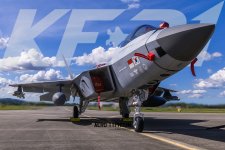
Indos
INT'L MOD
- Thread starter
- #261
Yudi Supriono post (aerospace writer, Indonesian)
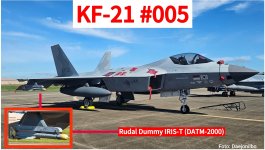
Last year, the KF-21 successfully fired an AIM-2000 IRIS-T missile at a target drone.
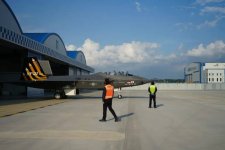
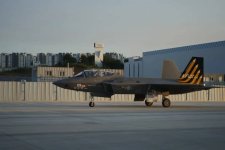
In the photo, prototype KF-21 No. 5 (for Indonesia) is shown carrying a DATM-2000 IRIS-T dummy missile.
---------------
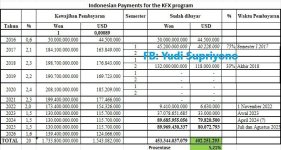
Until 2025, Indonesia has paid 5.2 % of total KF21 development, next year it is expected it will be completed into 7 % of total KF21 development.
Indonesia cost share is reduced into 7 % from 20 % of total development cost.
Indonesia is also expected to keep funding IF21 development every year around 81-100 Million USD for local IF21 varian development in Indonesian Aerospace. I think Indonesia and Korea will likely keep developing the fighter together until 6th generation
Last year, the KF-21 successfully fired an AIM-2000 IRIS-T missile at a target drone.
In the photo, prototype KF-21 No. 5 (for Indonesia) is shown carrying a DATM-2000 IRIS-T dummy missile.
---------------
Until 2025, Indonesia has paid 5.2 % of total KF21 development, next year it is expected it will be completed into 7 % of total KF21 development.
Indonesia cost share is reduced into 7 % from 20 % of total development cost.
Indonesia is also expected to keep funding IF21 development every year around 81-100 Million USD for local IF21 varian development in Indonesian Aerospace. I think Indonesia and Korea will likely keep developing the fighter together until 6th generation
Indos
INT'L MOD
- Thread starter
- #262
Indonesia is also expected to keep funding IF21 development every year around 81-100 Million USD for local IF21 varian development in Indonesian Aerospace. I think Indonesia and Korea will likely keep developing the fighter together until 6th generation
Korean Aerospace CEO Interview before June 2025 where both Indonesia and Korea boosted its cooperation in KF21/IFX program with contract amandement where one of the result is to reduce Indonesia stake from 20 % into 7 %
----------------------
Before the start of mass production of the KF-21, KAI was plagued by allegations of leaking secrets from researchers in Indonesia, the country that co-developed the KF-21.
"I should have managed those researchers better, but I apologize to the government and the people for the gaps. First of all, we checked at our level and there were no major problems. It was a collection of information that we provided at meetings and other meetings. The investigation is ongoing, so it is impossible to say what the outcome will be. However, as Indonesia is an important strategic partner for us, it is a burden for it to turn into a diplomatic issue. Indonesia purchased the KT-1 in 2001 and was the first exporter of the Korean aircraft. Later, the T-50 was also purchased. The development of the KF-21 could have been stalled if Indonesia had not participated. Indonesia has made a significant contribution to the development of Korea's aerospace industry. If Indonesia buys South Korean weapons, the impact will affect the entire Southeast Asian country. I hope that we can take these things into consideration and come to a victorious conclusion."
― Indonesia said it would not pay 1 trillion won out of the 1.6 trillion won allocated for the development of the KF-21, leaving the government and KAI to bear the shortfall of 1 trillion won.
"In the process of developing the KF-21, efforts were made to reduce costs. If R&D proceeds smoothly as it is now, it is expected that the cost will be reduced by 500 billion ~ 600 billion won. Still, it's a very heavy amount, but we have no choice but to go in the direction of sharing it between the government and KAI."
― Many point out that instead of Indonesia, which has repeatedly caused the problem of non-payment of development costs, joint development should be carried out with countries with strong financial capabilities, such as the Middle East.
"The development of the first phase (of air-to-air armament) is almost complete. The second stage is to add armaments such as air-to-ground, so development is relatively simple and development costs are not high. Involving other countries in the development of the second phase raises very complex issues, such as the exposure of the technology in the first phase. From the third stage of development, it is planned to go to a manned and unmanned complex system, which will cost a lot of money. From the third stage, I think it would be good to develop it with countries that are rich in both money and technology."

“KF-21은 AI기술 등 집약… 동남아 넘어 유럽도 관심”
“KF-21을 4.5세대 전투기라고 하는데, 과소평가라고 생각합니다. 4.5세대 프랑스 라팔, 유럽 유로파이터 타이푼 등과 비교하면 성능이 뛰어나거든요. 그래서 저는 5세대(완전한 스텔스 기능을 갖춘 전투기)에 가까운 4.9세대 전투기라고 부릅니다. 게다가 가격까지 …
www.donga.com
Indos
INT'L MOD
- Thread starter
- #264
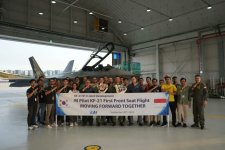
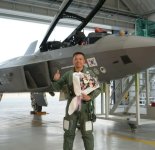
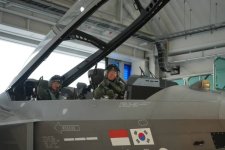
KF-21 First Front-Seat Test Flight for Indonesian Pilot Colonel Pnb Mohammad Sugiyanto
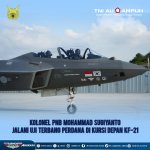
The defense cooperation between Indonesia and South Korea has once again reached an important milestone. Air Force Colonel Pnb Mohammad Sugiyanto, an Indonesian Air Force test pilot with the callsign "Mammoth," successfully completed his first test flight as the front seater on the prototype of the 4.5 generation fighter jet, the KF-21 Boramae, on Tuesday, September 30, 2025, in Sacheon, South Korea.
During the one-hour mission, Mammoth conducted performance and Stability & Control testing at altitudes between 10,000 and 20,000 feet, accompanied by Korea Aerospace Industries (KAI) test pilot, Koh Hwi Seok.
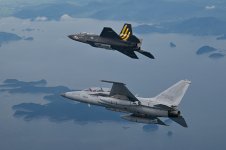
Previously, on May 16, 2023, Colonel Pnb Sugiyanto made history as the first foreign pilot to fly in the back seat of the KF-21. Now, his success in occupying the front seat further affirms Indonesia's active role in the joint fighter jet development program.
The involvement of Indonesian Air Force pilots in the test flight phase is part of the implementation of the Indonesia-South Korea cooperation in the KF-21/IF-X project. Additionally, this activity also includes efforts for technology transfer and improving the quality of human resources in the defense sector.
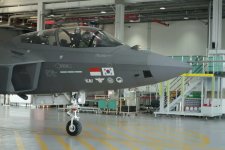
The success of the future fighter jet program for both countries is expected to strengthen defense technology self-reliance (or independence), while also enhancing professionalism in building a powerful Indonesian Air Force (TNI AU), characterized as AMPUH (Adaptable, Modern, Professional, Superior, and Humanist).
Indonesian Airforce statement
Kolonel Pnb Mohammad Sugiyanto Jalani Uji Terbang Perdana di Kursi Depan KF-21
Berita Tentara Nasional Indonesia
 tni-au.mil.id

wanglaokan
Registered Member

what's the purpose of a 'stealthy' fighter without weapon bay?
wanglaokan
Registered Member
Indonesia airforce is going for both KF21 and KAAN?There is weapon bay, it will be upgraded later (block3), please check previous pages
Those who design it is Phd, they know what should be done
Indos
INT'L MOD
- Thread starter
- #268
Indonesia airforce is going for both KF21 and KAAN?
Kaan is something that is still in question. I would say for future it is likely only Rafale and KF21 (Kaan has engine problem, lot of opposition inside Indonesia as well regarding Kaan acquisition since the plane is still very premature). Indonesian contract is with Turkish engine, not with F110 or others.
We also previously made contract for Su35 but never become effective contract (money is not given)

That_Guy
THINK TANK: CONSULTANT


Its just the initial block.what's the purpose of a 'stealthy' fighter without weapon bay?
The next block is likely to have full weapons bays.
This was done to quicken the induction of the fighter to replace Korea's old fighter fleet.
Besides, it's RCS is extremely small, even with its partially hidden bays.
Users who are viewing this thread
Total: 1 (members: 0, guests: 1)
Pakistan Defence Latest


Country Watch Latest


Latest Posts
-

-
 Mohammad Rizwan vs PCB: Why Was He Left Alone? | Court, ICC & NCCIA (15 Viewers)
- Latest: Mighty_Dragon_Strike
-

-
-
