Images - Pakistan Air Force in the Mirror of History.

1790950620272.png

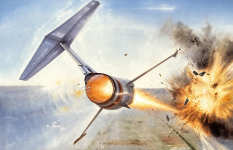
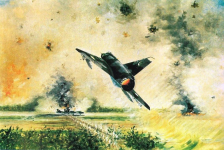
An F-104, Starfighter flown by Flight Lieutenant Amjad Hussain killed an enemy fighter near Sargodha.

Low Level Death
By: Usman Shabbir & Yawar Ahsan Mazhar

The first IAF air strikes on PAF bases took place on the morning of September 7, 1965.

It was at 05:30 hrs that the first IAF strike on PAF’s Sargodha airbase was detected when the formation of 6 IAF Mysteres was already pulling-up to attack the airfield. An F-104A flown by Flt Lt Amjad Hussain Khan was vectored by ground control to intercept the raid. According to Flt Lt Amjad he got behind two Mysteres which were exiting on a heading of 120 degrees at about 100 ft AGL.

He fired an AIM-9B at one of the Mysteres which hit the ground after leaving the launcher. Closing in he fired at the Mystere with his gun and saw hits on the aircraft. The second Mystere meanwhile broke into the Starfighter forcing Amjad to make a high speed yo-yo and attack again.

The Mystere turned into him again forcing another yo-yo with afterburners engaged. The Starfighter climbed to 13-15,000 feet and then dived to make another attack on the Mystere.

This time the Mystere pilot did not see the F-104, with the Starfighter diving and closing in at 540 knots and opening canon fire at a range of 3000 ft. The Mystere exploded when the range was 1000-1500 ft and before the Starfighter could pull up to clear the explosion, it flew through the resulting debris. The F-104’s controls froze and aircraft stopped responding, going into a left bank.

At this point about 75-100 ft AGL (Above Ground Level) Flt Lt Amjad Hussain ejected from the aircraft and landed near a village receiving a hero’s welcome from the villagers and made back to Sargodha airbase by a bicycle, a horse and a helicopter!!!

The British writer John Fricker in his book “The Battle for Pakistan: The 1965 air war” assigned this loss to Devayya actually shooting down the F-104. However no evidence was offered to substantiate this claim and Fricker also failed to explain how Sqn Ldr Devayya himself was shot down and killed. Later research showed that the site of both aircraft crashing was nearby which supports the likelihood of a mid-air collision or debris of the Mystere striking the F-104 (see Kaiser Tufail’s Great Air Battles of the Pakistan Air Force).

© Painting Gp Capt S M A Hussaini
 
1790967471334.png

Pakistan’s Delta Force "Mirage At War".

The article is by Usman Shabbir and Yawar Ahsan Mazhar and relates how Pakistan’s French-built Dassault Mirage delta jet fighters made their mark in the 1971 Indo-Pakistan War.

IN THE SIX years between 1965 and 1971, the Pakistan Air Force (PAF) had absorbed — at the cost of significant combat capacity — five years of the USA’s arms embargo that had been imposed on Pakistan at the start of the 1965 Indo-Pakistan War.

During this time the PAF had made efforts to replace a diminishing number of Martin B-57s and North American F-86s with Shenyang F-6s (Chinese-built MiG-19s), supplemented by ex-Luftwaffe Canadair Sabre Mk 6s received via Iran, but the combat force was facing obsolescence, with spares for the Sabres and B-57s in short supply.

As the ratio of combat aircraft between the Indian Air Force (IAF) and the PAF worsened, and with no possibility of acquiring military equipment from the USA, Pakistan evaluated various European options for its needs.

The need for speed:

The PAF Air Staff Requirement called for a multi-role strike aircraft that could replace the ageing F-86s and B-57s, but which would also have low-level night/all-weather interception capabilities. France’s Dassault Mirage III did not fully meet the requirement, but was selected as the best available aircraft. Under a project codenamed Blue Flash One, 18 single-seat Mirage IIIEPs were ordered in 1968 along with three two-seat Mirage IIIDPs and three single-seat photo-reconnaissance Mirage IIIRPs.

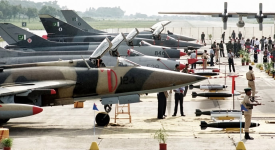
All 24 Mirages were delivered before the beginning of the 1971 conflict to a single unit, No 5 Sqn, based at Sargodha in West Pakistan. The first batch of six (67-101 to 67-106) was ferried to Pakistan in early March 1968, the last example arriving in early 1970. Once in Pakistan, regular dissimilar air combat training exercises were undertaken and new tactics were developed.

Preparing for war:

On December 3, 1971, the PAF began day and night strikes against Indian airfields and radar stations. The PAF’s overriding priority was to give maximum support to the Pakistan Army’s proposed land offensive into India from West Pakistan, aimed at stopping Indian aggression against East Pakistan by capturing strategically important Indian territory in the west, thus forcing a political settlement. Pakistan’s limited resources meant it was unwilling to sustain major offensives in both East and West Pakistan separated as they were by thousands of miles of hostile Indian territory.

The air staff considered that the success or failure of the PAF’s support would in all likelihood determine the fate of Pakistan’s crucial offensive. When the planning staff calculated the estimated cost of fulfilling this commitment in July 1971, it worked out at a loss of 100–120 combat aircraft and pilots over the projected seven- to ten-day period. This would amount to losing one third of the air force, but units were nevertheless directed in August to prepare for war.

Until the Army’s offensive was launched, the PAF was to maintain offensive pressure on the IAF with sustained strikes against forward and rear bases. The PAF had undertaken crippling strikes on Indian airfields in the 1965 war, destroying a considerable number of IAF aircraft on the ground. But the IAF had learned its lesson and upgraded its air bases with shelters, dispersals, camouflage and air defences.

During the same period, the PAF was also to provide whatever air support was needed for the Army’s “holding” actions along the entire 2,300-mile border from Kashmir to Kutch. These relatively shallow penetrations were to tie down as many of the enemy’s resources as possible and achieve a favourable tactical position in the process.

Source: Aeroplane Magazine, June 2009.

© Painting Gp Capt S M A Hus
 
The first day:

At 1630hr on December 3, a state of war was formally declared between Pakistan and India. Just 21 min later, the first PAF strike formations were taking off for their targets.

The assault against IAF airfields and radar stations was to involve Sabres, Lockheed F-104s and Mirages striking their targets between 1709hr and 1723hr. Two four-Mirage formations, led by Wg Cdr Hakimullah and Sqn Ldr Aftab Alam Khan were tasked with cratering the airfields at Amritsar and Pathankot respectively.

Hakimullah recalls the mission: “I went to a forward radar unit in the afternoon of December 2. I had gone there to observe the pattern of the IAF’s dawn and dusk airfield CAPs (combat air patrols) and evolve tactics and procedures of disrupting them. At about 1200hr the next day my base commander called me and asked me to return to the base immediately. I drove back and was with the base commander by about 1500hr. He handed me the orders for dusk strikes against Amritsar and Pathankot.

“Returning to the squadron, I detailed the two strike missions and asked the boys to update the maps and logs and prepare the aircraft in appropriate configuration [two 1,000lb bombs and two drop tanks]. I led the mission to Amritsar. The ingress to the target was as low as 100ft AGL [above ground level] at 480kt. We had planned a dive-bombing attack using the north-south axis. The pull-up for the attack was at 540kt, two miles north of the airfield, to about 6,000ft.”

The formation returned safely to Sargodha. Initial damage based on radio monitoring showed that the airfield was inoperative for that night and the next day.

The PAF prepared for two types of intercepts in which Mirages would play a role. The first was the interception of high-altitude IAF English Electric Canberra reconnaissance sorties, and the second was the interception of IAF Canberra night strikes.

For the first role PAF Mirages practised “zoom” tactics with radar-guided Matra R.530 missiles. Night interceptions, however, posed a bigger problem. A lack of comprehensive low-level radar coverage was compounded by mountainous topography, and existing airborne radar technology was inadequate for detecting low-level targets. Furthermore, IAF Canberras would be warned of an approaching interceptor by GCI/ELINT assets and their own tail warning radar.

These problems notwithstanding, the Mirages did achieve one success against night intruders on the night of December 4, when Flt Lt Naeem Atta used an AIM-9B Sidewinder to shoot down an IAF Canberra B(I).58 bomber on its ingress route to attack Sargodha. The Canberra crew, Flt Lt L.M. Sasoon and his navigator, Flt Lt R.M. Advani, were killed.

Hunting the Hunters:

The second aerial victory for the PAF Mirages shared by two pilots — came on December 5. At the start of the war a detachment of four Mirage IIIEPs and their pilots had moved to Mianwali air base with the aim of protecting the airfield and air defence radar located at Sakesar. On the morning of December 5 Sakesar detected an incoming raid, and a pair of Mirages was scrambled to intercept.

The pair detected two Hawker Hunters as they were diving to attack the radar. With the sky full of “friendly” anti-aircraft artillery (AAA), the Mirage pair did not follow the Hunters into the dive, setting up an orbit overhead before losing the Hunters when pulling up in poor visibility. After returning to the crew room the pilots were chided by Flt Lt Safdar Mehmood for not diving after the Hunters through the AAA. Little did Mehmood know that, a few hours later, he would be facing the same predicament.

With the Sakesar station warning of an incoming raid, another Mirage pair was ordered to scramble, this time led by Mehmood with Fg Off Suhail Hameed as his wingman.
 
Again the attacking Hunters were detected when they were diving in for their attack on the radar site, among intense AAA.
Mehmood instructed his wingman to stay on his tail, and dived through the AAA after the Hunters. Seeing the Mirages above and behind them the Hunters dropped to very low level, split and fled in an easterly direction.

Instead of splitting and following both Hunters, Mehmood decided to lead his inexperienced wingman against a single Hunter. With their superior speed, the Mirages soon closed and Mehmood fired his guns twice at close range, hitting the Hunter’s port wing. The wingman also acquired a lock on the Hunter and fired a Sidewinder. The pilot of Hunter A1014, Sqn Ldr Jal M. Mistry from 20 Sqn, was unable to eject.

Mirage versus Fitter:

The third PAF Mirage kill came on December 6, when Flt Lt Salimuddin, who had joined 5 Sqn at Sargodha only two days previously, shot down a Soviet-built Sukhoi Su-7 Fitter.
Taking off from Sargodha at noon on December 6, Salimuddin, in Mirage IIIEP 67-102, and his wingman Flt Lt Riazuddin Sheikh, were vectored towards aircraft attacking Pakistani troops south-east of Lahore.

While proceeding towards Lahore the pair was informed by ground-based radar that the enemy aircraft had turned tail and fled to their bases. They were now asked to set up a CAP inside Pakistani territory, awaiting new vectors. They did not have to wait long — four new contacts were attacking Pakistani ground targets in the Shakargarh sector.

Flying at combat speed and at 5,000ft, the Mirages were soon on top of the four Su-7s.
Closing in further, Salimuddin’s wingman attained a better tactical position and called for an attack. Salimuddin followed him after checking his tail. On seeing the Mirages the enemy aircraft broke off their attack, jettisoned their payloads and headed east for Indian territory, flying in two separate formations at low level and maximum speed. The Mirages began chasing one of the Su-7 formations, both ending up behind a single Su-7.

Salimuddin’s aircraft was carrying two fuel tanks, two Sidewinders and a single Matra R.530 air-to-air missile. To improve manoeuvrability Salimuddin fired the R.530, watching it dip and hit the ground. Acquiring a Sidewinder tone, Salimuddin pressed the trigger. For a moment nothing happened and, fearing a misfire, he immediately fired his second Sidewinder. He saw both missiles streak away towards the Su-7, then broke away for a gun pass on another Fitter, to starboard and ahead of the first Su-7.

As Salimuddin’s wingman told him that his missiles had contacted the first Su-7, he closed on the leader, by then flying at more than 600kt. He fired his guns but the Fitter was well out of range. The wingman gave a low-fuel call and the pair returned to Sargodha with almost empty tanks.

Sukhoi Su-7BMK Fitter-A B868 was the aircraft shot down by Flt Lt Salimuddin on December 6, 1971. The first Indian Fitters were delivered during 1968–69, India paying full price for each one, resisting Soviet offers of cheap aircraft in exchange for political influence.

Recce Mirages:

By 1971, strengthened IAF air defences meant that the PAF could not rely on its Lockheed RT-33s for reconnaissance missions over strongly defended areas. Enter the PAF’s three Mirage IIIRPs.

A month before the official start of the war a single Mirage IIIRP, piloted by Sqn Ldr Farooq Umar, penetrated Indian airspace near the IAF’s Pathankot airfield to gather intelligence on Indian armour dispositions between Katwa and Jammu. The intelligence gathered from this mission had large gaps in the coverage, however, owing to the aircraft banking to follow the terrain. A repeat mission was flown, the pilot using left and right rudder instead of banking, this time with successful results.

Later in the war, the recce Mirages were used to pinpoint Indian armour deployments as part of the land offensive in the western sector. On December 12 two missions were flown in the Kot Kupara/Muktasar area, covered by the IAF’s Halwara and Adampur airfields. The second of these missions met its assigned objective, revealing major Indian armour formations intended to blunt the Pakistani offensive south of the River Sutlej. Confirmation of this deployment played an important role in the ultimate decision by the Pakistan Army not to launch a counter-offensive in the west.

One unintended benefit of these recce sorties was a “blue on blue” MiG-21 kill by the IAF. On the night of December 11, PAF Flt Lt Najeeb Akhtar was detailed to fly a reconnaissance mission over the Shakarganj–Jammu area, to be followed 5 min later by Sqn Ldr Farooq Umar, who would pass over an area south of Najeeb’s route. Alerted by photo-flashes from Najeeb’s Mirage, the IAF directed a two-aircraft CAP towards the intruding Mirages.

Inside Indian territory Farooq received a call from Pakistani GCI warning of bogies 25 miles behind. Farooq started his photo run at 3,000ft AGL and 400kt. Shortly afterwards he saw a flash in his rear-view mirror. At the same time GCI called for an immediate break as the bogies were closing fast.

Flying on full instruments in IFR conditions, Farooq made a 4g break to the left, with the nose slightly down. He then egressed to Pakistan and, while breaking, saw a yellow flame pass by and strike the ground. Pakistani ELINT posts overheard calls from an Indian pilot trying to locate his leader and receiving no reply. It later transpired that while trying to intercept Farooq, the second MiG had shot down his own lead.

Summary of operations:

The PAF Mirages flew more than 200 sorties during the 1971 war, scoring at least three confirmed air-to-air kills without a single loss. Had the fighting continued, PAF Mirages would undoubtedly have been at the forefront of further operations.
Some 40 years on, most of the Mirages that flew during the 1971 war have been retired or are in the process of being phased out. Many will be scrapped, while the lucky ones may end up as gate guardians.

Source: Aeroplane Magazine, June 2009.
 

Users who are viewing this thread

Pakistan Defence Latest

Latest Posts

Back
Top