IMF - International Monetary Fund Program Updates

Mainstreaming climate issues into budget and investment planning:

(i) expand the climate budget-tagging framework to the provinces. Drawing on tagging results, publish an annual climate budget statement and compile and publish a quarterly report tracking climate expenditure, comparing execution to budgets. Expected outcome from this measure will be full incorporation of green budgeting practices across all four provinces (per the C-PIMA Action Plan) which will help to facilitate green public investments; and

(ii) publish a consolidated report on all new projects entering PSDP. Set out detail of mitigation impacts and climate sensitivity of each new project. Publish a report on the project selection process for each Ministry, detailing the selection criteria and scores for each project. Publish project appraisals for all “Core” projects. Expected outcome will be full implementation and incorporation of climate considerations into project selection and appraisal (beyond adoption of guidelines). Ability to revise guidelines or re-target policy priorities if reporting shows that guidelines are not be followed.

Improving the efficiency and productive use of water: Adoption of an e-Abiana irrigation service charge collection system by the irrigation authorities of Sindh, Khyber-Pakhtunkhwa and Balochistan to increase water revenue collections, and in turn service among the three provinces.
 
Strengthen the climate information architecture:

(i) issue guideline for the implementation of climate-related financial risk management and supervision (in line with BCBS 2022); and

(ii) adopt a green finance taxonomy adopted to Pakistan’s updated NDC. Based on the adopted taxonomy, the SECP will issue/ amend the ESG supervisory disclosure guidelines to enable listed companies to disclose climate-related risks and opportunities information including taxonomy-aligned data. Expected outcome will be fuller incorporation of climate considerations into Pakistan’s financial and private sector architecture.

Copyright Business Recorder, 2025
 

IMF concerned at low investment in social sector


Fund warns underinvestment perpetuating poverty and widening inequality across country

ISLAMABAD: The International Monetary Fund (IMF) has raised concerns over Pakistan’s persistently low investment in the social sectors, warning that this underinvestment is perpetuating poverty and widening inequality across the country.

This was stated in the Fund’s latest report titled “2024 Article IV Consultation and request for an Extended Arrangement under The Extended Fund Facility”.

The government should continue to maintain substantial fiscal contingency reserves to ensure the Benazir Income Support Program’s (BISP) capacity to disburse emergency cash transfers.

This would be a crucial component of building climate resilience, the report added.

Pakistan has announced plans to expand the scope and coverage of BISP - a landmark social safety net program which provides cash transfers to the country’s most vulnerable household; and has committed to gradually increasing these investments to 2.4% of GDP by fiscal year 2025 and 2.8 percent by fiscal year 2028.

The government also announced a significant increase in funding for the BISP fiscal year 2025. The allocation has been raised by 27% to Rs599 billion.

The quarterly unconditional cash transfer (UCT) under the Kafaalat program will rise from Rs10,500 to Rs13,500 by January 2025. This will help address inflation and provide greater financial assistance to the poorest households.
 

'IMF offers loans but wants tax reforms'​


Aurangzeb admits that salaried people are overburdened with taxes

Our Correspondent
February 23, 2025

federal finance minister muhammad aurangzeb app file


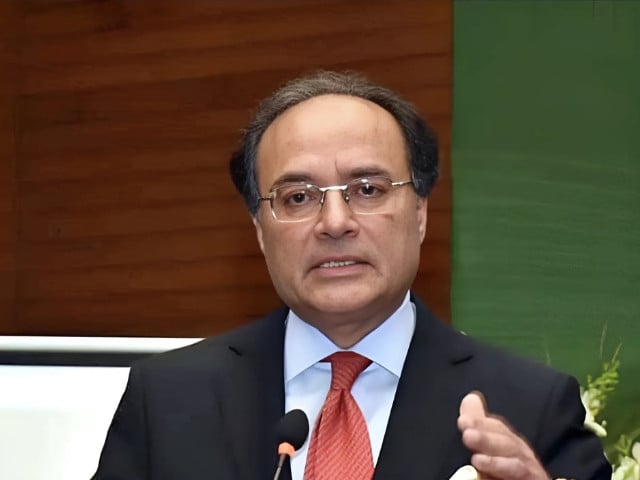
Federal Finance Minister Muhammad Aurangzeb. APP/file

ISLAMABAD: The country's finance minister has said the International Monetary Fund (IMF) is ready to give more money to the country but it also demands that the government makes tax reforms.

"The prime minister {Shehbaz Sharif] is clear about the [tax] reforms being undertaken by us," Muhammad Aurangzeb said while addressing an event organized by the Faisalabad Chamber of Commerce and Industries on Saturday.

Aurangzeb said it is repeatedly asked as to why we have to seek help from the IMF. "You know why we have to go to the IMF. So that the economy may continue to work," he added.

He acknowledged that the salaried class was bearing the brunt of taxes. He said the government wants the salaried individuals to submit a form. The minister stated that people belonging to seven different fields would be able to submit these forms online by November this year.

"We are digitalizing the entire [tax] system. You will see more improvements in the coming days."

Referring to a recent meeting of Prime Minister Shehbaz Sharif and Chief Justice of Pakistan Yahya Afridi, he said the PM called on the CJ to request him to adjudicate tax related cases expeditiously.

He said due to pending tax cases, the country has to suffer an annual loss of Rs1 trillion every year.

He said he would like to talk about the policy rate and inflation as these have been challenging issues for some time. He noted that Interest rates are decreasing and auto financing has already seen a reduction.
 

IMF mission to arrive in Pakistan on March 3 for review talks​


The talks will continue until March 15 and will play a key role in shaping the country’s 2025-26 fiscal policies.

Irshad Ansari
February 25, 2025

tribune


A nine-member International Monetary Fund (IMF) mission, led by Nathan Porter, is set to arrive in Pakistan on March 3 to conduct a crucial economic review.

The talks will continue until March 15 and will play a key role in shaping the country’s 2025-26 fiscal policies.

According to finance ministry sources, the negotiations will be held in two phases—technical-level discussions followed by policy-level talks.

The mission will engage with officials from the finance ministry, State Bank of Pakistan (SBP), Federal Board of Revenue (FBR), Oil and Gas Regulatory Authority (OGRA), and National Electric Power Regulatory Authority (NEPRA), among others.

A key issue on the agenda is tax relief for the salaried class, which sources say remains conditional on IMF approval.

The review will also assess Pakistan’s budgetary framework, fiscal consolidation efforts, and revenue generation measures.

Additionally, separate discussions will be held with all four provinces to align fiscal targets.

Pakistan’s economic policies, including taxation, energy pricing, and structural reforms, are expected to be scrutinised closely by the IMF before any further financial commitments are made.

Previously, a technical delegation from the International Monetary Fund (IMF) has arrived in Islamabad to discuss climate financing and related policy measures with Pakistani officials on Monday.
 
According to sources, the four-member IMF team will engage in talks with federal and provincial authorities to review climate funding strategies, including green budgeting and tracking mechanisms.

The discussions, set to run until February 28, aim to assess Pakistan’s progress on climate adaptation and financing.

One key agenda item is the proposed introduction of a carbon levy in the federal budget for the 2025-26 fiscal year.

The IMF will present recommendations on its implementation and framework.

The negotiations will also cover subsidies, electric vehicles, and the expansion of green budgeting. Officials are expected to provide briefings on Pakistan’s current climate initiatives and future plans.

The IMF delegation’s visit is part of broader efforts to align Pakistan’s financial policies with global climate commitments, ensuring sustainable economic reforms.

Moreover, the IMF has announced that its review mission will visit Pakistan to negotiate the next tranche of the $7 billion loan, with discussions also set to focus on climate financing.
 
The IMF delegation is scheduled to arrive in Pakistan in early March to conduct the first review of the ongoing loan programme.

According to IMF’s representative in Pakistan, Maahir Binesi, the delegation will engage in talks regarding the next installment of the loan and will also review the technical aspects of climate financing at Pakistan's request.

Finance Minister Aurangzeb had earlier said that Pakistan expects $1-1.5 billion in climate funding from the global lender.

Last month, the IMF held meetings with officials from the Auditor General of Pakistan (AGP), the Federal Board of Revenue (FBR), and the Securities and Exchange Commission of Pakistan (SECP) to conduct a governance and corruption assessment.

Sources revealed that the IMF mission was briefed on transparency and the audit process in the public sector. The mission was informed that Parliament serves as the highest forum for audit and accountability in the public sector.

Additionally, the opposition has the authority to audit government institutions, with the head of the Public Accounts Committee being nominated by the Leader of the Opposition.

FBR officials provided a briefing on digitalisation and tax reforms aimed at ensuring transparency in the tax system. Meanwhile, SECP representatives apprised the IMF about measures taken to enhance the ease of doing business in the stock market and corporate sector.

The IMF mission also held meetings with officials from the Ministry of Climate Change and the Ministry of Housing and Works.
 

Pakistan, IMF open talks on 1st review of $7bn programme

Reuters
March 4, 2025

Finance Minister Muhammad Aurangzeb on Tuesday confirmed that discussions between the International Monetary Fund (IMF) and Pakistan for the first biannual review of the $7 billion programme had begun, adding that the country was “well-positioned” for the talks.

Pakistan and the IMF had reached a three-year, $7bn aid package deal in July, with the new programme set to allow the country to “cement macroeconomic stability and create conditions for stronger, more inclusive and resilient growth”.

A nine-member mission from the IMF has began its first biannual review of Pakistan’s $7bn Extended Fund Facility (EFF).

“They are here. We will have two rounds of talks, first technical and then policy level,” Aurangzeb confirmed.

“I think we are well-positioned [for the review],” he added.

The IMF delegation, led by Nathan Porter, will hold discussions with Pakistani authorities for 10 days from March 3 to 14, assessing the country’s compliance with quantitative performance criteria, structural benchmarks and indicative targets under the 37-month programme.

A senior government official involved in preparations for the IMF review said there were some technical slippages for certain given deadlines, but they had been overcome with some delays — within weeks or a month.

The most critical weakness observed so far had been the revenue shortfall against programme targets, the official said. But he hastened to add that this had been more than compensated through a higher-than-targeted primary budget surplus and greater-than-estimated revenue-to-GDP ratio owing to better receipts from non-tax revenues like central bank profit, petroleum levy, telecom profits, etc.

The ongoing 37-month EFF programme consists of six reviews over the life of the bailout, and the release of the next tranche of approximately $1bn will be contingent on the success of the performance review.

Just before the IMF mission’s visit, the lender reiterated last week that its programme aimed to raise Pakistan’s notably low tax-to-GDP ratio by 3pc of GDP while improving the fairness and efficiency of the tax system by broadening the tax base and improving tax compliance.

Three key areas of focus include: expanding direct taxes by bringing retailers, property owners and agricultural income into the tax net; rationalising personal and corporate income taxes by reducing exemptions and streamlining rates in the general sales tax system; and enhancing Federal Excise Duty coverage and eliminating tariff exemptions to increase customs revenue.

In 2024, the salaried class became the third-largest income tax contributor, trailing banks and petroleum but surpassing textile exporters.

A separate IMF technical mission was in the country last week to discuss around $1bn in climate financing on top of the EFF.
 

Delay in audit of state institutions worries IMF, PAC told

Abdullah Momand
March 5, 2025

A delay in the audit process of state institutions has worried the International Monetary Fund (IMF), Auditor General of Pakistan (AGP) Ajmal Gondal told a meeting of the Publics Account Committee (PAC) on Wednesday.

The development comes as discussions began this week between the IMF and Pakistan for the first biannual review of the $7 billion Extended Fund Facility to address governance and corruption vulnerabilities.

While addressing today’s meeting, AGP Gondal disclosed that the IMF had expressed its concerns over nearly 600,000 pending audit paras.

“The IMF has demanded early settlement of audit cases of institutions,” Gondal said, adding that there were about 500,000 to 600,000 pending audit paras pertaining to ministries and institutions.

He continued that despite the orders of parliament, no chief internal accountant had been appointed. “The financial audit system is flawed due to non-implementation of the rules.

“Secretaries and chief financial officers of institutions are not clearing their audits,” he said. “There are only chief financial officers in 15 institutions, and none of them have a chief internal accountant.”

He reiterated that there were no internal audit systems in institutions.

“The number of pending audit cases with the PAC has increased to more than 30,000,” the AGP said.

The PAC sought details from ministries and institutions within a month.

In August last year, the AGP had expressed serious concerns over the country’s deteriorating financial affairs, which have resulted in less than 4 per cent of the over Rs38.67 trillion budget being available for socio-economic services.

Additionally, around 93pc of supplementary grants worth over Rs8tr had not been approved by the parliament and remained unspent, representing a loss of public resources.
 

IMF rejects tax relief on power bills​


Proposals are under consideration to provide tax relief to the real estate and tobacco sectors.

Irshad Ansari
March 07, 2025

tribune


The International Monetary Fund (IMF) has rejected Pakistan's proposal to reduce the General Sales Tax (GST) on electricity bills.

The IMF's decision poses challenges to Pakistan's efforts to provide financial relief to consumers amid ongoing economic reforms, Express News reported on Friday.

According to sources, the global lender also declined Pakistan’s request to extend the winter relief package for the industrial and agricultural sectors for the entire fiscal year.

Meanwhil, discussions between Pakistan and the IMF continue regarding measures to reduce circular debt in the energy sector.

Pakistan briefed the IMF on its plan to tackle circular debt by securing a loan of Rs1.25 trillion from commercial banks at an interest rate of 10.8%. An agreement on this loan has reportedly been finalised.

Additionally, proposals are under consideration to provide tax relief to the real estate, property, beverage, and tobacco sectors. If approved by the IMF, tax burdens on these industries will be reduced.

For the next budget, there are suggestions to lower tax burdens on salaried individuals.

Meanwhile, a plan to collect Rs250 billion in taxes from various sectors, including retail, is in place. The final approval for all proposed measures will be subject to IMF approval, sources said.
 

Govt seeks IMF approval to reduce net meter rates​


The IMF has expressed concerns regarding the government’s approach to handling solar panel owners

News Desk
March 07, 2025

photo stardust solar energy inc

Photo: Stardust Solar Energy Inc


The federal government has presented a proposal to the International Monetary Fund (IMF) to revise electricity tariffs for solar panel owners using net metering.

The plan includes purchasing surplus electricity generated by solar users at a significantly lower rate, reducing it from the current Rs27 per unit to approximately Rs10 per unit, Express News reported on Friday.

The IMF has expressed concerns regarding the government’s approach to handling solar panel owners who remain off-grid.

While no official commitment has been made, the global lender has warned that the increasing adoption of solar energy could impact the efficiency of the national power sector in the future.

Meanwhile, the International Monetary Fund (IMF) has rejected Pakistan's proposal to reduce the General Sales Tax (GST) on electricity bills.

The IMF's decision poses challenges to Pakistan's efforts to provide financial relief to consumers amid ongoing economic reforms, Express News reported on Friday.

According to sources, the global lender also declined Pakistan’s request to extend the winter relief package for the industrial and agricultural sectors for the entire fiscal year.

Meanwhil, discussions between Pakistan and the IMF continue regarding measures to reduce circular debt in the energy sector.

Pakistan briefed the IMF on its plan to tackle circular debt by securing a loan of Rs1.25 trillion from commercial banks at an interest rate of 10.8%. An agreement on this loan has reportedly been finalised.
 

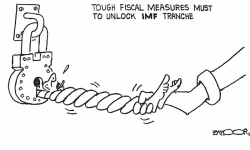
Pakistan, IMF begin policy-level talks for $1b tranche​


New taxation proposals, including carbon levies, are under review in the latest talks.

News Desk
March 10, 2025

tribune


Pakistan and the International Monetary Fund (IMF) have initiated policy-level discussions for the next tranche of the $7 billion loan program. The review process is scheduled to continue until March 14.

According to the Ministry of Finance, the IMF delegation will evaluate Pakistan’s progress in implementing economic reforms outlined under the program’s conditions.

The ongoing policy-level talks between the two sides are focused on new revenue measures, energy sector reforms, and debt reduction strategies, sources said.

According to officials, discussions include imposing a surcharge of Rs2.80 per unit on electricity bills and introducing a carbon tax on petrol and diesel vehicles.

There is also consideration of levies on coal-powered plants as part of Pakistan’s broader effort to meet climate and fiscal commitments.

Tax reforms in the electric vehicle policy are under discussion, with the IMF expected to push Pakistan to expand its revenue base.

The privatisation of state-owned enterprises is also part of the agenda, with the IMF seeking concrete short-term plans.

Technical negotiations are expected to lead to a formal statement from the IMF, outlining key policy expectations.

Sources indicate that Pakistan may be required to take additional fiscal measures to meet the lender’s conditions.

The latest talks come as Pakistan prepares for the next fiscal year’s budget and seeks to reduce its circular debt in the power sector. The IMF has reportedly urged authorities to demonstrate stronger commitments before releasing the next tranche.

Last week, the IMF mission arrived in Pakistan to officially initiate discussions for the first review of the $7 billion Extended Fund Facility (EFF) secured last year.

According to the Ministry of Finance, the IMF delegation, led by Nathan Porter, met with Finance Minister Muhammad Aurangzeb in Islamabad. The meeting focused on the overall economic situation in the country.

Moreover, the federal government also presented a proposal to the IMF to revise electricity tariffs for solar panel owners using net metering.

The plan includes purchasing surplus electricity generated by solar users at a significantly lower rate, reducing it from the current Rs27 per unit to approximately Rs10 per unit.
 

Users who are viewing this thread

Back
Top