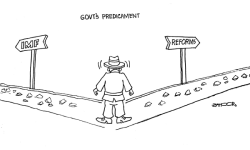
IMF - International Monetary Fund Program Updates

The government has been restructuring the PSDP portfolio on the IMF prodding to improve project selection, but even the Fund has been unable to restrict allocations for parliamentarians’ constituency schemes under the so-called Sustainable Development Goals (SDGs) Achievement Programme (SAP) that has claimed Rs70bn for the current year.

The government has given a commitment to the IMF to continue to improve project selection criteria and streamline the project pipeline to “better focus PSDP on long-term capital spending”.

“With careful reprioritisation, we have streamlined the PSDP pipeline by Rs2.5tr (around 25pc of the total). We will cap new project allocations to 10pc of the total in the FY27 budget,” the finance minister said in a written undertaking.

He also pledged further improvements to a scorecard-based system for project selection, including reducing overlapping criteria, introducing negative marking for projects with negative externalities and increasing the weight for climate-related criteria.

The IMF also noted that the government would reduce or postpone spending in response to lower revenues linked to the implementation of the National Tariff Policy. “As in the past, contingent and development spending are most likely to be affected,” it said.

This, it added, explained low development spending in the first five months of the current fiscal year (July-November), with utilisation at 9.2pc of the Rs1tr annual allocation amid fiscal rationing to meet IMF contingency measures against growing revenue shortfalls.
 
Development spending of Rs92bn in the current year was 20pc lower than last year’s Rs115bn for the same five-month period.

“PSDP utilisation in the current year remained low due to a significant reduction in expenditure by provinces, special areas and the Ministry of Railways,” the Planning Ministry said last week. “Development spending remained modest, with Rs92bn utilised against Rs196bn sanctioned, led mainly by infrastructure,” it added.
 

Is Pakistan’s IMF dependence a policy glitch?

The root of our crisis is the inability to delay gratification for the sake of national reconstruction, writes the former chief economist of Pakistan

Nadeem Javaid
January 7, 2026

The call to “break free” from the IMF is a recurring national refrain, often followed by a deceptively tidy prescription: slash spending, cut development expenditure, tax agriculture, and watch the deficits vanish. While this analysis is economically coherent, it’s politically sterile. It treats Pakistan’s economy like a malfunctioning machine, ignoring the volatile human ecosystem it operates within.

Our IMF dependence isn’t a policy glitch—it’s the logical outcome of a permanent state of emergency. Successive governments have governed in crisis mode, constantly mortgaging long-term reform for short-term oxygen. Economists call this hyperbolic discounting—the tendency to choose one candy today over two tomorrow. It’s the root of our crisis: the inability to delay gratification for the sake of national reconstruction.
 
Escaping the IMF will require us to break this cycle through a two-phase strategy: immediate stabilization through strategic triage, followed by structural repair through deep institutional reform. One buys us time. The other builds the foundations of real sovereignty.

Phase 1: Immediate Stabilization (1–3 Years)

You cannot rebuild a house while it’s still on fire. Before structural reforms, we must stabilize the economy and close the foreign exchange gap of $8–10 billion. The key is execution—not reinvention. Focused actions within the current system can generate short-term relief and policy credibility.

Unlock $3 billion in additional export earnings by fast-tracking tax refunds, ensuring uninterrupted energy for key sectors (textiles, IT, pharma), digitizing compliance processes, and offering ex-ante incentives linked to clear KPIs. No new subsidies—just predictable policy and reduced red tape.

Partner with Gulf countries and others to channel skilled and semi-skilled labor through formal corridors, aiming to boost remittance flows by $2 billion. Shift from passive inflows to active, managed deployment of human capital.

Launch industry-specific campaigns in mining, renewables, and export-oriented tech. Offer sovereign guarantees and fast-track dispute resolution to bring in $2 billion in credible, committed investment.

Reduce edible oil, pulses, and feed imports by $1.5 billion through investments in seed tech, local storage, and precision farming. Save foreign exchange while improving food security.

You cannot rebuild a house while it’s still on fire. Before structural reforms, we must stabilize the economy and close the foreign exchange gap of $8–10 billion.

These are not magic bullets—they are executable measures that buy the time and fiscal headroom necessary to begin real reform. But the bridge is only useful if we know what we’re crossing toward.

Phase 2: Long-Term Reform and Institutional Repair (3–10 Years)

Temporary fixes mean little without fixing the engine. The long-term path to IMF exit lies in strengthening state capacity—particularly its ability to collect and allocate resources in a fair, strategic, and transparent manner.

Pakistan’s tax system is a web of over 40 taxes, compliance traps, and predatory discretion. This complexity fuels evasion, breeds corruption, and suffocates economic activity. The solution isn’t more taxes—it’s fewer, smarter ones.

We must consolidate taxes, digitize administration, and flip the incentive structure: make it easier to pay than to dodge. Global examples prove this works. The Kaldor Reforms of 1960s South Asia rapidly broadened the tax base. More recently, Georgia’s 2004 overhaul slashed the number of taxes from 21 to 6—and tripled compliance.

Critically, the reform must be paired with tax justice. Any agricultural income tax must exempt smallholders and focus squarely on large commercial landowners who have long evaded the national fiscal contract.

True reform also requires honesty about spending priorities. Pakistan’s defense budget, given regional volatility, will remain significant. The question isn’t whether to spend—but whether we extract maximum strategic value per rupee. Scrutiny and efficiency must apply across the board.
 
Last time, Reis Erdo'an kicked out the IMF only to find coups and assassination attempts of all sorts unleashed against him. Not to mention the one after another "financial ops" to destroy the Turkish economy. By HIS INFINITE MERCY and GRACE, Turkey is progressing ahead against all odds....

The Pak Deep State, by definition, is historically extremely cautious vis-a-vis the Western Imperialists. It takes no chances whatsoever. ZAB's execution and IK's imprisonment are glaring examples. So, it won't get rid of the IMF, a principal tool for the US hegemony...
 
Blaming the IMF

EDITORIAL: The call by a panel, led by the planning and development minister, for “urgent ease of doing business reforms” to more than double export revenues to over $60bn within three years is familiar rhetoric. The panel was formed by the prime minister to devise a strategy to exit the IMF programme once the current bailout facility ends at the end of next year. Its weeklong consultations with public and private sector stakeholders this month has apparently concluded that the current state of affairs cannot drive the 250m-strong population towards sustained progress due to cross-cutting constraints affecting all 20 priority export products and six export drivers.

There is nothing new in the diagnosis of the problems hampering economic and export growth, or the solutions suggested by the panel. If anything, both diagnosis and prescription echo past policy pronouncements that were never followed up.

Read more: https://www.dawn.com/news/1966707
 
@Fatman17 sb

It is bizarre how Pakistan has practically not moved an inch on exports for almost a couple of decades now.

Regards
 

Blaming the IMF

Editorial
January 13, 2026
https://whatsapp.com/channel/0029VaMc238IiRov8okfYy3n
THE call by a panel, led by the planning and development minister, for “urgent ease of doing business reforms” to more than double export revenues to over $60bn within three years is familiar rhetoric.

The panel was formed by the prime minister to devise a strategy to exit the IMF programme once the current bailout facility ends at the end of next year. Its weeklong consultations with public and private sector stakeholders this month has apparently concluded that the current state of affairs cannot drive the 250m-strong population towards sustained progress due to cross-cutting constraints affecting all 20 priority export products and six export drivers.

There is nothing new in the diagnosis of the problems hampering economic and export growth, or the solutions suggested by the panel. If anything, both diagnosis and prescription echo past policy pronouncements that were never followed up.

The constraints to economic and export growth — high, volatile energy costs, policy unpredictability, distorted taxation, logistics and trade facilitation bottlenecks, institutional fragmentation, regulatory burden, etc — cited by the panel are old hat. These have featured in donor and government reports and in media commentary.

The persistence of these structural problems shows that the challenge lies less in their diagnosis or analysis and more in the state’s capacity and willingness to deliver politically tough, rules-based reform.

Against this backdrop, the panel’s implicitly holding restrictive IMF financing responsible for the government’s failure to aggressively implement reforms to return the economy to a sustainable growth path is an attempt to gloss over the state’s own dereliction of duty. Indeed, the IMF programme conditions and targets primarily aim for economic and fiscal stabilisation by imposing fiscal discipline rather than driving the economy towards growth.

However, the lender does not stop the government from undertaking or implementing reforms to restructure the economy or address stagnant growth. For example, it may demand that the authorities increase tax revenues as a ratio of GDP to slash the budget deficit — which should encourage the government to broaden the tax base. Nor does it ask them to cut development spending — instead of this, the government could reduce its own wasteful expenditure.
 
IMF — ideological and policy differences with its prescriptions aside — encourages the government to create a conducive business clime. The authorities are blaming the IMF programme for a sluggish, moribund economy to cover up their own incompetence, and obscure the ruling party’s unwillingness to dismantle the entrenched politically protected rent-seeking structures.

Unless the government walks the talk on reform to create a rules-based economy, its rhetoric of doubling exports and breaking the proverbial begging bowl will remain a pipe dream.
 

Pakistan unlikely to achieve IMF’s projected 3.2% GDP growth, say experts

  • Economists forecast growth more likely to remain between 2.5% to 3%
Tahir Amin
January 26, 2026

ISLAMABAD: Pakistan is unlikely to achieve the International Monetary Fund’s (IMF’s) projected 3.2 percent GDP growth for the current fiscal year as exports and investments continue to weaken.

This was the consensus among leading economists while talking to Business Recorder, who forecast a GDP growth more likely to remain between 2.5 percent and 3 percent, provided macroeconomic stability is maintained and no major shocks emerge.

Former Finance Minister Dr Hafeez Pasha said the government was under pressure to project higher growth figures, calling recent sectoral growth patterns unrealistic.

“GDP growth is expected to hover around 3 percent — a moderate outcome,” Pasha said, adding that the reported 3.1 percent growth in fiscal year 2025 was driven by an extraordinary over 28 percent expansion in the power sector and 9.9 percent growth in public administration. “This implies higher public spending and more government hiring, which directly contradicts the government’s contractionary and austerity policy,” he said.

Former Finance Ministry Advisor Dr Ashfaque Hassan Khan projected GDP growth in the 2.5–3 percent range, citing weak exports, collapsing investment and stagnant agriculture.

“Exports-oriented industries are under stress, capital investment is at a 50-year low, and no major turnaround is visible in agriculture,” Khan said. “If industry is not growing, exports are shrinking and investment is not coming in, where will growth come from?”
 
IMF cut Pakistan’s GDP growth forecast to 3.2 percent, down from 3.6 percent projected in its October 2025 World Economic Outlook. The Fund projected global growth of 3.3 percent in 2026 and 3.2 percent in 2027.

According to the State Bank of Pakistan (SBP), Foreign Direct Investment (FDI) plunged 43 percent in the first half of fiscal year 2026, falling to $808 million from $1.425 billion in the same period last year — a decline of $616 million.

Exports fell 8.7 percent to $15.18 billion during the first half of fiscal year 2026, compared to USD16.63 billion last year, while imports surged 11.28 percent to USD34.4 billion.

Exports declined for the fifth consecutive month, plunging 20.41 percent year-on-year in December, pushing the trade deficit to USD19.20 billion in the first half of the fiscal year.

In December 2025, exports stood at USD2.32 billion, down from USD2.91 billion a year earlier — a drop of USD594 million. Month-on-month, exports slipped 4.26 percent from USD2.42 billion in November.

With exports shrinking, investment drying up and industrial output under pressure, Khan cautioned that achieving even moderate growth will remain a challenge in the months ahead.
 
Last time, Reis Erdo'an kicked out the IMF only to find coups and assassination attempts of all sorts unleashed against him. Not to mention the one after another "financial ops" to destroy the Turkish economy. By HIS INFINITE MERCY and GRACE, Turkey is progressing ahead against all odds....

The Pak Deep State, by definition, is historically extremely cautious vis-a-vis the Western Imperialists. It takes no chances whatsoever. ZAB's execution and IK's imprisonment are glaring examples. So, it won't get rid of the IMF, a principal tool for the US hegemony...

Your assessment falls flat on its face, as it was those sovereign nations that approached the IMF, not the IMF initiating contact. It's flawed thinking: you go to the bank to get a home loan, then suddenly you can't pay the mortgage, and you blame the bank for a conspiracy? :unsure:
 

Users who are viewing this thread

Pakistan Defence Latest

Back
Top