IMF - International Monetary Fund Program Updates

IMF board expected to approve $1.2bn tranche for Pakistan by ‘early December’, says Aurangzeb


Pakistan, IMF authorities reached staff-level agreement in mid-October

Salman Siddiqui
November 5, 2025

KARACHI: Finance Minister Muhammad Aurangzeb said on Wednesday the International Monetary Fund (IMF) Executive Board was expected to approve the next tranche for Pakistan in “early” December 2025.

The two sides reached the staff-level agreement (SLA) in Washington DC in mid-October.

“The IMF is expected to approve the next $1.2 billion tranche by early December,” Aurangzeb said while speaking at the 9th Edition of The Future Summit titled ‘Course Correction: Redefining The Direction’ on Wednesday.


The IMF board is estimated to approve issuing $1.2 billion in its third tranche, including $1 billion under the ongoing 37-month Extended Fund Facility (EFF) and another $200 million under 28-month Resilience and Sustainability Facility (RSF). The SLA was signed at the completion of the IMF second review of the economy under EFF.

During his speech, Aurangzeb mentioned the Overseas Investors Chamber of Commerce and Industry’s (OICCI) latest business survey result.

“ [Up to] 73% CEOs of the foreign firms operating in Pakistan believe the country is a viable investment destination at present compared to 61% CEO in the previous survey,“ he said.

“The endorsement has come from the existing investors, which is an important thing. If the existing investors are not in a good place, you cannot talk about new foreign direct investment. [In this regard,] we have a long way to go, but we are moving in the right direction.”

The finance minister said Pakistan had achieved macroeconomic stability with the support of its traditional partners including China, US, GCC, and Saudi Arabia in particular.

“They all have provided Pakistan the required funding, provided bilateral support, and supported reaching the 37-month EFF with the IMF. Now the time has come to extend and further strengthen the ties through trade and investment. Now we have the real opportunity to translate all of this into trade and investment-grown led by the private sector.”

The areas of attracting the new foreign investments included minerals and mining, IT, agriculture, and pharma, he added.

“Pakistan is using [artificial intelligence] AI-based monitoring to control corruption and tax leakages and theft. The government is already using AI-led monitoring and invoicing models in sugar and banking sectors to stop sales tax leakages. We are going to extend AI-led monitoring in the tobacco and beverages sectors,” he announced at the conference organised by Nutshell.

Aurangzeb informed that Pakistan had registered 900,000 (or 0.9 million) new tax payers in the tax year 2025.
 

IMF humiliation ritual continues, the price to pay for cheap loans.​


IMF launches technical assistance mission to overhaul Pakistan’s budget management​


Mission aims to address a Rs448 billion statistical discrepancy in Pakistan’s fiscal records, with a focus on improving data governance and make it compatible with global fiscal data governance standards
By
Monitoring Desk

IMF-PP-696x390.jpg


The International Monetary Fund (IMF) has initiated a technical assistance mission at Pakistan’s request to enhance budget management practices and tackle the persistent statistical discrepancies that have plagued the country’s fiscal data. The IMF mission, which began on November 9, 2025, will stay in Pakistan until November 21, 2025, The Express Tribune reported.


Led by Nino Tchelishvili from the IMF’s Fiscal Affairs Department, the mission will assess Pakistan’s laws, rules, and practices surrounding budget management.

This mission follows the recent release of Pakistan’s fiscal operations summary for the July-September quarter, which revealed a statistical discrepancy of Rs448 billion, primarily related to misreported expenses and revenues at both federal and provincial levels.


According to the Tribune report, the IMF team will focus on strengthening fiscal data governance to support data-driven decision-making in the country’s budget management. The mission will explore the compatibility of Pakistan’s budget with international fiscal data governance standards and will work on enhancing data interoperability across government departments.

Pakistan’s finance ministry noted discrepancies in the federal and provincial accounts, which included Rs93 billion in unaccounted federal expenses and discrepancies totaling Rs354 billion across the provinces. These discrepancies arose due to issues like delayed payments, time lag in reporting, and variations in data handling by entities like the State Bank of Pakistan (SBP), the Federal Board of Revenue (FBR), and the Economic Affairs Division.

As part of the technical mission, the IMF will examine multiple areas of fiscal data, including legal frameworks, fiscal data strategy, data architecture, privacy, and internal controls. The mission will also assess treasury and cash management, public finance management laws, and the accuracy of tax revenue reporting, which often varies by significant margins.


The IMF will look into Pakistan’s public procurement systems, debt management practices, and the central bank’s payment systems, all of which have been identified as areas requiring urgent reform.

This mission is part of a broader effort by Pakistan to align its fiscal systems with international standards and improve governance. The IMF’s findings will be presented to its executive directors and the sponsor countries, and its recommendations are expected to shape Pakistan’s fiscal policy moving forward.
 

IMF reveals ‘elite capture’ costing Pakistan billions


Singles out sugar industry as a textbook example of how intertwined relationship between economic elites and state regulators combines to capture public benefits

Ahmed
November 20, 2025

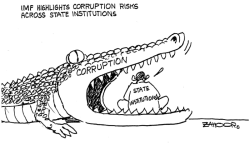
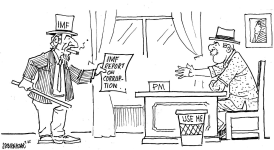
The International Monetary Fund (IMF) has revealed the scale of elite capture across Pakistan’s most influential sectors, warning that entrenched interests in key sectors, including sugar, real estate, agriculture and energy, continue to undermine the country’s reform trajectory.

The Technical Assistance Report, Pakistan Governance and Corruption Diagnostic Assessment, released on the Finance Division website late Thursday night, singles out the sugar industry as a textbook example of how the intertwined relationship between economic elites and state regulators combines to capture public benefits at a deep cost to the overall public.

“Firms in the sugar sector benefited from favourable government policies, subsidies, and regulatory loopholes for decades, mainly due to the nexus between industry magnates and political leaders,“ it said.

“Sugar mill owners, many of whom hold government positions, have ensured highly ‘recommended’ prices for sugarcane and protective tariffs, keeping their operations profitable at the expense of competitiveness,” said the IMF.
 
The term elite capture is used to describe the process where powerful, wealthy, or politically connected groups manipulate public policy and resources for their own private gain, often at the expense of the general public. The result is that development and resources are ‘captured’ and disproportionately flow to the elite.

“They have also influenced export and pricing policies to their advantage. In 2018–19, a government decision allowed significant sugar exports, even subsidising them, which created domestic shortages and price spikes for consumers,” it noted.

Similar patterns of privilege are evident in real estate, where generous tax exemptions erode revenues, the IMF notes.

“Until recently, agricultural income has not been taxed, while real estate, manufacturing, and the energy sector continue to benefit from favourable taxation arrangements,” the report noted.

IMF said that the revenue loss from such tax expenditures is substantial, with the government itself estimating costs at 4.61% of GDP in FY 2023.

“This pattern of preferential treatment contributes significantly to Pakistan’s low tax-to-GDP ratio and fiscal challenges. The selective and arbitrary enforcement of laws and policies enables powerful forces to shape economic decisions and influence economic possibilities for both public and private parties,” it said.
 
The Fund noted that historically, Pakistan’s economic elite consolidated power through their control over land, a legacy shaped by colonial policies that favoured landowners.

“Following independence, the continuation of these policies further entrenched elite control over land and broader economic activity,” it said.

Citing a 2020 UNDP report, which estimated that the “elite privilege” amounted to $4.7 billion for the corporate sector alone.

The IMF cautions that without dismantling these privileges, Pakistan’s economic stabilisation efforts risk being repeatedly undone by vested interests that have long shaped the country’s political economy.
 

IMF: Pakistan loses up to 6.5% of GDP to corruption as elite capture strangles growth​

It was coming as Asim Munir is angry for getting removed from the DG ISI post. At the same time, PMLN has been in "why I was ousted" for the last 3 years and why no one came to support them.
All have been colluding and have been seeking revenge from IK for last 3 years. All laws, campaigns and political manoeuvring are stuck in the loop. SA I think just signed pact with us for Gaza only. Let's see the only positive thing bears some fruit or not.
 

IMF opposes purchasing rule tweaks​


Asks Pakistan to end practice of awarding contracts to SOEs without bidding

Shahbaz Rana
November 23, 2025


imf opposes purchasing rule tweaks

IMF opposes purchasing rule tweaks

ISLAMABAD: The International Monetary Fund (IMF) has slammed federal and Punjab governments for amending public procurement rules to award contracts to state departments without bidding and observes that some of these firms are subletting the contracts to private companies in an opaque manner.

The IMF has asked Pakistan to end preferences for state-owned enterprises (SOEs), including the provisions that allow direct contracting, within one year. Preferences, such as these, serve to disrupt competition, are vulnerable to abuse and increase the risk of corruption, it said in remarks on the government's procurement system.

In its Governance and Corruption Diagnostic Assessment, the global lender termed decisions of the government of Punjab to amend public procurement rules to award contracts to SOEs without competitive bidding "unfortunate". The IMF observed that "there appears to be an extensive practice of sub-contracting to private firms in opaque and unmonitored transactions. It is perhaps an understatement to observe that corruption vulnerabilities are high in contracting processes that feature direct negotiation".

It added that the decision to amend rules for direct contracting has undermined the core principles of competition in public procurements. These observations have highlighted the unchecked practice of giving contracts, particularly in the infrastructure sector, to government entities on the grounds of being time sensitive and in public interest.
 
The IMF said that the 2023 National Risk Assessment (NRA) has identified corruption as a major predicate offense for money laundering and high-risk sectors include banking, real estate, construction, politically exposed persons and public procurement. "Unfortunately, amendments introduced in public procurement rules at the federal government level and in Punjab province have undermined core principles of open competition," it said.

The IMF added that these amendments have provided for the award of contracts to SOEs without competition when projects are considered time sensitive and in the public interest. It pointed out that it was not possible to quantify the number and value of contracts directly negotiated with state-owned firms. "Anecdotal stories in the media have frequently highlighted high-value contracts that have been assigned in this fashion and the tendency for contractual costs to exceed expectations."

The IMF said that public procurement remains fragmented and privileges state parties, who are able to capture markets and rents from their favored status.
 
Sovereign Wealth Fund

The report revealed that the government has finally given assurance to the IMF that it will withdraw the exemption from the applicability of the SOE Act to the Sovereign Wealth Fund. The government had been resisting this for the past over one year.

The report noted that while the approval of the SOE Act had been an important step, there were concerns about the exemption to the 2023 SOE Act and the SOE Policy Framework included in the enactment of the Sovereign Wealth Fund (SWF) Act. In the 2023 SWF Act, seven SOEs were exempted from the SOE Act.

"The authorities have proposed amendments to end the SWF Act, which are expected to be placed before parliament to ensure that these SOEs will no longer be exempted." The IMF underlined that it is crucial that all SOEs are included without any exemptions.

It said that many of the governance weaknesses in public procurement flow from issues with its legal and regulatory framework. The Public Procurement Rules 2004 under Rule 20 prescribes open competition as the principal method of procurement with mandatory consideration for transparency under Rule 4. It is mandatory for all the procuring agencies to publish the final evaluation report 15 days prior to the award of a contract.
 
IMF praises CMU

The global lender acknowledged the work being done by the Central Monitoring Unit (CMU) in monitoring the performance of SOEs. It said that the establishment of the monitoring unit has been a significant step forward for SOE financial oversight and transparency regarding the performance of SOE.

This will further strengthen their analysis, which will enhance the monitoring of SOE performance and avoid governance vulnerabilities related to SOEs, according to the IMF. The CMU publishes a wide range of reports and guidelines related to the performance, governance and oversight of SOEs. These publications are available on the official CMU page.
 
Debt management

The IMF found faults in public debt management. It said that the government debt management function in Pakistan has been conducted under a fragmented institutional structure.

This fragmentation has led to inefficiencies and challenges in managing the country's debt effectively. The current setup involves multiple entities with overlapping responsibilities, which complicates coordination and decision-making that can lead to suboptimal borrowing choices.

The fragmentation is evident in debt data monitoring and management. The debt data repository, DMFAS, currently only includes external debt captured by the Economic Affairs Division. This limited scope hinders a comprehensive view of the country's total debt obligations.
 
To view this content we will need your consent to set third party cookies.
For more detailed information, see our cookies page.
 

Users who are viewing this thread

Pakistan Defence Latest

Back
Top