IMF - International Monetary Fund Program Updates


Pulling this from the article:

Recently, even the SIFC national coordinator said that the "country's growth plan was missing" and that "we have made a mess of our fiscal situation".

Per the SIFC national coordinator, there has never been a roadmap for growth. This is evident in the lack of structural reforms in the economy; the current program is only to patch holes in the ship.

Not to forget, this SIFC is duplicating a previously failed Board of Investment (BOI) initiative. This is where it gets interesting. The BOI was created in 1992 and, under the Board of Investment Ordinance 2001, was established under the direct administrative control of the Prime Minister. In twenty-four years, they've failed in the implementation phase, which doesn't surprise me, as Vision 2025, MTDF, Uraan Pakistan, and other five-year plans haven't yielded much in the way of results.

There is much talk about how to move forward from stabilisation to economic growth. A plan is in the making in consultation with the Special Investment Facilitation Council (SIFC), the business community and the Ministry of Finance. A roadmap for such a plan was best presented by the SIFC national coordinator: reducing tax rates and cutting down the interest rate – a policy taken from the supply-side playbook.

Now, coming to this paragraph, working on a tax reduction and interest rate plan, as if it would help the supply-side issues; but wait, the second paragraph from this quote says it would be a big no from the IMF, as it wants Pakistan to expand the tax-net.

What I find humorous is that the Pakistani government’s internal logic mirrors Reaganomics, but with a desperate twist: they are trying to implement it without the necessary capital, which they hoped would flow into SIFC.

So, why waste time on a plan that won't work? Even if you implement it, you're not going to get the FDI you need, anyway, because you lack any sort of credibility.

@Forsvaret
 
Last edited:
@PakFactor

PF sb,

I have a simple explanation behind SIFC. It wasn't meant to bring in FDI. It was meant to convince the citizenry that steps were being taken to bring in FDI.

Regards
 

IMF review mission arrives on 25th​


IMF will also be briefed on privatisation efforts, including developments related to PIA

Irshad Ansari
February 16, 2026

the government has agreed to the need for a mini budget if revenues fall short of expectations by end december 2025 according to the imf photo file


The government has agreed to the need for a mini-budget if revenues fall short of expectations by end-December 2025, according to the IMF. Photo: file

ISLAMABAD: Talks between Pakistan and the International Monetary Fund (IMF) will begin in the last week of this month, as Islamabad seeks to unlock fresh funding under its bailout programme amid persistent fiscal pressures and slowing revenue momentum.

An IMF review mission is scheduled to arrive on February 25 for a two-week stay, during which officials will assess economic performance from July to December 2025, alongside progress on agreed benchmarks covering taxation, energy reforms, monetary policy and foreign exchange reserves.

While authorities met targets for the primary budget surplus and provincial cash balances, the federal tax goal fell short by Rs329 billion. The Federal Board of Revenue (FBR) collected Rs6,161 billion over six months, according to official figures.

Provinces reported a combined cash surplus of Rs1,179 billion and collected more than Rs568 billion in taxes during the same period. The IMF will also be briefed on privatisation efforts, including developments related to Pakistan International Airlines (PIA).
 
@PakFactor

PF sb,

I have a simple explanation behind SIFC. It wasn't meant to bring in FDI. It was meant to convince the citizenry that steps were being taken to bring in FDI.

Regards
No sir the geniuses that run Pakistan actually believed that once those pesky and obstructive bureaucrats are shoved aside via SIFC , it would rain FDI all over the country.

This is typical incompetent and half baked thinking that the Establishment has inflicted on this god forsaken country for the last 70 years.
 
All the IMF loan will disappear into the personal bank accounts of the ruling kanjar elites, and more taxes will be on the already poor and suffering ordinary citizens

There is no fucking accountability.........their perks, protocols, security, benefits and priviledges will never be curtailed.......watch the money disappear into dubai, london, paris, swiss, newyork accounts.....etc

IMF wont even get its money back!! lol
 

IMF spox says EFF reforms helped stabilise Pakistan’s economy​


Fund cites strong fiscal performance and first current account surplus in 14 years ahead of review talks on Feb 25

Web Desk
February 20, 2026

imf communications director julie kozack addressing a press briefing on thursday photo screengrab


IMF Communications Director Julie Kozack addressing a press briefing on Thursday. PHOTO: SCREENGRAB

The International Monetary Fund (IMF) has said that Pakistan's policy efforts under its Extended Fund Facility (EFF) programme have "helped stabilise the economy and rebuild confidence" with fiscal performance described as "strong".

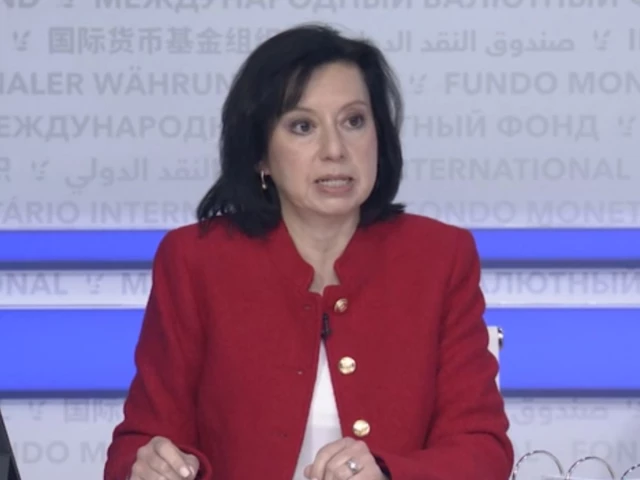
Speaking at a weekly press briefing on Thursday, IMF Communications Director Julie Kozack said a staff team is expected to visit Pakistan from February 25 to hold discussions on the third review under the EFF and the second review under the Resilience and Sustainability Facility (RSF).

Kozack noted that Pakistan currently holds a primary fiscal surplus of 1.3% of gross domestic product (GDP) in fiscal year 2025, which was "in line with programme targets." Headline inflation has been “relatively contained,” she added, while Pakistan recorded its first current account surplus in 14 years in fiscal year 2025.

She also referred to the recent publication of the IMF’s Governance and Corruption Diagnostic Report on Pakistan, which she said "includes proposals for reforms, including simplifying tax policy design, levelling the playing field for public procurement, and improving the asset declaration transparency."
 
It was further stated that the IMF’s review discussions will assess Pakistan’s progress under the programme and determine the next steps in disbursements tied to reform benchmarks.

The implementation of the Governance and Corruption Diagnostic report and the National Fiscal Pact will top the agenda of the upcoming review talks for the release of the next loan tranches worth $1.2 billion.

The global lender's continued focus on areas that, until a few years ago, were dealt with by non-financial institutions underscores that it now attaches equal importance to areas considered the root causes of poor governance, tax evasion and the prevalence of corruption in Pakistan.

Progress on these plans will determine whether the IMF sends a technical assistance mission to Pakistan, which federal authorities have so far resisted.

Led by its Mission Chief for Pakistan, Iva Petrova, the IMF team will first land in Karachi on February 25, where it will hold exclusive discussions with the State Bank of Pakistan, before proceeding to Islamabad.
 
An International Monetary Fund (IMF) mission led by Iva Petrova on Tuesday began technical-level discussions with the State Bank of Pakistan (SBP) in Karachi for the third review of the $7bn Extended Financing Facility (EFF) and the second review of the $1.1bn Resilience and Sustainability Facility (RSF).

The mission will remain in Karachi this week and begin policy discussions with the federal and provincial governments on Monday, with the customary opening roundup with Finance Minister Muhammad Aurangzeb.

Read more: https://www.dawn.com/news/1975678
 
To view this content we will need your consent to set third party cookies.
For more detailed information, see our cookies page.
 
@PakFactor

PF sb,

I have a simple explanation behind SIFC. It wasn't meant to bring in FDI. It was meant to convince the citizenry that steps were being taken to bring in FDI.

Regards

Its sole purpose was to serve as a vehicle to attract FDI and, eventually, to operate as a sovereign wealth fund.

The initial goal, though not publicly stated by the government, was to have SIFC hold the state-owned enterprises (SOEs), strip the debt, and place them into another holding company to create the illusion that it had assets on its balance sheet; with that, it would leverage the SIFC to borrow against those assets. The intent was to operate this along the lines of the UAE's Mubadala.

Pakistan's strategy was about optics and leverage, not actual economic improvement. Rather, it was completely misguided, as Pakistan never developed the knowledge base to include such complex funds in its business school curriculum, or to have industry professionals in Pakistan to operate this sort of fund. Even the Saudi and UAE funds have hired external guidance teams to manage such vehicles. It was set up to fail from the get-go.
 
Last edited:

Users who are viewing this thread

Back
Top