IMF - International Monetary Fund Program Updates

IMF programme targets: performance


Dr Hafiz A Pasha
February 11, 2025


This is an appropriate time to evaluate the initial performance of Pakistan’s economy in the first half of 2024-25, in relation to the IMF programme targets for the year. Any major deviations are likely to feature in the forthcoming first review of the three-year Extended Fund Facility.

The IMF programme expectations are that in 2024-25 the economy of Pakistan will stabilize significantly while achieving a modest improvement in the GDP growth rate. The inflation rate will fall sharply and the two deficits, both in the budget and in the current account, becoming more manageable or remaining low.

The first indicator of the state of the economy is the GDP growth rate. The programme expects this to be 3.2% in 2024-25. This will represent a modest improvement over last year’s growth rate of 2.4 percent.

However, the unfortunate reality is that in the first quarter of 2024-25, the economy registered a very low growth rate of only 0.9 percent. Two sectors have performed poorly. These are major crops and large-scale manufacturing, with growth rates respectively of negative 11 percent and negative 1 percent.

The message is clear. Pakistan’s growth has been stifled by a number of negative factors. The large-scale manufacturing sector faces a tax burden, which is over four times the national average. In addition, there has been substantial cost-push inflation due to the escalation in electricity and gas tariffs.

The export industries are seeing a loss of profitability and ability to compete due to the process of increasing overvaluation of the rupee. After a gap of seven years, the Real Effective Exchange Rate index has gone significantly beyond 100 to 108, implying that there is need for some downward adjustment in the value of the rupee.

SBP will need to follow a more market-oriented policy on the exchange rate. IMF expectation is that the rupee will depreciate by over 7 percent in 2024-25.

The IMF projection is that the average rate of inflation in 2024-25 will be 9.5 percent and rise somewhat by June 2025 to 10.6%. The actual rate of inflation was 7.3 percent in the first six months of 2024-25. This is already significantly below the annual target. In fact, the rate of inflation in December 2024 was as low as 4.2 percent.
 
The big reasons for the large decline in the rate of inflation are, first, a strong supply response earlier by the agricultural sector, especially with the bumper crop of wheat. This has reduced the rate of inflation in food prices to only 2.7 percent in the first half of 2024-25.

Second, lower international prices, especially of oil, and a nominally stable exchange rate have largely eliminated ‘imported’ inflation. Third, there has been virtually no expansion in money supply due to the substantially reduced bank borrowing by the federal government, because of reasons given later.
 
The IMF programme projection is also for a small increase in the investment to GDP ratio to 13.6 percent of the GDP in 2024-25. The less pressure on commercial banks to lend to the federal government by purchase of bonds has created much more space for lending and led to a tripling of credit to the private sector. This has also been facilitated by a big reduction in interest rates.

However, the large credit flows to the private sector have not yet been accompanied by a corresponding increase in the import of machinery. This has increased by 15 percent.

Turning to the crucial indicators of the state of Pakistan’s external balance of payments, there is good news. The IMF expectation is of a current account deficit of close to 1% of the GDP, equivalent to USD 3.6 billion, in 2024-25.

However, during the first six months a surplus has actually been generated in the current account of USD 1.2 billion.
 
An analysis of the trends reveals that exports have shown faster growth of 7.1 percent, as compared to the IMF projection for the year of only 2.1 percent.

Further, import growth has been restricted to 9.3 percent, compared to the projected growth rate of 11.3 percent. These positive outcomes have been substantially augmented by the unprecedented 33 percent increase in workers’ remittances.

However, the good news on the balance of payments front tends to end here. The surplus in the financial account of the balance of payments has fallen substantially by 89 percent in relation to the surplus in the first six months of 2023-24.

The IMF expects the financial account surplus to be USD 6.3 billion in 2024-25, as compared to the actual magnitude of only USD 0.5 billion in the first six months of 2024-25.

The main reason for the decline is the sharp fall of net inflows into the general government account. Disbursements have declined by over 42 percent, while the amortization payments have increased by almost 13 percent.

Consequently, there has been a net outflow in the government account. Overall, the result is that the overall balance of payments surplus is lower by 43 percent.
 
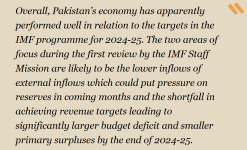
The big decline in external borrowing, both from public and private sources, and the shortfall in meeting the external financing targets in the IMF programme for 2024-25, is likely to be one of the areas of primary focus by the IMF mission in the forthcoming review.

Pakistan will need to show how it can mobilize more external support and attract substantially more foreign direct investment.

The second area of primary focus is likely to be the state of public finances. The bottom line is the size of the primary surplus/deficit. One of quantitative performance criteria in the programme is a ceiling on the general government primary surplus of Rs 2877 billion as of end-December 2024.

The Ministry of Finance has released recently information on fiscal operations in the first half of 2024-25. There is a very large primary surplus of Rs 3604 billion. This appears to be an excellent fiscal performance by the federal and provincial governments in the first half of 2024-25.

However, the IMF may argue that this is due to the lumpy transfer of the annual profits of the SBP to the federal government of Rs 2500 billion in the first quarter of 2024-25. A phasing of this transfer to half the annual profit in the first six months would have implied a transfer of Rs 1250 billion. Consequently, the primary surplus would have been reduced to Rs 2354 billion, significantly below the target level of Rs 2877 billion.

This also reflects the relative failure in meeting the various revenue targets, including that of FBR revenues. The shortfall in the first six months is estimated at Rs 348 million. This includes a failure to achieve the target of Rs50 billion from retailers.

At the provincial level, collection of the agricultural income tax under the new law has been postponed to the 1st of July 2025.
 

Two more IMF missions due in next few weeks


Khaleeq Kiani
February 13, 2025

ISLAMABAD: On top of a technical mission currently in town studying judicial and regulatory systems, Pakistan is expecting two more policy-level staff missions of the International Monetary Fund (IMF) for talks on more than $1bn additional financing for climate resilience and review of ongoing $7bn Extended Fund Facility (EFF).

Informed sources in the finance ministry said a staff mission on climate resilience financing would arrive on Feb 24 for discussions on Pakistan’s request for more than $1bn financing under the Fund’s relatively cheaper Resilience and Sustainability Facility (RSF).

The funding under RSF is made available to nations who commit high quality reforms to build resilience against climate catastrophes through adaptation and is repayable over 30-year period including a 10-year grace and is normally cheaper than EFF terms.

Teams to hold talks for over $1bn climate resilience funding, biannual performance review of $7bn EFF

In October last year, Pakistan had formally requested the IMF to top up its $7bn EFF with another $1.2bn RSF.

This would be followed by another staff mission visiting Pakistan, tentatively in the first week of March, for the first biannual performance review of the $7bn EFF.

The authorities are working overnight these days to meet pending measures to meet most of the benchmarks, the latest being approval by the federal cabinet the mechanism for publication of assets and tax returns of the top government servants.

The finance ministry officials confirmed these visits a day after Prime Minister Shehbaz Sharif met IMF Managing Director Kristalina Georgieva in Dubai on the sidelines World Governments Summit to seek support for energy sector reforms.
 
The Fund had already advised Pakistan to invest 1pc of GDP per year (over Rs1.24 trillion at current year estimate) in climate resilience and adaptation reforms to be ready to fight increasing cycles of extreme weather conditions.
 

Defence minister defends IMF team’s meeting with CJP


Iftikhar A. Khan
February 13, 2025

ISLAMABAD: After a JUI-F lawmaker raised questions over the meeting of International Monetary Fund (IMF) delegation with the Chief Justice of Pakistan (CJP), Defence Minister Khawaja Asif said the judiciary’s help in financial discipline was vital and the meeting was in this context.

“We got the breathing space because of the IMF. We have compulsions, not a choice,” the defence minister said.

“Within our compulsions, we are trying to survive financially,” he remarked, adding that the meeting took place with the consent of both the parties.

He said discussions keep on taking place with the IMF over monetary and fiscal issues. He said the government was making efforts to impose financial discipline, which was also a conditionality of IMF. The judiciary has a big role to play in this regard, he said.

PPP opposes closure of Utility Stores across the country

Stressing that the country is facing economic difficulties, he said the judiciary should support efforts for financial discipline.

Earlier, Noor Alam Khan of JUI-F raised alarm over the meeting of IMF delegation with the CJP and sought to know under which capacity and under whose permission the IMF team met the chief justice.

He also asked the government to tell the House to what was discussed during the meeting. “Will you roll back the nuclear programme, if it is demanded by IMF?” he questioned.

According to a press release issued by the Supreme Court a day earlier, the meeting took place on the request of the finance division.
 
. Team in town to engage with financial, revenue, election bodies
• Assessment report to be published in July, measures to address corruption, governance vulnerabilities to be shared
• Pakistan required to publish corruption report under UN framework immediately after review

ISLAMABAD: The government on Sunday said the International Monetary Fund (IMF) was scrutinising the judicial and regulatory system as part of the ongoing $7 billion Extended Fund Facility (EFF) to address governance and corruption vulnerabilities.
 

IMF team visits AGP, FBR

FBR officials briefs IMF team about digitalization of the taxation authority

NNI
February 13, 2025


ISLAMABAD: Visiting delegation of IMF experts on Wednesday called on the Auditor General of Pakistan to get briefing over the audit procedure and transparency in the public sector.

A mission of the International Monetary Fund (IMF) has been on the visit of Pakistan to conduct a Governance and Corruption Diagnostic Assessment (GCDA), the Ministry of Finance earlier said in a statement.

The IMF delegation was briefed that the Parliament has been the major forum of audit and accountability in public sector and according to a parliamentary tradition, the opposition entrusted to audit the government institutions.

“The Leader of Opposition or his nominee used to be the head of the Public Accounts Committee of the Parliament,” the delegation was informed.

The IMF mission also held a meeting with the officials of the Federal Board of Revenue (FBR).

The FBR officials briefed the IMF team about digitalization of the taxation authority. “Transparency being introduced in the taxation system with tax reforms,” FBR officials said.

The delegation also held a meeting with the officials of the Securities & Exchange Commission of Pakistan.

The officials briefed the IMF team on the ease of business practices in corporate sector and the stock market.

The IMF mission visited the Ministry of Climate Change. The mission also held a meeting with the housing and works department officials. The department officials given the mission briefing about digitalization of the land record in the country.
 

Call for ending graft to attract investment


Nasir Iqbal
February 15, 2025

ISLAMABAD: A visiting IMF mission on Friday called on the president of the Supreme Court Bar Association (SCBA) and chairman of the Pakistan Bar Council’s (PBC) special committee on judicial reforms, and discussed with them a wide range of topics with primary focus on eradicating corrupt practices to create an inclusive environment for attracting foreign investment to Pakistan.

The meeting between the IMF’s Governance and Corruption Diagnostic Assessment team and SCBA President Mian Muhammad Rauf Atta and PBC committee’s chairman Hassan Raza Pasha lasted over an hour.

According to an SCBA announcement, Mr Atta spoke about shortcomings in the judicial system such as the backlog of cases in lower and district courts, the insufficient number of judges, inefficiencies within departments, and potential measures like Alternative Dispute Resolution (ADR) system to alleviate the burden on courts and enhance public access to justice.

Various strategies were discussed to combat corruption in government departments, promote good governance, and implement legal reforms that would benefit the judicial hierarchy, it said, terming the proposed strategies essential for fostering a stronger and more vibrant economy as well as an efficient judicial system.

SCBA, PBC panel’s heads discuss host of issues with IMF team

The SCBA president emphasised the need for measures to eradicating financial crimes to boost the economy. He noted that a system of punishment and reward was already in place within the judiciary, where the Supreme Judicial Council (SJC)addresses complaints against the judges of higher judiciary while respective high courts handle issues related to district judges.

Mr Atta cited the example of a Supreme Court judge who was removed over a complaint filed with the SJC last year.

He described the rule of law as the cornerstone of a democratic society and reaffirmed his commitment to uphold it, along with the SCBA’s dedication to the Constitution, the supremacy of institutions, and the independence of judiciary.

The meeting concluded with both sides expressing gratitude and a desire for more such meetings in the future.

SCBA’s Additional Secretary Mohammad Aurangzeb Khan and Balochistan High Court Bar Association President Mir Attaullah Langove also attended the meeting.

The discussion also revolved around legal matters and backlog of cases in superior courts and the implementation of legal reforms for an efficient working of the judicial system.
 
The IMF mission expressed its concerns that business matters, particularly relating to investments, remain pending for a long time as decisions are not made timely, which ultimately affects the country’s economy.

Mr Pasha informed the visiting team that cases, including the business matters, would be resolved through mediation and ADR, under which the parties may resolve their matters without delay.

Both the government and superior courts had supported it, he said and expressed the hope that it would improve the efficiency of courts, reduce the backlog of cases and help the economy to grow.

The PBC committee’s president suggested that the strength of judges at the lower judiciary should be enhanced to finish the backlog of cases.

Mr Pasha urged the IMF officials to soften the conditions imposed upon Pakistan under which the government has imposed heavy taxes so that the latter could reduce the taxes for the ultimate benefit of people. Due to heavy taxes, he added, the common man is facing difficulties in the shape of price hike.

Published in Dawn, February 15th, 2025
 

IMF, govt teams to discuss energy reform mechanism


Viable mechanism to extend electricity and gas tariff differential subsidy through Benazir Income Support Fund will also come under discussion

Mushtaq Ghumman
February 17, 2025


ISLAMABAD: The International Monetary Fund (IMF) and government’s teams will discuss viable mechanism to extend electricity and gas tariff differential subsidy through Benazir Income Support Fund (BISP), adjustment of gas prices quarterly and additional levy on vehicles on use of liquid fuels on Tuesday (tomorrow), well informed sources in Finance Ministry told Business Recorder.

These Reform Measures (RMs) are part of the Resilience and Sustainability Facility (RSE) for Pakistan. Finance Ministry has also asked the concerned Ministries/ Divisions and provincial representatives and Governor State Bank of Pakistan to attend the meeting.

According to sources, following proposed measures are to be considered to align energy sector reforms with national mitigation commitments:

(i) budgeted gas and electricity Tariff Differential Subsidy (TDS) and tariff cross-subsidy system replaced with the targeted rebate for low-income consumers via BISP.

The expected outcome will be better-targeted and more progressive subsidies with reduced incentive for over-consumption and theft;

(ii) adoption of the pending power sector anti-theft law for institutionalisation of effective anti-theft measures to reduce electricity theft, improve Discos’ financial health and bolster power sector viability;

(iii) OGRA adoption and implementation of a quarterly tariff adjustment mechanism so that gas tariffs are better aligned with costs, minimising larger intra-year tariff adjustment, in turn reducing losses and Circular Debt (CD) pressures and improving CD performance;

(iv) Minimum Efficiency Performance Standards (MEPS) adopted for new appliances entering the market and amendment of public procurement law/ regulation such that MEPS for these appliances applies in all public procurement procures meant to improve energy efficiency and savings .
 
Promotion of green mobility and transport decarbonisation:

(i) adoption of an additional carbon levy on the use of liquid fuels based on their carbon content. The purpose of this measure is to disincentivise the use of ICE vehicles contributing to the authorities’ goal of 30 per cent of new vehicles being EVs by 2030;

(ii) adoption of revenue-neutral scheme including a subsidy for EVs and on supplementary tax on internal combustion vehicles, purpose of which is to incentivise the uptake of EVs in a progressive fashion, contributing to the authorities’ goal of 30 per cent of new vehicles being EVs by 2030; and

(iii) adoption and implementation of a PPP-viability gap financing framework to incentivise development of charging station infrastructure, with modalities to be determined in line with FAD recommendation. The purpose of this measure is to create efficient incentives for the uptake and use of EVs, contributing to the authorities’ goal of 30 per cent of new vehicles being EVs by 2023.
 

Users who are viewing this thread

Pakistan Defence Latest

Back
Top