
hydrabadi_arab
Trusted Member

Sam Dalrymple: A few months ago I wrote about the Indo-Greeks, who established a series of Greek-speaking kingdoms across Punjab in the wake of Alexander the Great’s conquest.
They are a fascinating subject, but Alexander’s conquests were not actually the first documented time that Greeks encountered people from the Indus basin.
The ‘Buddha of Liberty',’ at the MET
A few months ago, I was in eastern Turkey, and on one of our last days we made our way up to the south face of the citadel at Van. High on the cliff is a trilingual cuneiform inscription begun by Darius the Great and completed by his son Xerxes around 470 BCE.
The Xerxes Inscription
Xerxes was, at the time, heading back from sacking the Acropolis of Athens and fighting the 300 of Sparta. Marching with him were regiments from across modern Pakistan and Afghanistan, and possibly as far east as modern India - the earliest documented force from the Indian subcontinent to have set foot in Europe.
The Parthenon that dominates Athens today was built on the ruins of an older one, destroyed by this army of Xerxes’.
It’s a fascinating story, and far too little known in the subcontinent itself. For some reason, the Achaemenid Persian Empire rarely features in Indian and Pakistani history books. And yet it was only because of the Persian Conquest of Punjab that Alexander had gone there at all!
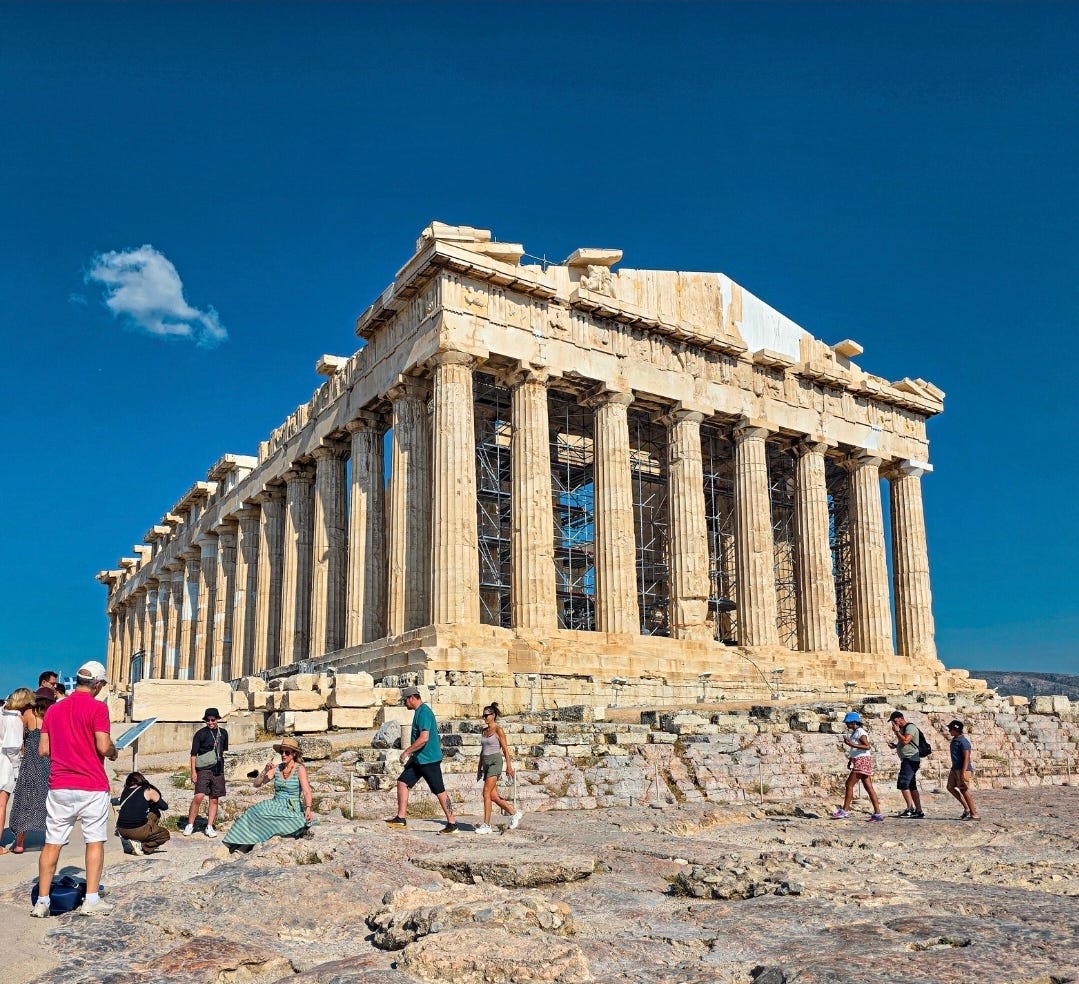
The Parthenon
The Indic and Iranian language families are believed to have emerged from a common linguistic ancestor spoken on the grasslands of the steppe around 2200 BC. Its speakers, the successors of the first people to domesticate the horse, called themselves Ārya. The reason namaz of Muslim prayer and namas in namaste sound so similar is that they are descended from the same proto-language!
Vedic Sanskrit and the Avestan dialects were probably two dialects amongst many spoken around 1500 BC. Yet they are the only ones to survive, as they became liturgical languages and were thus preserved orally by priests for thousands of years after they ceased to be spoken.
Rigveda and Gathas
Today we are used to calling the Achaemenid Persian Emperors by their names in Latin: Cyrus, Cambyses and Xerxes. Their names in Old Persian sound infinitely more familiar to Indians: Kūruš, Kambūjiya and Xšaya-ṛšā.
Fascinatingly, the Sanskrit Vedas and the Persian Avesta describe the same Bronze Age world of cattle-herders, chariots and warring clans. The Vedic yajna appears in Zoroastrian scripture as the yasna, while the Vedic soma is the Avestan haoma.
When a Parsi navjote and a Brahmin upanayana are set side by side, one is essentially watching two performances of the same Bronze Age initiation. Zarathustra, the founder of the Zoroastrian faith, describes himself as a zaotar, a cognate of the Vedic hotar, the chief priest of the Rigvedic sacrifice, and in one verse styles himself an ərəši-, a word many philologists have connected to the Vedic ṛṣi, the inspired seer.
3rd Century image of Zarathustra, from the Syrian Dura Europos Mithraum, now at Yale, Wikicommons
Zarathustra exalted one being above all others: Ahura Mazda, the “Wise Lord.” Ahura is the Avestan form of Sanskrit asura, “lord”, while mazdā is cognate with Sanskrit medhā, “wisdom.”
What is most fascinating is that the two traditions invert one another. In Iran, Zarathustra condemned the daēvas as false deities, so that daēva came to mean “demon.” The god Indra even appears in later Avestan texts as an arch-fiend. In India,
Devas and Asuras churn the Ocean, Bonhams
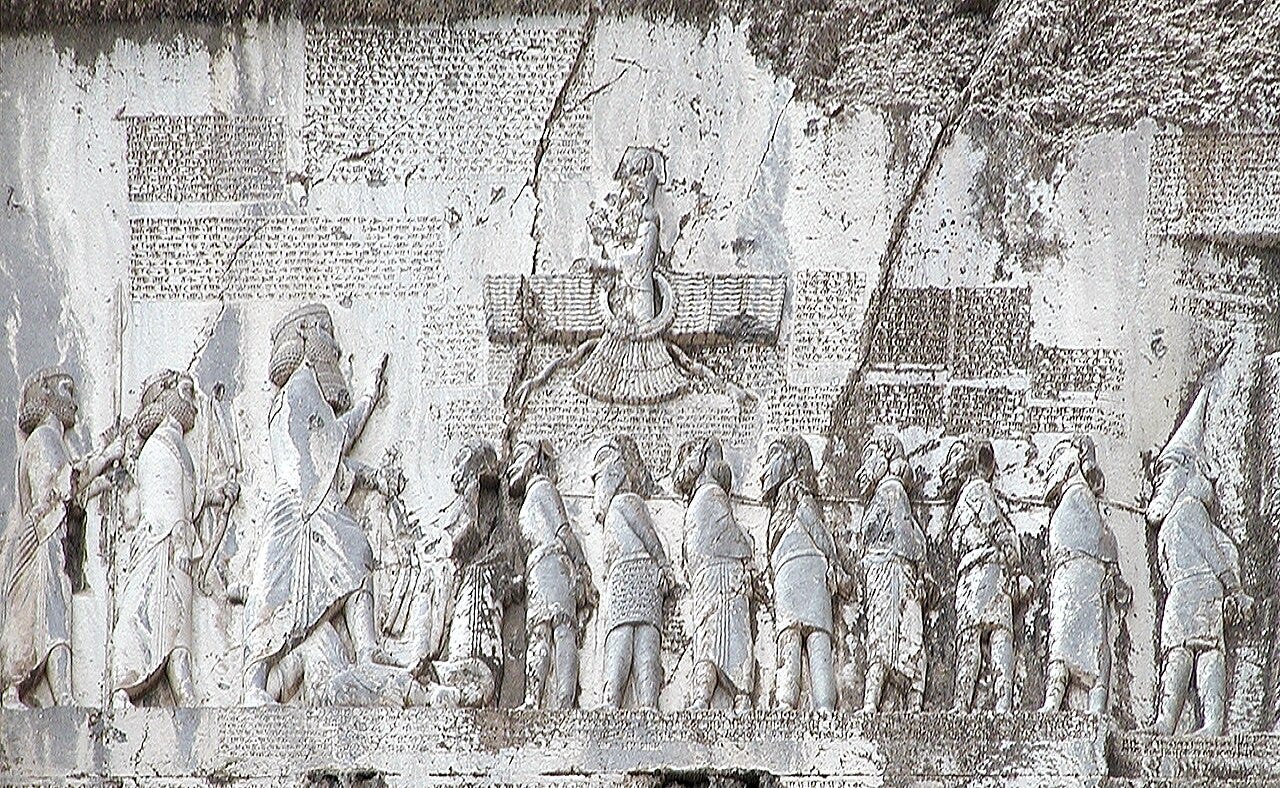
Darius tramples the head of Gaumata
Darius’ later inscriptions at Naqsh-e-Rustam and Susa, meanwhile, add another province called Hindush (the Indus region) to the list. Certainly the Persians seem to have reached the banks of the Indus by 517 BC, for that year Darius commissioned a Greek captain, Scylax of Caryanda, to sail down the Indus to the sea.
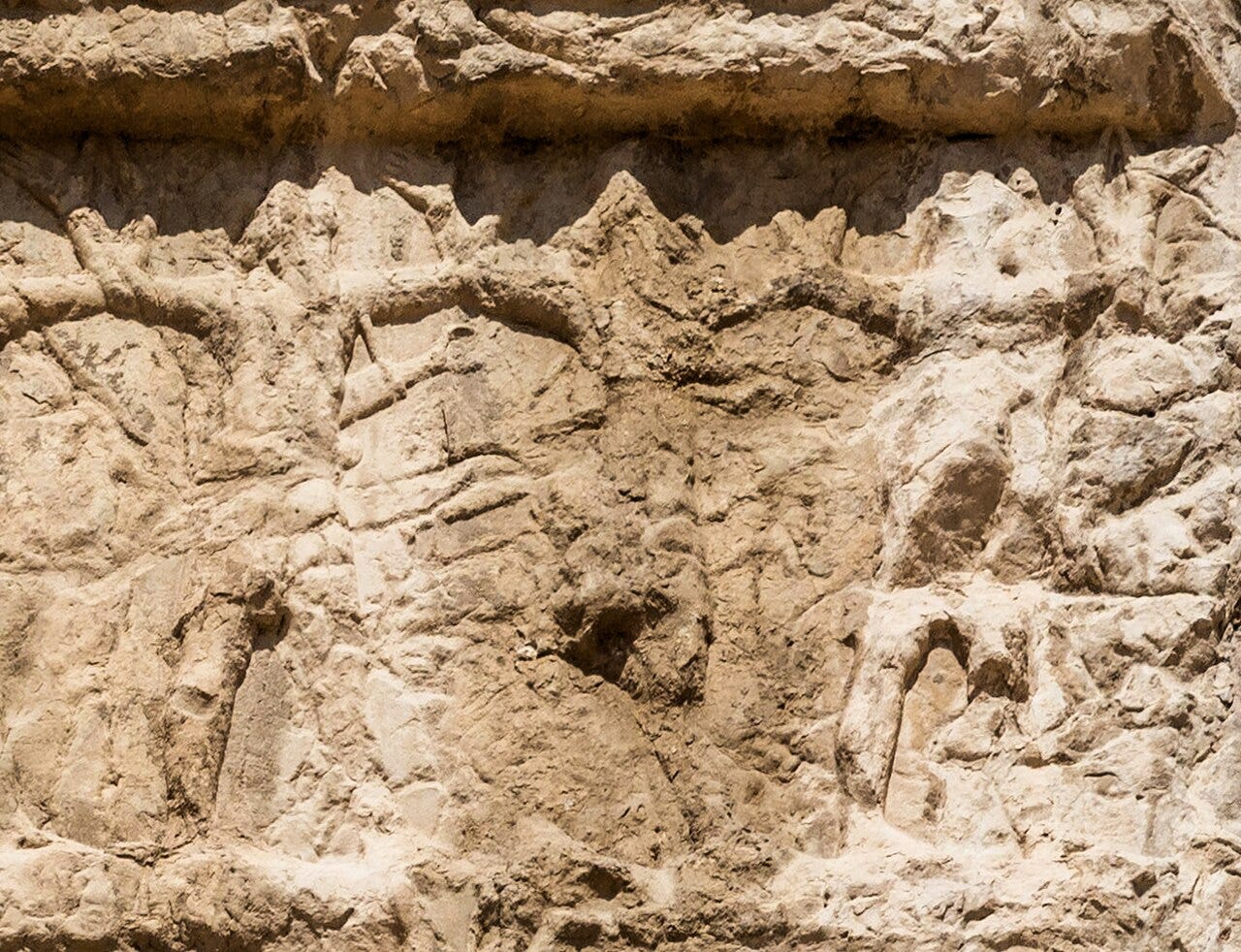
Indians on the Tomb of Darius, one of the earliest images of South Asians, Wikicommons
The Greek historian Herodotus later described the province of Hindush as the richest satrapy of the Persian empire, paying an annual tribute of 360 talents of gold dust. Much of what Herodotus says, of course, is hearsay - he also believed that this gold dust was mined by giant ants.
Persepolis
Darius’ palace would be carved with the earliest images of South Asians anywhere in the world. His audience hall at Persepolis depicts twenty-three delegations of subject peoples from across the Empire. Among them are delegations from the four eastern provinces of Gadara, Hindush, Thatagush and Harauvatish.
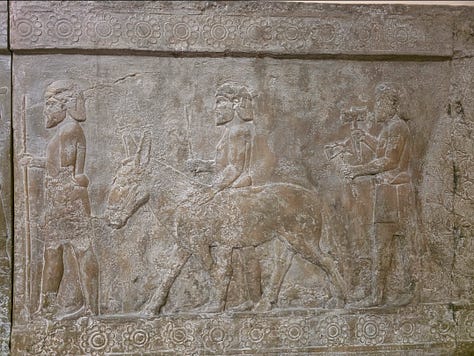
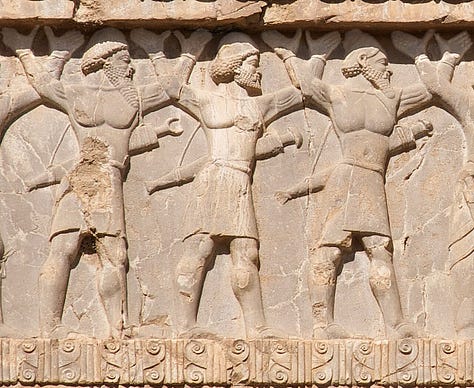
South Asians in Achaemenid Art
Tragically little documentation of these eastern provinces survives, and for the longest time even their locations were unclear. Gadara of course corresponds with Gandhara, the region between modern Peshawar and Kabul. Harauvatish was the name for southern Afghanistan, named after the Haraxvaiti or Helmand river (one of the candidates for the Vedic Saraswati). Thatagush appears to be the Bannu basin, while Hindush seems to be the Indus region of West Punjab and Sindh, centred perhaps on Taxila. The empire is notably absent from South Asian literature, and some scholars have suggested that these provinces were more akin to border protectorates than directly ruled satrapies.
In the last two decades, however, that picture has finally begun to change. At Akra, a vast mound rising out of the Bannu basin in northwest Pakistan, the Bannu Archaeological Project has uncovered a major Achaemenid-era city, possibly the provincial capital of Thatagush itself. Among the finds were the distinctive ‘tulip bowls’ of the imperial heartland, suggesting that local elites had adopted the banqueting culture of the Persian court.
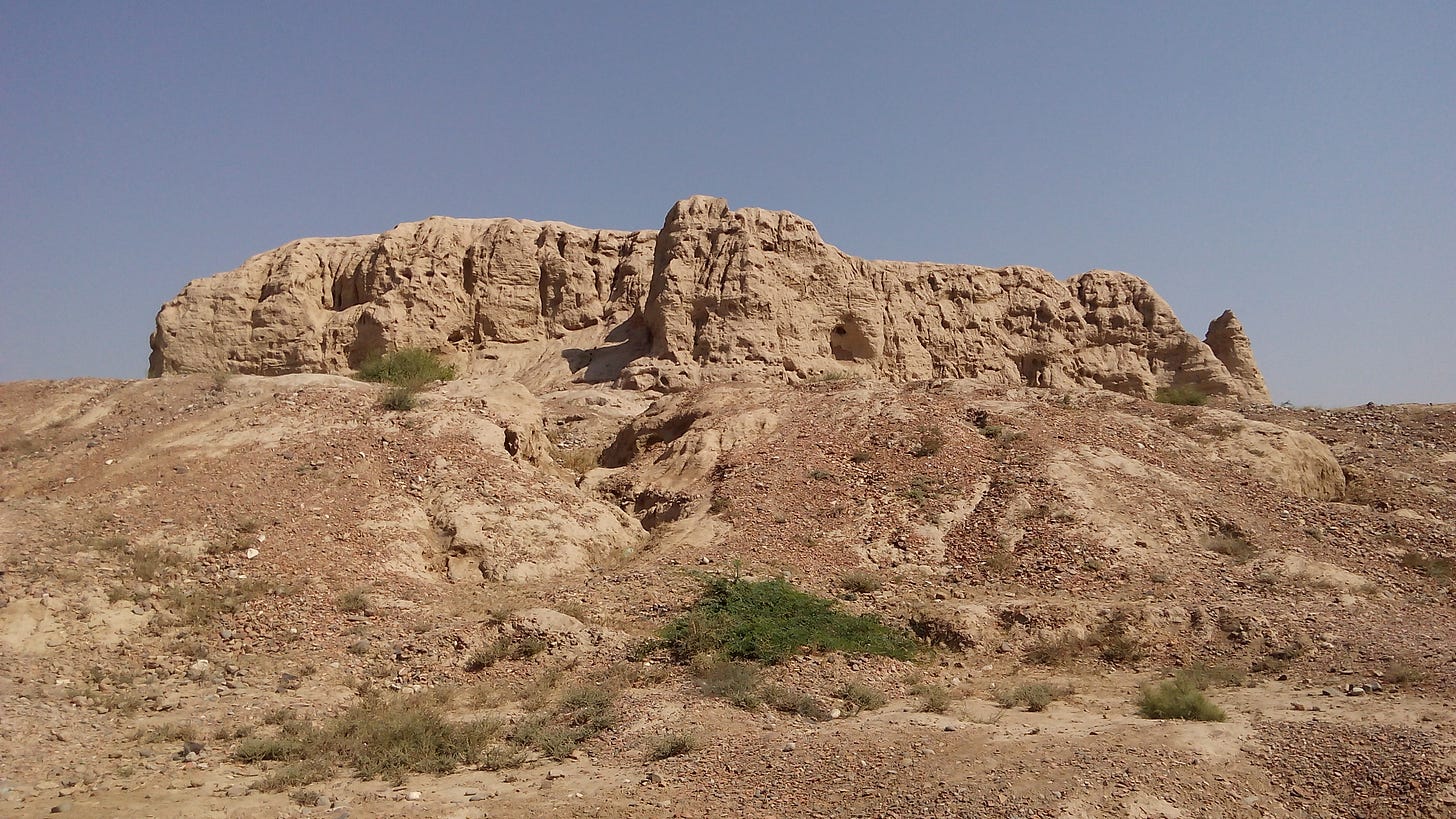
The Achaemenid Citadek at Akra, Bannu
Similar Achaemenid-period horizons have emerged at the Bhir Mound at Taxila (ancient Takshashila), at Charsadda (ancient Pushkalavati), and above all at Old Kandahar, which has yielded fragments of an Elamite administrative tablet of Persepolis type.
https://substackcdn.com/image/fetch/$s_!0etj!,f_auto,q_auto:good,fl_progressive:steep/https://substack-post-media.s3.amazonaws.com/public/images/11e619e7-0c41-4443-87bb-32bae4b9d465_2985x2702.jpeg
The Achaemenid section of Taxila near Bhir
Subscribe
The Achaemenids don’t seem to have had an overarching policy towards the eastern provinces of the Empire beyond a desire for taxes, defence and tribute. Nonetheless, the churn of people and ideas that the Achaemenid Empire produced had a very real impact on the region.
We have references to Gandharan slaves living in Babylon, Gandharan linen being worn in Uruk, and Indian diaspora businesses present at Nippur. The Persepolis Fortification Tablets even mention a tour guide called Dausaka “escorting one hundred Indians... to Susa.”
Perhaps most excitingly, scholars have found that ancient Indian mathematics and astronomy utilised earlier Babylonian discoveries. Babylonian units of time appear frequently in post-Achaemenid Sanskrit treatises on mathematics, for example, implying that Babylonian and Gandharan mathematicians may have worked together under the Achaemenids.
In the foundation inscription of his palace at Susa, Darius also lists how expensive materials were brought from every province of the empire. Cedar wood was brought from modern Lebanon, silver and ebony from Egypt, turquoise from modern Turkmenistan and stone columns from Elam. Yaka timber, meanwhile, was brought from Gandhara, and ivory from Hindush and Harauvatish.
https://substackcdn.com/image/fetch/$s_!LZDp!,f_auto,q_auto:good,fl_progressive:steep/https://substack-post-media.s3.amazonaws.com/public/images/e4ca9551-d111-4b3f-83e9-08963d17e5cf_1280x1085.jpeg
Frieze of Archers, formerly at the Apadana of the Palace of Darius in Susa, Iran, now in Louvre Museum, France, Wikicommons
The story is in all likelihood apocryphal. More believable, however, is his narration of Xerxes’ invasion of Greece.
In the spring of 480 BC, Xerxes assembled the largest army the ancient world had ever seen. There were soldiers drawn from every corner of his empire: Ethiopians wrapped in leopard skins, Scythians in tall caps, and of course the Hindush, “wearing garments made of tree-wool” and driving chariots “drawn by horses and wild asses.” Near them marched the Gandharans, brigaded with the Dadicae and equipped with short spears and reed bows, under Artyphius son of Artabanus. From the Bannu basin, meanwhile, came the Pactyans in cloaks of skin, carrying bows and daggers.
An Ethiopian in the Persian Army
This was the army that came grinding down through northern Greece to a narrow coastal pass called Thermopylae, where King Leonidas of Sparta and his 300 held the road before being betrayed, surrounded and annihilated. The pass fell, and in September 480 BC, Xerxes’ army marched on Athens.
Spearheads found on the fields of Thermopylae
The Athenians, advised by the oracle to trust in their “wooden walls,” took this to mean their ships and evacuated the city. The few who stayed barricaded themselves on the Acropolis, the sacred rock overlooking Athens, and were overwhelmed. Its ancient temples were then burnt by Xerxes’ army, drawn from what is now Ethiopia, Lebanon, Turkmenistan, Punjab, Sindh and the Khyber.
A collection of Greek artifacts that were destroyed by Persian soldiers at the Acropolis of Athens, photographed shortly after being excavated in 1866. Wikicommons
The oracle’s prophecy proved true, however. Weeks later, the Athenian-led fleet lured the Persian navy into the narrow straits of Salamis, just offshore, and destroyed it while Xerxes watched from a silver-footed throne above. Without his fleet, Xerxes withdrew to Asia, leaving his general Mardonius to complete the conquest with a hand-picked force: first the Persian Immortals, then the Medes, the Sacae, the Bactrians and the Indians. Out of the dozens of nations that had marched to Greece, the men of the Indus ranked among the five contingents worth keeping.
The Greeks finally drove the Persians out the following year, and the Athenians began to rebuild. They left the scorched column-drums of the old temple embedded in the Acropolis wall, where you can still see them today, and raised a new Parthenon above the ashes. Today, it is perhaps the most famous building in Europe.
Panini was born around the fifth century BC near Taxila, in what is now northern Pakistan but was then one of the easternmost cities of the Achaemenid Empire.
Taxila today
Panini is little known outside of India, yet his work, the Ashtadhyayi, is one of the great intellectual achievements of the ancient world: a sort of proto-algorithm that can generate every valid sentence in the language through some 4,000 compressed rules.
The Achaemenid world of satraps and emperors is remarkably absent from his work, yet he does refer to the Yavanas (Greeks), implying that he may have composed his work after Gandharan troops returned from Athens.
Subscribe
Just as fascinating, meanwhile, is the fact that Panini refers to both script (lipi) and scribes (lipikara). The Persians ran their empire on a written language called Aramaic, which they brought with them, and at least one of India’s earliest known scripts -Kharosthi - grew out of it. It may even have been the first script in use in India since the fall of the Indus Valley Civilisation, although this remains uncertain.
Aramaic document found at Bactria
Whatever the case, the man who fixed classical Sanskrit forever did his work in a frontier province of the Persian Empire, newly buzzing with scribes, foreign scripts and stories of Greece.
New work published this year by Kevin van Bladel has also sent me down a new rabbit hole of thought. Panini’s grandparents would have grown up in a world where the Persian language was still mutually intelligible with Sanskrit. Yet as vast numbers of Persian subjects began learning the language, the language itself had begun to simplify. Indeed, the Achaemenid royal inscriptions may provide, in van Bladel’s words, the earliest clear example of “morphological reduction through mass nonnative acquisition,” which essentially means that so many people who only partly knew the language began passing it on to their children that the language itself began to simplify, losing its complex cases and inflections.
Seen against this, Panini’s Ashtadhyayi takes on a new poignancy. Panini was not the first Sanskrit grammarian, and he himself names a whole lineage of predecessors. Yet he was working at the precise moment when languages across the region were changing faster than ever before, and when the mutual intelligibility that had bound the Indo-Iranian world together for two thousand years ended.
It is hard not to wonder whether Panini was working to make sure that the sacred language of the Vedas would never be as corrupted as its imperial cousin. Whatever the case he succeeded, freezing Sanskrit’s grammar forever and becoming the foundation of Sanskrit learning for the next two millennia.
They are a fascinating subject, but Alexander’s conquests were not actually the first documented time that Greeks encountered people from the Indus basin.
The ‘Buddha of Liberty',’ at the MET
A few months ago, I was in eastern Turkey, and on one of our last days we made our way up to the south face of the citadel at Van. High on the cliff is a trilingual cuneiform inscription begun by Darius the Great and completed by his son Xerxes around 470 BCE.
The Xerxes Inscription
Xerxes was, at the time, heading back from sacking the Acropolis of Athens and fighting the 300 of Sparta. Marching with him were regiments from across modern Pakistan and Afghanistan, and possibly as far east as modern India - the earliest documented force from the Indian subcontinent to have set foot in Europe.
The Parthenon that dominates Athens today was built on the ruins of an older one, destroyed by this army of Xerxes’.
It’s a fascinating story, and far too little known in the subcontinent itself. For some reason, the Achaemenid Persian Empire rarely features in Indian and Pakistani history books. And yet it was only because of the Persian Conquest of Punjab that Alexander had gone there at all!
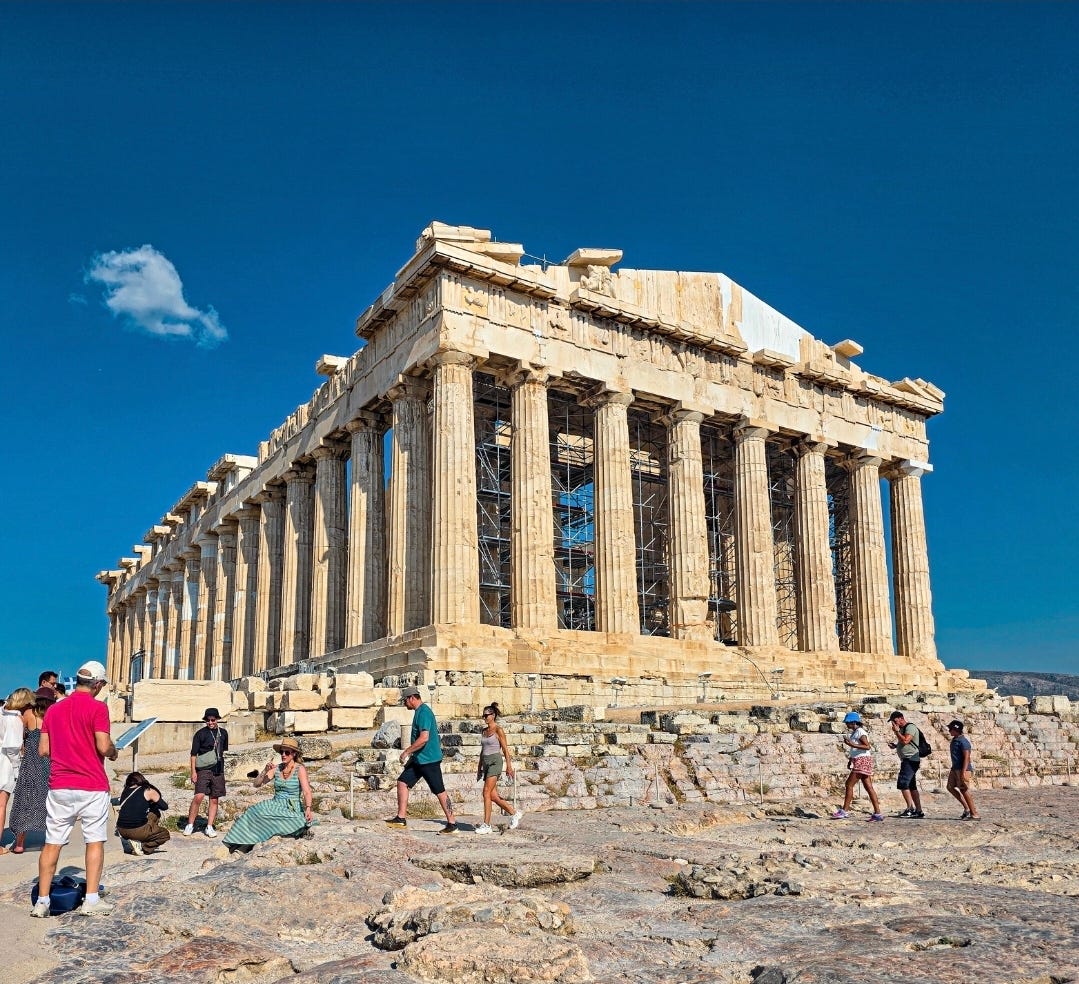
The Parthenon
The Indo-Persian World
It is important to remember, of course, that ‘India’ and ‘Persia’ were not yet definable spaces in the way that we imagine them today. Indeed, at the time of the Achaemenid Empire, Sanskrit and Old Persian were still mutually intelligible languages.The Indic and Iranian language families are believed to have emerged from a common linguistic ancestor spoken on the grasslands of the steppe around 2200 BC. Its speakers, the successors of the first people to domesticate the horse, called themselves Ārya. The reason namaz of Muslim prayer and namas in namaste sound so similar is that they are descended from the same proto-language!
Vedic Sanskrit and the Avestan dialects were probably two dialects amongst many spoken around 1500 BC. Yet they are the only ones to survive, as they became liturgical languages and were thus preserved orally by priests for thousands of years after they ceased to be spoken.
Rigveda and Gathas
Today we are used to calling the Achaemenid Persian Emperors by their names in Latin: Cyrus, Cambyses and Xerxes. Their names in Old Persian sound infinitely more familiar to Indians: Kūruš, Kambūjiya and Xšaya-ṛšā.
Fascinatingly, the Sanskrit Vedas and the Persian Avesta describe the same Bronze Age world of cattle-herders, chariots and warring clans. The Vedic yajna appears in Zoroastrian scripture as the yasna, while the Vedic soma is the Avestan haoma.
When a Parsi navjote and a Brahmin upanayana are set side by side, one is essentially watching two performances of the same Bronze Age initiation. Zarathustra, the founder of the Zoroastrian faith, describes himself as a zaotar, a cognate of the Vedic hotar, the chief priest of the Rigvedic sacrifice, and in one verse styles himself an ərəši-, a word many philologists have connected to the Vedic ṛṣi, the inspired seer.
3rd Century image of Zarathustra, from the Syrian Dura Europos Mithraum, now at Yale, Wikicommons
Zarathustra exalted one being above all others: Ahura Mazda, the “Wise Lord.” Ahura is the Avestan form of Sanskrit asura, “lord”, while mazdā is cognate with Sanskrit medhā, “wisdom.”
What is most fascinating is that the two traditions invert one another. In Iran, Zarathustra condemned the daēvas as false deities, so that daēva came to mean “demon.” The god Indra even appears in later Avestan texts as an arch-fiend. In India,
Devas and Asuras churn the Ocean, Bonhams
The Achaemenid Conquest of the Indus Valley
In the 530s BC, Cyrus the Great marched an army into Afghanistan, destroying the city of Kapisa (Bagram). Precisely when he annexed the Indus Valley is uncertain, but just a decade later, his successor Darius ordered the creation of a carving at Bisotun, announcing his vanquishing of the pretender Gaumata, the rebellion of the province of Thatagush, and the conquest of Gandhara.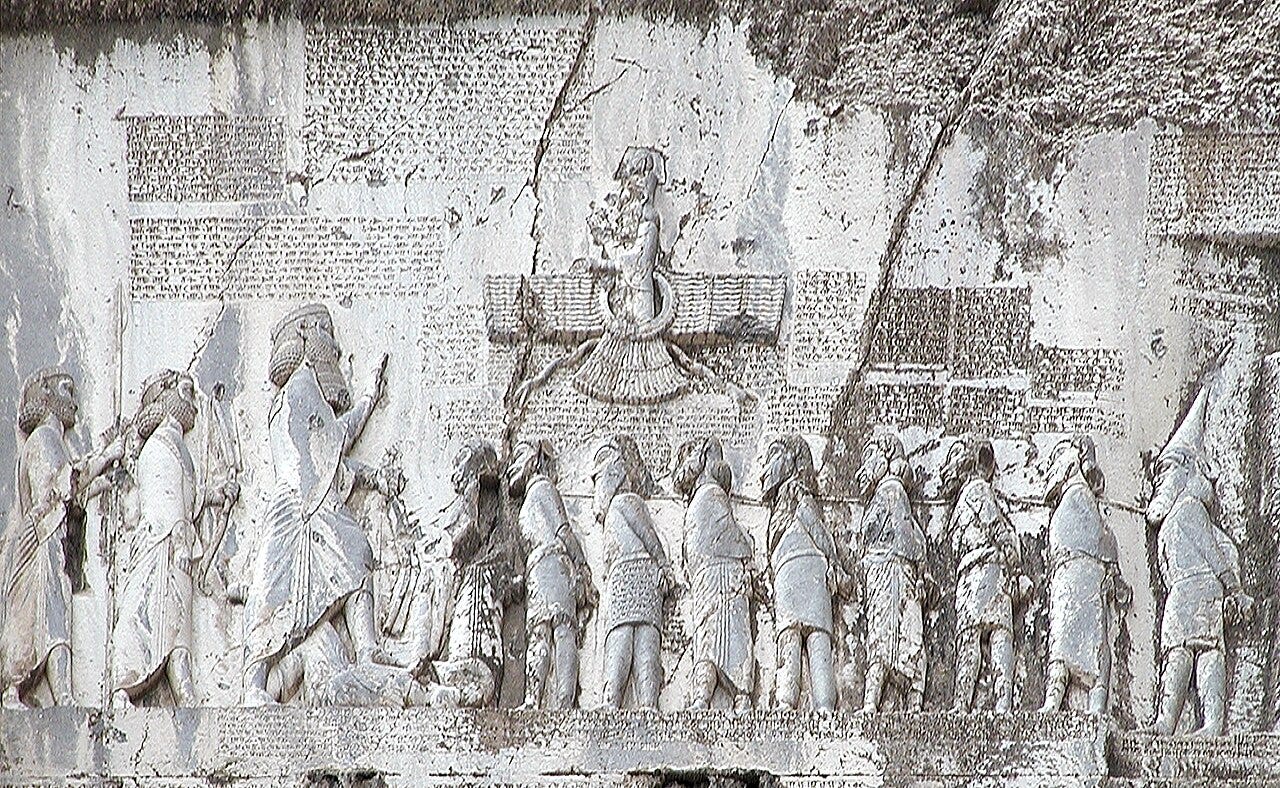
Darius tramples the head of Gaumata
Darius’ later inscriptions at Naqsh-e-Rustam and Susa, meanwhile, add another province called Hindush (the Indus region) to the list. Certainly the Persians seem to have reached the banks of the Indus by 517 BC, for that year Darius commissioned a Greek captain, Scylax of Caryanda, to sail down the Indus to the sea.
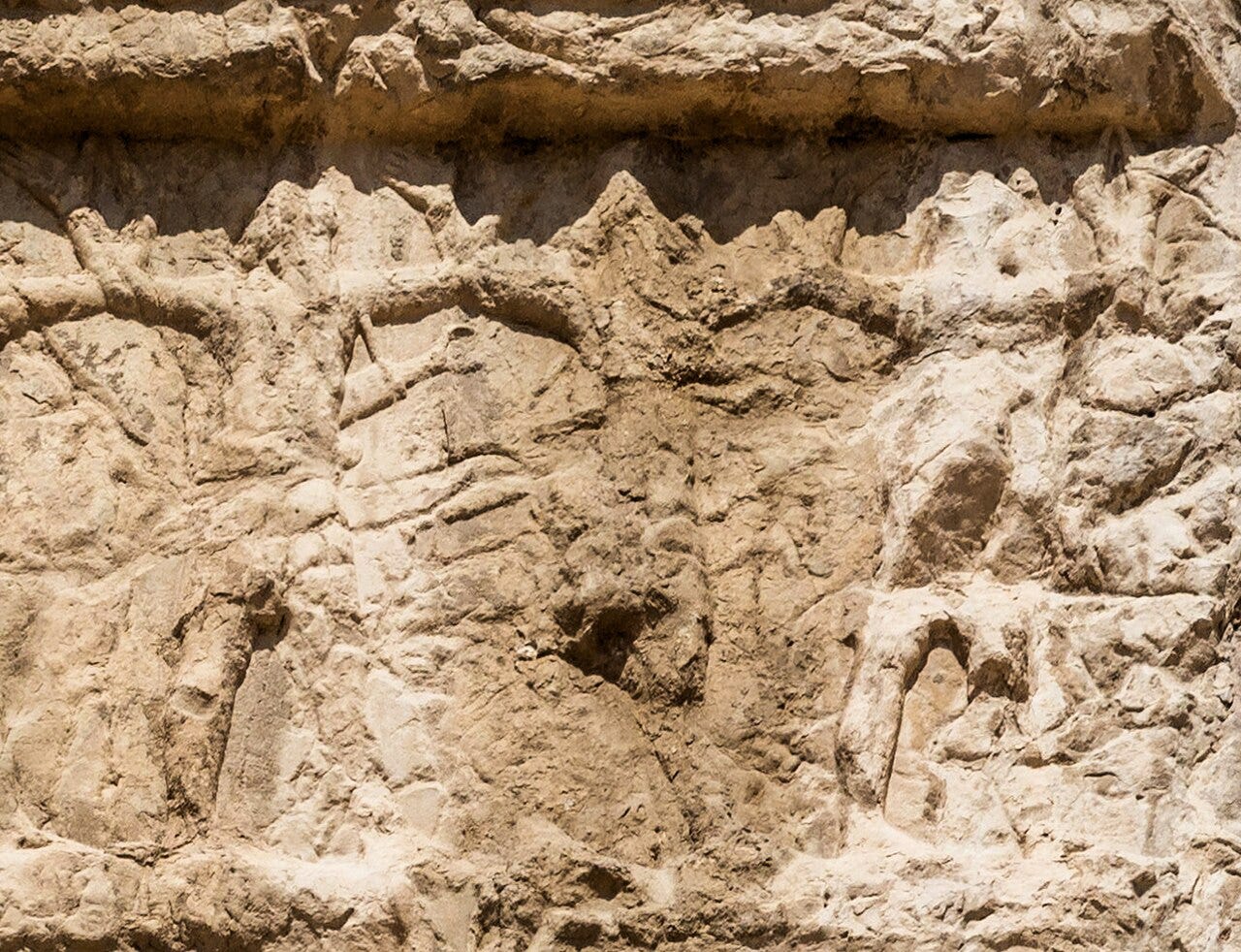
Indians on the Tomb of Darius, one of the earliest images of South Asians, Wikicommons
The Greek historian Herodotus later described the province of Hindush as the richest satrapy of the Persian empire, paying an annual tribute of 360 talents of gold dust. Much of what Herodotus says, of course, is hearsay - he also believed that this gold dust was mined by giant ants.
Persepolis
Darius’ palace would be carved with the earliest images of South Asians anywhere in the world. His audience hall at Persepolis depicts twenty-three delegations of subject peoples from across the Empire. Among them are delegations from the four eastern provinces of Gadara, Hindush, Thatagush and Harauvatish.
South Asians in Achaemenid Art
Tragically little documentation of these eastern provinces survives, and for the longest time even their locations were unclear. Gadara of course corresponds with Gandhara, the region between modern Peshawar and Kabul. Harauvatish was the name for southern Afghanistan, named after the Haraxvaiti or Helmand river (one of the candidates for the Vedic Saraswati). Thatagush appears to be the Bannu basin, while Hindush seems to be the Indus region of West Punjab and Sindh, centred perhaps on Taxila. The empire is notably absent from South Asian literature, and some scholars have suggested that these provinces were more akin to border protectorates than directly ruled satrapies.
In the last two decades, however, that picture has finally begun to change. At Akra, a vast mound rising out of the Bannu basin in northwest Pakistan, the Bannu Archaeological Project has uncovered a major Achaemenid-era city, possibly the provincial capital of Thatagush itself. Among the finds were the distinctive ‘tulip bowls’ of the imperial heartland, suggesting that local elites had adopted the banqueting culture of the Persian court.
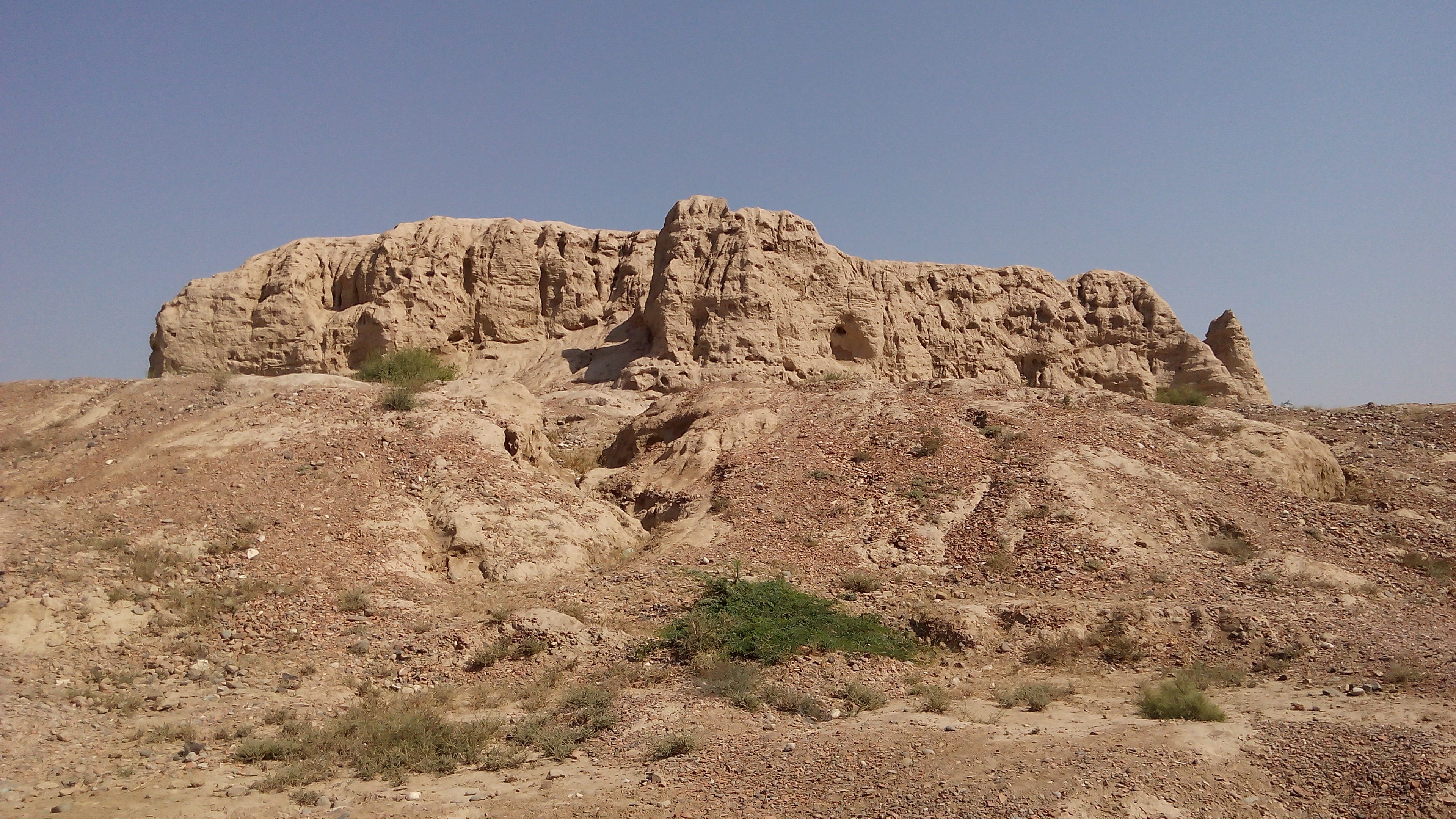
The Achaemenid Citadek at Akra, Bannu
Similar Achaemenid-period horizons have emerged at the Bhir Mound at Taxila (ancient Takshashila), at Charsadda (ancient Pushkalavati), and above all at Old Kandahar, which has yielded fragments of an Elamite administrative tablet of Persepolis type.
https://substackcdn.com/image/fetch/$s_!0etj!,f_auto,q_auto:good,fl_progressive:steep/https://substack-post-media.s3.amazonaws.com/public/images/11e619e7-0c41-4443-87bb-32bae4b9d465_2985x2702.jpeg
The Achaemenid section of Taxila near Bhir
Subscribe
The Achaemenids don’t seem to have had an overarching policy towards the eastern provinces of the Empire beyond a desire for taxes, defence and tribute. Nonetheless, the churn of people and ideas that the Achaemenid Empire produced had a very real impact on the region.
We have references to Gandharan slaves living in Babylon, Gandharan linen being worn in Uruk, and Indian diaspora businesses present at Nippur. The Persepolis Fortification Tablets even mention a tour guide called Dausaka “escorting one hundred Indians... to Susa.”
Perhaps most excitingly, scholars have found that ancient Indian mathematics and astronomy utilised earlier Babylonian discoveries. Babylonian units of time appear frequently in post-Achaemenid Sanskrit treatises on mathematics, for example, implying that Babylonian and Gandharan mathematicians may have worked together under the Achaemenids.
In the foundation inscription of his palace at Susa, Darius also lists how expensive materials were brought from every province of the empire. Cedar wood was brought from modern Lebanon, silver and ebony from Egypt, turquoise from modern Turkmenistan and stone columns from Elam. Yaka timber, meanwhile, was brought from Gandhara, and ivory from Hindush and Harauvatish.
https://substackcdn.com/image/fetch/$s_!LZDp!,f_auto,q_auto:good,fl_progressive:steep/https://substack-post-media.s3.amazonaws.com/public/images/e4ca9551-d111-4b3f-83e9-08963d17e5cf_1280x1085.jpeg
Frieze of Archers, formerly at the Apadana of the Palace of Darius in Susa, Iran, now in Louvre Museum, France, Wikicommons
The Burning of Athens
The earliest documented encounter between Indians and Greeks occurred, according to Herodotus, in the reign of King Darius, who summoned some Greeks at his court and asked what it would take for them to eat the bodies of their dead fathers. They recoiled in horror, at which point Darius summoned a group of Indians, the Kallatiai, who did eat their dead.The story is in all likelihood apocryphal. More believable, however, is his narration of Xerxes’ invasion of Greece.
In the spring of 480 BC, Xerxes assembled the largest army the ancient world had ever seen. There were soldiers drawn from every corner of his empire: Ethiopians wrapped in leopard skins, Scythians in tall caps, and of course the Hindush, “wearing garments made of tree-wool” and driving chariots “drawn by horses and wild asses.” Near them marched the Gandharans, brigaded with the Dadicae and equipped with short spears and reed bows, under Artyphius son of Artabanus. From the Bannu basin, meanwhile, came the Pactyans in cloaks of skin, carrying bows and daggers.
An Ethiopian in the Persian Army
This was the army that came grinding down through northern Greece to a narrow coastal pass called Thermopylae, where King Leonidas of Sparta and his 300 held the road before being betrayed, surrounded and annihilated. The pass fell, and in September 480 BC, Xerxes’ army marched on Athens.
Spearheads found on the fields of Thermopylae
The Athenians, advised by the oracle to trust in their “wooden walls,” took this to mean their ships and evacuated the city. The few who stayed barricaded themselves on the Acropolis, the sacred rock overlooking Athens, and were overwhelmed. Its ancient temples were then burnt by Xerxes’ army, drawn from what is now Ethiopia, Lebanon, Turkmenistan, Punjab, Sindh and the Khyber.
A collection of Greek artifacts that were destroyed by Persian soldiers at the Acropolis of Athens, photographed shortly after being excavated in 1866. Wikicommons
The oracle’s prophecy proved true, however. Weeks later, the Athenian-led fleet lured the Persian navy into the narrow straits of Salamis, just offshore, and destroyed it while Xerxes watched from a silver-footed throne above. Without his fleet, Xerxes withdrew to Asia, leaving his general Mardonius to complete the conquest with a hand-picked force: first the Persian Immortals, then the Medes, the Sacae, the Bactrians and the Indians. Out of the dozens of nations that had marched to Greece, the men of the Indus ranked among the five contingents worth keeping.
The Greeks finally drove the Persians out the following year, and the Athenians began to rebuild. They left the scorched column-drums of the old temple embedded in the Acropolis wall, where you can still see them today, and raised a new Parthenon above the ashes. Today, it is perhaps the most famous building in Europe.
Panini and Achaemenid Sanskrit
Perhaps the most important witness to Achaemenid India, however, is the Sanskrit grammarian Panini.Panini was born around the fifth century BC near Taxila, in what is now northern Pakistan but was then one of the easternmost cities of the Achaemenid Empire.
Taxila today
Panini is little known outside of India, yet his work, the Ashtadhyayi, is one of the great intellectual achievements of the ancient world: a sort of proto-algorithm that can generate every valid sentence in the language through some 4,000 compressed rules.
The Achaemenid world of satraps and emperors is remarkably absent from his work, yet he does refer to the Yavanas (Greeks), implying that he may have composed his work after Gandharan troops returned from Athens.
Subscribe
Just as fascinating, meanwhile, is the fact that Panini refers to both script (lipi) and scribes (lipikara). The Persians ran their empire on a written language called Aramaic, which they brought with them, and at least one of India’s earliest known scripts -Kharosthi - grew out of it. It may even have been the first script in use in India since the fall of the Indus Valley Civilisation, although this remains uncertain.
Aramaic document found at Bactria
Whatever the case, the man who fixed classical Sanskrit forever did his work in a frontier province of the Persian Empire, newly buzzing with scribes, foreign scripts and stories of Greece.
New work published this year by Kevin van Bladel has also sent me down a new rabbit hole of thought. Panini’s grandparents would have grown up in a world where the Persian language was still mutually intelligible with Sanskrit. Yet as vast numbers of Persian subjects began learning the language, the language itself had begun to simplify. Indeed, the Achaemenid royal inscriptions may provide, in van Bladel’s words, the earliest clear example of “morphological reduction through mass nonnative acquisition,” which essentially means that so many people who only partly knew the language began passing it on to their children that the language itself began to simplify, losing its complex cases and inflections.
Seen against this, Panini’s Ashtadhyayi takes on a new poignancy. Panini was not the first Sanskrit grammarian, and he himself names a whole lineage of predecessors. Yet he was working at the precise moment when languages across the region were changing faster than ever before, and when the mutual intelligibility that had bound the Indo-Iranian world together for two thousand years ended.
It is hard not to wonder whether Panini was working to make sure that the sacred language of the Vedas would never be as corrupted as its imperial cousin. Whatever the case he succeeded, freezing Sanskrit’s grammar forever and becoming the foundation of Sanskrit learning for the next two millennia.


