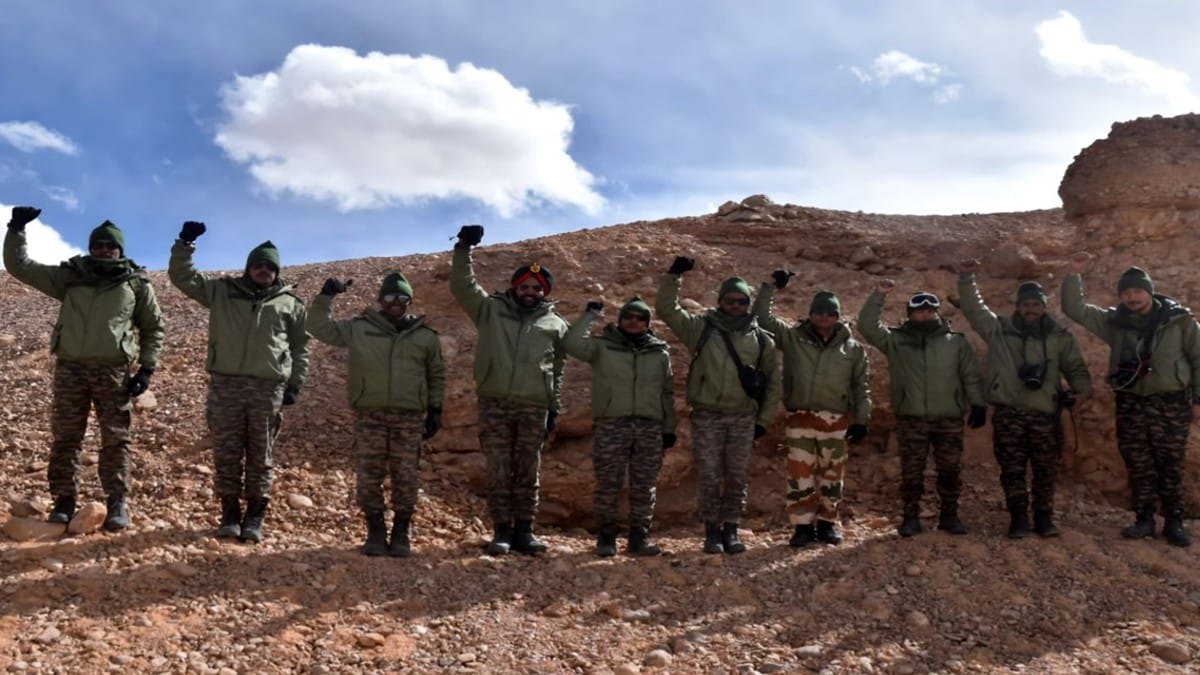
2024, the year India defeated China's salami-slicing strategy
For decades, China’s strategy of “salami slicing”— incrementally encroaching on territory to solidify its claims — has reshaped borders and silenced resistance across Asia. From the South
China Sea to Himalayan frontiers, Beijing’s methodical approach has left neighbouring countries scrambling to respond. China shares its border with more than a dozen countries and it has had border disputes with at least six of them over the past few years. On its border disputes with its neighbors, China has mostly gone unchallenged, gradually pushing its salami-slicing strategy forward. But 2024 was a turning point:
India was the first country in past few decades to decisively stop China in its tracks and refuse to yield to its tried-and-tested game. India’s resistance proved to be a firm message that China’s expansionist ambitions can't always go unchecked.
China’s Unchecked March: A History of Dominance
China’s history of border disputes is a study in opportunism. China has locked horns with no fewer than six of its neighbours, from Japan over islands in the East China Sea, down to Vietnam, Malaysia and the Philippines in the South China Sea. From the construction of artificial islands to weaponizing of trade, leveraging economic dependence, it has often found a way to dominate.
The Turning Point: India’s Bold Stand
India’s watershed moment came in 2024 with a landmark agreement over the Line of Actual Control (LAC). This wasn’t just another border negotiation; it marked the culmination of years of tension following the deadly 2020 Galwan clash that left 20 Indian soldiers and an undisclosed number of Chinese troops dead. While China likely expected India to fall in line, as many of its neighbors had, it faced a resolute adversary instead.
India refused to let China dictate terms. The strategic deployment of troops, modernising infrastructure on the LAC, and an unambiguous message through diplomatic channels made it amply clear that China’s salami slicing was not going to work this time. This multi-pronged approach forced Beijing to agree to a phased disengagement and a novel patrolling mechanism — a first in decades of border disputes.
The turning point came when Prime Minister Narendra Modi and Chinese President Xi Jinping sat down for their first face-to-face meeting in years at the BRICS Summit in Kazan. For the first time since 2019, the two leaders had directly engaged each other, and the meeting marked a shift toward breaking the deadlock in their strained relationship. Both leaders agreed that stability in bilateral ties needed to be rebuilt, with a focus on respect for each other's sensitivities and concerns.
This rare exchange injected a sense of cautious optimism into an otherwise tense chapter in India-China relations.
Foreign Secretary Vikram Misri confirmed that both nations had reached a resolution to address the issues stemming from the 2020 border clashes, a significant step towards stabilising bilateral ties.
Following high-level talks between National Security Advisor Ajit Doval and Chinese Foreign Minister Wang Yi in St Petersburg, both countries agreed to expedite efforts to resolve the remaining border disputes and improve bilateral relations.
A month before the border breakthrough, External Affairs Minister S Jaishankar said that 75 per cent of the disengagement issues had been sorted out.
The disengagement agreement in the remaining areas, Depsang and Demchok, in October had paved the way for a bilateral meeting between PM Modi and President Xi on the margins of the BRICS summit in Kazan in which the leaders endorsed the agreement and agreed to resume exchanges between the special representatives on the boundary question and the foreign ministers.
During the talks, both sides highlighted the importance of regular exchanges and contacts at diplomatic and military level through established mechanisms. "They agreed on the need for effective border management and maintenance of peace & tranquillity in accordance with relevant bilateral agreements, protocols and understandings reached between the two governments," said the Indian govt, adding that the Chinese delegation also called on foreign secretary Vikram Misri.
According to the Indian side, the two countries reviewed the situation in border areas, and reflected on the lessons learnt from the events of 2020, which included the deadly Galwan clashes, in order to prevent their recurrence.
Confirming that the disengagement process has been completed in eastern Ladakh, foreign minister S Jaishankar had said in Parliament this week that India will now focus on de-escalation and on effective management of border activities. He had also said that ties with China, which went into a tailspin after the 2020 Galwan military clashes, are now improving.In the latest round of the Working Mechanism for Consultation & Coordination on India-China Border Affairs (WMCC) talks on Thursday,
both sides "positively affirmed the implementation of the most recent disengagement agreement which completed the resolution of the issues that emerged in 2020, said the Indian govt.
"They also prepared for the next meeting of the special representatives, which is to be held in accordance with the decision of the two leaders in their meeting in Kazan on Oct 23, 2024," added the Indian readout.
"They also prepared for the next meeting of the special representatives, which is to be held in accordance with the decision of the two leaders in their meeting in Kazan on Oct 23, 2024," added the Indian readout.
The agreement includes rights related to patrolling and grazing in traditional areas .He added, Based on this consensus, the disengagement process is nearly complete. We will strive to move beyond just disengagement, but for that, we will need to wait a little longer.
This came after both India and China confirmed that an agreement had been reached between the two nations regarding patrolling arrangements along the Line of Actual Control (LAC) in the India-China border areas.
Speaking at a press briefing, MEA spokesperson Randhir Jaiswal confirmed that India and China had finalised the last phase of disengagement in these regions. "On October 21, 2024, the final phase of disengagement was agreed upon between India and China.
As a result, verification patrolling has commenced on mutually agreed terms in Demchok and Depsang. We will keep you updated," he said.
Earlier in the day, the spokesperson of the Chinese Embassy in India announced on the social media platform, X that the Chinese and Indian troops are implementing the resolutions that the two sides reached on issues concerning the border area, which is going smoothly at the moment .Chinese Ambassador to India Xu Feihong had also earlier said that he hoped the bilateral ties would move forward smoothly and ties between both countries would not be restricted or interrupted by specific disagreements.
How India Did It
India’s success in halting China wasn’t accidental. It was the result of deliberate actions on multiple fronts:
Strategic Military Presence
India’s military strategy underwent a significant transformation to counter the challenges posed by China. Unlike other nations that found themselves blindsided by Beijing’s gradual territorial encroachments, New Delhi adopted a proactive stance. Over the years, India invested heavily in upgrading its border infrastructure in remote, high-altitude regions such as Ladakh and Arunachal Pradesh, ensuring year-round access for its forces. Advanced weaponry and specialised units were deployed to enhance readiness, leaving little room for complacency. As one senior military official put it, “India’s capability to deploy swiftly and respond robustly has completely shifted the dynamics along the LAC.”
Stiff Negotiations
Breaking from past approaches that often yielded temporary solutions, India’s negotiators took a firmer stance. Talks with China became uncompromising, linking broader diplomatic relations to peace along the LAC. By insisting that de-escalation was a prerequisite for any meaningful engagement, India reset the terms of negotiation. External Affairs Minister S. Jaishankar emphasized, “There can be no normalization of ties without peace and tranquillity in border areas. That is the baseline.”
Why India’s Stand Matters
This move by India carries great importance beyond its borders. The firm stand against China has made New Delhi a shining example for other countries that have been facing similar pressures while navigating them. It shows how strategic blending of military preparedness, economic resilience and robust international alliances can counterbalance the dominance of an adversary.
More importantly, India's approach has derailed the narrative of China's unchecked border aggression. It proved that even the most ambitious expansionist plans of China can be restrained through determined resistance.
While India has achieved some notable success, major issues remain. The border dispute is far from fully resolved, and disputed areas like Depsang and Arunachal Pradesh are still unresolved. Restoration of trust will demand persistent dialogue and strict adherence to disengagement agreements -- no small feat given Beijing's spotty track record.
2024 wasn’t just another year in India-China relations. It was the year India proved that China’s salami-slicing strategy has limits. While many others have capitulated, India resisted, setting a precedent for how neighbours can counterbalance Beijing’s growing assertiveness.
In 2024, India became the first nation in decades to effectively halt China's 'salami-slicing' territorial encroachment strategy. Following the 2020 Galwan clash, India's bolstered military presence, economic diversification, and firm negotiation tactics led to a landmark border agreement...

economictimes.indiatimes.com