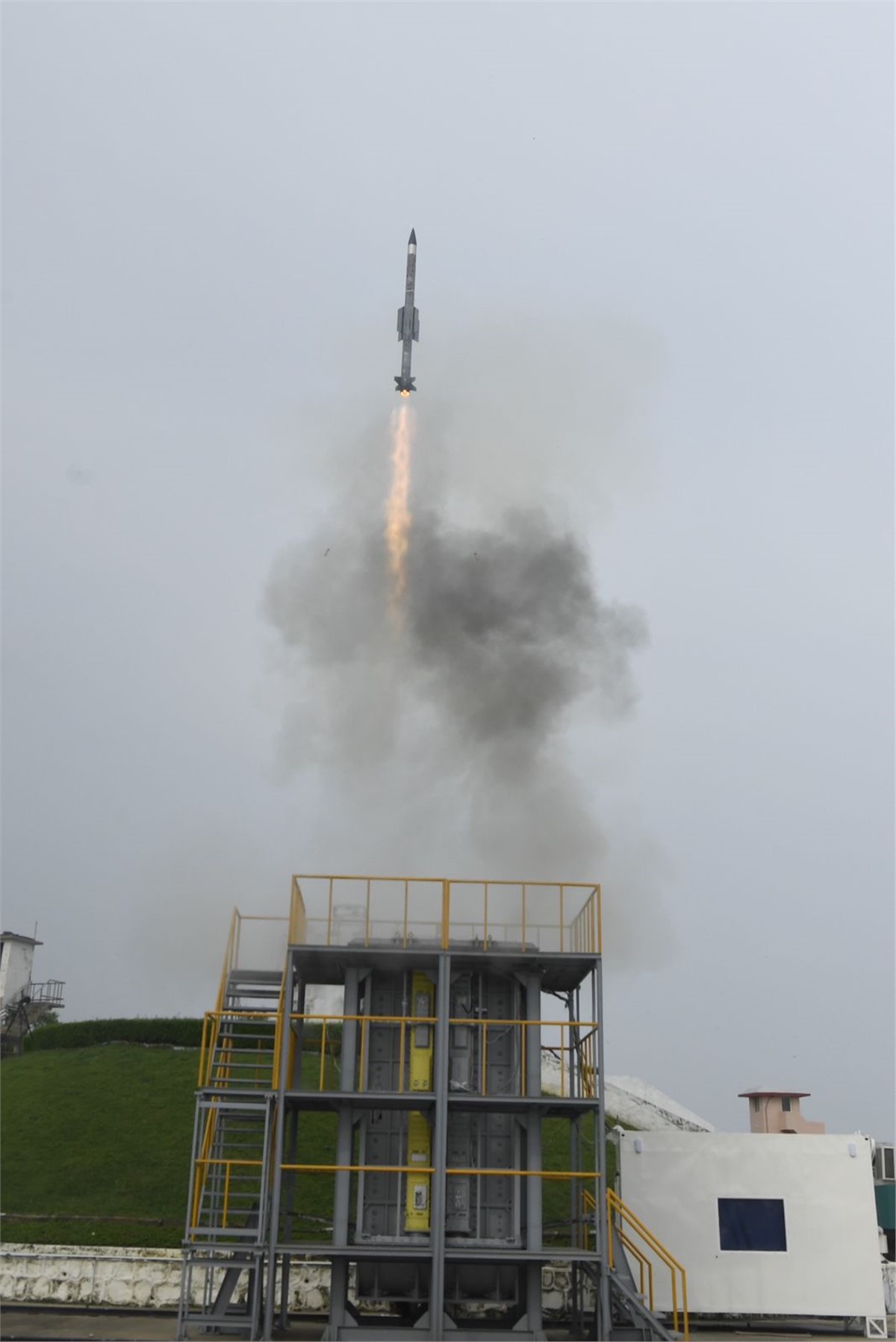
India's latest test of the vertical launch short-range surface-to-air missile (VL-SRSAM) was conducted on 12 September 2024. The missile fired in this test features an updated seeker and proximity fuze. (PIB)
India's Defence Research and Development Organisation (DRDO) and the Indian Navy have carried out another test of the country's vertical launch short-range surface-to-air missile (VL-SRSAM), which has since been updated with new systems.
The test was conducted on 12 September from the Integrated Test Range located in Chandipur, off the coast of Odisha, India's Ministry of Defence (MoD) disclosed in a statement on the same day.
The flight test was carried out from a land-based vertical launcher and intercepted a high-speed aerial target flying at a low altitude, the statement said. An image accompanying the statement indicates that this was similar to the eight-cell launcher seen in previous tests of the weapon system.
The missile system successfully tracked and engaged the target, the statement added.
n a further explanation of what the test entailed, the MoD noted that it was carried out to validate several updated elements of the weapon system.
These include the missile's proximity fuze and seeker. The performance of these new components was tracked with various instruments including telemetry systems and radar and electro-optic trackers, the MoD added.
The VL-SRSAM is estimated to have a length of about 3.8 m, while its estimated top speed is Mach 4 and its maximum range is believed to be between 40 and 50 km.
It is armed with a high-explosive pre-fragmented warhead and relies on an inertial navigation system (INS) for its mid-course before switching to a radio frequency-based seeker for the terminal phase of its flight.





 PTI Murad Saeed in Afghanistan, was 'controlling KP govt' from there: Rana Sanaullah (22 Viewers)


