India Economy Thread

You guys gonna stop fudging the GDP in India then. IMF wasn't happy at all.
You must be living in 2025. Keep yourself updated.

Better data, sharper accuracy: IMF applauds India’s new GDP calculation framework - BusinessToday
 
The Rs 19,000+ crore Talcher Fertiliser(TFL) Project in Odisha is finally making significant progress.

Once operational, it will be India’s first coal-gasification-based urea plant, producing 1.27 million tonnes of urea annually.

The project is now 72.97% complete, with Dec.....

 
You must be living in 2025. Keep yourself updated.

Better data, sharper accuracy: IMF applauds India’s new GDP calculation framework - BusinessToday


Oh no, we need to figure out new ways to be shameless!

I know, IMF is too stupid to catch fake data!
 
You must be living in 2025. Keep yourself updated.

Better data, sharper accuracy: IMF applauds India’s new GDP calculation framework - BusinessToday
I do keep myself updated. So you admit the IMF was waving its arms over the fact India couldn't do basic mathematics. Still...
 

Attachments

  • Screenshot_20260922_155044_Chrome.jpg
    Screenshot_20260922_155044_Chrome.jpg
    278.2 KB · Views: 8
I do keep myself updated. So you admit the IMF was waving its arms over the fact India couldn't do basic mathematics. Still...
Niha Masih still salty despite IMF approval.
If calculating GDP of a rapidly advancing and digitalising economy which changes economic sector every year is basic mathematics for you, then you must be a some highly advance A.I. , which I seriously doubt.
 
Niha Masih still salty despite IMF approval.
If calculating GDP of a rapidly advancing and digitalising economy which changes economic sector every year is basic mathematics for you, then you must be a some highly advance A.I. , which I seriously doubt.
“The ‘basic mathematics’ remark was sarcasm, obviously. But apparently the sarcasm has caused you to miss the actual point. The IMF didn't criticise India's ability to perform arithmetic; it criticised the methodology being used to produce the GDP figures — including the outdated 2011–12 base year, extensive single deflation and discrepancies between production and expenditure estimates.
Indeed, India subsequently replaced the 2011–12 GDP series with a 2022–23 base and introduced methodological changes. So your argument about a rapidly changing economy rather conveniently demonstrates why the methodology matters.
You responded to the joke. I'm discussing the statistics.”
 
“The ‘basic mathematics’ remark was sarcasm, obviously. But apparently the sarcasm has caused you to miss the actual point. The IMF didn't criticise India's ability to perform arithmetic; it criticised the methodology being used to produce the GDP figures — including the outdated 2011–12 base year, extensive single deflation and discrepancies between production and expenditure estimates.
Indeed, India subsequently replaced the 2011–12 GDP series with a 2022–23 base and introduced methodological changes. So your argument about a rapidly changing economy rather conveniently demonstrates why the methodology matters.
You responded to the joke. I'm discussing the statistics.”
India already corrected that discrepancy by applying retrospective double deflator for 2011-23 and reduced its GDP by 3.5% earlier this year.
So I don't know what are you harping about ? India Happy. IMF Happy ,but You and some other Jurnos with agenda not Happy.
 
India already corrected that discrepancy by applying retrospective double deflator for 2011-23 and reduced its GDP by 3.5% earlier this year.
So I don't know what are you harping about ? India Happy. IMF Happy ,but You and some other Jurnos with agenda not Happy.
“That’s rather the point. ‘India happy, IMF happy’ doesn't erase the fact that the figures being presented to the world for years were produced using a methodology the IMF had repeatedly identified as having significant shortcomings.
This wasn't suddenly discovered yesterday: the IMF had been flagging problems with India's national accounts for years. By 2025 it identified an outdated 2011–12 base year, extensive reliance on single deflation, problematic use of WPI and discrepancies between production- and expenditure-side GDP.
India subsequently replaced the series with a 2022–23 base and changed the methodology, including adopting double deflation in relevant areas.
So no, I'm not ‘harping’. I'm pointing out that the numbers being confidently presented for years were not as methodologically robust as your post implies. The fact that the methodology was subsequently overhauled rather proves why the criticism mattered.
 
India already corrected that discrepancy by applying retrospective double deflator for 2011-23 and reduced its GDP by 3.5% earlier this year.
So I don't know what are you harping about ? India Happy. IMF Happy ,but You and some other Jurnos with agenda not Happy.
Sorry for the delay in this detailed reply. I had to look up the links

“‘India Happy, IMF Happy’ rather skips over quite a lot of history.
This issue didn't begin with the latest IMF report.

1. Indian media were questioning the credibility of GDP figures years ago. NDTV ran “GDP Data: Credible Or Exaggerated?” in March 2017, explicitly reporting the controversy over the 7% growth figure. NDTV — GDP Data: Credible Or Exaggerated?⁠

2. In 2019, an NSSO technical report found that 36% of units in the MCA-21 database used in GDP calculations were either not identifiable or not traceable in the field. NDTV reported the finding at the time. The Finance Ministry disputed the inference that this necessarily meant major GDP overestimation and said any overestimation was likely marginal — which is precisely why the issue was contested rather than simply settled. NDTV — GDP Numbers ‘Overestimated’?⁠ NDTV — Finance Ministry response⁠

3. The IMF has been raising methodological issues for years. Its 2023 India assessment said the 2011/12 base year was outdated, identified weaknesses in the deflation method, noted that WPI was being used as a deflator for many activities, and highlighted major discrepancies between GDP measured by activity and by expenditure. IMF — India 2023 Article IV⁠

4. By 2025 the IMF was considerably more explicit. It identified three principal problems with India's national accounts: the outdated base year, the method used for volume estimates, and discrepancies between production- and expenditure-side GDP. It noted that single deflation accounted for around 70% of GVA over 2011/12–2022/23 and explained why this can over- or underestimate real GDP. IMF — India Article IV / Real Sector Statistics⁠

5. And then India changed the system. In February 2026, MoSPI replaced the 2011/12 GDP series with a new series based on 2022/23, incorporating methodological changes, additional administrative data, improved estimation granularity and double deflation in agriculture and manufacturing. MoSPI explicitly says that single deflation has now been completely eliminated from the new series. MoSPI — New GDP Series, 2022/23 Base⁠

MoSPI's own FAQ explains why the base year is revised: to reflect structural changes in the economy and incorporate improved data and methods. It also acknowledges that the new series changes previously released estimates because the calculation method, indicators and inflation adjustments have changed. MoSPI — GDP methodology FAQ⁠

So my ‘basic mathematics’ comment was obviously a sarcastic poke. The substantive issue is not whether Indian statisticians can operate a calculator. It's whether the methodology used to turn economic activity into the headline GDP figure was sufficiently robust.

That question has been raised by Indian media, Indian statistical bodies and the IMF over a period of years — and India has subsequently undertaken a major methodological revision.

I have the links to the above, if you require the references but I'm sure being capable Indians, you know all this anyway.
 
Sorry for the delay in this detailed reply. I had to look up the links

“‘India Happy, IMF Happy’ rather skips over quite a lot of history.
This issue didn't begin with the latest IMF report.

1. Indian media were questioning the credibility of GDP figures years ago. NDTV ran “GDP Data: Credible Or Exaggerated?” in March 2017, explicitly reporting the controversy over the 7% growth figure. NDTV — GDP Data: Credible Or Exaggerated?⁠

2. In 2019, an NSSO technical report found that 36% of units in the MCA-21 database used in GDP calculations were either not identifiable or not traceable in the field. NDTV reported the finding at the time. The Finance Ministry disputed the inference that this necessarily meant major GDP overestimation and said any overestimation was likely marginal — which is precisely why the issue was contested rather than simply settled. NDTV — GDP Numbers ‘Overestimated’?⁠ NDTV — Finance Ministry response⁠

3. The IMF has been raising methodological issues for years. Its 2023 India assessment said the 2011/12 base year was outdated, identified weaknesses in the deflation method, noted that WPI was being used as a deflator for many activities, and highlighted major discrepancies between GDP measured by activity and by expenditure. IMF — India 2023 Article IV⁠

4. By 2025 the IMF was considerably more explicit. It identified three principal problems with India's national accounts: the outdated base year, the method used for volume estimates, and discrepancies between production- and expenditure-side GDP. It noted that single deflation accounted for around 70% of GVA over 2011/12–2022/23 and explained why this can over- or underestimate real GDP. IMF — India Article IV / Real Sector Statistics⁠

5. And then India changed the system. In February 2026, MoSPI replaced the 2011/12 GDP series with a new series based on 2022/23, incorporating methodological changes, additional administrative data, improved estimation granularity and double deflation in agriculture and manufacturing. MoSPI explicitly says that single deflation has now been completely eliminated from the new series. MoSPI — New GDP Series, 2022/23 Base⁠

MoSPI's own FAQ explains why the base year is revised: to reflect structural changes in the economy and incorporate improved data and methods. It also acknowledges that the new series changes previously released estimates because the calculation method, indicators and inflation adjustments have changed. MoSPI — GDP methodology FAQ⁠

So my ‘basic mathematics’ comment was obviously a sarcastic poke. The substantive issue is not whether Indian statisticians can operate a calculator. It's whether the methodology used to turn economic activity into the headline GDP figure was sufficiently robust.

That question has been raised by Indian media, Indian statistical bodies and the IMF over a period of years — and India has subsequently undertaken a major methodological revision.

I have the links to the above, if you require the references but I'm sure being capable Indians, you know all this anyway.
Nah ain't reading all that AI slop nitpicking. I believe in Macros
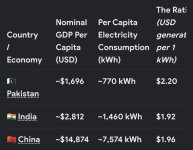
Indian gdp stats are normal for its energy consumption.
Screenshot_20260923_010541_Brave.jpg
 
Na. I got it from my notes on India's GDP catastrophe. Some women collect shoes. I collect India's disasters for my own entertainment. You should see what I have on India's faulty drugs.

You should read the extracts from NDTV. They are fascinating. I watched all the progs during the time. You should do. Educate yourself do you can debate faster.

Can anyone rely on India's figures after the fiasco of the past. Pretty humiliating being pulled up by Teacher IMF who has given India a huge slap.

Goodnight to all. It was a shame you ran off from debating. I can understand though. Its tough to read the truth.
 

Users who are viewing this thread

Country Watch Latest

Back
Top