India foreign policy thread

@Moderators, I would like to pre-emptively request that you keep this thread clean and free of ad hominem personal attacks and low quality troll posts.

@MNZGamerX
The parameters in which Bangladesh operates viz a viz foreign policy are the same regardless of which party is in power and both major parties, the Awami League and BNP operate within those parameters. It is worth noting that both parties are genetically descendants of the Muslim league and represent the majority sentiment amongst east Bengalis/Bangladeshis.

1. We need to have good relations with the USA and west. They rule the world and we export our garments to them. We cannot get into a major conflict with them. The same sort of religious extremists who hate India will not urge conflict with the USA which has killed far more Muslims or invaded and destroyed far more Muslim countries e.g. Iraq, Afghanistan, Gaza than India ever has.

2. We need to have good relations with the GCC due to remittances from there.
3. We need to have good relations with China which supports us militarily as well as economically.


Even Turkey on a nation-to-nation basis is a country which we have good ties irrespective of which major party is in power. So even during the previous Awami League administration we developed ties with them including on the military front.

As for India, the Awami League's soft spot for them is known but they had issues with India too e.g. disappointment over Teesta. Our national interests remain the same whether it is Awami League or BNP in power and it is not in our national interest to have either a hot war with India or even a cold war et la Pakistan v India, and the BNP know that, hence they will seek to cultivate ties with our giant western neighbour and this can be evidenced by some of the news articles I have posted here in the past few weeks.


One should not conflate the extreme India-hatred and inflammatory rhetoric from certain dark and unsavoury elements online who can spew India-hatred with impunity with the actual behaviour of the national government who have to deliver economic progress, e.g. jobs to the electorate. If they fail to deliver that they will either be removed electorally or failing that removed by force as Hasina was.

Bangladesh's economic development is dependent on good relations with India.
 
While Bangladesh may wish to be friends with all the big powers they have objectives and agendas of their own and while the political parties may seek to accommodate all of them it will come at a cost and satisfy none of them ... I fear that the Interim Government and now the BNP are beating the drum too loudly ...
 
While Bangladesh may wish to be friends with all the big powers they have objectives and agendas of their own and while the political parties may seek to accommodate all of them it will come at a cost and satisfy none of them ... I fear that the Interim Government and now the BNP are beating the drum too loudly ...

Balancing act isn't a sustainable strategy. It never works.

Non alignment isn't possible either in today's world. Even if we want to, the greater powers around us won't allow it.

Eventually Bangladesh will have to take a stance and choose a camp. BAL was heading towards that with complete dedication towards India. The poor balancing game Hasina played came crumbling down during the 2024 China visit.

It remains to be seen which camp the BNP eventually chooses - India, US or China.
 
Kiwis are the nicest people on the planet, but even they have limits

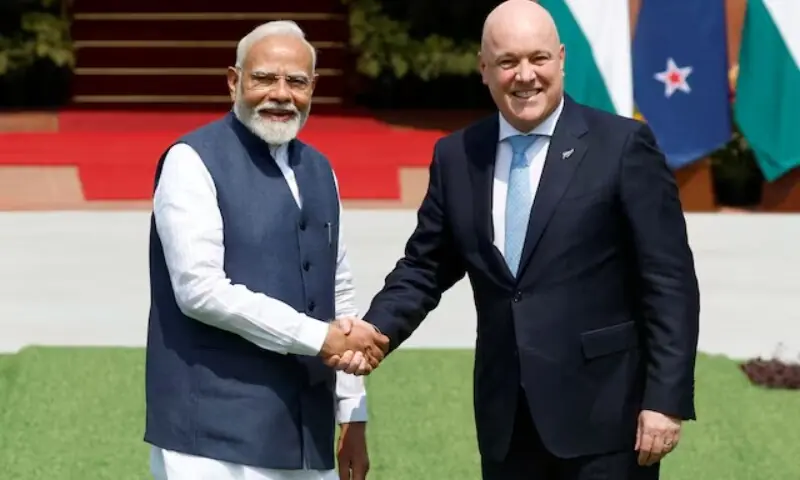
Modi visits New Zealand as trade deal sparks India pushback

AFP Published July 10, 2026 Updated about 4 hours ago

https://www.google.com/preferences/source?q=dawn.com
India’s Prime Minister Narendra Modi lands in New Zealand on Friday touting a free trade deal that has sparked a backlash despite promises it will unlock jobs and economic riches.

On the agenda are trade, tourism and sport — but recent undercurrents of anti-migrant sentiment risk tarnishing his trip to a nation long proud of its tolerance.

New Zealand Prime Minister Christopher Luxon celebrated the signing in April of the free trade deal with the world’s most populous nation, touting an export boom that would deliver jobs and investment in spades.


The pact is widely expected to be approved by New Zealand’s parliament. But not everyone is happy at the prospect.


Lawmakers in the populist New Zealand First Party, part of Luxon’s governing coalition, railed against parts of the agreement covering migration and visas.

“I don’t care how much criticism we get, I am just never going to agree with a butter chicken tsunami coming to New Zealand,” government minister Shane Jones told a local radio show.

An Indian community leader accused Jones of “outright racism”.

A prominent evangelical preacher went even further when he heard Indian leader Modi would soon be arriving on New Zealand’s shores.

Self-proclaimed “apostle” Brian Tamaki accused Modi of vilifying Christians in India — and suggested New Zealanders should retaliate in kind.


“Let’s purge New Zealand of Hindus, Sikhs and Muslims,” Tamaki said on Instagram.

“While we’re at it, if they’re burning churches down, why don’t we burn mosques and their temples down? Tit for tat,” he said, in comments condemned by New Zealand’s race relations commissioner as “utterly appalling”.

Indigenous Maori activist Che Wilson was earlier this year accused of insulting an Indian-born New Zealand lawmaker with a cultural “haka” performance that allegedly included several mocking references tinged by race.

Massey University anthropologist Sita Venkateswar said Modi was visiting as Indian-New Zealanders were being singled out and “denigrated”.

“A ‘butter chicken tsunami’, slurs set to a haka, graffiti on a school wall – South Asians are already the most frequent targets of racially motivated incidents in our data,” she told AFP.

“That is real and it is wrong.” Modi will be in New Zealand for little more than a day, at the tail end of a July 6-11 tour that has also taken him to Indonesia and Australia.

He will be attending an official ceremony at the Government House and a business and sport event in Auckland — the first visit to the country by an Indian leader in 40 years.

The big event is expected to be Modi’s starring role before as many as 10,000 people from the Indian diaspora at a community event in Auckland’s Spark Arena.

Despite the negative rhetoric about their ties from some quarters, New Zealand’s Luxon has been promoting a welcoming image for Modi’s visit to a country that is home to an Indian diaspora of about 300,000.

“This visit is about celebrating a winning partnership between New Zealand and India — one that delivers for our people and supports greater prosperity and security for both our countries,” he said.


Good to see traditionally good relations between Bangladesh and India reverting to their default norm and these two traditional allies and friends ironing out issues they may have, also cultural interaction and relations.

@SoulSpokesman @Prince_ @BananaRepublic @vasanthm @Nimble


Good to see traditionally good relations between Bangladesh and India reverting to their default norm and these two traditional allies and friends ironing out issues they may have, also cultural interaction and relations.

@SoulSpokesman @Prince_ @BananaRepublic @vasanthm @Nimble


Bangladesh and India need good relations to support each other’s growth.

Neither can prosper by being antagonistic.
 
Breaking: India, China will be targeted by upto 100% tariffs for buying Russian energy while Europe gets a free pass,

admits US Senator "This bill is carefully crafted to make sure we are not hitting our allies and that we are hitting India and China"


lmao
 
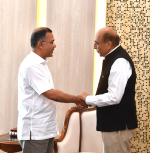
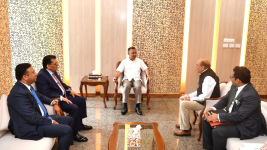
High Commissioner Dinesh Trivedi paid a courtesy call on Bangladesh Foreign Minister Dr. Khalilur Rahman, reaffirming India's commitment to a positive, constructive and forward-looking partnership with Bangladesh, rooted in mutual interest and mutual benefit, and to deepening people-centric cooperation across all sectors.He also met State Minister for Foreign Affairs Shama Obaed Islam for a wide-ranging exchange on strengthening bilateral ties.


1785573172033.png

1785573189629.png
 
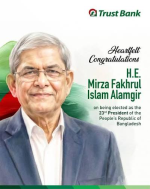
India congratulates Bangladeshi nationalist who has become the new president of Bangladesh, Mirza Fakhrul Islam Alamgir.


1787426700591.png

1787426847661.png

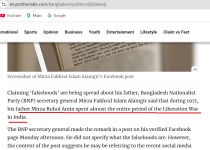
Some Jamaati-orientated people hate him as they view him as "too pro-Indian" but Fakhrul has always been clear about the need for mutually respectful relations between the two nations.

His own father had refuge in India during 1971.

1787427198885.png


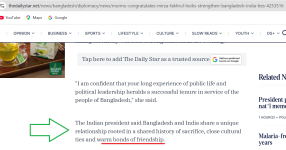
The Indian president has congratulated Fakhrul.

1787427348754.png

Link: https://www.thedailystar.net/news/b...ooks-strengthen-bangladesh-india-ties-4253516
 

Imports from India rise, exports remain almost unchanged​

31 August 2026
ECONOMY
SHARE
Refayet Ullah Mirdha

Refayet Ullah Mirdha
Bangladesh India Trade


Bangladesh’s imports from India continue to rise despite restrictions imposed by both countries on the movement of some goods, while exports to the neighbouring country remained almost unchanged.


The country imported goods worth $10.96 billion from India in fiscal year 2025-26, up from $9.62 billion a year earlier, according to National Board of Revenue (NBR) data.


In contrast, exports to India stood at $1.75 billion in FY26, compared with $1.76 billion in the previous fiscal year.


The figures show that trade between the two neighbours has continued despite restrictions introduced over the past two years, particularly on the movement of goods through land ports.


Bangladeshi businesses say Indian yarn, cotton, fabrics and other industrial raw materials remain in demand because of their competitive rates, and because some international buyers specify particular fabrics or yarn from India.

After China, India is Bangladesh’s second-largest trading partner and the country’s largest trading partner in South Asia.


The trade gap between the two countries, however, remains wide, with Bangladesh importing more than six times as much from India as it exports to the country.

Businesses and economists say Bangladesh has scope to raise exports to India, but the country’s export basket remains heavily concentrated in apparel.


India granted Bangladesh duty-free market access in 2010, with one year of retrospective effect, for all products except 25 alcoholic and beverage items under the South Asian Free Trade Area’s (SAFTA) least developed country category.

Although exports have increased since then, the growth has not been enough to narrow the trade gap.

M Masrur Reaz, chairman of the Policy Exchange Bangladesh, said three factors are limiting Bangladesh’s exports to India.

“Firstly, India has its own import-substitute goods such as garments; secondly, India has a long list of standard requirements, and thirdly, both Bangladesh and India could not establish a regional value chain yet,” he said.

He suggested signing the Comprehensive Economic Partnership Agreement (CEPA) between the two countries to expand bilateral trade.

The two countries have introduced a series of trade restrictions since the political changeover in Bangladesh in 2024.

In March 2025, Bangladesh’s commerce ministry asked the National Board of Revenue to take steps to restrict yarn imports through land ports to protect the local textile and spinning sector. In early April, India suspended a transhipment facility used by Bangladesh to send garments to third countries through Indian airports.

The NBR restricted yarn imports from India through land ports. Yarn imports from India are now allowed only through Chattogram port.

India later imposed restrictions on the import of garments, agro-processed food, jute goods, furniture and some other Bangladeshi goods through land ports.

Despite the restrictions, imports of Indian goods continued to rise.

Showkat Aziz Russell, president of the Bangladesh Textile Mills Association, said yarn imports from India doubled to around Tk 30,000 crore in FY26 from Tk 14,000 crore a year earlier.

“The higher import of yarn through the seaport is the real reflection of yarn imports from India. Because when yarn was allowed to be imported through the land ports, a lot of yarn used to be imported through informal channels, meaning it was smuggled in,” he said.

Russell said restrictions on yarn imports through land ports should not be lifted. He argued that local textile mills are facing higher production costs and competition from imported yarn.

Mahmud Hasan Khan, president of the Bangladesh Garment Manufacturers and Exporters Association, said businesses have raised trade-related issues in different forums to increase exports to India.

He said Bangladesh should be able to export more goods through land ports and gain greater access to the Indian market.

Mohammad Hatem, president of the Bangladesh Knitwear Manufacturers and Exporters Association, said the recent trade disputes have commercial implications but require a political solution.

“It needs a political solution from the top-level leaders of both countries,” Hatem said.

MA Razzaque, chairman of Research and Policy Integration for Development, said the issue of land ports is part of a wider bilateral relationship.

“The land port is not an issue alone; it is a matter of a warm relationship between Bangladesh and India,” he said.

He said better bilateral relations could support stronger trade because both countries stood to gain from greater commercial engagement.

Md Abdul Wahed, former honorary joint secretary general of the India-Bangladesh Chamber of Commerce and Industry, said trade could increase if the movement of major goods through land ports resumes.

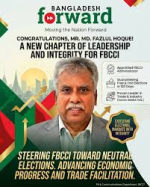
Md Fazlul Hoque, administrator of the Federation of Bangladesh Chambers of Commerce and Industry, called for discussions between the two countries to ease trade rules.


1788191654400.png

Fazlul Haque is the 3rd from the left and wants good relations with India to boost trade.

1788191726813.png

MA Razzaque also wants better relations.

1788191824164.png


Good to see Bangladesh, India relations doing well despite the plans by some of our enemies to stoke hatred between the two friendly nations.


Good to see Bangladesh, India relations doing well despite the plans by some of our enemies to stoke hatred between the two friendly nations.

We both form a very big chunk of the world, Asia and south asia population.... we need each other and should not fall for any provocation staged by world powers.... hope both leaderships in these countries are enough matured.....
 
We both form a very big chunk of the world, Asia and south asia population.... we need each other and should not fall for any provocation staged by world powers.... hope both leaderships in these countries are enough matured.....

There is a saying "actions speak louder than words".


Beyond all the rhetoric and nonsense, what is actually happening? Bangladesh is doing business with India because it needs to. We have no other option. This forum and some of the delusional trolls in it have no connection to reality.

Also any modernisation or development of Bangladesh's armed forces is not linked to any offensive posture against India (a nuclear giant) but because we have to be strong and have a strong defensive capability. Our population is bigger than Russia, but we are not seeking to have armed forces bigger than Russia or equal to Russia but still smaller than Russia, but bigger than what we have now, especially given the genodical racist, fascist Myanmar regime next door.

India is a liberal democracy with a strong civil society and nothing like Myanmar.
 

Users who are viewing this thread

  • Back
    Top