India Foreign Policy Thread

India moved to deepen trade ties with Brazil on Saturday, signing a pact to expand cooperation in mining and minerals as it seeks to meet rising domestic steel demand and support capacity expansion amid a global race for raw materials.

The agreement was signed in the presence of India's Prime Minister Narendra Modi and Brazilian President Luiz Inacio Lula da Silva, who arrived in New Delhi earlier this week for a three-day visit.

Brazil is among the world's top producers of iron ore and holds large reserves of minerals critical to steelmaking. Closer cooperation is expected to improve India's access to raw materials and technologies needed to sustain long-term growth in its steel sector, an Indian government statement said.

The cooperation will focus on attracting investment in exploration, mining and steel sector infrastructure, the statement said. India has steelmaking capacity of 218 million metric tons, and companies are expanding output to meet rising domestic demand driven by infrastructure development and industrialisation.

Addressing a meeting with a Brazilian delegation led by Lula, Modi said their talks had focused on ways to deepen the India-Brazil trade partnership.
"We are committed to taking bilateral trade much beyond $20 billion in the next five years," Modi said.

Bilateral trade between the two countries currently stands at about $15 billion.
"Our nations will also work closely in areas such as technology, innovation, digital public infrastructure, AI, semiconductors and more," Modi said.

India and Brazil have been strategic partners since 2006, with cooperation spanning trade, defence, energy, agriculture, health, critical minerals, technology and digital infrastructure.

Brazil is India's largest trading partner in the Latin America and Caribbean region, and the two countries work closely on global issues such as U.N. reform, climate change and counter-terrorism.

Lula on Thursday advocated for Brazil and India to conduct trade in their own currencies rather than settling transactions in U.S. dollars, but dismissed speculation that the BRICS group of countries, of which both nations are members, would create a common currency.​
 
To view this content we will need your consent to set third party cookies.
For more detailed information, see our cookies page.


What do PDF Indians think of Israel's new status in the deepening partnership as the Father.. land? Lets us know your thoughts!
 
OTTAWA, Feb 27 (Reuters) - Canadian Prime Minister Mark Carney arrives in Mumbai on Friday on his first official visit to India, hoping to reset the sometimes fractious relationship with the world's most populous country as he seeks new global alliances.

Carney will meet business leaders in Mumbai and start talks on a comprehensive trade agreement, which is expected to be completed by November, his foreign minister told Reuters. He is scheduled to travel on to New Delhi for talks with Prime Minister Narendra Modi.

Carney has sought closer ties with China and Middle Eastern countries as well as India, as he tries to reduce Canada's dependence on the United States and forge a new global trading order led by what he calls middle-power countries.

Relations between Canada and India soured several years ago after explosive allegations by then-Prime Minister Justin Trudeau that the Indian government was linked to the assassination of a Canadian citizen who was also a prominent Sikh separatist. India has repeatedly denied any such links.

Unlike several previous Canadian leaders, including Trudeau, Carney will not make a stop in India's Punjab region, a major origin of Indian migration to Canada. Sikh separatists have pushed for an independent state in the Punjab and a visit there risks irking Carney's Indian hosts.

Analysts say the move signals a more pragmatic foreign policy that aims to wean Canada away from the United States, spurred by President Donald Trump's tariff war and annexation threats.

"The Prime Minister has a laser-beam focus on attracting capital to Canada, not playing to the Indian diaspora back home," said Goldy Hyder, president of the Business Council of Canada.

"This is a business trip aimed at growing the economy to give Canadians more economic sovereignty," he said, calling the approach a significant shift from the Trudeau era.

Last month, the European Union and India reached a landmark trade deal to cut tariffs on most goods, raising expectations that India might soon sign a similar deal with Canada. India's high commissioner to Canada told Reuters in January that Carney will likely sign a 10-year, C$2.8 billion ($2.05 billion) uranium supply deal and smaller agreements on oil and gas, the environment, artificial intelligence, quantum computing, education and culture.

Anand said Carney's foreign policy was driven by the reordering of global trading relationships and that "no country will ever have a pass in terms of the domestic safety and security of this country."

FENDING OFF AMERICAN HEGEMONY​

After India, Carney will visit Australia, where he will address parliament and discuss military, trade and defense links. En route back to Ottawa, Carney will meet Japanese Prime Minister Sanae Takaichi and talk about boosting trade in autos, energy and critical minerals.

Jonathan Kalles, a former adviser to ex-Prime Minister Trudeau, said Carney's agenda was defined by the new geopolitical order he outlined in his Davos speech, where he called for middle powers to adopt a "principled and pragmatic" path to fend off American hegemony.

"When the world is nice and calm, you can try to change the world and talk about virtues," he said. "But when you're living in uncertain times, the Prime Minister's job is to advance the country's interests and Mark Carney knows very well his job is to diversify our trade and strengthen the economy."

($1 = 1.3684 Canadian dollars)
Reporting by Maria Cheng; Editing by Caroline Stauffer and Edmund Klamann
 
OTTAWA, Feb 27 (Reuters) - Canadian Prime Minister Mark Carney arrives in Mumbai on Friday on his first official visit to India, hoping to reset the sometimes fractious relationship with the world's most populous country as he seeks new global alliances.

Carney will meet business leaders in Mumbai and start talks on a comprehensive trade agreement, which is expected to be completed by November, his foreign minister told Reuters. He is scheduled to travel on to New Delhi for talks with Prime Minister Narendra Modi.

Carney has sought closer ties with China and Middle Eastern countries as well as India, as he tries to reduce Canada's dependence on the United States and forge a new global trading order led by what he calls middle-power countries.

Relations between Canada and India soured several years ago after explosive allegations by then-Prime Minister Justin Trudeau that the Indian government was linked to the assassination of a Canadian citizen who was also a prominent Sikh separatist. India has repeatedly denied any such links.

Unlike several previous Canadian leaders, including Trudeau, Carney will not make a stop in India's Punjab region, a major origin of Indian migration to Canada. Sikh separatists have pushed for an independent state in the Punjab and a visit there risks irking Carney's Indian hosts.

Analysts say the move signals a more pragmatic foreign policy that aims to wean Canada away from the United States, spurred by President Donald Trump's tariff war and annexation threats.

"The Prime Minister has a laser-beam focus on attracting capital to Canada, not playing to the Indian diaspora back home," said Goldy Hyder, president of the Business Council of Canada.

"This is a business trip aimed at growing the economy to give Canadians more economic sovereignty," he said, calling the approach a significant shift from the Trudeau era.

Last month, the European Union and India reached a landmark trade deal to cut tariffs on most goods, raising expectations that India might soon sign a similar deal with Canada. India's high commissioner to Canada told Reuters in January that Carney will likely sign a 10-year, C$2.8 billion ($2.05 billion) uranium supply deal and smaller agreements on oil and gas, the environment, artificial intelligence, quantum computing, education and culture.

Anand said Carney's foreign policy was driven by the reordering of global trading relationships and that "no country will ever have a pass in terms of the domestic safety and security of this country."

FENDING OFF AMERICAN HEGEMONY​

After India, Carney will visit Australia, where he will address parliament and discuss military, trade and defense links. En route back to Ottawa, Carney will meet Japanese Prime Minister Sanae Takaichi and talk about boosting trade in autos, energy and critical minerals.

Jonathan Kalles, a former adviser to ex-Prime Minister Trudeau, said Carney's agenda was defined by the new geopolitical order he outlined in his Davos speech, where he called for middle powers to adopt a "principled and pragmatic" path to fend off American hegemony.

"When the world is nice and calm, you can try to change the world and talk about virtues," he said. "But when you're living in uncertain times, the Prime Minister's job is to advance the country's interests and Mark Carney knows very well his job is to diversify our trade and strengthen the economy."

($1 = 1.3684 Canadian dollars)
Reporting by Maria Cheng; Editing by Caroline Stauffer and Edmund Klamann
I thought India is a superpower next to the US. Middle power visit, nah.
 
whatever happened to the case where Indian agents popped some Canadian citizen?
It was blamed on rogue elements of Indian intelligence. A few Indians were prosecuted and convicted.
 
It was blamed on rogue elements of Indian intelligence. A few Indians were prosecuted and convicted.

You mean to say you can pop Canadian citizens, blame it on rogue elements, and no one has to serve prison time
 
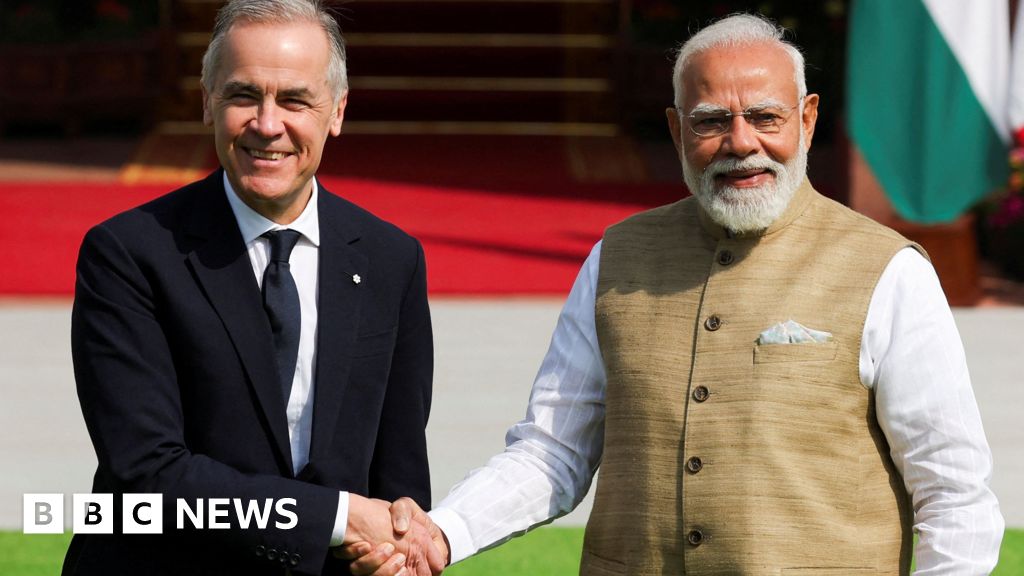
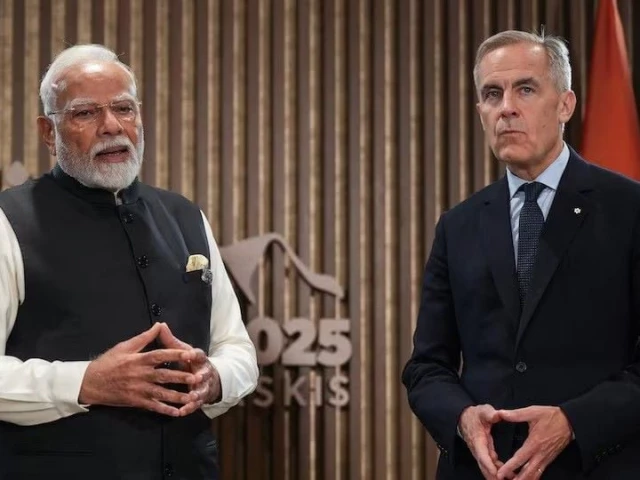
India and Canada have announced a host of agreements, including a 10-year nuclear energy deal, after their prime ministers met in Delhi to reset ties that plummeted due to diplomatic tensions.
Narendra Modi and Mark Carney also struck agreement in areas such as technology, critical minerals, space, defence and education.
Carney said they agreed to conclude a free trade deal, years in the making, by the end of 2026. Both countries want to reduce exposure to punitive US trade tariffs.
Under Carney, the two governments are trying to repair ties that were strained when his predecessor accused Delhi of a link to the 2023 assassination of Sikh separatist Hardeep Singh Nijjar on Canadian soil.


India and Canada have announced a host of agreements, including a 10-year nuclear energy deal, after their prime ministers met in Delhi to reset ties that plummeted due to diplomatic tensions.
Narendra Modi and Mark Carney also struck agreement in areas such as technology, critical minerals, space, defence and education.
Carney said they agreed to conclude a free trade deal, years in the making, by the end of 2026. Both countries want to reduce exposure to punitive US trade tariffs.
Under Carney, the two governments are trying to repair ties that were strained when his predecessor accused Delhi of a link to the 2023 assassination of Sikh separatist Hardeep Singh Nijjar on Canadian soil.


Indian foreign is long lasting success, only a few hurdles comes sometimes.

Always need to maintain this policy - being neutral - no permanently declared any country as hostile
 

India has much to lose from a world in chaos​


BY RIGHTS, THIS should be a told-you-so moment for the high priests of Indian foreign policy. The strongest countries on earth are bent on dominating the rest. Lesser nations are increasingly cowed. No law or international treaty seems able to constrain the exercise of raw power.

In their book-lined Delhi studies and tree-shaded official residences, the Brahmins of Indian statecraft saw this coming. India has been braced for a messier world for a long time, and sometimes seemed to welcome it. Since President Donald Trump was first elected and again as he returned to office last year, Indian officials mocked Western allies for lamenting his transactional ways and America First rhetoric. As Indians put it, Mr Trump represented the true and eternal face of America—with the mask off.


For good measure, India declined to condemn its longtime ally, Russia, as a pariah for invading Ukraine in 2022. Great powers have always been ruthless, Indian grandees sighed to visitors, and the so-called liberal rules-based order was a sham. Western democracies may mourn the old world that they once dominated. But India had deals to cut.

India’s foreign minister, Subrahmanyam Jaishankar, is still pushing this message. News of the war in Iran and the Gulf dominated the Raisina Dialogue, a government-backed conference held in Delhi from March 5th to 7th. But on the main stage Mr Jaishankar sounded calm about a move from global “order to disorder”. After all, he argued, the post-1945 international system was an order “by the West, for the West, from the West”. Those rules lasted 70 years, or a mere one percent of Indian history. If it is ending, that is unsurprising and may create opportunities for India and the global south, he averred. “Life moves on.”

Alas, Delhi’s foreign policy and security establishment does not buy Mr Jaishankar’s sangfroid. Over many cups of (excellent) Darjeeling and chai, this columnist spoke to retired and serving Indian and foreign diplomats, army officers, business executives and scholars. The foreign minister is whistling to keep up our courage, but this is a time of humiliation, said one Indian bigwig. With the Iran conflict preventing ships from safely using the Strait of Hormuz, and liquefied natural gas exports suspended from such major suppliers as Qatar, India faces an energy crunch if the war does not end soon.

The Trump administration announced during the Raisina Dialogue that it was issuing a waiver authorising Indian to buy sanctioned Russian oil. Rather than inspiring gratitude, American talk of India being allowed to buy Russian oil for 30 days provoked grumbles about India being handed a “chit” by its master. The mood at the talking shop was not helped when America’s deputy secretary of state, Christopher Landau, told his audience that “we are not going to make the same mistakes with India that we made with China 20 years ago in terms of saying, ‘we are going to let you develop all these markets,’ and then, the next thing we know, you are beating us in a lot of commercial things.”


Several people expressed angst about the sinking by an American submarine of an Iranian warship in international waters near Sri Lanka. The attack by torpedo, which Mr Trump later called more “fun” than capturing Iran’s frigate, was seen as an insult to India, which had just hosted the Iranian ship at a naval exercise. That angst turned into anger that the government of Narendra Modi did not condemn the sinking, and has been generally rather silent about the war in Iran.

The explanation is fear of Mr Trump. Relations with America were awful last year, after what an insider calls the government’s “arrogance and swagger” when Mr Trump returned to power. In 2025 Mr Trump picked a trade war with India and, after a brief India-Pakistan clash, seemed to side with Pakistan. His eagerness to improve ties with China undercut Indian hopes of being America’s valued hedge against China. Yet among Delhi elites there is a consensus that India needs closer ties with America, an unrivalled source of investment, technology and high-quality defence kit.

Indian officials talk up their skill at maintaining close ties with disparate powers, from America and Russia to Israel and the Gulf Arab monarchies. Despite booming trade with the Gulf and ever-closer ties with Israeli intelligence and defence-technology firms, India has maintained reasonably cordial links with Iran, reflecting a shared antipathy to Pakistan and India’s need for a land route to Afghanistan. But senior figures in Delhi questioned whether India’s balancing-act offers it autonomy, as Mr Jaishankar and other cheerleaders claim. Insiders suggest that the country is instead dangerously dependent on lots of different places at once.

Rising power, growing vulnerabilities​

An extended war in Iran imperils not just trade with the Gulf but also 9.5m Indians who live and work in the United Arab Emirates and other Arab states, sending huge amounts home in remittances. A long Middle Eastern energy blockade would prompt China to buy more Russian oil. If that deepens Russia’s dependency on China, that is a threat to India, which simultaneously relies on Russia as an important (though diminishing) defence supplier and has tense relations with China, including fatal border clashes in recent years. A lengthy Iran war could give China more leverage over India in another way, too. If India needs greater energy independence, a big push on renewables will be needed. Only China offers the solar panels, windmills and batteries needed at scale and at low cost, dependency be damned.

In short, a world in turmoil is terrible for India. That is to the country’s credit. It has plans to become a prosperous, advanced economy that chaos would derail. For reasons of pride and propaganda, though, Indian leaders cannot admit this aloud.

 
1773999989742.png
Google Translate:

Chinese Foreign Ministry Spokesperson Lin Jian presided over a regular press conference on the 20th.
A reporter asked: India has appointed a widely recognized, veteran "China expert" as its new Ambassador to China. What is China's comment on this?
Lin Jian stated that diplomatic envoys serve as vital bridges for fostering friendly and cooperative relations between nations. I have noted that the Ambassador has already adopted a Chinese name for himself: 魏嘉盟(Pinyin: Wei Jiameng). China welcomes India's new Ambassador to China, 魏嘉盟(Pinyin: Wei Jiameng); we stand ready to provide him with necessary facilitation for assuming his duties in China and look forward to his playing a positive role in promoting the sustained improvement and development of China-India relations following his assumption of office.

=========================================================

IMO.

The newly appointed Indian Ambassador to China is a true "China expert." The Chinese name he chose for himself—"魏嘉盟(Pinyin: Wei Jiameng)"—is a homophone for the phrase "为加盟(Pinyin: Wei Jiameng)" . The underlying implication is: "I have come here to join China."

This type of homophonic metaphor is highly prevalent in Chinese culture.

Such behavior on his part—specifically, this act of self-effacement—serves as an effective way to ingratiate himself with the Chinese people. However, since Indians do not grasp this cultural nuance regarding homophonic metaphors, he remains free to maintain a "haughty" demeanor back home in India.
 
View attachment 187044
Google Translate:

Chinese Foreign Ministry Spokesperson Lin Jian presided over a regular press conference on the 20th.
A reporter asked: India has appointed a widely recognized, veteran "China expert" as its new Ambassador to China. What is China's comment on this?
Lin Jian stated that diplomatic envoys serve as vital bridges for fostering friendly and cooperative relations between nations. I have noted that the Ambassador has already adopted a Chinese name for himself: 魏嘉盟(Pinyin: Wei Jiameng). China welcomes India's new Ambassador to China, 魏嘉盟(Pinyin: Wei Jiameng); we stand ready to provide him with necessary facilitation for assuming his duties in China and look forward to his playing a positive role in promoting the sustained improvement and development of China-India relations following his assumption of office.

=========================================================

IMO.

The newly appointed Indian Ambassador to China is a true "China expert." The Chinese name he chose for himself—"魏嘉盟(Pinyin: Wei Jiameng)"—is a homophone for the phrase "为加盟(Pinyin: Wei Jiameng)" . The underlying implication is: "I have come here to join China."

This type of homophonic metaphor is highly prevalent in Chinese culture.

Such behavior on his part—specifically, this act of self-effacement—serves as an effective way to ingratiate himself with the Chinese people. However, since Indians do not grasp this cultural nuance regarding homophonic metaphors, he remains free to maintain a "haughty" demeanor back home in India.

I do not understand what you are trying to communicate here Michael
 

Users who are viewing this thread

Pakistan Defence Latest

Back
Top