Good article, basically going over what we have debated here, issue is now beyond just MIG-21 replacement as Jags and MIG-29s start to get to end of life. Even if they sign for 114 Rafails and get 180 Tejas, it still ay not be enough here
India needs more fighter jets. It cannot build them fast enough
Delayed engines and assembly bottlenecks leave India’s domestic output falling behind the pace of fleet retirements
4-MIN READ
Biman Mukherji
Published: 8:00am, 19 Oct 2026
India has a soaring ambition to modernise its air force, built around a fleet of domestically developed fighter jets. Yet production of these aircraft has been hampered by engine delays and other bottlenecks that defence analysts say could limit its ability to fight future air wars.
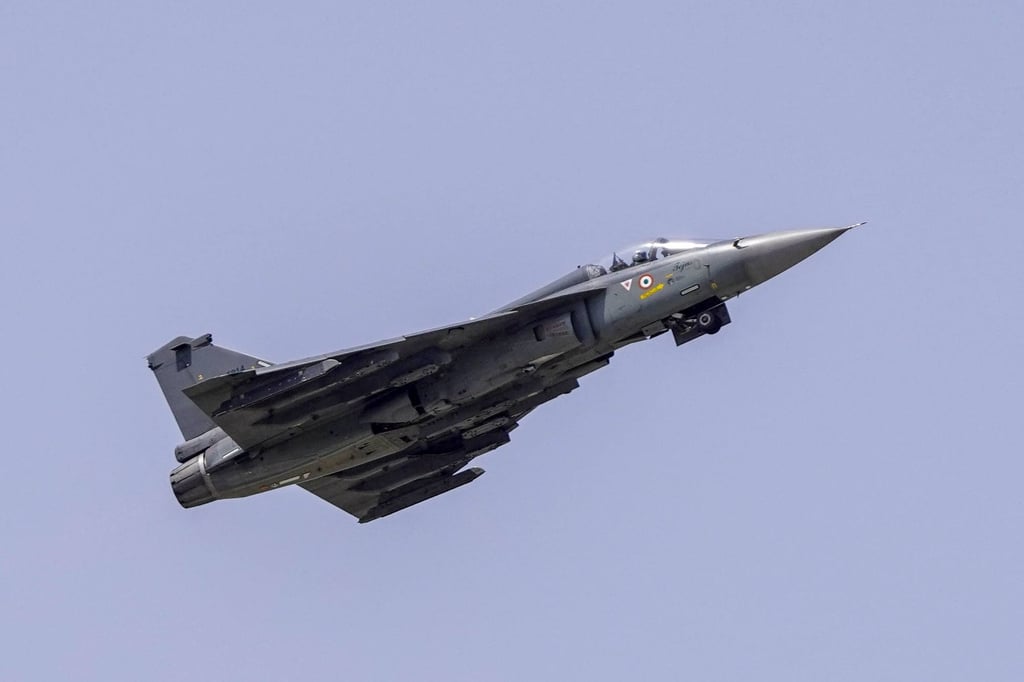
On October 11 at an airbase in Jodhpur, Air Chief Marshal A.P. Singh strapped into a Tejas jet for the last time. It was his final fighter sortie before retiring later this month and he flew it in an Indian-built jet to show support for the country’s domestic defence industry.
A week earlier, he had warned that the Indian Air Force (IAF) faced a critical shortage of fighter squadrons. “We need to induct two fighter squadrons every year,” Singh said on October 3, noting that “between 36 and 40 aircraft” would need to be produced annually to meet India’s target of having 42 fighter squadrons in service.
“Actually, we need even more than that,” he said.
The Tejas programme, which dates back to the 1980s, has become emblematic of India’s drive to build up its domestic defence industry. A Mark 1A variant of the light combat aircraft
was unveiled last year and a Mark 2 is still under development.
Induction of the Mark 1A is only now about to begin, 2½ years late, after
the F404 engines needed from US manufacturer GE Aerospace arrived late and the various radar, weapons and software systems took longer to integrate than planned.
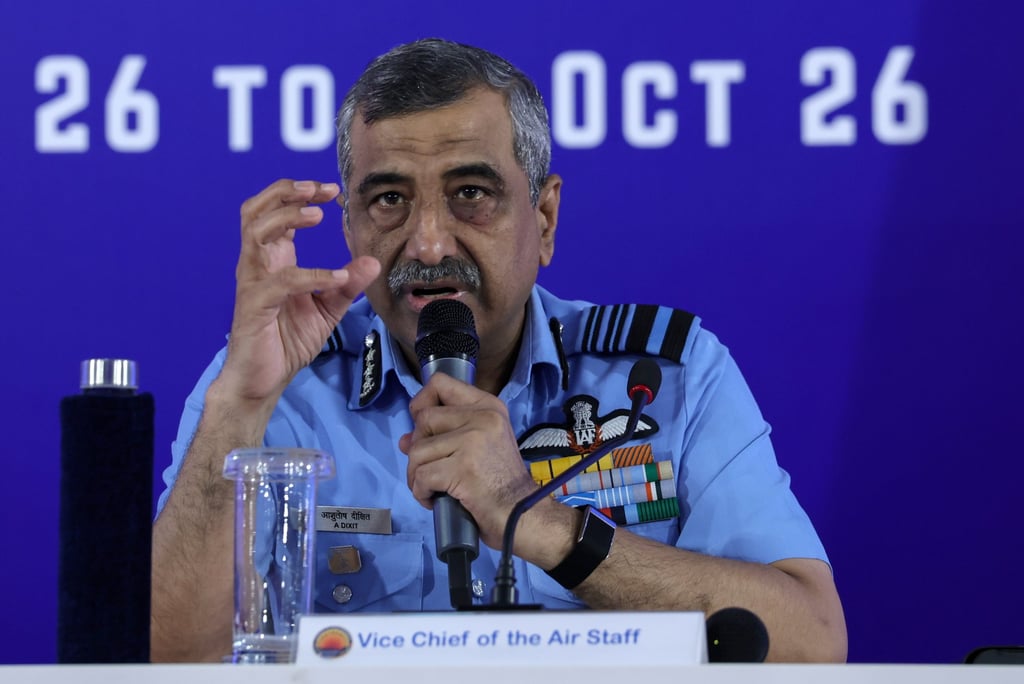
Indian Air Force Vice-Chief of the Air Staff Ashutosh Dixit addresses a press conference in New Delhi on September 22. Photo: EPA
Vice-Chief of the Air Staff Air Marshal Ashutosh Dixit said in late September that induction was expected to begin within one or two months, following a protracted development cycle and exhaustive operational evaluations of the aircraft’s avionics suite.
GE Aerospace, the Tejas programme’s only engine supplier, recently stepped up deliveries to principal manufacturer Hindustan Aeronautics Limited (HAL), shipping three F404-IN20 engines in August and another four engines in September. That makes 14 engines delivered so far, against the 20 that are due to arrive by the end of this year.
State-run HAL aims to produce 24 Tejas fighters annually. The IAF has already ordered 83 Mark 1As, wants to add 97 more and is also actively considering the Mark 2 variant.
Projections indicate at least 350 – and potentially more than 400 – Tejas will eventually be built, with the aircraft expected to form the backbone of India’s air force in future.
However, “repeated delays in certification, weapons/radar integration and engine supply show that indigenisation still needs execution, not just policy”, said Gurcharan Singh Bedi, a retired IAF air marshal.
“Having acquired the capability to produce the aircraft, we are then just talking of scale, which can be boosted. But it will take a very strong focus by the government and a very hard commitment by HAL or whosoever produces these aircraft.”
The Indian Air Force’s HAL Tejas fighter jet takes part in a bilateral air exercise in Jodhpur on September 20. Photo: AFP
Fleet depletion
India’s air force badly needs replacements for the ageing aircraft that are leaving active service.
The IAF officially retired the last of its Cold War-era Soviet-designed MiG-21 jets in September last year – 36 in total – with another six squadrons of Anglo-French Sepecat Jaguar ground-attack fighters due to be phased out between 2028 and 2031.
To keep the remainder of its Jaguar fleet flying, India is buying nine of the aircraft that Britain’s Royal Air Force retired in 2007 to use for spare parts.
Three MiG-29 squadrons and three squadrons of the French-designed Mirage 2000 are set to also be retired through the mid-to-late 2030s.
Each IAF squadron contains about 18 active aircraft, plus three or four in reserve.
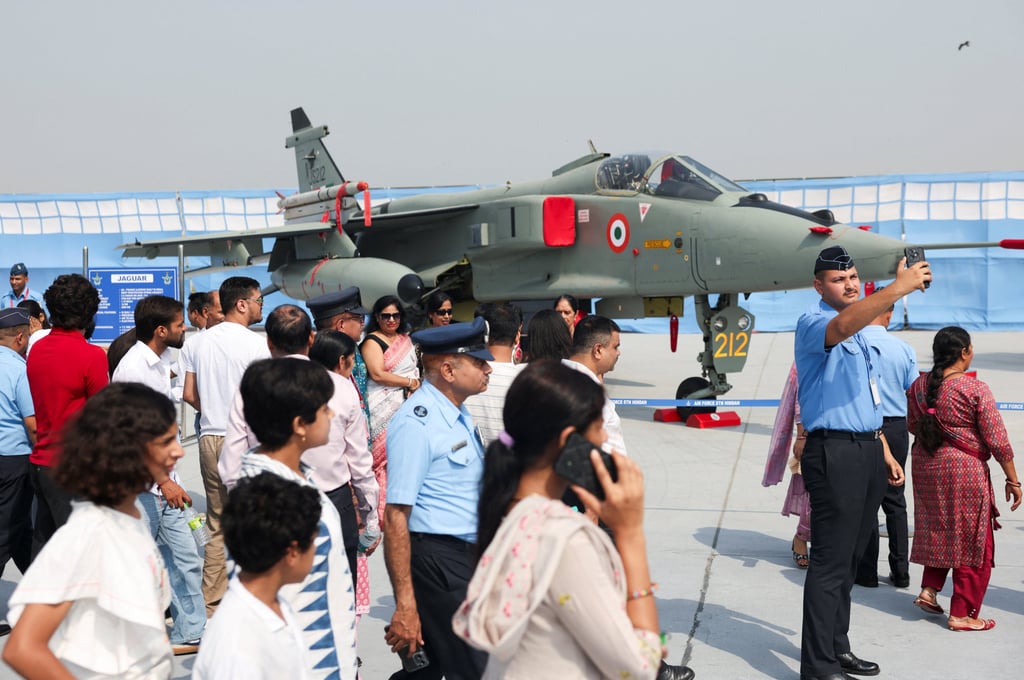
People look at a Jaguar fighter jet during the 94th Indian Air Force Day parade in Ghaziabad on October 8. Photo: Reuters
Bedi agreed with outgoing air force chief Singh’s assessment that roughly two new squadrons per year would be needed simply to maintain the number of aircraft India had in service.
HAL’s target of 24 Tejas fighters a year would fall short of that goal, but a second programme could help close the gap, he said.
In February, India cleared the purchase of 114 Rafales from France, under a government-to-government deal as part of its Multi-Role Fighter Aircraft programme.
Taken together, Bedi said this would bring annual deliveries close to the 32 or 36 aircraft required.
Final talks on price and production arrangements for the Rafales are still pending, though local media reports indicate manufacturer Dassault Aviation has agreed to 50-60 per cent “Make in India” content for the aircraft, as well as technology transfers and the integration of Indian weapons and systems.
Bedi said a “genuine acceleration” of India’s fighter jet production would depend on HAL meeting or beating its target of 24 combat aircraft per year, the timely delivery of multi-role fighters from France and retirements not outpacing inductions.
“The chief has spelled out the requirement, but it’s difficult to meet in the near future,” he said of Singh’s assessment. “At the same time, I believe anything is possible.”
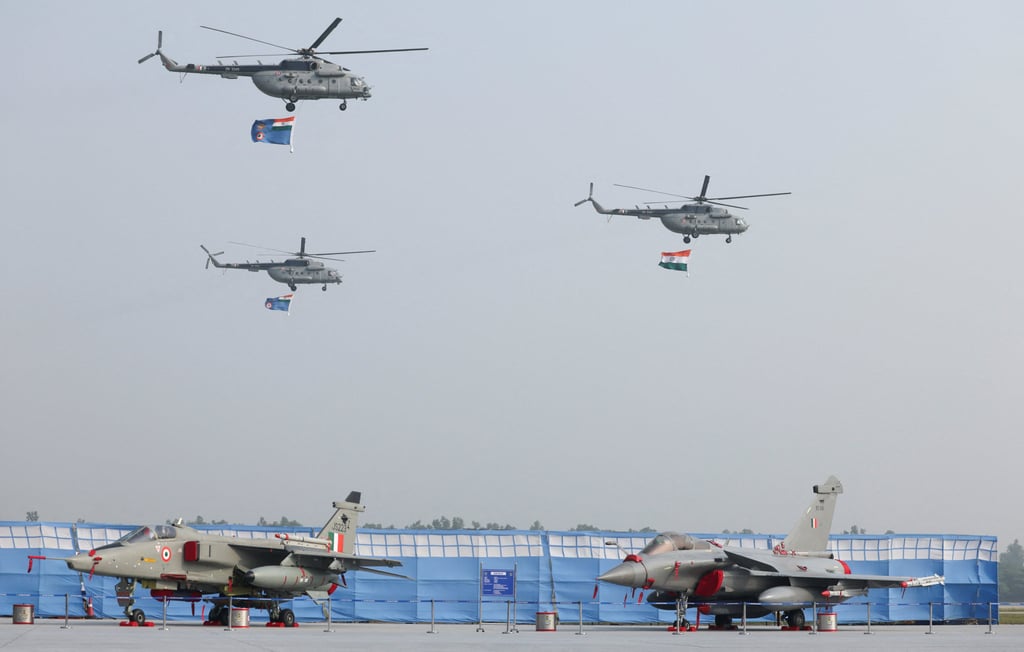
Fighter jets are parked as the Indian Air Force’s Mi-17 helicopters perform during the 94th Air Force Day parade in Ghaziabad on October 8. Photo: Reuters
‘The real constraint’
Several new aircraft are on the way. The first flight of the Tejas Mark 2 is expected between June and September 2027, with initial induction planned for 2030-31 if development stays on track.
India also wants to have a prototype of its fifth-generation stealth fighter, the
Advanced Medium Combat Aircraft (AMCA), airborne for a test flight by September 2028.
Bids to develop and produce the AMCA prototype have come in from India’s Tata Advanced Systems and domestic consortiums led by Larsen & Toubro and Bharat Forge, while France’s Safran is competing with a partnership formed by
India’s Reliance and Britain’s Rolls-Royce to supply AMCA’s engine.
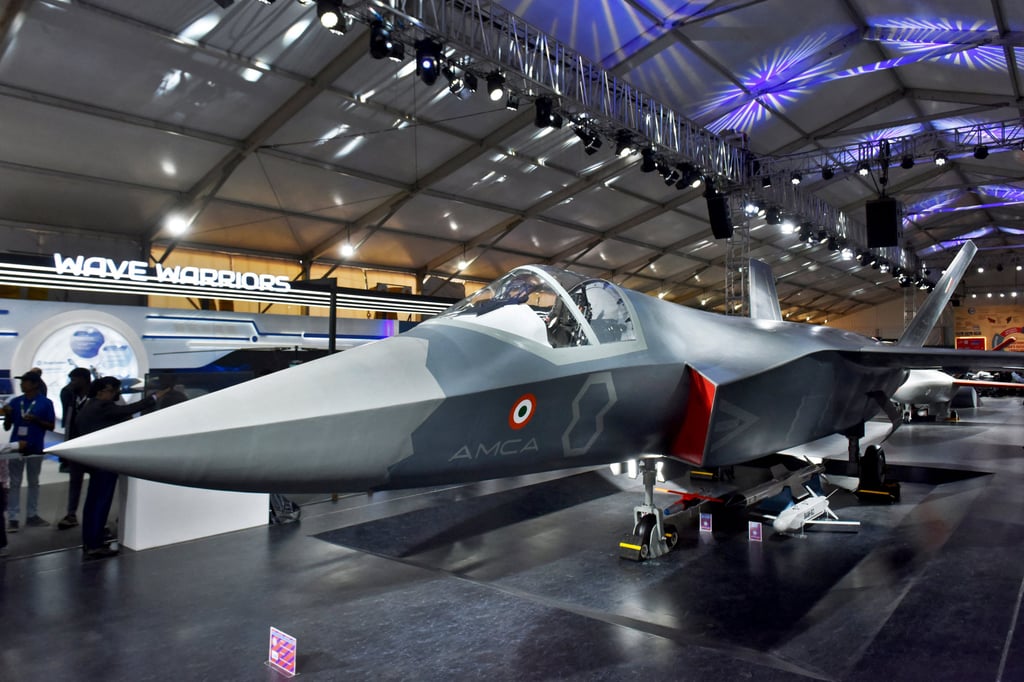
Visitors stand next to a prototype of India’s Advanced Medium Combat Aircraft (AMCA) at an air show in Bengaluru last year. Photo: Reuters
Sanjay Iyer, a retired Indian Army brigadier, said these overlapping programmes were likely to hit another bottleneck: the fact that they had to draw from the same pool of test pilots, certification staff and integration engineers.
“That is the real constraint, not shop-floor space,” he said. “And even if every Tejas [production] line ran flat out, you would still fall short of 36 to 40 a year.”
Iyer argued that India’s aircraft production problems could best be tackled through increased domestic engine manufacturing, design discipline and boosting private industry’s role.
Much time was lost on the Mark 1A’s development because of design changes, he said, adding that private companies – some of which already made fuselages and wings for HAL – should also be allowed to assemble aircraft.
“As long as one American supplier decides when your fighters fly, your output figures are really their output figures,” Iyer said regarding the Tejas’ GE engine. “And geopolitical considerations matter too. The US is not beyond twisting India’s arm if its other interests are affected.”
Holding buffer stocks of engines could serve as a costly stopgap solution, he added, further calling the opening of AMCA development and manufacturing to domestic private industry a “good sign”.