
Navigation
Install the app
How to install the app on iOS
Follow along with the video below to see how to install our site as a web app on your home screen.
Note: This feature may not be available in some browsers.
More options
Style variation
You are using an out of date browser. It may not display this or other websites correctly.
You should upgrade or use an alternative browser.
You should upgrade or use an alternative browser.
Indian Air Force News and Discussions ll
- Thread starter Fatman17
- Start date
More options
Who Replied?


Yasser76
Elite Member

It's getting bad with these clowns now, really bad, same level as when Iran showed off that "stealth fighter" that was the same size as a family SUV....
Sam6536
Registered Member

What?@samsite84 That you buddy? Alternate ID number 47 activated after you were banned?
Not every Indian account is someone's alt.
Yasser76
Elite Member
What?
Not every Indian account is someone's alt.
Reenaging with the site the moment another Indian gets banned.....
Sam6536
Registered Member
Well you're free to think whatever you want to.Reenaging with the site the moment
another Indian gets banned.....
I occasionally visit the website, reading through the posts but not engaging much.
And I mostly skip the flame bait type posts/comments anyways. This is an old account ported from the old website with same account name since joining.
Last edited:
indo17787
Registered Member
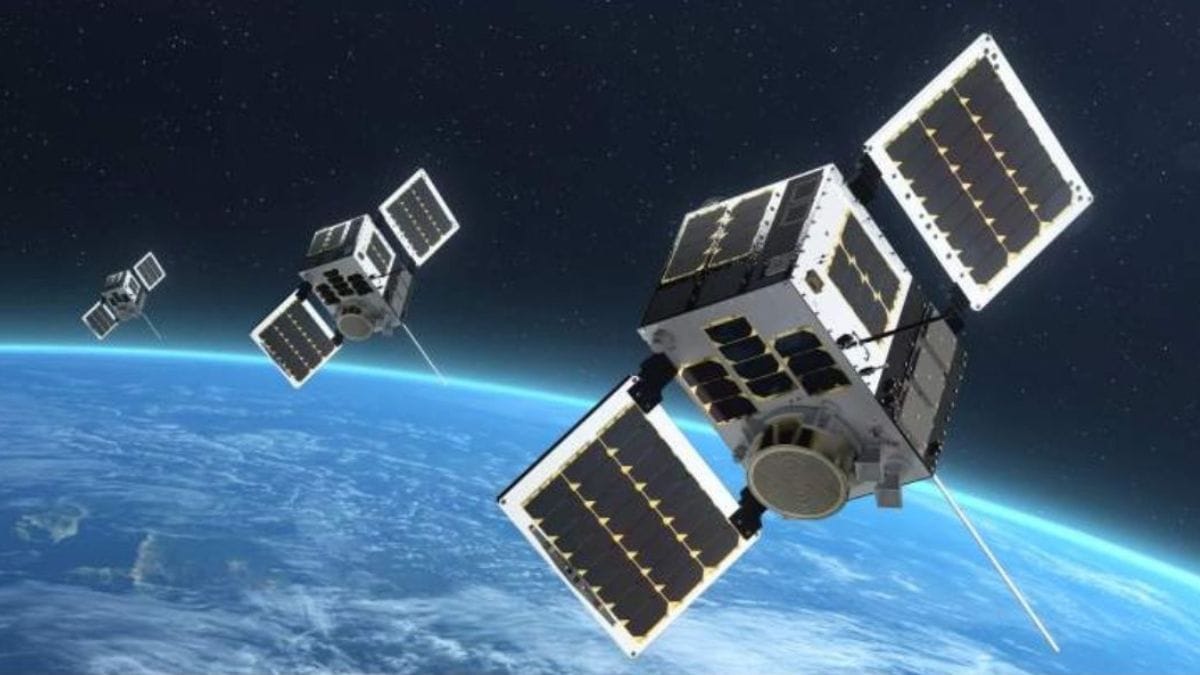
IAF to get first dedicated communications satellite GSAT-7C, to be operational by 2030IAF to get its own satellite as defence ministry signs Rs 2,563 crore deal
Army's own satellite, GSAT-7B, is being built under a Rs 3,000-crore contract signed with NSIL in March 2023. The Navy launched GSAT-7R, the replacement for its GSAT-7 'Rukmini' satellite, in November last year.

IAF to get second satellite, Navy more Varunastra torpedoes in Rs 4,106 crore deals
New Delhi: The Indian Air Force (IAF) is set to get a second dedicated communication satellite and the Navy more indigenous Varunastra heavyweight torpedoes, wiwww.newindianexpress.com
IAF to get first dedicated communications satellite GSAT-7C, to be operational by 2030
GSAT-7C will form part of a military communications network linking satellite infrastructure, ground hubs and software-defined radios (SDRs).
 theprint.in
Yasser76
Elite Member
Good article, basically going over what we have debated here, issue is now beyond just MIG-21 replacement as Jags and MIG-29s start to get to end of life. Even if they sign for 114 Rafails and get 180 Tejas, it still ay not be enough here
India needs more fighter jets. It cannot build them fast enough
Biman Mukherji
Published: 8:00am, 19 Oct 2026
India has a soaring ambition to modernise its air force, built around a fleet of domestically developed fighter jets. Yet production of these aircraft has been hampered by engine delays and other bottlenecks that defence analysts say could limit its ability to fight future air wars.
On October 11 at an airbase in Jodhpur, Air Chief Marshal A.P. Singh strapped into a Tejas jet for the last time. It was his final fighter sortie before retiring later this month and he flew it in an Indian-built jet to show support for the country’s domestic defence industry.
A week earlier, he had warned that the Indian Air Force (IAF) faced a critical shortage of fighter squadrons. “We need to induct two fighter squadrons every year,” Singh said on October 3, noting that “between 36 and 40 aircraft” would need to be produced annually to meet India’s target of having 42 fighter squadrons in service.
“Actually, we need even more than that,” he said.
The Tejas programme, which dates back to the 1980s, has become emblematic of India’s drive to build up its domestic defence industry. A Mark 1A variant of the light combat aircraft was unveiled last year and a Mark 2 is still under development.
Induction of the Mark 1A is only now about to begin, 2½ years late, after the F404 engines needed from US manufacturer GE Aerospace arrived late and the various radar, weapons and software systems took longer to integrate than planned.
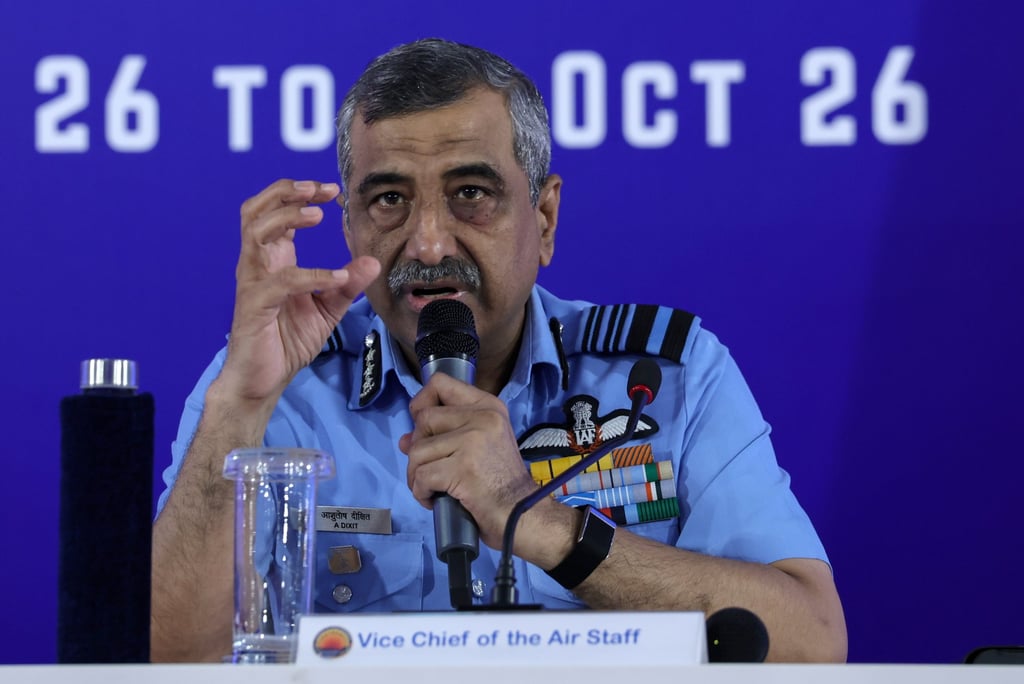
Indian Air Force Vice-Chief of the Air Staff Ashutosh Dixit addresses a press conference in New Delhi on September 22. Photo: EPA
Vice-Chief of the Air Staff Air Marshal Ashutosh Dixit said in late September that induction was expected to begin within one or two months, following a protracted development cycle and exhaustive operational evaluations of the aircraft’s avionics suite.
GE Aerospace, the Tejas programme’s only engine supplier, recently stepped up deliveries to principal manufacturer Hindustan Aeronautics Limited (HAL), shipping three F404-IN20 engines in August and another four engines in September. That makes 14 engines delivered so far, against the 20 that are due to arrive by the end of this year.
State-run HAL aims to produce 24 Tejas fighters annually. The IAF has already ordered 83 Mark 1As, wants to add 97 more and is also actively considering the Mark 2 variant.
Projections indicate at least 350 – and potentially more than 400 – Tejas will eventually be built, with the aircraft expected to form the backbone of India’s air force in future.
However, “repeated delays in certification, weapons/radar integration and engine supply show that indigenisation still needs execution, not just policy”, said Gurcharan Singh Bedi, a retired IAF air marshal.
“Having acquired the capability to produce the aircraft, we are then just talking of scale, which can be boosted. But it will take a very strong focus by the government and a very hard commitment by HAL or whosoever produces these aircraft.”
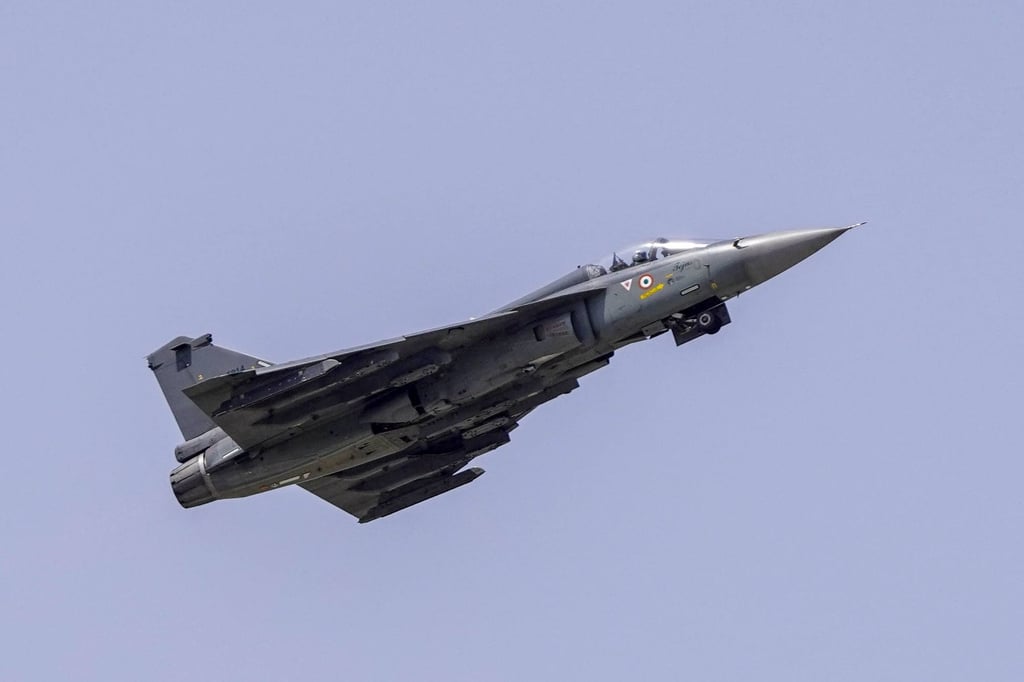
The Indian Air Force’s HAL Tejas fighter jet takes part in a bilateral air exercise in Jodhpur on September 20. Photo: AFP
The IAF officially retired the last of its Cold War-era Soviet-designed MiG-21 jets in September last year – 36 in total – with another six squadrons of Anglo-French Sepecat Jaguar ground-attack fighters due to be phased out between 2028 and 2031.
To keep the remainder of its Jaguar fleet flying, India is buying nine of the aircraft that Britain’s Royal Air Force retired in 2007 to use for spare parts.
Three MiG-29 squadrons and three squadrons of the French-designed Mirage 2000 are set to also be retired through the mid-to-late 2030s.
Each IAF squadron contains about 18 active aircraft, plus three or four in reserve.
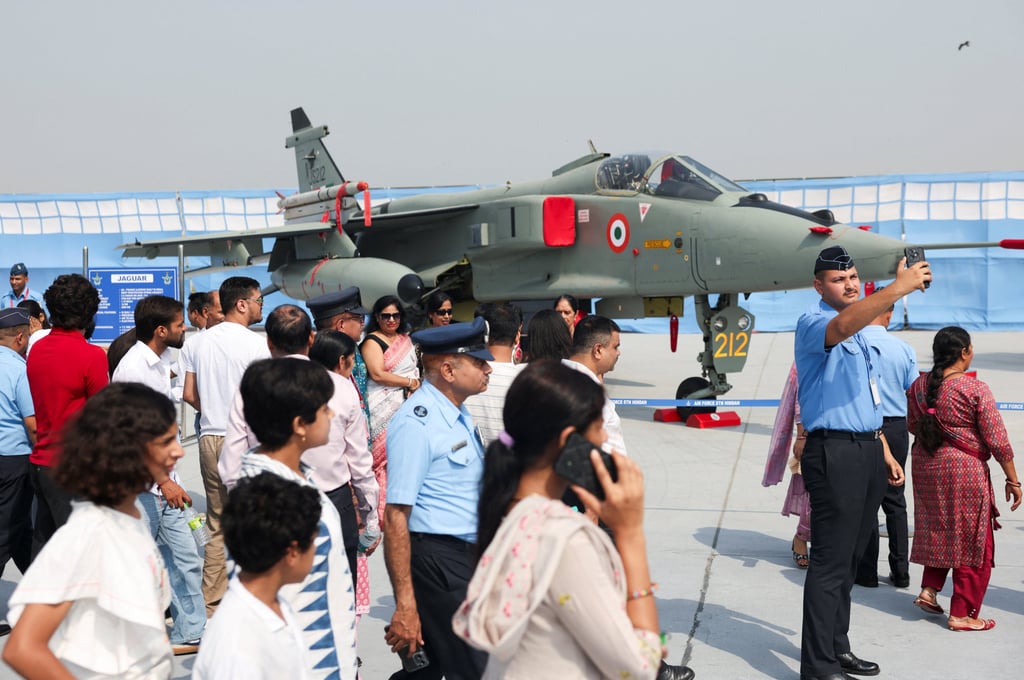
People look at a Jaguar fighter jet during the 94th Indian Air Force Day parade in Ghaziabad on October 8. Photo: Reuters
Bedi agreed with outgoing air force chief Singh’s assessment that roughly two new squadrons per year would be needed simply to maintain the number of aircraft India had in service.
HAL’s target of 24 Tejas fighters a year would fall short of that goal, but a second programme could help close the gap, he said.
In February, India cleared the purchase of 114 Rafales from France, under a government-to-government deal as part of its Multi-Role Fighter Aircraft programme.
Taken together, Bedi said this would bring annual deliveries close to the 32 or 36 aircraft required.
Final talks on price and production arrangements for the Rafales are still pending, though local media reports indicate manufacturer Dassault Aviation has agreed to 50-60 per cent “Make in India” content for the aircraft, as well as technology transfers and the integration of Indian weapons and systems.
Bedi said a “genuine acceleration” of India’s fighter jet production would depend on HAL meeting or beating its target of 24 combat aircraft per year, the timely delivery of multi-role fighters from France and retirements not outpacing inductions.
“The chief has spelled out the requirement, but it’s difficult to meet in the near future,” he said of Singh’s assessment. “At the same time, I believe anything is possible.”
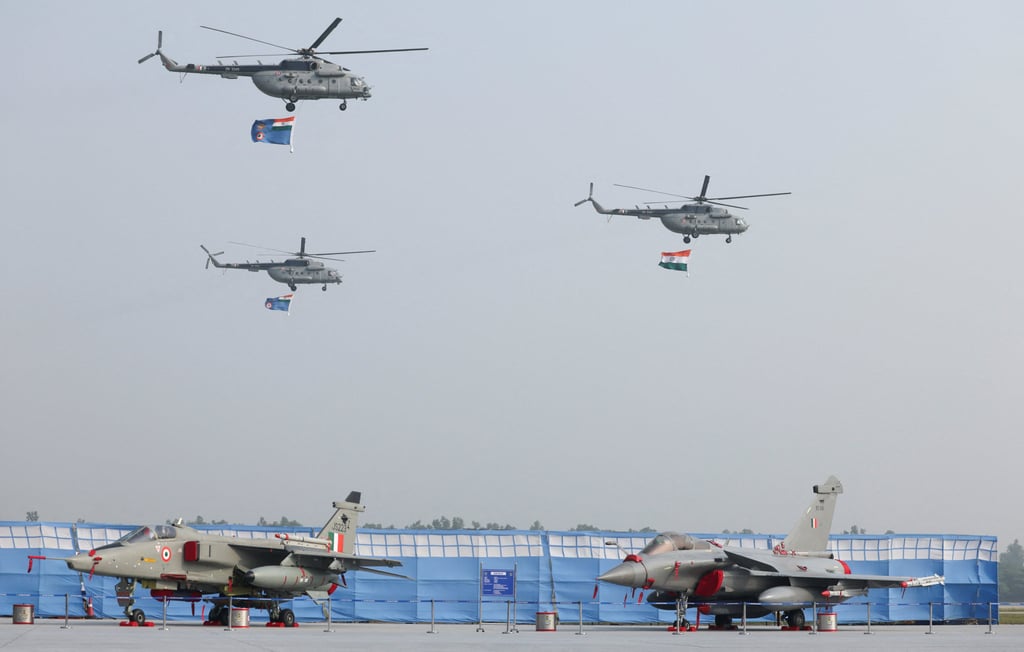
Fighter jets are parked as the Indian Air Force’s Mi-17 helicopters perform during the 94th Air Force Day parade in Ghaziabad on October 8. Photo: Reuters
India also wants to have a prototype of its fifth-generation stealth fighter, the Advanced Medium Combat Aircraft (AMCA), airborne for a test flight by September 2028.
Bids to develop and produce the AMCA prototype have come in from India’s Tata Advanced Systems and domestic consortiums led by Larsen & Toubro and Bharat Forge, while France’s Safran is competing with a partnership formed by India’s Reliance and Britain’s Rolls-Royce to supply AMCA’s engine.
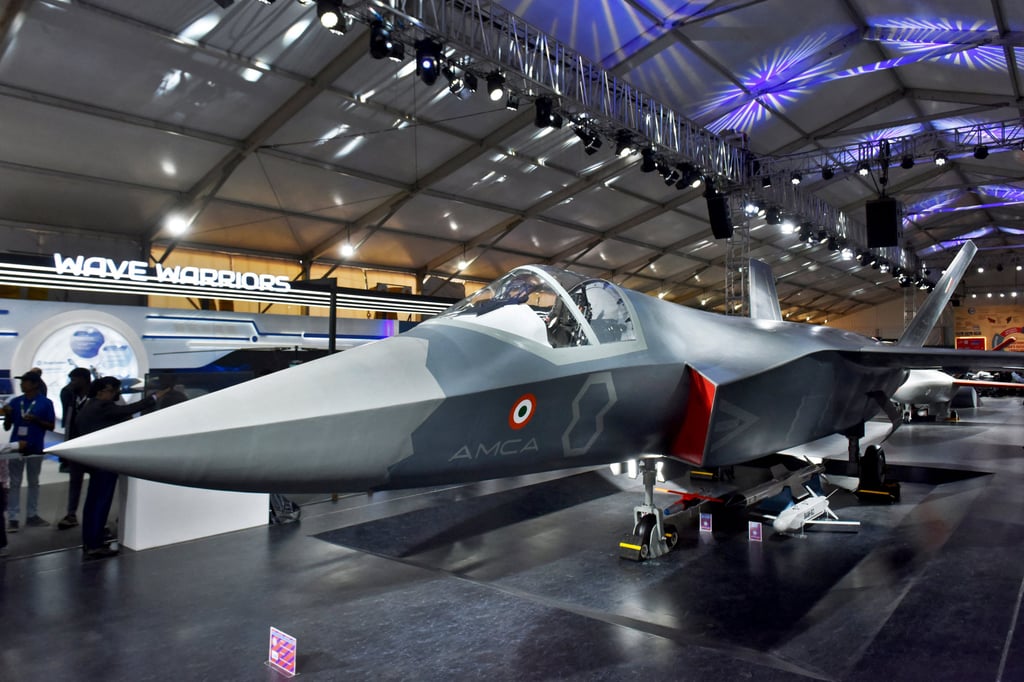
Visitors stand next to a prototype of India’s Advanced Medium Combat Aircraft (AMCA) at an air show in Bengaluru last year. Photo: Reuters
Sanjay Iyer, a retired Indian Army brigadier, said these overlapping programmes were likely to hit another bottleneck: the fact that they had to draw from the same pool of test pilots, certification staff and integration engineers.
“That is the real constraint, not shop-floor space,” he said. “And even if every Tejas [production] line ran flat out, you would still fall short of 36 to 40 a year.”
Iyer argued that India’s aircraft production problems could best be tackled through increased domestic engine manufacturing, design discipline and boosting private industry’s role.
Much time was lost on the Mark 1A’s development because of design changes, he said, adding that private companies – some of which already made fuselages and wings for HAL – should also be allowed to assemble aircraft.
“As long as one American supplier decides when your fighters fly, your output figures are really their output figures,” Iyer said regarding the Tejas’ GE engine. “And geopolitical considerations matter too. The US is not beyond twisting India’s arm if its other interests are affected.”
Holding buffer stocks of engines could serve as a costly stopgap solution, he added, further calling the opening of AMCA development and manufacturing to domestic private industry a “good sign”.
India needs more fighter jets. It cannot build them fast enough
Delayed engines and assembly bottlenecks leave India’s domestic output falling behind the pace of fleet retirements
4-MIN READBiman Mukherji
Published: 8:00am, 19 Oct 2026
India has a soaring ambition to modernise its air force, built around a fleet of domestically developed fighter jets. Yet production of these aircraft has been hampered by engine delays and other bottlenecks that defence analysts say could limit its ability to fight future air wars.
On October 11 at an airbase in Jodhpur, Air Chief Marshal A.P. Singh strapped into a Tejas jet for the last time. It was his final fighter sortie before retiring later this month and he flew it in an Indian-built jet to show support for the country’s domestic defence industry.
A week earlier, he had warned that the Indian Air Force (IAF) faced a critical shortage of fighter squadrons. “We need to induct two fighter squadrons every year,” Singh said on October 3, noting that “between 36 and 40 aircraft” would need to be produced annually to meet India’s target of having 42 fighter squadrons in service.
“Actually, we need even more than that,” he said.
The Tejas programme, which dates back to the 1980s, has become emblematic of India’s drive to build up its domestic defence industry. A Mark 1A variant of the light combat aircraft was unveiled last year and a Mark 2 is still under development.
Induction of the Mark 1A is only now about to begin, 2½ years late, after the F404 engines needed from US manufacturer GE Aerospace arrived late and the various radar, weapons and software systems took longer to integrate than planned.
Indian Air Force Vice-Chief of the Air Staff Ashutosh Dixit addresses a press conference in New Delhi on September 22. Photo: EPA
Vice-Chief of the Air Staff Air Marshal Ashutosh Dixit said in late September that induction was expected to begin within one or two months, following a protracted development cycle and exhaustive operational evaluations of the aircraft’s avionics suite.
GE Aerospace, the Tejas programme’s only engine supplier, recently stepped up deliveries to principal manufacturer Hindustan Aeronautics Limited (HAL), shipping three F404-IN20 engines in August and another four engines in September. That makes 14 engines delivered so far, against the 20 that are due to arrive by the end of this year.
State-run HAL aims to produce 24 Tejas fighters annually. The IAF has already ordered 83 Mark 1As, wants to add 97 more and is also actively considering the Mark 2 variant.
Projections indicate at least 350 – and potentially more than 400 – Tejas will eventually be built, with the aircraft expected to form the backbone of India’s air force in future.
However, “repeated delays in certification, weapons/radar integration and engine supply show that indigenisation still needs execution, not just policy”, said Gurcharan Singh Bedi, a retired IAF air marshal.
“Having acquired the capability to produce the aircraft, we are then just talking of scale, which can be boosted. But it will take a very strong focus by the government and a very hard commitment by HAL or whosoever produces these aircraft.”
The Indian Air Force’s HAL Tejas fighter jet takes part in a bilateral air exercise in Jodhpur on September 20. Photo: AFP
Fleet depletion
India’s air force badly needs replacements for the ageing aircraft that are leaving active service.The IAF officially retired the last of its Cold War-era Soviet-designed MiG-21 jets in September last year – 36 in total – with another six squadrons of Anglo-French Sepecat Jaguar ground-attack fighters due to be phased out between 2028 and 2031.
To keep the remainder of its Jaguar fleet flying, India is buying nine of the aircraft that Britain’s Royal Air Force retired in 2007 to use for spare parts.
Three MiG-29 squadrons and three squadrons of the French-designed Mirage 2000 are set to also be retired through the mid-to-late 2030s.
Each IAF squadron contains about 18 active aircraft, plus three or four in reserve.
People look at a Jaguar fighter jet during the 94th Indian Air Force Day parade in Ghaziabad on October 8. Photo: Reuters
Bedi agreed with outgoing air force chief Singh’s assessment that roughly two new squadrons per year would be needed simply to maintain the number of aircraft India had in service.
HAL’s target of 24 Tejas fighters a year would fall short of that goal, but a second programme could help close the gap, he said.
In February, India cleared the purchase of 114 Rafales from France, under a government-to-government deal as part of its Multi-Role Fighter Aircraft programme.
Taken together, Bedi said this would bring annual deliveries close to the 32 or 36 aircraft required.
Final talks on price and production arrangements for the Rafales are still pending, though local media reports indicate manufacturer Dassault Aviation has agreed to 50-60 per cent “Make in India” content for the aircraft, as well as technology transfers and the integration of Indian weapons and systems.
Bedi said a “genuine acceleration” of India’s fighter jet production would depend on HAL meeting or beating its target of 24 combat aircraft per year, the timely delivery of multi-role fighters from France and retirements not outpacing inductions.
“The chief has spelled out the requirement, but it’s difficult to meet in the near future,” he said of Singh’s assessment. “At the same time, I believe anything is possible.”
Fighter jets are parked as the Indian Air Force’s Mi-17 helicopters perform during the 94th Air Force Day parade in Ghaziabad on October 8. Photo: Reuters
‘The real constraint’
Several new aircraft are on the way. The first flight of the Tejas Mark 2 is expected between June and September 2027, with initial induction planned for 2030-31 if development stays on track.India also wants to have a prototype of its fifth-generation stealth fighter, the Advanced Medium Combat Aircraft (AMCA), airborne for a test flight by September 2028.
Bids to develop and produce the AMCA prototype have come in from India’s Tata Advanced Systems and domestic consortiums led by Larsen & Toubro and Bharat Forge, while France’s Safran is competing with a partnership formed by India’s Reliance and Britain’s Rolls-Royce to supply AMCA’s engine.
Visitors stand next to a prototype of India’s Advanced Medium Combat Aircraft (AMCA) at an air show in Bengaluru last year. Photo: Reuters
Sanjay Iyer, a retired Indian Army brigadier, said these overlapping programmes were likely to hit another bottleneck: the fact that they had to draw from the same pool of test pilots, certification staff and integration engineers.
“That is the real constraint, not shop-floor space,” he said. “And even if every Tejas [production] line ran flat out, you would still fall short of 36 to 40 a year.”
Iyer argued that India’s aircraft production problems could best be tackled through increased domestic engine manufacturing, design discipline and boosting private industry’s role.
Much time was lost on the Mark 1A’s development because of design changes, he said, adding that private companies – some of which already made fuselages and wings for HAL – should also be allowed to assemble aircraft.
“As long as one American supplier decides when your fighters fly, your output figures are really their output figures,” Iyer said regarding the Tejas’ GE engine. “And geopolitical considerations matter too. The US is not beyond twisting India’s arm if its other interests are affected.”
Holding buffer stocks of engines could serve as a costly stopgap solution, he added, further calling the opening of AMCA development and manufacturing to domestic private industry a “good sign”.
Yasser76
Elite Member
I think they were also looking to buy Soviet era unfinished Mig-29 airframes that have been lying around for decades.
Really? That would be very interesting. Desperate move though, even ugraded the MIG-29 is easy prey, even for earlier JF-17 blocks....

Corax
Trusted Member
Yeah, real desperate. The Mig-29/35 production line has effectively ceased.Really? That would be very interesting. Desperate move though, even ugraded the MIG-29 is easy prey, even for earlier JF-17 blocks....
Yasser76
Elite Member
Yeah, real desperate. The Mig-29/35 production line has effectively ceased.
Maybe just for spares like they did with Omani Jags.
Issue is now they are dedicating engineers, pilots, bases etc to aircraft that are so obsolete no one else is flying them.
Granted PAF doing the same with Mirages, but in our case PAC can literally zero life the airframes, and we have a path to replacemnt in form of JF-17C/J-10C/J-35

Hakikat ve Hikmet
VIP Member


Manufacturing is a beast you need to tame. It's no Java Programming for Dummies. There're no "undo" buttons. The defects flow with the process. And, they follow Murphy's Law by showing up at the most unexpected time! The Tejas tragedy at the Dubai Air Show is a prime example. Devils lie in the deatils of manufacturing processes. And, you need to slay them with the Zulfikar by uttering Bismillah...Good article, basically going over what we have debated here, issue is now beyond just MIG-21 replacement as Jags and MIG-29s start to get to end of life. Even if they sign for 114 Rafails and get 180 Tejas, it still ay not be enough here
India needs more fighter jets. It cannot build them fast enough
Delayed engines and assembly bottlenecks leave India’s domestic output falling behind the pace of fleet retirements
4-MIN READ
Biman Mukherji
Published: 8:00am, 19 Oct 2026
India has a soaring ambition to modernise its air force, built around a fleet of domestically developed fighter jets. Yet production of these aircraft has been hampered by engine delays and other bottlenecks that defence analysts say could limit its ability to fight future air wars.
On October 11 at an airbase in Jodhpur, Air Chief Marshal A.P. Singh strapped into a Tejas jet for the last time. It was his final fighter sortie before retiring later this month and he flew it in an Indian-built jet to show support for the country’s domestic defence industry.
A week earlier, he had warned that the Indian Air Force (IAF) faced a critical shortage of fighter squadrons. “We need to induct two fighter squadrons every year,” Singh said on October 3, noting that “between 36 and 40 aircraft” would need to be produced annually to meet India’s target of having 42 fighter squadrons in service.
“Actually, we need even more than that,” he said.
The Tejas programme, which dates back to the 1980s, has become emblematic of India’s drive to build up its domestic defence industry. A Mark 1A variant of the light combat aircraft was unveiled last year and a Mark 2 is still under development.
Induction of the Mark 1A is only now about to begin, 2½ years late, after the F404 engines needed from US manufacturer GE Aerospace arrived late and the various radar, weapons and software systems took longer to integrate than planned.
Indian Air Force Vice-Chief of the Air Staff Ashutosh Dixit addresses a press conference in New Delhi on September 22. Photo: EPA
Vice-Chief of the Air Staff Air Marshal Ashutosh Dixit said in late September that induction was expected to begin within one or two months, following a protracted development cycle and exhaustive operational evaluations of the aircraft’s avionics suite.
GE Aerospace, the Tejas programme’s only engine supplier, recently stepped up deliveries to principal manufacturer Hindustan Aeronautics Limited (HAL), shipping three F404-IN20 engines in August and another four engines in September. That makes 14 engines delivered so far, against the 20 that are due to arrive by the end of this year.
State-run HAL aims to produce 24 Tejas fighters annually. The IAF has already ordered 83 Mark 1As, wants to add 97 more and is also actively considering the Mark 2 variant.
Projections indicate at least 350 – and potentially more than 400 – Tejas will eventually be built, with the aircraft expected to form the backbone of India’s air force in future.
However, “repeated delays in certification, weapons/radar integration and engine supply show that indigenisation still needs execution, not just policy”, said Gurcharan Singh Bedi, a retired IAF air marshal.
“Having acquired the capability to produce the aircraft, we are then just talking of scale, which can be boosted. But it will take a very strong focus by the government and a very hard commitment by HAL or whosoever produces these aircraft.”
The Indian Air Force’s HAL Tejas fighter jet takes part in a bilateral air exercise in Jodhpur on September 20. Photo: AFP
Fleet depletion
India’s air force badly needs replacements for the ageing aircraft that are leaving active service.
The IAF officially retired the last of its Cold War-era Soviet-designed MiG-21 jets in September last year – 36 in total – with another six squadrons of Anglo-French Sepecat Jaguar ground-attack fighters due to be phased out between 2028 and 2031.
To keep the remainder of its Jaguar fleet flying, India is buying nine of the aircraft that Britain’s Royal Air Force retired in 2007 to use for spare parts.
Three MiG-29 squadrons and three squadrons of the French-designed Mirage 2000 are set to also be retired through the mid-to-late 2030s.
Each IAF squadron contains about 18 active aircraft, plus three or four in reserve.
People look at a Jaguar fighter jet during the 94th Indian Air Force Day parade in Ghaziabad on October 8. Photo: Reuters
Bedi agreed with outgoing air force chief Singh’s assessment that roughly two new squadrons per year would be needed simply to maintain the number of aircraft India had in service.
HAL’s target of 24 Tejas fighters a year would fall short of that goal, but a second programme could help close the gap, he said.
In February, India cleared the purchase of 114 Rafales from France, under a government-to-government deal as part of its Multi-Role Fighter Aircraft programme.
Taken together, Bedi said this would bring annual deliveries close to the 32 or 36 aircraft required.
Final talks on price and production arrangements for the Rafales are still pending, though local media reports indicate manufacturer Dassault Aviation has agreed to 50-60 per cent “Make in India” content for the aircraft, as well as technology transfers and the integration of Indian weapons and systems.
Bedi said a “genuine acceleration” of India’s fighter jet production would depend on HAL meeting or beating its target of 24 combat aircraft per year, the timely delivery of multi-role fighters from France and retirements not outpacing inductions.
“The chief has spelled out the requirement, but it’s difficult to meet in the near future,” he said of Singh’s assessment. “At the same time, I believe anything is possible.”
Fighter jets are parked as the Indian Air Force’s Mi-17 helicopters perform during the 94th Air Force Day parade in Ghaziabad on October 8. Photo: Reuters
‘The real constraint’
Several new aircraft are on the way. The first flight of the Tejas Mark 2 is expected between June and September 2027, with initial induction planned for 2030-31 if development stays on track.
India also wants to have a prototype of its fifth-generation stealth fighter, the Advanced Medium Combat Aircraft (AMCA), airborne for a test flight by September 2028.
Bids to develop and produce the AMCA prototype have come in from India’s Tata Advanced Systems and domestic consortiums led by Larsen & Toubro and Bharat Forge, while France’s Safran is competing with a partnership formed by India’s Reliance and Britain’s Rolls-Royce to supply AMCA’s engine.
Visitors stand next to a prototype of India’s Advanced Medium Combat Aircraft (AMCA) at an air show in Bengaluru last year. Photo: Reuters
Sanjay Iyer, a retired Indian Army brigadier, said these overlapping programmes were likely to hit another bottleneck: the fact that they had to draw from the same pool of test pilots, certification staff and integration engineers.
“That is the real constraint, not shop-floor space,” he said. “And even if every Tejas [production] line ran flat out, you would still fall short of 36 to 40 a year.”
Iyer argued that India’s aircraft production problems could best be tackled through increased domestic engine manufacturing, design discipline and boosting private industry’s role.
Much time was lost on the Mark 1A’s development because of design changes, he said, adding that private companies – some of which already made fuselages and wings for HAL – should also be allowed to assemble aircraft.
“As long as one American supplier decides when your fighters fly, your output figures are really their output figures,” Iyer said regarding the Tejas’ GE engine. “And geopolitical considerations matter too. The US is not beyond twisting India’s arm if its other interests are affected.”
Holding buffer stocks of engines could serve as a costly stopgap solution, he added, further calling the opening of AMCA development and manufacturing to domestic private industry a “good sign”.
As for the Bharati aviation industry, they're reinforcing failure due to their utmost jealosy and animosity toward the Pak aviation industry.....
Hakikat ve Hikmet
VIP Member
Yasser76
Elite Member
Now even their senior analysts realise the rot is setting in, not just a question of MIG replacement but issue with rest of the fleet too
Author : Harsh V. Pant

The Indian Air Force’s most urgent challenge is not a lack of ambition or strategic vision. It is the erosion of numbers. With fighter strength at roughly 29 squadrons against an authorised 42, the IAF is operating with a margin that is becoming increasingly difficult to sustain. Air Chief Marshal A.P. Singh’s recent warning that India needs to induct 36–40 fighter aircraft every year should therefore be seen not as an aspirational target but as the minimum required to arrest further decline and begin rebuilding strength.
The strategic environment makes this particularly urgent. India continues to face the possibility of a two-front contingency involving China and Pakistan, while both adversaries are modernising their air forces. China’s rapid progress in stealth technology and reports of potential Chinese fifth-generation aircraft being supplied to Pakistan point to a changing regional balance. India cannot afford to allow its numerical disadvantage to widen while its competitors acquire new capabilities.
The immediate priority must therefore be simple: arrest and reverse the fighter-squadron shortfall. The debate over air power often becomes a choice between quantity and quality. That is misleading. India needs both. Advanced aircraft, precision weapons, sensors and networks provide qualitative advantages, but they cannot compensate indefinitely for insufficient numbers. Aircraft require maintenance, training and rotation. Operations generate fatigue and attrition. A force that is too small has limited surge capacity and reduced flexibility across multiple theatres.
The immediate objective should therefore be to remove every remaining bottleneck and enable HAL to reach production rates of 20 or more Tejas aircraft annually. The IAF has several streams through which it can begin rebuilding squadron strength. The first is the Tejas Mk-1A, whose production must be accelerated. The second is the proposed Multi-Role Fighter Aircraft programme, involving roughly 114 aircraft and potentially centred on the Rafale, with substantial production in India. Once established, this could provide another stream of around 12 aircraft annually. The additional Su-30 aircraft already envisaged would provide further reinforcement.
If these programmes proceed on schedule, India could approach the 35-40 aircraft-a-year induction rate identified by the Air Chief. But that requires procurement, industrial production, engines, certification and logistics to be treated as one integrated national-security problem rather than separate bureaucratic processes. At the same time, the existing fleet must be kept combat-ready. Su-30s, Rafales, Mirage-2000s, Jaguars and Tejas Mk-1s need reliable spares, high serviceability and rapid integration of indigenous weapons such as the Astra family. Numbers matter only when aircraft are available for operations.
India’s long-term answer must remain the indigenous Advanced Medium Combat Aircraft. AMCA is more than another fighter programme: it is a test of whether India can develop an advanced combat-aircraft ecosystem rather than remain dependent on foreign suppliers. But strategic patience cannot become strategic paralysis.
If AMCA timelines slip substantially, India will eventually have to consider interim options, including the Russian Su-57 offer. Such an option would involve difficult questions concerning cost, technology access, interoperability and industrial benefits. Nevertheless, the choice should be made on the basis of strategic necessity rather than institutional inertia.
Modern air warfare is increasingly about systems rather than individual platforms. Sensors, electronic warfare, missiles, communications, command-and-control networks, training and doctrine can be as important as the aircraft itself. India therefore needs an integrated combat system rather than a fixation on individual platforms.
Unmanned systems and loitering munitions will increasingly shape the battlefield. For the IAF, they can provide surveillance, targeting, persistence and strike capabilities while complementing manned aircraft. But they should not become an excuse for accepting inadequate fighter numbers.
The future battlefield will involve manned aircraft, unmanned systems, missiles, electronic warfare and air-defence networks operating together. The objective should be integration rather than creating parallel structures that fragment command. Humans are likely to remain in the decision loop for the foreseeable future, particularly for high-end combat operations. India’s air-power challenge extends beyond fighter procurement. The IAF needs an integrated aerospace architecture in which sensors, shooters and command networks operate seamlessly.
Indigenous weapons such as Astra, Akash and BrahMos need to be produced and integrated rapidly. Artificial intelligence should augment human decision-making. Integrated air and missile defence must keep pace with increasingly complex threats involving aircraft, cruise missiles, ballistic missiles and unmanned systems.
India therefore needs both indigenous development and carefully structured international partnerships, particularly in areas such as aero-engines and next-generation technologies. Foreign collaboration should strengthen domestic industrial capacity rather than create another cycle of dependence.
The IAF’s priorities should therefore be sequenced clearly. First, arrest the decline in fighter numbers. Accelerate Tejas Mk-1A production, move the MRFA programme rapidly into execution, induct additional Su-30s and maintain the existing fleet at high availability.
Second, protect qualitative capability. Modern weapons, sensors, electronic warfare, communications and network integration must ensure that every additional aircraft adds more than a single platform to India’s combat power.
Third, push AMCA aggressively while establishing clear milestones and decision points. If delays become strategically unacceptable, India should consider interim fifth-generation options rather than wait indefinitely.
Fourth, expand unmanned systems, artificial intelligence, integrated air defence and network-centric warfare as force multipliers. The sequencing matters. India cannot build its future air force while allowing its present one to hollow out.
For too long, delays in defence acquisition have been treated as bureaucratic inconveniences. In an increasingly contested regional environment, they are becoming strategic liabilities. Air power will remain a central instrument through which India converts economic and diplomatic weight into strategic influence. But influence ultimately rests on credible capability. And credible air power requires both technological sophistication and sufficient numbers. India must therefore move from managing scarcity to rebuilding strength-and do so before the strategic environment leaves it with fewer choices.
Author : Harsh V. Pant
Originally Published Hindustan Times Published on Oct 17, 2026 Add as preferred on Google

The debate over air power often becomes a choice between quantity and quality. But India needs both
The Indian Air Force’s most urgent challenge is not a lack of ambition or strategic vision. It is the erosion of numbers. With fighter strength at roughly 29 squadrons against an authorised 42, the IAF is operating with a margin that is becoming increasingly difficult to sustain. Air Chief Marshal A.P. Singh’s recent warning that India needs to induct 36–40 fighter aircraft every year should therefore be seen not as an aspirational target but as the minimum required to arrest further decline and begin rebuilding strength.
The strategic environment makes this particularly urgent. India continues to face the possibility of a two-front contingency involving China and Pakistan, while both adversaries are modernising their air forces. China’s rapid progress in stealth technology and reports of potential Chinese fifth-generation aircraft being supplied to Pakistan point to a changing regional balance. India cannot afford to allow its numerical disadvantage to widen while its competitors acquire new capabilities.
The immediate priority must therefore be simple: arrest and reverse the fighter-squadron shortfall. The debate over air power often becomes a choice between quantity and quality. That is misleading. India needs both. Advanced aircraft, precision weapons, sensors and networks provide qualitative advantages, but they cannot compensate indefinitely for insufficient numbers. Aircraft require maintenance, training and rotation. Operations generate fatigue and attrition. A force that is too small has limited surge capacity and reduced flexibility across multiple theatres.
This is why the delays surrounding the Tejas Mk-1A are strategically significant. India had hoped that the indigenous fighter would become the foundation of a sustained production ecosystem. Instead, delays involving GE F404 engines, radar and missile integration and software certification have slowed induction. The principle that “technology delayed is technology denied” is particularly relevant here. Every aircraft that arrives years late represents combat capability that was unavailable when it was needed.India needs both. Advanced aircraft, precision weapons, sensors and networks provide qualitative advantages, but they cannot compensate indefinitely for insufficient numbers.
The immediate objective should therefore be to remove every remaining bottleneck and enable HAL to reach production rates of 20 or more Tejas aircraft annually. The IAF has several streams through which it can begin rebuilding squadron strength. The first is the Tejas Mk-1A, whose production must be accelerated. The second is the proposed Multi-Role Fighter Aircraft programme, involving roughly 114 aircraft and potentially centred on the Rafale, with substantial production in India. Once established, this could provide another stream of around 12 aircraft annually. The additional Su-30 aircraft already envisaged would provide further reinforcement.
If these programmes proceed on schedule, India could approach the 35-40 aircraft-a-year induction rate identified by the Air Chief. But that requires procurement, industrial production, engines, certification and logistics to be treated as one integrated national-security problem rather than separate bureaucratic processes. At the same time, the existing fleet must be kept combat-ready. Su-30s, Rafales, Mirage-2000s, Jaguars and Tejas Mk-1s need reliable spares, high serviceability and rapid integration of indigenous weapons such as the Astra family. Numbers matter only when aircraft are available for operations.
India’s long-term answer must remain the indigenous Advanced Medium Combat Aircraft. AMCA is more than another fighter programme: it is a test of whether India can develop an advanced combat-aircraft ecosystem rather than remain dependent on foreign suppliers. But strategic patience cannot become strategic paralysis.
If AMCA timelines slip substantially, India will eventually have to consider interim options, including the Russian Su-57 offer. Such an option would involve difficult questions concerning cost, technology access, interoperability and industrial benefits. Nevertheless, the choice should be made on the basis of strategic necessity rather than institutional inertia.
Modern air warfare is increasingly about systems rather than individual platforms. Sensors, electronic warfare, missiles, communications, command-and-control networks, training and doctrine can be as important as the aircraft itself. India therefore needs an integrated combat system rather than a fixation on individual platforms.
Unmanned systems and loitering munitions will increasingly shape the battlefield. For the IAF, they can provide surveillance, targeting, persistence and strike capabilities while complementing manned aircraft. But they should not become an excuse for accepting inadequate fighter numbers.
The future battlefield will involve manned aircraft, unmanned systems, missiles, electronic warfare and air-defence networks operating together. The objective should be integration rather than creating parallel structures that fragment command. Humans are likely to remain in the decision loop for the foreseeable future, particularly for high-end combat operations. India’s air-power challenge extends beyond fighter procurement. The IAF needs an integrated aerospace architecture in which sensors, shooters and command networks operate seamlessly.
Indigenous weapons such as Astra, Akash and BrahMos need to be produced and integrated rapidly. Artificial intelligence should augment human decision-making. Integrated air and missile defence must keep pace with increasingly complex threats involving aircraft, cruise missiles, ballistic missiles and unmanned systems.
India’s defence-industrial ambitions have made significant progress, but the next challenge is scale and speed. Self-reliance cannot simply mean announcing indigenous programmes. It must mean the ability to produce engines, components, weapons and platforms in sufficient quantities and within strategically relevant timelines. The experience of the Tejas programme demonstrates the problem. A largely indigenous aircraft can still be constrained by imported engines or delays in certification and systems integration.Self-reliance cannot simply mean announcing indigenous programmes. It must mean the ability to produce engines, components, weapons and platforms in sufficient quantities and within strategically relevant timelines.
India therefore needs both indigenous development and carefully structured international partnerships, particularly in areas such as aero-engines and next-generation technologies. Foreign collaboration should strengthen domestic industrial capacity rather than create another cycle of dependence.
The IAF’s priorities should therefore be sequenced clearly. First, arrest the decline in fighter numbers. Accelerate Tejas Mk-1A production, move the MRFA programme rapidly into execution, induct additional Su-30s and maintain the existing fleet at high availability.
Second, protect qualitative capability. Modern weapons, sensors, electronic warfare, communications and network integration must ensure that every additional aircraft adds more than a single platform to India’s combat power.
Third, push AMCA aggressively while establishing clear milestones and decision points. If delays become strategically unacceptable, India should consider interim fifth-generation options rather than wait indefinitely.
Fourth, expand unmanned systems, artificial intelligence, integrated air defence and network-centric warfare as force multipliers. The sequencing matters. India cannot build its future air force while allowing its present one to hollow out.
For too long, delays in defence acquisition have been treated as bureaucratic inconveniences. In an increasingly contested regional environment, they are becoming strategic liabilities. Air power will remain a central instrument through which India converts economic and diplomatic weight into strategic influence. But influence ultimately rests on credible capability. And credible air power requires both technological sophistication and sufficient numbers. India must therefore move from managing scarcity to rebuilding strength-and do so before the strategic environment leaves it with fewer choices.
Users who are viewing this thread
Total: 1 (members: 0, guests: 1)
Pakistan Defence Latest
-

-
 Federal cabinet gives nod to imposition of emergency in KP; summary sent to president (14 Viewers)
- Latest: Goenitz
-

-
-
 PTI Murad Saeed in Afghanistan, was 'controlling KP govt' from there: Rana Sanaullah
- Latest: Pakistanithinktank
Country Watch Latest
-
China blocking sale of tunnel boring machines to India: Piyush Goyal to German minister (12 Viewers)
- Latest: Hussain
-

-

-
-

Latest Posts
-
-
-
-
 Japan ‘months’ from running out of critical rare earth as China squeezes supply (20 Viewers)
- Latest: Beijingwalker
-
 Yemen's Houthi rebels claim attack on Aramco facility after fire, smoke seen in Riyadh (17 Viewers)
- Latest: Mobius