[Long Post Warning] - PART 1
Why the situation along the border will not play out the fantasises of the Indian government.
How we got here:
Volatility, distrust, and uncertainty best define the strategic environment of South Asia. In contemporary Indian politics, there exists an underlying relationship between the mainstream political parties and nationalistic-ideological mentoring organizations.1
The Bharatiya Janata Party(BJP)acts as the political wing of radical Rashtriya Swayamsevak Sangh(RSS)–the Saffron Bridge–which is providing an over-arching ideological and structural base.2
Ramakrishnan observed that the “religious extremists (RSS and its ideological partners) are yoked to political objectives via religious ideology which becomes political ideology...religion then becomes legitimization of violence.”3
RSS-BJP duo rejects the concept of composite Indian culture ostensibly that Prime Minister Jawaharlal Nehru and others had espoused.4
BJP-RSS partnership has been flourishing with the use of ideology-driven violence as a weapon for achieving political objectives.
In Mahatma Gandhi’s fabled riverside ashram in Ahmedabad, Gujarat, is a poster recalling his stand against majoritarianism:
“I do not believe in the doctrine of the greatest good of the greatest number. It means in its nakedness that in order to achieve the supposed good of fifty-one percent, the interest of forty-nine percent, may be, or rather should be sacrificed. It is a heartless doctrine and has done harm to humanity.” 5
Empirical evidence suggests the complicity of state institutions and BJP leadership, steered by ideological mooring of RSS.
Modern Indian politics is driven by Hindutva,6 an ideological front-line that champions Hindu nationalism for decades, even before the partition in 1947.
After stripping Indian Occupied Kashmir(IOK) of special status and protection of its rights through Articles 370 and 35-A and growing humanitarian crises in IOK and other parts of India, the strategic environment of South Asia has never been as bitter and explosive as in contemporary times.
Widening conventional capabilities gap and insane voices of ‘nuclear war’ from Indian policy makers have further deteriorated the regional strategic environment.
Religion, Nationalism and RSS
There are two dynamics of RSS influence on Indian policy; internal and external. BJP’s rise and domestic competition with its peers are not founded purely on political grounds.
It rather wields profound ideological influence over 80 percent Hindu population of India8 through RSS to the extent of using violence, which is explained by the theory of religious nationalism.
William Barker explains that “even if the threat is not truly religious in nature, religion will still play a key role in nationalism because religion provides the easiest, most identifiable, and most useful tool of rallying opposition to the threat.”7
In this context, Mark Juergensmeyer observes that violence “has always been endemic to religion.”8
Another scholar, David Rapoport writes that “all major religions have enormous potentialities for creating and directing violence.”9 It may,
therefore, be concluded that in reaction to the religious slogan of building a predominantly Hindu state by RSS, other forms of nationalisms, such as religious, ethnic, linguistic, etc., thrive as a by product.
The competition of action and reaction forces may permit religion to be employed as an instrument to justify xenophobic tendencies. Such tendencies influence the political system and policymakers promoting aggression instead of peace and accommodation.
RSS espouses to preserve and expand the Hindutva ideology while relating historical sufferings and subjugation of Hindus by invaders. RSS downplays division of India on religious identity grounds, therefore, stress regaining the control over the entire Indian Subcontinent as the pre-ordained seat of Hindu rule after British Raj –an expansionist notion in the modern concept of nation-state.
RSS external relations thinking under various BJP regimes can be explained by the Mearsheimer’s theory of offensive realism, which buttresses survival through hegemony,advocating hard power
aggrandizement to dominate Subcontinent and beyond in the anarchic international system.10 RSS-BJP duo follows the Chanakya’s philosophy of statecraft, however, lacks his shrewdness and skill as evident from its overt aggression.
Since BJP’s coming into power, Indian regional policies of Indian exclusiveness validate RSS-BJP’s hegemonic thinking.
Hindutva Ideology and Its Organizational Structures
Headquartered at Nagpur, RSS was established in 1925 in southern India by Keshav Baliram Hedgewar (1889–1940) to foster unity amongst the Hindu nation in reaction to pan-Islamic Khilafat Movement in Subcontinent in the 1920s.11
RSS initially presented itself as a cultural and apolitical organization.
In 1923, V. D. Savarkar coined the term ‘Hindutva’ in an essay titled “Hindutva: Who is a Hindu.”12 He asserted that Hindutva is not identical with what is vaguely indicated by the term Hinduism; in fact, it primarily concerns politics that is the political mobilization of
Hindus into one nation.
He advocated the omni dominance of Hindutva –religion, culture, and language over the geographical expanse of the Indian Subcontinent. He crafted the motto, Hindu-Hindi-Hindustan–which refers to religion, language, and country while restricting and prohibiting minorities.13
In this context, M. S. Golwalkar writes that it is a cultural nationalism that, in fact, is a nation as defined through a common culture (religion).14
It proclaimed forced allegiance of minorities to Hindu society and should practice their faiths in private places.15
He further vowed that Jews and Parsi landed on the soil as guests and Muslims and Christians as invaders, who cannot claim to be the children of the soil because the heterogeneity of the Indian state happened due to common threats in the form of territorial nationalism.
This had deprived Hindus of the positive inspiration of Hindu nationhood.16 It is important to mention that RSS claims to be a unified party with members from all Hindu castes but it is dominated by upper-caste Brahmins.17
Ram Puniyani elaborates that the Hindutva movement seeks to build a strong nation on the tenets of Hindu Dharma (Hindu faith) for Hindus only.18
Objectives of RSS discerned from the empirical evidence and literature are: a) to penetrate the society at grass-root level to accentuate Hindu nationalism and impose its pre-modern social hierarchies; b) to offset the impact of communism and Christianity; c) progressively weaken and subjugate of Muslim population with apparent aim to compel them either reconvert to Hindu religion or marginalize them as non-entity or to leave India; d) assert and establish influence over the entire subcontinent as historical right; e) get rid of foreign dependence and assert Indian role at the regional and global levels; and f) introduce legislative changes to abrogate Article 370 of the Indian Constitution (that grants special status to IOK) introducing a Uniform Civil Code to terminate the special rights of vulnerable minorities provided by the existing Indian constitution along with repeal of Sixth Schedule of the Constitution that grants special privileges and greater autonomy to the tribal areas of northeast.19
The RSS-BJP Nexus

RSS was apolitical at the time of its creation but soon learned that it was vital to take political pathways for the attainment of its social and religious objectives.
As the first step, BJS was setup in 1951 in collaboration with the Hindu Mahasabha leader Shyam Prasad Mookerjee to channelize RSS’s societal influence into a mainstream political force.
After his death, RSS’s strong man, Upadhaya, took over the power structure of BJS.31 The party continued its struggle through the 1970s due to a stronghold of J. Nehru’s political charisma and Indira Gandhi’s political sway over the Indian politics right till the mid-1970s.32
‘RSS is no longer a social organization. It has become more of a political force and less of social over the past three decades or so argues Pathak.33
Sensing the weaknesses in Congress Party, Jana Sangh joined hands with the Janata Party in the 1970s to make its way to the power corridors of India.
Atal Bihari Vajpayee and L. K. Advani became ministers in the Janata Party’s government in 1977. In the changing political situation, Vajpayee quickly sensed a change in Indian political power structure, and BJP was created (1980).
BJP tried to fill the space created after the exit of Congress and kept BJP away from RSS which benefited BJP but initiated differences with RSS, temporarily.34
To Ellen Barrymay, RSS remained a vital force in mobilizing support for BJP during the last two elections.35 To understand that, a snapshot of RSS’s unprecedented support to BJP during the conduct of Indian elections of 2014 and the developments afterward, are imperative to understand the dynamics of their (RSS-BJP) philosophy.
This election offers a profound insight into BJP-RSS formal unification. The New York Times correspondent, who covered 2014-elections, reported an extensive RSS mobilization campaign using its organizational presence in each village and urban locality to garner support for BJP.36
RSS volunteers urged people to ensure 100 percent Hindu voters turnout. In Varanasi alone, the constituency of Prime Minister Modi, some 5000 RSS volunteers and nearly 6000 BJP workers were actively garnering support for the success of BJP candidates.37
Commenting upon RSS’s support to BJP during 2014-elections, late Arun Jaitly, a key BJP leader, cautiously remarked that “people, who do have a lot of ideological affinity to us, have been extremely active and helpful in this campaign.”
While Dilip Deodhar, an Indian analyst whose family has been active in RSS for generations, states that “BJP and RSS are married to each other.”38
The most devout RSS prachariks (workers) have been rewarded with appointments as ministers and public office holders; an apt example is Prime Minister Modi who rose from a waiter at a tea stall.
Manipulation of Communal Violence for Electoral Politics
According to a survey of Indian NDTV cited by Human Rights Watch, the use of communally divisive language in speeches by elected officials rose by nearly 500 percent during the 2014-2018 period as compared to the time before BJP’s power assumption.
90 percent of such speeches were attributed to BJP leaders.39RSS-BJP duo used violence to coerce and pressurize minorities for votes.
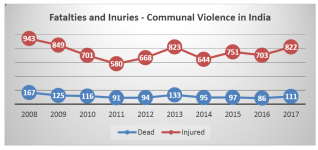
As many as 7,484 communal incidents have been reported over the last decade between 2008 and 2017,killing over 1,100 people, according to data released to the Lok Sabha(lower house of Parliament).40
Year on year casualties resulting from communal violence is animated by the graph given below:
Graph 1: Casualties resulting from communal violence in India:
Source: Business Recorder.
Eight states: Bihar, Gujarat, Karnataka, Kerala, Madhya Pradesh, Maharashtra, Rajasthan, and Uttar Pradesh accounted for 85 percent of all the incidents.42
This pattern of violence for securing votes still exists with a greater upbeat. Wilkinson theorized that minorities are protected only if the government relies on minority vote for its survival and political advantage;43 stands vindicated and manifested by Indian treatment of its minorities.
According to the Huffington Post (2017), India was declared the fourth most insecure country on religious grounds in 2015 behind Syria, Nigeria, and Iraq.44
Most recent communal violence happened on the eve of President Trump’s visit to India in late February 2020, in which more than 50 innocent Muslims were killed and over 400 injured.45Hence, Wilkinson’s theory has been verified by the ensuing two case studies in which violence is used against religious minorities as a tool for securing votes.
A) Uttar Pradesh Communal Violence: Uttar Pradesh is one of the most populous multi-religious states of India with 31 percent Muslims, a significant swing factor in elections. Of all the incidents of communal violence in the state of Uttar Pradesh, 57 percent of the riots and 67 percent casualties (295 killed) took place between 1989 and 1991 during state elections.46 More than half of these communal riots had taken place in two constituencies aimed at increasing Hindu votes where BJP had lost narrowly in previous elections.
Resultantly, BJP’s vote bank increased by 24 percent, especially in the riot-affected areas, whereas this increase was a mere seven percent in the rest of the areas where violence had not erupted.47
B) Ayodhya Violence: In another case, a series of communal violence was engineered in 1992 after the demolition of Babri Masjid by RSS cohorts.48
At least 1000 people were killed; most of whom were Muslims across India.49 The charged religious emotions were shrewdly exploited by RSS-BJP leadership to increase its vote bank in the next election.
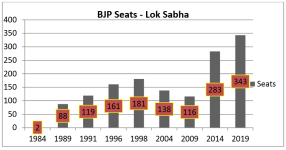
Resultantly, BJP’s Lok Sabha (House of People) seats tally rose from 119 seats in 1991-elections to 161 seats in 1996-elections. In the election campaign, BJP downplayed Hindu nationalist ideology even on the issue of Ram Mandirin 1992 overtly, but maintained connections with RSS covertly, to benefit from RSS support.50
Net Gains by RSS and BJP
In the past three decades, RSS-BJP nexus has deepened and became more methodical in manipulating the communal violence for political ends.
RSS also benefited as its Shakhas increased by 10 percent by mid-2015 due to the tacit support of BJP-led government, which carried momentum subsequently.51
On the other side, BJP’s political performance remained on the ascendant trajectory with the exception of 2004 and 2009 elections; best being in 2019,52 as reflected in Graph-2
Graph-2: BJP Seats in Lok Sabha(1984 –2019)
Source: Produced by Christophe Jaffrelotin his book titled“Religion, Caste, and Politics.
How RSS Benefits from BJP in Power
RSS and BJP immensely depend on each other for survival, growth, and influence in India. Since Gandhi’s assassination in 1948 by an RSS follower, Nathuram Godse, RSS faced administrative and operational
restrictions on its activities.
Appointing devout RSS workers on government jobs is the main method of influencing India’s policies.53For instance, Anil Dave was appointed as Advisor to the Chief Minister of Madhya Pradesh in 2003, who played a key role in the demolition of Babri Masjid.54
Similarly, Modi along with numerous cabinet ministers and important public office holders had been notable Prachariks (staunch followers and workers) of RSS.55
In Utter Pradesh, the BJP-led government was formed in 2017. Yogi Adityanath – a staunch RSS religious leader was nominated as Chief Minister. Yogi has become a symbol of hate and communal violence in Utter Pradesh vindicating the profoundness of RSS-BJP interdependence.
Shashi Shekhar writes that “the firebrand Hindutva leader like Yogi, politics is a means to further the mission of serving for a cause....he comes from the league of saints who treat politics and religion as two faces of the same coin.”56
It validates that RSS gets access to the corridors of power as a reward of BJP’s electoral support which is used for propagation of Hindutva ideology and securing immunity from state institutions, especially police action and prosecution.
The reciprocity of gains establishes the win-win equation for RSS and BJP.
Public Office Holders’ Interaction with RSS
Interactions of Sangh(RSS) leaders with BJP Ministers have been admitted by the government citing it as a matter of routine affair.57
RSS’s Annual Conclaves (2003 and2015) aimed at fostering coordination between RSS and BJP were attended by Vajpayee, L. K. Advani, Narendara Modi, V. Naidu, A. Jaitly, M. M. Joshi and numerous other cabinet members.58
In 2015, Prime Minister Modi including 15 RSS-affiliates in his cabinet conclave.59 RSS decides leaders and policies, and BJP is merely a political front faceof it, claims Anand Sharma, a Congress leader.
The symbolism of Modi and his top ministers attending RSS gathering underpins the transition of RSS-BJP relationship from covert to overt outlook.60
To sum up, it is a two-way traffic between RSS and BJP. Therefore, BJP is the vehicle of empowerment of RSS. What RSS thinks can happen on ground only if it enjoys legislative and state institutions support, which comes only if it plays in sync with BJP.
Similarly, BJP cannot exploit Hindu majority factor without exploiting Hindutva card in which minorities in India and its Muslim majority neighbouring states are object of RSS-BJP hostile strategy.
RSS Influence on Indian Domestic Environment and Policies
Internal power optimization of RSS-BJP nexus is critical to its external power projection, therefore, merits slightly lengthier description in the preceding part of this post.
A)
Radicalization of Bureaucracy and Institutions: Guy Peters states that “institutionalizing the bureaucratic form of governing was to ensure equal treatment of citizens.”61
Contrarily, the Indian bureaucracy has been gradually radicalized. Pradip K. Datta remarks:“ Placing people who will survive changes of government and push governance towards the Hindu right is central to the plan... The RSS wants to influence the country’s policies in defense and education.”62
Indian public service officeholders can associate themselves with RSS, undermining the principle of neutrality in the public service.63The Government of India had imposed a ban on this in 1986 after the murder of Prime Minister Indira Gandhi but later, most of the states lifted the ban under BJP’s political pressure.64
Structured interaction of bureaucrats with RSS leaders65 explains the propensity of RSS to indoctrinate and cultivate the top bureaucracy through BJP’s facilitation.
The biased conduct of police and other state institutions in myriad cases of violence against minorities in recent years substantiate the argument. In the recent anti-Muslim riots in Delhi, Police not only supported the violent mob but also torched the Muslims and their properties.66
It has also been working to change the history of the Subcontinent to replace Muslims with Hindu heroes.67 This elucidates the devastating regression of Indian state institutions due to Hindu radicalization.
B) Radicalization of Education Institutions: To radicalize the youth, RSS has penetrated into the Indian education system. Under Vajpayee, former Prime Minister, the Delhi Chapter of RSS launched a network of schools indoctrinating RSS philosophy.
As a result, by 2003, it had 14000 schools, 73000 teachers, and 1.7 million students in its folds. Nowadays, it has the largest student union in India with 1,101,000 members.68
It capitalized on the pervasive anti-Congress sentiments against its declaration of emergency in 1977. BJP has also altered and reproduced public school textbooks to indoctrinate Hindutva ideology in the Hindu youth.69
C) Marginalization and Subjugation of Minorities:
Modi’s reputation had been tainted by hatred and violence since Muslims’ Gujrat carnage.70RSS goals spurting from the Hindutva philosophy are embedded in the BJP’s campaign narrative.
For instance, before election-2019, it promised to introduce Uniform Civil Codes termination minorities specific rights and to replace Articles 370 and 35-A of the Indian Constitution; laws to cede special laws protecting Kashmiris exclusive rights on lands and properties ownership.71
He did it after being re-elected to the Premier’s Office. Wilkinson observed the phenomenon of Hindus’ economic gains as an outcome of communal violence in India.
He asserted that communal violence was employed by the slum-lords and the real-estate tycoons to grab the valuable lands and then selling it at inflated rates;72 Bombay and Calcutta are cases in point.
In the same vein, some of the Hindu businessmen endeavoured to get hold of Muslims’ cloth business in Meerut and cigarette business in Jabalpur, Moradabad, and Kanpur. This resulted in the eruption of anti-Muslims violence and their forcible eviction.73
This argument is further reinforced with proportionately greater Muslims losses of life and property as compared to other minorities in the communal violence incidences.74 RSS-BJP’s recent National Register of Citizens (NRC) and Citizenship Amendment Act (CAA) bills aiming at reducing Muslims to the status of illegal immigrants,75 are opposed by the minorities and Hindu civil society.
It has also proven that Jinnah’s “Two Nation Theory” was realistic.
C) Annexation of IOK and Plans of Demographic Change:
Following the strategy of fait accompli, the BJP-ledIndian government revoked Articles 370 and 35A of the Indian Constitution to assimilate IOK as Indian Union territory.76
Disregarding the global community’s concerns and advice, Modi is heading for the next phase of effecting demographic alteration. RSS-BJP is set to roll out a land-grabbing scheme to allot 6000 Acres Kashmiri Muslims’ land at a paltry rate of just one Indian Rupee per Kanal (600 square yards).77
It plans to offer 50 percent GST waiver and cheap loans to Hindu investors in the garb of promoting industrial, IT, and tourism development in IOK.78
Such a plan implies serious diplomatic, economic, and security consequences for India. With engineered policies of providing domicile and employment, Indian intent of converting Kashmiris from majority to minority is evident.79
D) From Secularism to Hindu Fascism:
Indian Parliament adopted a CAA bill to fortify Modi’s Hindu-nationalist agenda. This move shall alter India’s much-cherished secular character since1947.80 It followed violent protests and arrests of leftist intellectuals in India.
Arundhati Roy reacts by saying, “We're up against a fascist regime in India... this government is trying to overturn the constitution in order to declare India a Hindu Rashtra (Hindu nation) – more significantly an upper-caste Hindu Rashtra.”81
The situation reflects fascist thinking of BJP, which is gradually descending India into chaotic polarization with attendant global consequences for India.
Recent Human Rights Watch report on the persecution of Muslims and deprivation of fundamental citizen rights, released on April 9,2020, amply validate the argument.82
Impact of RSS on Indian Foreign and Security Policies
Historically, RSS and BJP have been the hard opponents of the Two Nation Theory and division of India on religious lines. Their Akhand Bharat (undivided India) slogan shows their ambitions of reuniting the entire Subcontinent under Hindu rule, which is likely to keep Pakistan-India relations on the boil.
Indian National Security Advisor, Ajit Doval’s claim of “India sharing 106km long borders with Afghanistan”83 validates the assertion and complicates the Kashmir dispute–the principal Pak-India contention.
This thinking has made South Asia’s relatively smaller countries vulnerable. Under the Indian coercive policies seeking submission, they are compelled to seek external balancing, essentially from China, which will enhance power competition in South Asia especially in the context of US-China power contestation.
The RSS influence on India’s external relations creates negative internal pressure on the Indian government to pursue an aggressive Pakistan policy. Thus, dissuading it from encouraging people-to-people interactions through art, sports, cultural, and religious events.
Andy Marino puts Indian mindset as Narendra (Modi) was charged up and voluble on how all Pakistanis should be decimated.’84 Glimpses of such aggressive thinking were predominantly visible from Indian Airforce aggression along the LOC prior to 2019-elections in India, which resulted in an embarrassing loss of two aircraft and a pilot captured alive in Pakistan.85
Indo-Pakistan estrangement is aggravating due to non-conciliatory Indian regional policies. India has rendered SAARC dysfunctional and desires to make it an exclusive Indian domain through bilateral engagements, excluding Pakistan.
Following the Chanakya’s teachings, India has been deepening its relations with Iran and Afghanistan to use their soil for fomenting instability in Pakistan.
This was admitted by Indian Prime Minister Manmohan Singh at the Sharam-al-Sheikh Summit86 and later confessed by Indian intelligence spy captured in Pakistan– Kulbhoshan Jadhav.87
On the diplomatic front, India has been persistently orchestrating to portray Pakistan as a terrorist state. It has raised objections on CPEC projects under the garb of its claim on Gilgit-Baltistan and Kashmir.88
Additionally, it has been trying hard to get Pakistan labeled in the ‘black’ category at the Financial Action Task Force (FATF) plenary sessions.89
Thus, India’s aggressive policy against Pakistan under the RSS-BJP regime is likely to intensify as India consolidates power. Since 1947, India and Pakistan have seen each other through the enemies’ lens 90 and RSS ideology is reinforcing this perception.
Acquiring hard power for Hindu hegemony been the ambition of RSS, adopted by BJP. As the Indian hard power is increasing, it is becoming increasingly belligerent (manifested by killing of innocent civilians along LOC), a proclamation of military doctrine (Cold Start Doctrine which projects its perilous over-confidence to wage a limited conventional war91), and post-Pulwama events (losing two fighter aircraft).92
India is accruing hard power by projecting China’s threat. But its primary preoccupation is Pakistan not China93 as validated by the deployment of bulk of its operational commands close to the Pakistan border.
However, the recent Sino-Indian standoff at Ladakh is becoming a serious concern for the Indians. The BJP government has permitted the creation of Theater Commands94 along with an expensive shopping list of defense hardware including missiles, air defense systems, fighter jets, submarines, and warships, drones, etc.95
Earlier, it has already contracted the purchase of S-400 anti-aircraft missile systems worth $800 million with Russia.96It is now pushing the case for building a third aircraft carrier to realize its dream of a blue water navy and establish its hegemony on the Indian Ocean and beyond before China could dominate the Indian Ocean.97
These developments are stressing the regional deterrence regime. Indian hard power accumulation is potentially destabilizing for South Asia’s security environment and arms it to be rogue and hegemonic –in line with RSS philosophy.
India’s application of hard power is dependent upon the Pak-India deterrence regime. Despite Indian conventional preponderance, the nuclear capabilities of Pakistan have preserved strategic equilibrium in the region and deter conventional war.
Therefore, India understands that as long Pakistan is in possession of nuclear weapons, all-out war is nearly impossible. Therefore, the debate on the revision of ‘no first use’ nuclear policy has been triggered by BJP leaders, which may prove perilous for the entire region.98
Pakistan has been experiencing a hybrid threat, mainly emanating from India.99 Having understood the viability of the deterrence regime, India had switched to the policy of indirect strategy to bleed Pakistan instead of destroying.100
The manifestation of such a policy change is evident from Indian efforts to isolate Pakistan diplomatically, targeting Pakistan by manipulated information warfare (exposed by EU Disinfo Lab101), launching a so-called surgical strike by India in Azad Jammu and Kashmir area along the line of control (LoC) to undermine Pakistan’s security forces102 (an unsubstantiated Indian claim), using Afghan and Iranian soil to foment instability in Pakistan and targeting CPEC projects evidenced by Kulbhushan Jadhav’s arrest on Pakistan’s territory and confession of perpetrating terrorism.103
So far, Pakistan’s robust conventional and nuclear capabilities have deterred India from any escalation to all-out war, it may, however, get out of control due to miscalculation and incorrect threat perception.
Conclusion
RSS is a well-organized, the most influential, and fast-expanding violent Hindu nationalist organization that enjoys immense influence over BJP.
It espouses unchallenged influence over entire India to consolidate Hinduism initially and then establish Indian hegemony over the entire Subcontinent.
RSS-BJP nexus has taken the parliamentary and constitutional path to manipulate state institutions, manage lacunas in the Indian legal framework hindering Hindutva domination by using communal violence and Pakistan bashing as means.
RSS, by the virtue of its influence over BJP, enjoys tremendous clout to re-model the entire fabric of Indian society in accordance with fundamentalist Hindu socio-political and cultural ethos.
RSS needs BJP in power, and BJP needs RSS for dominating the Indian political system. RSS spurts when BJP comes to power but retains its ground when other parties rule.
Therefore, it is logical to conclude that RSS enjoys a quasi-permanent influence in Indian decision-making either through consent or through protesting dissent. In a nutshell, RSS postures reflecting it as an extremist militant organization with a terrorist outlook.
From Pakistan’s perspective, the RSS influence on Indian policymaking shall deepen the mistrust between India and Pakistan and aggravate instability fuelling arms race without a robust crisis control mechanism.
In addition, the tilting of geo-economic, military, and balance of power trajectory in India’s favor is likely to enhance Pakistan’s insecurity especially in the context of Indo-US strategic partnership under the BJP government.
India’s fiddling with deterrence regime by tempering ‘No First Use’ is potentially disastrous and uncalled for. Both countries are burdened with heavy historical baggage of mutual suspicion and cultural difference, which results in a strategic outlook characterized by perpetual friction.104
In essence, the rise of BJP in politics enhances the power ambiance of RSS in policymaking, which in turn, radicalizes the Indian policies. With their hegemonic aspirations, the regional stability will remain in peril.


