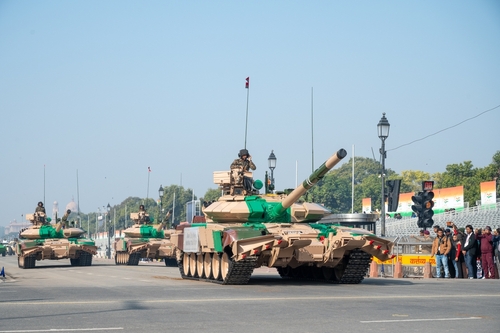
Indian IBGs - Recent Quwa+ article

Just like US military defeated Soviet Army doctrinally in 1980s, Indian military is doing same to Pak military
And the trash talking has started.. i wondered how long it would take.

Let me atleast try to respond in a civilized manner.

Does Indian Employment of its advantage in mass and fires pose a challenge to Pakistan? Absolutely.

Is this challenge insurmountable? No.

Is Pakistan able to respond in kind? Likely.

Do India and Pakistan remain capable of inflicting conventional punishment on each other? Yes.

Is this punishment likely to be decisive? No

The soviet military was probably most equal to NATO from 1975 to 1985. This is not just my opinion. It is also the opinion of the US Joint chiefs and most US Army war college publications in the aftermath of the cold war. Post 1985, the U.S army's advantage was a combination of better organization and the precision revolution as its new weapons started to come online. There is currently nothing in the Indian Organization or foreseeable procurement pipeline that would confer such a decisive advantage to the Indian military.
 
The answer to seizing of minor pieces of territory is likely to be fires. There is simply no reason to expose assets if artillery, MLRS and drones can make the enemy's position untenable. 10-20 km is well within Fire control range of most FPV and Artillery systems. Thus any attempt to seize territory is likely to be in the 30-50km range.

You are correct, i think, that the real threat is the saturation of Pakistani Air bases and ground facilities to cause paralysis. I have personally not been impressed with Pakistani decision making in 2019 and 2025 and shudder to think what could happen if Pakistani decision makes are forced into "reactive" mode early into a crisis.
Myself have been un-impressed with Pakistani command and decision making in 2019 and 2025. It seems the PAF has been carrying the entire country and that burden is too great to bear for any air force.

It also matters whether India plans to use one of these IBG's in a blitzkrieg or many of them. If India uses , say 3 IBG's and all three are able to grab 50 km each inside Pakistan, then the political pressure on Pakistani command might be too much to exercise this strategy of patience and harassement of IBG's and to eventually drive them out. The pressure will be to mobilize Pakistani assets and to throw them at the IBG's, thus exposing the assets to Indian attack.

It's possible these IBG's are in reality just bait.
 
Last edited:
Exactly. Also really interesting in the proximity of railways for Pakistan near central Pak border (where much of the desert fighting may accour), compare that to Indian side. We even have a single gauge line going all the way to Fort Abbas. That means tanks, water, ammo and fuel can be shipped almost directly to frontline units

Pakistan

View attachment 205082


Indian

View attachment 205083
These railways will be under constant Indian attack. They are an ideal target for cheap drones. How Pakistan will re-supply its forces and people, under saturation Indian air attack by planes, missiles and drones is a real challenge.
 
Last edited:
These railways will be under constant Indian attack. They are an ideal target for cheap drones. How will Pakistani re-arm and re-supply its forces and people, under saturation Indian air attack by planes, missiles and drones is a real challenge.
Pakistani logistics might be surprisingly resilient. We have a pretty dense road network and the PA has a large number of heavy and medium duty trucks (Hello Toyota Hilux) that are almost impossible to interdict. With how close formations are located to the IB, this might be less of a challenge. The civilian economy is a challenge but Ukraine has survived for 4 years under massed bombardment. As a general rule, bombardment has never caused the breakdown of civilian morale
 
Pakistani logistics might be surprisingly resilient. We have a pretty dense road network and the PA has a large number of heavy and medium duty trucks (Hello Toyota Hilux) that are almost impossible to interdict. With how close formations are located to the IB, this might be less of a challenge. The civilian economy is a challenge but Ukraine has survived for 4 years under massed bombardment. As a general rule, bombardment has never caused the breakdown of civilian morale
The roads might get mined, like what the US/Israel did around Iranian missile bases. The railways will be constantly hit by cheap drones. But that is not the title of this thread though, it's what to do about these IBG's.
 
The roads might get mined, like what the US/Israel did around Iranian missile bases. The railways will be constantly hit by cheap drones. But that is not the title of this thread though, it's what to do about these IBG's.
Yes. Overall, my opinion is that IBGs are likely to be a poor force employment choice and one that has a real world example of failing in high intensity, peer-on-peer conflict.
 
They have been "reorganising" into IBGs for last 20 years. Every new chief comes in, moves the chess set around the living room then leaves claiming "Major reorganisation"

All they do is rename units of paper and shuffle things around.

Indian Armed forces are still plagued by massive levels of disjointness, duplication and very old equipment in the army

Quick moving tanks where relevant 20 years ago, modern war has changed that, big armour formations can never have the element of suprise anymore
Very poor comparison. You're just comparing nos on paper instead of comparing actual capability.

Tell me this. Out of all your artillery, including SPHs, how many can reliably fire beyond 30-40 km using bi-modular charges and base bleed shells? India's 155 mm guns can fire up to 48+ km with base bleed shells alone without even using rocket assisted ammo. Most of your tube artillery is still based on 1950s era designs. So, comparing gun numbers without looking at ammunition, charges, range and fire control systems doesn't mean much.

The same goes for your air defence. Apart from infantry MANPADS, Pakistan Army also mounts MANPADS on APCs, usually one RBS 70 launcher on each M113 and uses them as light air defence battalion vehicles. That's because it doesn't have enough dedicated tracked air defence systems to move with its armoured formations. It doesn't have a comparable mix of SPAAGs like the Tunguska and Shilka or mobile air defence systems like the Osa and Strela to provide layered protection for its armoured columns.

Indian Army can also mount MANPADS on vehicles but that's a completely different role. Those are infantry weapons not the dedicated air defence for armoured and mechanised formations. Our tanks and mobile formations are protected by dedicated systems like Tunguska and Shilka SPAAGs, Osa systems and Strela systems. These will eventually be replaced by even more capable QR-SAM and VSHORADS.

So comparing Pakistan's M113 carrying a single MANPADS launcher with India's dedicated mobile air defence network simply doesn't make sense. Pakistani Army is using those launchers to make up for a capability gap. In the Indian Army, MANPADS are infantry weapons. Even if they're mounted on jeeps or other vehicles, they operate separately and are not a replacement for the dedicated air defence that protects armoured and mechanised formations.
 
@hmuham8

Below article doesn't have much on how to counter these IBG's but the analysis is good. It's main point is that India is moving towards a different force posture that enables its political leaders to have more punitive options against Pakistan and avoid the old war or peace binary.

 
The purpose of these Rudra battalions is to quickly attack and seize land with their existing assets and to not require further mobilization. It ties into India's Cold Strike doctrine.

Suppose this Rudra IBG attacks and does seize a sliver of 10-20km land inside Pakistan, what then ? Army units need constant logistics and re-enforcements, else they will end up being destroyed by the opposing force. How will India support these Rudra groups inside Pakistan ?

One Pakistani strategy could be to allow these Rudra IBG's to over-run border defenses and come into the country, and then to harass them constantly via drones, rockets and ATGM teams as well as attacking their air and logistical support from India. Then when these IBG's are exhausted , Pakistan can launch a counter-attack to drive the IBG back into India and maybe even capture and hold some territory.

I do think these IBG's form part of a bigger Indian plan that involves heavy saturation of Pakistan with missile and drone attacks as well as naval operations to disorient and disable the country and prevent it from mounting effective counter-attacks.
Can't allow too much time for this ...
If they quickly make a shallow thrust...and hold some territory and it takes time for a counterattack to push them out...
...well that's time ur enemy has to mobilize more troops/equipment to provide support, supplies, backup to these forward units.

So while things like Nasr were a good counter to cold start doctrine...
...and the fact that Pakistan's narrow geography(while a lack of strategic depth) allows for quicker mobility in general...
..still resting on ur laurels isn't a good thing. Just like how Pakistan created rocket force...it wouldn't be so bad to have a few of the above type of rapidly deployable forces...
...if not for the equivalent quick shallow thrusts into India...then at least for a quick defensive response to Indian IBGs.
 

Users who are viewing this thread

Pakistan Defence Latest

Back
Top