Indian Missiles and Guided Munitions

To view this content we will need your consent to set third party cookies.
For more detailed information, see our cookies page.


To view this content we will need your consent to set third party cookies.
For more detailed information, see our cookies page.
 
Last edited:
To view this content we will need your consent to set third party cookies.
For more detailed information, see our cookies page.
 
Air to Surface Subsonic Cruise Missiles

View attachment 13241
NameNASM SR
StatusUnder Developmental Trials
Range55km
PropulsionSolid Fuel Rocket Motor
Max SpeedMach 0.8
GuidenceINS + SATNAV+ IIR Seeker
Accuracy1m CEP
Warhead100kg Multi Explosively Formed Projectile
Launch PlatformMH 60R, HAL Dhruv, DBMRH (Planned)
Comparable SystemSea Venom


View attachment 13244
NameNASM MR
StatusUnder Development
Range-- (Most Likely 150 km)
Propulsion- (Unknown Turbofan Engine)
Max SpeedMach 0.8
GuidenceINS + SATNAV + RF Seeker
Accuracy1m CEP
Warhead-
Launch PlatformMig 29 (Planned), Tejas Mk 1 (Planned), TEDBF (Planned)
Comparable SystemHarpoon Block II


View attachment 13243
NameCATS Hunter
StatusUnder Development
Range225 - 250 km
PropulsionPTAE -7 Turbojet Engine
Max Speed0.7 Mach
GuidenceINS + SATNAV + 2 Way Data link + RF Seeker
Accuracy-
WarheadInterchange Warhead
Launch PlatformTejas Mk 1 (Planned), Tejas Mk 2 (Planned), AMCA (Planned)
Comparable SystemRoketsan SOM
NASM SR onboard IIR seeker footage
To view this content we will need your consent to set third party cookies.
For more detailed information, see our cookies page.
 

India successfully tests new version of Nag Mark 2 anti-tank guided missile

Story by Shivani Sharma
• 12h • 2 min read
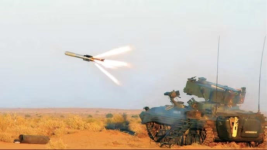
1736834162423.png

The Defence Research and Development Organisation (DRDO) on Monday successfully field evaluation trials of the Nag Mark 2, an indigenously developed third-generation fire-and-forget anti-tank guided missile.

The trials were conducted at the Pokhran field range in Rajasthan, where the missile showcased exceptional precision and reliability, destroying all designated targets at both maximum and minimum range limits, according to the Defence Ministry.

"Field evaluation trials of indigenously-developed Nag Mk 2, the third-generation anti-tank fire-and-forget guided missile, were successfully conducted recently at Pokhran field range in the presence of senior officers of the Indian Army," the ministry said in an official statement.

"During the three field trials, the missile system destroyed precisely all the targets -- maximum and minimum range, thus validating its firing range," it added.

Developed by the DRDO, the Nag Mark 2 missile is specifically designed to neutralise modern armoured threats. Its fire-and-forget technology enables operators to lock onto targets before launch, ensuring precision strikes even in complex battlefield scenarios.

In addition to the missile trials, the Nag Missile Carrier (NAMICA) Version 2 also underwent successful field evaluations, marking a critical step in operationalising the complete weapon system, the ministry said.

The achievement underscored India's growing capabilities in anti-tank warfare and strengthened the readiness of its defence forces.

Defence Minister Rajnath Singh congratulated the DRDO, the Army and industry stakeholders for their role in achieving the milestone. "The successful trials of the Nag Mk 2 reaffirm India's commitment to achieving self-reliance in defence manufacturing," he said.

Dr Samir V Kamat, Secretary of Defence R&D and DRDO Chairman, lauded the teams involved, saying, "This achievement underscores the synergy between DRDO, the Indian Army, and the defence industry in advancing India's indigenous defence capabilities."

FEATURES OF NAG MARK 2

  • Third-Generation Fire-and-Forget Technology: Enables precision targeting with minimal operator intervention post-launch.
  • Versatile Performance: Capable of neutralising modern armoured vehicles equipped with explosive reactive armour (ERA).
  • Platform Compatibility: Successfully integrated with NAMICA, enhancing battlefield mobility and deployment flexibility.
The Nag Mark 2 is a vital addition to India's defence arsenal, addressing critical operational needs in anti-tank warfare. Its induction is expected to enhance the Indian Army's ability to counter evolving armour threats, particularly along the nation's borders.

The missile testing success also highlighted India's progress in achieving self-reliance under the 'Atmanirbhar Bharat' (self-reliant India) initiative. By reducing dependence on imported defence systems, the country continues to strengthen its indigenous research and development capabilities.

 
To view this content we will need your consent to set third party cookies.
For more detailed information, see our cookies page.


To view this content we will need your consent to set third party cookies.
For more detailed information, see our cookies page.
 
Air to Surface Supersonic Cruise Missiles

View attachment 13236
NameBrahmos A
StatusIn Service
Range450 - 500km
PropulsionLiquid Fueled Ramjet Engine
Max SpeedMach 3
GuidenceINS + SATNAV+ Active Radar Homing
Accuracy1m CEP
Warhead300kg High Explosive PF warhead
Launch PlatformSu 30MKI
Comparable SystemASMP-A


View attachment 13233
NameBrahmos NG
StatusUnder Development
Range290-300km
PropulsionLiquid Fueled Ramjet Engine
Max SpeedMach 3
GuidenceINS + SATNAV + Active Radar Homing
Accuracy1m CEP
Warhead-- High Explosive PF warhead
Launch PlatformSu 30MKI (Planned), Tejas Mk 1 (Planned), Tejas Mk 2 (Planned)
Comparable SystemASMP


View attachment 13232
NameSTAR (Supersonic TARget)
StatusUnder Development
Range150 km
PropulsionLiquid Fueled Ramjet Engine
Max Speed2.5 Mach
GuidenceINS + SATNAV + 2 Way Data link
Accuracy-
Warhead-
Launch PlatformSu 30MKI (Planned), Tejas Mk 1 (Planned), Tejas Mk 2 (Planned)
Comparable System-
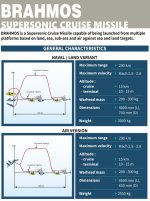
Brahmos Brochure
1737097783018.jpeg
At 8500mm length and 650mm diameter the Air launched version is just huge.

Somebody go fix that damn Wikipedia page
 

Attachments

I absolutely have no doubt Indian missles are amongst the best in the world right now

What we lack where we need to catch up the leaders is our manned and unmanned platforms that will carry these missiles

We need Amca and Tejas 2/3
We need our own drones and wingmen
 
Indian harpy like loitering munition...range 1000 km, warhead 25-40 kg
To view this content we will need your consent to set third party cookies.
For more detailed information, see our cookies page.
 
VL-SRSAM tested successfully. This SAM is based on the Astra Mk1 BVRAAM. Will give an Indian alternative to the SpyDer.

To view this content we will need your consent to set third party cookies.
For more detailed information, see our cookies page.
 
To view this content we will need your consent to set third party cookies.
For more detailed information, see our cookies page.
 
4 MR-SAM tests in one day, all direct hits

India conducts MRSAM flight trials

ndia's Defence Research and Development Organisation (DRDO) and the Indian Army have conducted flight trials of the army variant of Medium-Range Surface-to-Air Missile (MRSAM) ahead of its induction into front-line regiments.

The Indian Ministry of Defence (MoD) said four flight trials were conducted on 3 and 4 April from a ground-based mobile launcher system at DRDO's Integrated Test Range (ITR) in Chandipur, Odisha, on India's east coast.

The tests were likely carried out as part of the weapon's full operational capability milestone, but Janes has not been able to verify this.

The MoD said the flight trials were conducted against “high-speed” aerial targets.

“The missiles intercepted the aerial targets and destroyed them, registering direct hits,” the MoD said. “The trials were carried out to intercept four targets at long range, short range, high altitude, and low altitude, proving the operational capability.”

According to the MoD, MRSAM's performance was validated through flight data captured by tracking instruments including electro-optical systems and radars based at the ITR.

The MoD said that the eastern and southern commands of the Indian Army carried out the flight tests, under the guidance of DRDO. “These trials have proven the operational capability of both army commands and paved the way for operationalisation of weapon systems in two regiments,” the MoD added.

In April 2017 the MoD signed a contract worth USD1.6 billion with Israel to procure land-based MRSAMs for the Indian Army.

Subsequently, Janes reported that the Indian Army had inducted the MRSAM systems at the northeastern and northwestern borders in 2023.
 

Users who are viewing this thread

Back
Top