Indian Navy News & Discussions

I am not sure how credible IRDW is as s source

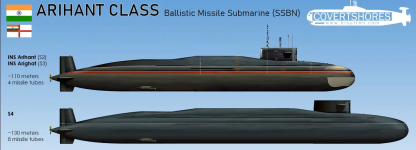
But they are saying that Indian Navy is looking to order 2 more S4 class Subs , which are to be armed with 24 Brahmos ER missiles in 3 x 8 configuration instead of 8 K4 missiles

Navy has achieved 90% indigenisation with S4* , so ordering more subs of same Design will be more cost effective rather than having an all new design for an SSN

Trust them with good amount of salt. S4 is SSBN ! Arming them with Cruise missiles makes no sense. Ideally Cruise missiles is carried by SSN!
However if they want to turn further S4s Into hybrid type then it's fine. Still there are lot of other platforms to Launch Brahmos !
 
If S4 are being armed with guided cruise missiles then it will become mixture of SSBN and SSGN...
 

Lack of indigenous engine option is the biggest roadblock country is facing right now towards attaining atmanirbharta. Govt should fund the fund indigenous engine programs on war footing if they are really serious about self reliance.
 
It's good that India laid the groundwork for it's navy back in the 1980-90s.

We don't have the strongest nor the most advanced navy but it's practical for our needs which is limited to Indian Ocean. Most importantly making the Andaman and Nicobar islands an impenetrable fortress.

Indigenization takes time and moves in snail pace.

Its good to seen IN leads from front compared to other two forces and period between 2029-32 will be important for IN because construction of IAC-2, LHP/LDPs at CSL, SSBN, SSN at LT, Capitals ships at MDL & GRSE will take the pace.
 
If navy is looking to order 2 more SSBNs then instead of S4 they should try for 2 more S5s.... we will have 4 S4s and additional nos of S5 with more heavy fire power will make more sense.... then we can focus on our homemade SSKs and SSNs...

Ordering more nos of such second strike capable platforms shows India too is planning for future war with super powers like America or China.... more nos will obviously make sense as ASW capabilities are also evolving and being far dangerous.... in a war if God forbid we loose all SSBNs to ASW warfare by super powers then we loose our nuclear triad.... in this case more nos makes sense....

Trust them with good amount of salt. S4 is SSBN ! Arming them with Cruise missiles makes no sense. Ideally Cruise missiles is carried by SSN!
However if they want to turn further S4s Into hybrid type then it's fine. Still there are lot of other platforms to Launch Brahmos !

If S4 are being armed with guided cruise missiles then it will become mixture of SSBN and SSGN...

S4 will be the INs design for future SSNs and S5 will be for SSBNs, weight might change between S4, S4+ & S5, S5+ but it seems simultaneous constructions of S4 & S5 will be on cards
 
1775663888476.png
India’s third Arihant-class SSBN INS Aridhaman and fourth Nilgiri-class frigate INS Taragiri were commissioned on April 3 at Visakhapatnam by defence minister Rajnath Singh.

Defence minister Rajnath Singh posted a cryptic tweet translating to “It’s not words but power, Aridhaman!”. Multiple Indian media confirmed that the submarine was inducted. However, there was no official confirmation regarding the commissioning of Aridhaman.

The frigate Taragiri was commissioned at the naval base in Visakhapatnam which hosts India’s SSBN construction center as well as the base for SSBNs. Aridhaman is India’s third SSBN and is longer than the first two submarines. The additional length accommodates eight launch tubes compared to the four tubes on the first two SSBNs. These tubes are intended for the K-4 SLBM and each tube can also accommodate three shorter range K-15 SLBMs.

1775663950636.png
Taragiri is the fourth Nilgiri-class P-17A frigate to be commissioned and was built by Mazagon Docks. Nilgiri class consists of seven ships, with four ships by Mazagon Docks and three by GRSE. All ships of the class are expected to be delivered to the Navy this year. The 6,700 ton frigates feature CODOG propulsion. Armament includes eight BrahMos cruise missiles and 32 MRSAM surface to air missiles along with a 76mm SRGM, torpedoes and other armament. The class will bolster the strength of the Eastern Fleet. A follow-on project for seven P-17B frigates is also underway.

In the last two days of March, multiple shipbuilding projects crossed various milestones. This included the delivery of three vessels to the Navy: the fifth Nilgiri-class vessel Dunagiri and the fourth and last Survey Vessel Large Sanshodhak, both built by GRSE as well as Malwan, the second of eight Anti-Submarine Warfare Shallow Water Craft (ASW SWC) by Cochin Shipyard Limited (CSL). Further, the first of eleven Next Generation Offshore Patrol Vessels (NGOPVs), named Shachi, was launched by Goa Shipyard Limited (GSL).

Survey Vessel Large is built by GRSE and will be followed by a five ship Next Generation Survey Vessel project. These will be built by CSL. ASW SWC consists of sixteen vessels with eight each built by CSL and GRSE.

Aridhaman, also referred to as S4, will be followed by S4* which will be the final SSBN of the Arihant-class. S4* is undergoing sea trials. The next generation of Indian SSBNs, called S5, is currently under development.
1775664055634.png
 
Indian Navy gets three GRSE-built ships, including frigate and ASW craft
1775664250257.png
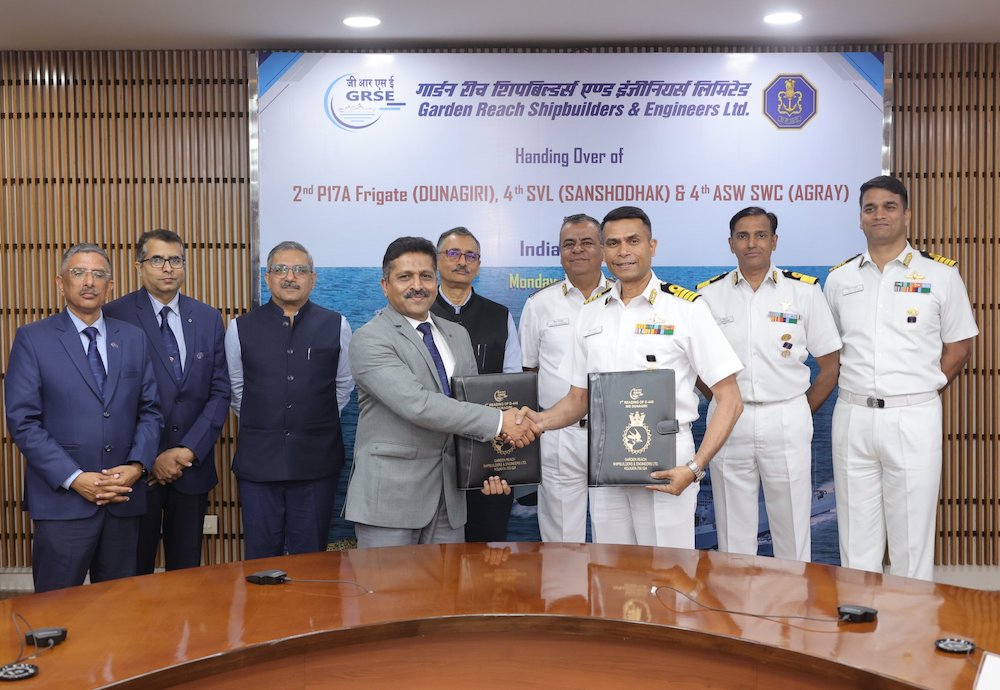
Kolkata: In a rare display of shipbuilding momentum, the Indian Navy took delivery of three indigenously built vessels from Garden Reach Shipbuilders & Engineers (GRSE) in Kolkata on Monday. The ships are Dunagiri, a stealth frigate; Sanshodhak, a hydrographic survey ship, and Agray, an anti-submarine warfare craft.

The triple handover in a single day is unusual even by the standards of a yard that has become one of India’s most productive naval shipbuilders.

The deliveries reflect a broader shift in India’s defence procurement strategy. The government has been pushing its domestic shipyards to reduce dependence on foreign platforms, and the three vessels handed over on Monday carry indigenous content of 75% to over 80%, involving more than 200 small and medium enterprises across the country.

Dunagiri: Fifth Project-17A frigate delivered

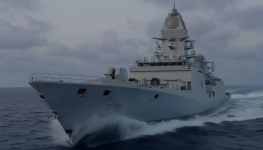
The most significant of the three deliveries is Dunagiri (Yard 3023), the fifth ship in the Nilgiri class under Project-17A and the second of the class built at GRSE. It is a guided-missile stealth frigate designed by the Warship Design Bureau (WDB) and represents India’s most capable surface combatant to enter serial production.

The ship revives a storied name. The original INS Dunagiri was a Leander-class frigate that served the Navy from May 5, 1977, to October 10, 2010 – 33 years of active service. The new Dunagiri is a fundamentally different kind of warship: far larger, stealthier, and substantially more lethal.


Project-17A frigates are configured with combined diesel or gas (CODOG) propulsion, pairing a diesel engine and a gas turbine to drive a controllable pitch propeller on each shaft. The weapon suite includes BrahMos supersonic anti-ship missiles, the medium-range surface-to-air MRSAM system, the MFSTAR multi-function radar, a super-rapid gun mount (SRGM), close-in weapon systems, and a combination of rockets and torpedoes for anti-submarine warfare – a considerably denser armament than the earlier Project-17 Shivalik-class frigates.

Notably, Dunagiri was built in 80 months, compared with the 93 months taken for Nilgiri, the first of the class. It is the fifth Project-17A ship delivered in the past 16 months – a pace that would have seemed ambitious even a few years ago. The learning curve in large warship construction is compressing, which matters because India has a sizeable fleet modernization backlog.

Sanshodhak: Last of four survey vessels

The survey vessel Sanshodhak completes a four-ship class contracted in October 2018. Its predecessors – INS Sandhayak, INS Nirdeshak, and INS Ikshak – were commissioned in February 2024, December 2024, and November 2025 respectively. Sanshodhak’s delivery on Monday closes out the class.

With a displacement of about 3,400 tonnes and an overall length of 110 metres, the ship is designed primarily for hydrographic survey of coastal waters, harbour approaches, and deep-water areas, as well as the mapping of navigational channels. It also carries equipment for collecting oceanographic and geophysical data for both defence and civilian use.


The vessel’s survey capability rests on a modern suite: a data acquisition and processing system, an autonomous underwater vehicle (AUV), a remotely operated vehicle (ROV), differential GPS long-range positioning systems, and a digital side-scan sonar. Twin diesel engines give it speeds in excess of 18 knots. The keel was laid in June 2022; the ship was launched in June 2023 and has since undergone comprehensive harbour and sea trials.

Hydrographic capability is operationally critical. Accurate seabed charts underpin submarine navigation, mine warfare planning, and the safe movement of the Navy’s increasingly large surface ships into shallow coastal waters – a domain that is growing in strategic importance as India’s interests in the Indian Ocean Region expand.

Agray: Shallow watercraft for submarine hunting

The third vessel, Agray, is the fourth of eight Arnala-class anti-submarine warfare shallow-watercraft (ASW SWC) being built by GRSE. These are specialist platforms: approximately 77 metres in length and, according to the Navy, the largest Indian naval warships propelled by waterjets – a propulsion choice suited to operations in confined, shallow littoral waters where conventional propellers would be vulnerable.

The ship carries lightweight torpedoes, indigenous rocket launchers, and a shallow-water sonar – the core toolkit for detecting and engaging submarines in coastal and near-shore environments. The class is also assigned mine-warfare and coastal surveillance roles, giving the Navy a versatile platform for the lower-intensity but strategically significant end of maritime security.

Like Dunagiri, the new ship inherits a legacy name. The original INS Agray was the fourth of the 1241 PE-class patrol vessels and was decommissioned in 2017. The Arnala class carries more than 80% indigenous content.

GRSE and the wider picture

GRSE, a defence public sector undertaking under the ministry of defence, has emerged as one of India’s two principal naval shipbuilders alongside Mazagon Dock Shipbuilders Limited in Mumbai. The yard has historically concentrated on smaller combatants and auxiliaries, but the Project-17A assignment has moved it into the category of major surface warship construction for the first time.

The scale of the industrial participation behind the three vessels is worth noting. The Project-17A programme alone has engaged more than 200 MSMEs and has generated direct employment for roughly 4,000 workers, with indirect employment put at more than 10,000. For a government that has made domestic defence manufacturing a political as well as strategic priority, these numbers matter beyond the purely naval calculation.


India’s Navy is in the middle of an ambitious expansion. It is simultaneously operating nuclear-powered ballistic missile submarines, building its second aircraft carrier, acquiring P-8I maritime patrol aircraft, and pushing through multiple surface combatant programmes. The ability to compress build periods – as demonstrated by Dunagiri’s 80-month construction cycle – is essential if the fleet is to keep pace with the government’s stated target of a 175-ship Navy by the early 2030s.

Monday’s simultaneous delivery of three ships is not merely a logistical coincidence. It signals that GRSE’s production pipeline – across multiple ship classes of different complexity – is now synchronized enough to produce parallel outputs. Whether that rhythm can be sustained will determine how quickly the Navy can close the gap between its current fleet strength and its long-term requirements.
 
Indian Navy receives anti-submarine watercraft INS Malwan to boost maritime security
1775664523932.png

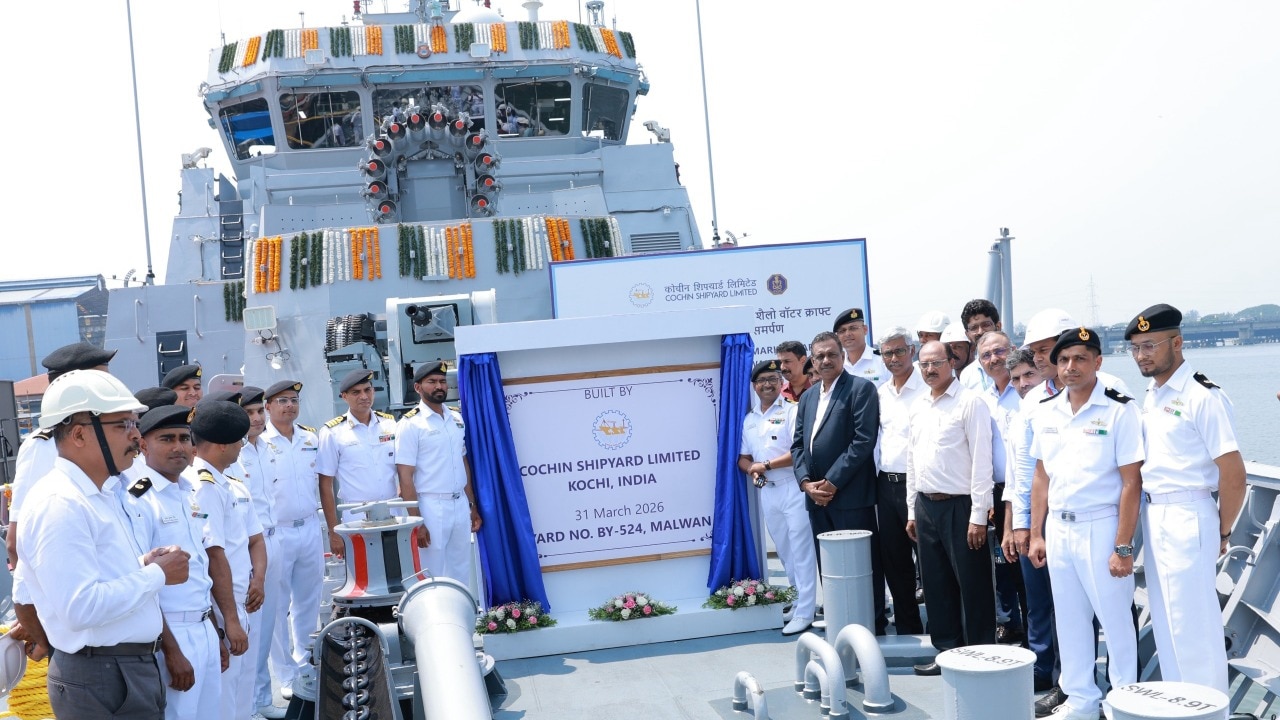
The Indian Navy on Tuesday received INS Malwan – the second Anti-Submarine Warfare Shallow Water Craft (ASW SWC) built by Cochin Shipyard Limited in Kochi, a government statement said. The vessel is part of a series of eight ships being constructed to strengthen India’s coastal defence and underwater surveillance capabilities.

Designed and built indigenously by CSL in accordance with Indian Navy requirements and the classification standards of DNV - a globally recognised Norway-based classification body that establishes technical standards and certification guidelines for ships, offshore platforms, and maritime systems - INS Malwan represents a significant step in India’s push for self-reliance in defence manufacturing.

INS Mahe was the first Anti-Submarine Warfare Shallow Water Craft (ASW SWC) built by CSL and was commissioned last November.

INS Malwan, meanwhile, incorporates over 80 percent indigenous content, reflecting the growing role of domestic industries, including MSMEs, in building advanced naval platforms.

The vessel derives its name from Malwan, a historic coastal town in Maharashtra associated with the maritime legacy of Chhatrapati Shivaji Maharaj.

It also carries forward the legacy of the earlier INS Malwan, a minesweeper that served the Navy until 2003, maintaining the tradition of reusing distinguished naval names.

Measuring around 80 metres in length and displacing approximately 1,100 tonnes, INS Malwan is equipped with modern propulsion and combat systems tailored for operations in shallow coastal waters.

The ship is powered by waterjet propulsion and fitted with advanced sensors, including radars and sonar systems, enabling effective underwater detection and tracking.

INS Malwan is designed to perform a range of missions, including anti-submarine warfare, underwater surveillance, and low-intensity maritime operations.

It is also equipped with mine warfare capabilities, enhancing its versatility in safeguarding coastal and near-shore areas.

The ship carries torpedoes and anti-submarine rockets, allowing it to respond effectively to underwater threats.

The induction of INS Malwan underscores India’s ongoing efforts to modernise its naval fleet while promoting indigenous design and production.

The project aligns with the government’s broader vision of achieving self-reliance in defence under the Aatmanirbhar Bharat (Self-reliant India) initiative.

With the delivery of this vessel, the Indian Navy continues to strengthen its operational readiness in coastal regions, while supporting the domestic defence manufacturing ecosystem.

The remaining ships in the series are expected to further enhance the Navy’s capabilities in anti-submarine warfare and maritime security in the coming years.
 
View attachment 191216
India’s third Arihant-class SSBN INS Aridhaman and fourth Nilgiri-class frigate INS Taragiri were commissioned on April 3 at Visakhapatnam by defence minister Rajnath Singh.

Defence minister Rajnath Singh posted a cryptic tweet translating to “It’s not words but power, Aridhaman!”. Multiple Indian media confirmed that the submarine was inducted. However, there was no official confirmation regarding the commissioning of Aridhaman.

The frigate Taragiri was commissioned at the naval base in Visakhapatnam which hosts India’s SSBN construction center as well as the base for SSBNs. Aridhaman is India’s third SSBN and is longer than the first two submarines. The additional length accommodates eight launch tubes compared to the four tubes on the first two SSBNs. These tubes are intended for the K-4 SLBM and each tube can also accommodate three shorter range K-15 SLBMs.

View attachment 191217
Taragiri is the fourth Nilgiri-class P-17A frigate to be commissioned and was built by Mazagon Docks. Nilgiri class consists of seven ships, with four ships by Mazagon Docks and three by GRSE. All ships of the class are expected to be delivered to the Navy this year. The 6,700 ton frigates feature CODOG propulsion. Armament includes eight BrahMos cruise missiles and 32 MRSAM surface to air missiles along with a 76mm SRGM, torpedoes and other armament. The class will bolster the strength of the Eastern Fleet. A follow-on project for seven P-17B frigates is also underway.

In the last two days of March, multiple shipbuilding projects crossed various milestones. This included the delivery of three vessels to the Navy: the fifth Nilgiri-class vessel Dunagiri and the fourth and last Survey Vessel Large Sanshodhak, both built by GRSE as well as Malwan, the second of eight Anti-Submarine Warfare Shallow Water Craft (ASW SWC) by Cochin Shipyard Limited (CSL). Further, the first of eleven Next Generation Offshore Patrol Vessels (NGOPVs), named Shachi, was launched by Goa Shipyard Limited (GSL).

Survey Vessel Large is built by GRSE and will be followed by a five ship Next Generation Survey Vessel project. These will be built by CSL. ASW SWC consists of sixteen vessels with eight each built by CSL and GRSE.

Aridhaman, also referred to as S4, will be followed by S4* which will be the final SSBN of the Arihant-class. S4* is undergoing sea trials. The next generation of Indian SSBNs, called S5, is currently under development.
View attachment 191218
Welcome back @NeptunesVortex
 

Kongsberg Signs Waterjet contract for Indian Navy’s Next Generation Missile Vessel​


Kongsberg Maritime has signed a contract to supply 18 large Kamewa waterjets for the Indian Navy’s Next Generation Missile Vessel (NGMV) programme.

Kongsberg Maritime press release:

Kongsberg Maritime has signed a contract to supply 18 large Kamewa waterjets for the Indian Navy’s Next Generation Missile Vessel (NGMV) programme. Each of the vessels will feature waterjets, delivering exceptional speed and manoeuvrability for high-performance naval operations.

The NGMV fleet is being built by Cochin Shipyard Limited and will play a critical role in India’s maritime defence strategy.

This contract marks Kongsberg Maritime’s largest single waterjet order to date and signals a strong return to large waterjet manufacturing after a relatively quiet period over the past decade.

A spokesperson for Cochin Shipyard Limited, said: “We are pleased to collaborate with Kongsberg Maritime for the supply of the waterjet propulsion system for the Naval project currently under construction at CSL for the Indian Navy. Kongsberg Maritime has been a valued and reliable partner to CSL across several commercial projects in the past, and the association has been marked by strong technical cooperation and mutual confidence.

“CSL looks forward to Kongsberg Maritime delivering a high-quality and reliable system in line with the exacting standards required for this important project and to their continued support in achieving an important milestone for CSL.”

Anders Valkeinen, Vice President, High-Speed Craft at Kongsberg Maritime, said:
“This is a milestone project for Kongsberg Maritime and a testament to the trust placed in our waterjet technology for demanding naval applications. Our Kamewa waterjets will deliver the speed, agility, and reliability required for these advanced missile vessels.”

Anette Holte, Country Manager – India at Kongsberg Maritime, added: “We value our long-standing relationship with the Indian Navy and Cochin Shipyard and are committed to supporting India’s naval ambitions. This contract underlines our dedication to growing our presence in India and delivering world-class technology for critical defence programmes.”

Delivery of the waterjets will align with the NGMV construction schedule at Cochin Shipyard.


Kongsberg Signs Waterjet contract for Indian Navy’s Next Generation Missile Vessel​


Kongsberg Maritime has signed a contract to supply 18 large Kamewa waterjets for the Indian Navy’s Next Generation Missile Vessel (NGMV) programme.

Kongsberg Maritime press release:

Kongsberg Maritime has signed a contract to supply 18 large Kamewa waterjets for the Indian Navy’s Next Generation Missile Vessel (NGMV) programme. Each of the vessels will feature waterjets, delivering exceptional speed and manoeuvrability for high-performance naval operations.

The NGMV fleet is being built by Cochin Shipyard Limited and will play a critical role in India’s maritime defence strategy.

This contract marks Kongsberg Maritime’s largest single waterjet order to date and signals a strong return to large waterjet manufacturing after a relatively quiet period over the past decade.

A spokesperson for Cochin Shipyard Limited, said: “We are pleased to collaborate with Kongsberg Maritime for the supply of the waterjet propulsion system for the Naval project currently under construction at CSL for the Indian Navy. Kongsberg Maritime has been a valued and reliable partner to CSL across several commercial projects in the past, and the association has been marked by strong technical cooperation and mutual confidence.

“CSL looks forward to Kongsberg Maritime delivering a high-quality and reliable system in line with the exacting standards required for this important project and to their continued support in achieving an important milestone for CSL.”

Anders Valkeinen, Vice President, High-Speed Craft at Kongsberg Maritime, said:
“This is a milestone project for Kongsberg Maritime and a testament to the trust placed in our waterjet technology for demanding naval applications. Our Kamewa waterjets will deliver the speed, agility, and reliability required for these advanced missile vessels.”

Anette Holte, Country Manager – India at Kongsberg Maritime, added: “We value our long-standing relationship with the Indian Navy and Cochin Shipyard and are committed to supporting India’s naval ambitions. This contract underlines our dedication to growing our presence in India and delivering world-class technology for critical defence programmes.”

Delivery of the waterjets will align with the NGMV construction schedule at Cochin Shipyard.

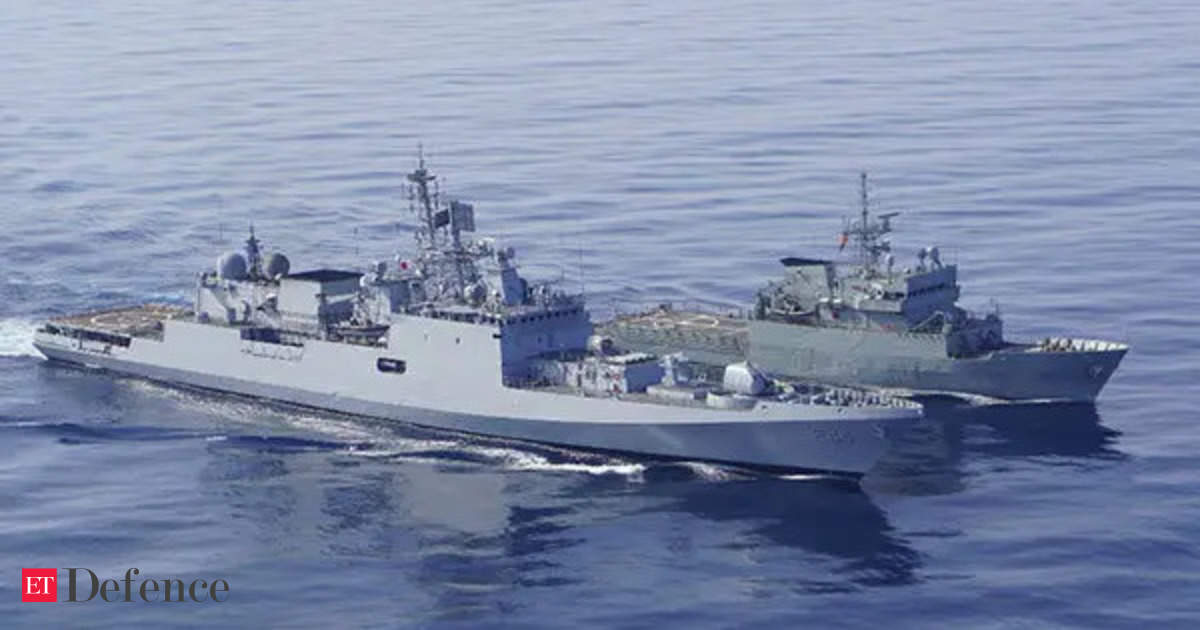
One good thing about the NGMVs is that they’ll use an Indian X-band radar and VLSRSAM missiles for their main air defense.
images - 2026-04-10T180336.978.jpeg
 
One good thing about the NGMVs is that they’ll use an Indian X-band radar and VLSRSAM missiles for their main air defense.
View attachment 191668
Excellent 👌🏻 💯
 
One good thing about the NGMVs is that they’ll use an Indian X-band radar and VLSRSAM missiles for their main air defense.
View attachment 191668

only 6 pieces ?? I thought MoD would order atleast 12-18 nos, splitting with 3 shipyards
 

Users who are viewing this thread

Country Watch Latest

Back
Top