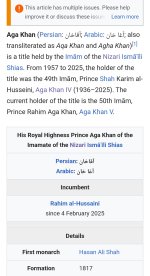
Prince Karim Aga Khan IV, leader of the Nizari Ismaili community, passed away, but India’s government did not issue a condolence message despite his deep contributions to Indian heritage and society. His initiatives, such as the Aga Khan Trust’s restoration of Sunder Nursery and Humayun’s Tomb...

frontline.thehindu.com
Prince Karim Aga Khan IV passed away in Lisbon on February 4 after having held the Imamate of the Nizari Ismaili community, as the 49th Mawlana Hazrat Imam, since 1957.
As far as I know, the Narendra Modi government has issued no official condolence message. This is not only an insult to the memory of the prince, but also an insult to the 1.5 million-strong Indian Ismaili community he led for the last 68 years. It not only ignores the Padma Vibhushan awarded to the prince, but also neglects that it was in the Prime Minister’s home State of Gujarat that Aga Khan IV started and has until now sustained the Aga Khan Rural Support Programme, the precursor to the worldwide Aga Khan Development Network which deals with healthcare, housing, education, and rural economic development.
The guiding principle of the Aga Khan’s life has been to recognise that his followers live among others of different ethnicities and religions. Therefore, he devotes a significant portion of his vast wealth to “improving the quality of life for individuals and communities across the world” as he wished to do so “irrespective of their religious affiliations or origins”.
I go for a walk whenever I can to Sunder Nursery in central New Delhi. It used to be an unkempt jungle until the Aga Khan Trust for Culture took charge of it. While preserving, conserving, restoring, and renovating the numerous Mughal-era monuments that dot the park, the Aga Khan Trust has converted the wilderness into an arresting Mughal Gardens with a profusion of flowers in full bloom as winter turns to spring. The greenery is enhanced by the numerous trees and the woods at its periphery, home to many birds and small animals.
And because Sunder Nursery is close to Muslim residential areas, Muslim families and students, young men and women in wooing mode, and newly married Muslim couples holding hands wander at ease through its enchanted gardens and waterways, the way they do along the sea-face at Mumbai’s Marine Drive.
Aga Khan Trust’s contribution
It is one place in Modi’s India where our major minority community can have a sense of belonging, where their identity is unquestioned, their heritage (which is also ours) is lovingly celebrated. The open-air auditorium is a magnificent setting to display the composite civilisation that defines the Idea of India, especially in poetry, music, and dance—and true spirituality. Is that why the current Indian establishment shuns this UNESCO-recognised site, although it was Vice President Venkaiah Naidu, a former BJP activist, who inaugurated the park?
Right next to Sunder Nursery is Humayun’s Tomb. It was neglected and run-down till Prince Karim turned his attention to it. Today, it stands rejuvenated, its surrounding greens and lawns perfectly manicured and with a world-class museum that explains and celebrates that period of our history. A fitting tribute to Humayun whose father, the Mughal emperor Babur, left him a letter emphasising that if he wished to keep the empire he was inheriting, he must remember not to forcibly convert to Islam the inhabitants of the land. This injunction resulted in only a quarter of India’s population being Muslim after 666 years of Muslim sultans and badshahs ruling from the throne of Delhi (1192-1858). India was where Islam learned to co-exist with other religions. Elsewhere, Islam was either totally triumphant (from Afghanistan and Iran to West Asia and North Africa, Central Asia, and much of South-East Asia down to Indonesia, the most populous Muslim nation in the world) or totally defeated (as at the Pyrenees that separate Spain from France and at the gates of Vienna).
Islamic contact with India may have started with invasions and bigotry but very quickly turned to mutual respect and cultural synthesis. Right opposite Sunder Nursery is a large sign proclaiming, “I LOVE NIZAMUDDIN”. The reference is not to the great Sufi spiritual leader, Nizamuddin Auliya, but to the upscale post-Partition residential colony named in an earlier more tolerant and accommodating period of independent India. It was here, at what is now his dargah, that Nizamuddin Auliya, spiritual adviser to the Khiljis and the Tughlaqs, persuaded Ghiyasuddin Tughlaq that Alauddin’s resort to merciless armed conversions was not the way the sultan should adopt, leading to Ghiyasuddin’s imperial decree to leave non-Muslims free to believe in and practise their faith. It is here that lie the origins not only of modern India’s secularism but also its national language, Hindi. For it was here that Nizamuddin Auliya’s renowned disciple, Amir Khusrau, fused the vernacular Braj Bhasha with imported words, phrases, and expressions from Turkish, Persian, and Central Asian dialects into a language he called “Hindawi”, from which contemporary Hindi was derived.
This was also the locale of the Sufi movement that evolved in India parallel to the Bhakti movement and led to the intertwining of the spiritual ecstasy that is the essence of both Sufism and Bhakti. Where in its heyday the dargah of Nizamuddin Auliya rested in expansive surroundings, it is now enclosed in a warren of narrow streets and dilapidated buildings. The Aga Khan Trust for Culture has made the renovation and upgrading of the Nizamuddin basti and its numerous imposing structures, as also that wondrous architectural masterpiece, the tomb of Abdur Rahim Khan-e-Khanan, another focus of its generous attention.
It is no surprise that non-Islamic, secular India is where Prince Karim Aga Khan IV concentrated his efforts. I only met him once—when he visited Karachi in 1981, where I was serving as India’s first-ever Consul General, to present his annual award for architecture to a highly talented Pakistani architect, Yasmeen Lari, who had brilliantly designed a hotel in India incorporating Islamic motifs with modern ones. Her fellow awardee was an Indian Christian named Charles Correa.
The chairman of the Aga Khan Trust, Rajeshwar Dayal, a former High Commissioner to Pakistan, was also present. Prince Karim was not concerned that a Hindu was heading his Trust. (One amusing but telling fallout of that visit was that the Jama’at-e-Islami Mayor of Karachi found himself being pushed down the reception line by higher-ups from Islamabad. Indignant, he rang me the next day to ask where the Mayor of Mumbai stood in the warrant of precedence. I was much taken by the fact that he did not think the position of the Lord Mayor of London, or the Mayor of New York, relevant. He instinctively understood that his case would be strengthened only by an Indian example. The Aga Khan was sensitive to the nuances of such a relationship between Pakistan and India!)
Champion of justice
His ecumenical (in the sense of all-embracing) and inclusive approach was also evident when Aga Khan IV took up the cause of Asians being expelled from East Africa, especially from Uganda under Idi Amin. Having himself been brought up as a boy in Kenya, Prince Karim championed his campaign of justice for all uprooted Asian communities, not only Ismailis, in those tense and difficult times, using his wide network in the West, particularly his friendship with Canadian premier Pierre Trudeau, to resettle thousands of refugee families in Canada.
It is surely churlish of the government of India to not issue a statement of condolence on the passing away of so noble an international Muslim leader with numerous followers in India and the recipient of India’s second highest civilian honour. But then the Modi-Amit Shah-Yogi Adityanath trio was preoccupied at the time of his passing with covering up the Mahakumbh stampede that killed uncounted numbers of Hindu pilgrims in the narrow alleys leading to the bathing ghats at Prayagraj, with those who escaped death being welcomed into mosques and madrasas that had thrown open their doors to offer hospitality and succour—although the triumvirate had let it be known that no Muslim would be allowed into the
sangam (river confluence) during the Mahakumbh.
The irony of this is lost on no one.
Regards