onlinpunit
Trusted Member

Secularism at its peak !
Follow along with the video below to see how to install our site as a web app on your home screen.
Note: This feature may not be available in some browsers.


Hope the Mods dont mind a little freewheeling discussion
@Vikramaditya1 @vasanthm @kambhakt @AjayGhatak @Dalit @r3alist @PakFactor @FuturePAF @UKBengali @BananaRepublic
Chill it has nothing to do with the MAGA vs H1B debate
I asked a 35-year-old unemployed youth standing at the village's paan shop, "Why don't you do something productive and earn? You spend the whole day drinking and spitting out Rajshree (a brand of tobacco/pan masala)."
He replied, "It's my choice."
I asked, "Are you married?"
He said, "Yes."
I asked, "How did you get married?" He said, "I got 30,000 rupees from the Chief Minister's Adarsh Vivah Yojana (a government scheme) and 2,50,000 rupees from the Antyodaya Kanya Vivah Yojana (another government scheme)."
I asked, "Don't you need to work for your children?" He said, "Delivery is free under the Janani Suraksha Yojana (a government scheme), and I get 1,500 rupees and 20,000 rupees under the Bhagini Prasuti Yojana (another government scheme)." My wife, Mother and daughter all get Rs 1500 pm under the Mukhyamantri Ladli Behen Yojana.
I asked, "What about your children's education?" He said, "Everything is free for them - education, uniforms, books, and food. And under the Chief Minister's Naulnihaal and Medhavi Chhatravriti Yojana (government schemes), they get money every year."
I asked, "How do you run your household?" He said, "My younger daughter got a cycle from the government. My son got a laptop. My parents get old-age pension, and we get rice for 1 rupee per kilo for the whole month."
I asked, "Don't you need to work for your parents' pilgrimage?" He said, "I've sent them under the Chief Minister's Teerth Yatra Yojana (government scheme)."
I asked, "At least work for their medical treatment?" He said, "I have an Ayushman card, so I get free treatment up to 5 lakhs."
I asked, "What about their funeral expenses?" He said, "There's a 1-rupee electric crematorium."
I asked, "Don't you need to work for your children's marriage?" He smiled and said, "It'll happen the same way I did."
He continued, "You and lakhs of people like you work and pay taxes for us. Farmers work hard to produce grains, and the government buys them and gives them to us for free. So why should we work?"
Regards

 timesofindia.indiatimes.com
Interesting Facts about India
India never invaded any country in her last 100000 years of history.
When many cultures were only nomadic forest dwellers over 5000 years ago, Indians established Harappan culture in Sindhu Valley (Indus Valley Civilization)
The name 'India' is derived from the River Indus, the valleys around which were the home of the early settlers. The Aryan worshippers referred to the river Indus as the Sindhu.
The Persian invaders converted it into Hindu. The name 'Hindustan' combines Sindhu and Hindu and thus refers to the land of the Hindus.
Chess was invented in India.
Algebra, Trigonometry and Calculus are studies, which originated in India.
The 'Place Value System' and the 'Decimal System' were developed in India in 100 B.C.
The World's First Granite Temple is the Brihadeswara Temple at Tanjavur, Tamil Nadu. The shikhara of the temple is made from a single 80-tonne piece of granite. This magnificent temple was built in just five years, (between 1004 AD and 1009 AD) during the reign of Rajaraja Chola.
India is the largest democracy in the world, the 7th largest Country in the world, and one of the most ancient civilizations.
The game of Snakes & Ladders was created by the 13th century poet saint Gyandev. It was originally called 'Mokshapat'. The ladders in the game represented virtues and the snakes indicated vices. The game was played with cowrie shells and dices. In time, the game underwent several modifications, but its meaning remained the same, i.e. good deeds take people to heaven and evil to a cycle of re-births.
The world's highest cricket ground is in Chail, Himachal Pradesh. Built in 1893 after leveling a hilltop, this cricket pitch is 2444 meters above sea level.
The world's first university was established in Takshila in 700 BC. More than 10,500 students from all over the world studied more than 60 subjects. The University of Nalanda built in the 4th century was one of the greatest achievements of ancient India in the field of education.
Ayurveda is the earliest school of medicine known to mankind. The Father of Medicine, Charaka, consolidated Ayurveda 2500 years ago.
India was one of the richest countries till the time of British rule in the early 17th Century. Christopher Columbus, attracted by India's wealth, had come looking for a sea route to India when he discovered America by mistake.
The Art of Navigation & Navigating was born in the river Sindh over 6000 years ago. The very word Navigation is derived from the Sanskrit word 'NAVGATIH'. The word navy is also derived from the Sanskrit word 'Nou'.
Bhaskaracharya rightly calculated the time taken by the earth to orbit the Sun hundreds of years before the astronomer Smart. According to his calculation, the time taken by the Earth to orbit the Sun was 365.258756484 days.
The value of "pi" was first calculated by the Indian Mathematician Budhayana, and he explained the concept of what is known as the Pythagorean Theorem. He discovered this in the 6th century, long before the European mathematicians.
Algebra, Trigonometry and Calculus also originated in India.Quadratic Equations were used by Sridharacharya in the 11th century. The largest numbers the Greeks and the Romans used were 106 whereas Hindus used numbers as big as 10*53 (i.e. 10 to the power of 53) with specific names as early as 5000 B.C.during the Vedic period.Even today, the largest used number is Terra: 10*12(10 to the power of 12).
Until 1896, India was the only source of diamonds in the world
(Source: Gemological Institute of America).
The Baily Bridge is the highest bridge in the world. It is located in the Ladakh valley between the Dras and Suru rivers in the Himalayan mountains. It was built by the Indian Army in August 1982.
Sushruta is regarded as the Father of Surgery. Over2600 years ago Sushrata & his team conducted complicated surgeries like cataract, artificial limbs, cesareans, fractures, urinary stones, plastic surgery and brain surgeries.
Usage of anaesthesia was well known in ancient Indian medicine. Detailed knowledge of anatomy, embryology, digestion, metabolism,physiology, etiology, genetics and immunity is also found in many ancient Indian texts.
India exports software to 90 countries.
The four religions born in India - Hinduism, Buddhism, Jainism, and Sikhism, are followed by 25% of the world's population.
Jainism and Buddhism were founded in India in 600 B.C. and 500 B.C. respectively.
Islam is India's and the world's second largest religion.
There are 300,000 active mosques in India, more than in any other country, including the Muslim world.
The oldest European church and synagogue in India are in the city of Cochin. They were built in 1503 and 1568 respectively.
Jews and Christians have lived continuously in India since 200 B.C. and 52 A.D. respectively
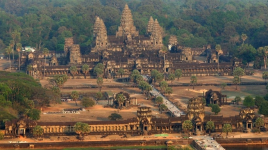
The largest religious building in the world is Angkor Wat, a Hindu Temple in Cambodia built at the end of the 11th century.
The Vishnu Temple in the city of Tirupathi built in the 10th century, is the world's largest religious pilgrimage destination. Larger than either Rome or Mecca, an average of 30,000 visitors donate $6 million (US) to the temple everyday.
Sikhism originated in the Holy city of Amritsar in Punjab. Famous for housing the Golden Temple, the city was founded in 1577.
Varanasi, also known as Benaras, was called "the Ancient City" when Lord Buddha visited it in 500 B.C., and is the oldest, continuously inhabited city in the world today.
India provides safety for more than 300,000 refugees originally from Sri Lanka, Tibet, Bhutan, Afghanistan and Bangladesh, who escaped to flee religious and political persecution.
His Holiness, the Dalai Lama, the exiled spiritual leader of Tibetan Buddhists, runs his government in exile from Dharmashala in northern India.
Martial Arts were first created in India, and later spread to Asia by Buddhist missionaries.
Yoga has its origins in India and has existed for over 5,000 years.
Interesting Facts about India - My India, My Pride - Know India: National Portal of India


 www.history.com
www.history.com
www.history.com


Cambodia is now India as well?=> The largest religious building in the world is Angkor Wat, a Hindu Temple in Cambodia built at the end of the 11th century.
Angkor Wat is an enormous Buddhist temple complex located in northern Cambodia. It was originally built in the first half of the 12th century as a Hindu temple. Spread across more than 400 acres, Angkor Wat is said to be the largest religious monument in the world.
View attachment 92996
History is alive
Find out more about the shows on Sky HISTORY's TV channel, with plenty to read and watch on your favourite historical topics.
Where Is Angkor Wat?
Angkor Wat is located roughly five miles north of the modern Cambodian city of Siem Reap, which has a population of more than 200,000 people.
However, when it was built, it served as the capital of the Khmer empire, which ruled the region at the time. The word “Angkor” means “capital city” in the Khmer language, while the word “Wat” means “temple.”
Initially, Angkor Wat was designed as a Hindu temple, as that was the religion of the region’s ruler at the time, Suryavarman II. However, by the end of the 12th century, it was considered a Buddhist site.
Unfortunately, by then, Angkor Wat had been sacked by a rival tribe to the Khmer, who in turn, at the direction of the new emperor, Jayavarman VII, moved their capital to Angkor Thom and their state temple to Bayon, both of which are a few miles to the north of the historic site.
As Angkor Wat’s significance within the Buddhist religion of the region increased, so too did the legend surrounding the site. Many Buddhists believe the temple’s construction was ordered by the god Indra, and that the work was accomplished in one night.
However, scholars now know it took several decades to build Angkor Wat, from the design phase to completion.
History is alive
Find out more about the shows on Sky HISTORY's TV channel, with plenty to read and watch on your favourite historical topics.
U can always bad apples and to be frank there are lots of them..Hope the Mods dont mind a little freewheeling discussion
@Vikramaditya1 @vasanthm @kambhakt @AjayGhatak @Dalit @r3alist @PakFactor @FuturePAF @UKBengali @BananaRepublic
Chill it has nothing to do with the MAGA vs H1B debate
I asked a 35-year-old unemployed youth standing at the village's paan shop, "Why don't you do something productive and earn? You spend the whole day drinking and spitting out Rajshree (a brand of tobacco/pan masala)."
He replied, "It's my choice."
I asked, "Are you married?"
He said, "Yes."
I asked, "How did you get married?" He said, "I got 30,000 rupees from the Chief Minister's Adarsh Vivah Yojana (a government scheme) and 2,50,000 rupees from the Antyodaya Kanya Vivah Yojana (another government scheme)."
I asked, "Don't you need to work for your children?" He said, "Delivery is free under the Janani Suraksha Yojana (a government scheme), and I get 1,500 rupees and 20,000 rupees under the Bhagini Prasuti Yojana (another government scheme)." My wife, Mother and daughter all get Rs 1500 pm under the Mukhyamantri Ladli Behen Yojana.
I asked, "What about your children's education?" He said, "Everything is free for them - education, uniforms, books, and food. And under the Chief Minister's Naulnihaal and Medhavi Chhatravriti Yojana (government schemes), they get money every year."
I asked, "How do you run your household?" He said, "My younger daughter got a cycle from the government. My son got a laptop. My parents get old-age pension, and we get rice for 1 rupee per kilo for the whole month."
I asked, "Don't you need to work for your parents' pilgrimage?" He said, "I've sent them under the Chief Minister's Teerth Yatra Yojana (government scheme)."
I asked, "At least work for their medical treatment?" He said, "I have an Ayushman card, so I get free treatment up to 5 lakhs."
I asked, "What about their funeral expenses?" He said, "There's a 1-rupee electric crematorium."
I asked, "Don't you need to work for your children's marriage?" He smiled and said, "It'll happen the same way I did."
He continued, "You and lakhs of people like you work and pay taxes for us. Farmers work hard to produce grains, and the government buys them and gives them to us for free. So why should we work?"
Regards

Move on.
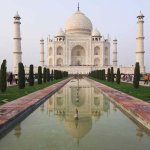
A waqf property is not just any property that is lying around; it is property in trust placed under a board of trust, that is called the Waqf Board. The documentation, the deed of trust, is precise but comprehensive.i think, the skilled workers who worked on Taj Mahal would be Hindu & Muslim both. but as the ruler was Mughal King, Taj Mahal is now property of 'Waqf Board' in India
.
=> Waqf properties, governed under Islamic law, make up the third-largest landholdings in India. Spanning nearly 900k properties & 2.3mn acres—roughly the size of Delaware or Luxembourg—they include iconic sites like the Taj Mahal, Jama Masjid, and Charminar.