
Beijingwalker
VIP Member

India’s Zorawar tank for China border faces 2-year delay as Army’s new demand puts engineers to the test
India’s Zorawar tank for China border faces 2-year delay as Army’s new demand puts engineers to the testBy Trending Desk, ET Online
Last Updated: Oct 17, 2026, 05:36:00 PM IST
Synopsis
India’s Zorawar light tank must overcome a difficult engineering trade-off before it can fulfil its role in the Himalayas. Stronger armour could help protect crews against heavier weapons, but additional weight may undermine the mobility that sets the vehicle apart. The decision could shape the tank’s engine requirements, testing schedule and planned induction around 2028-2029.
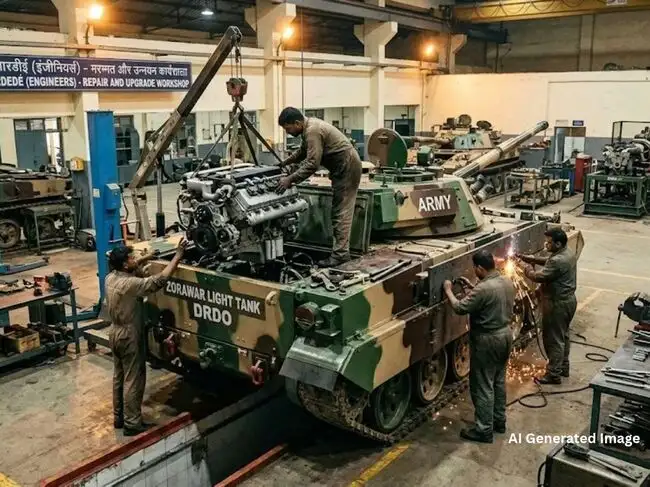
AI generated image used for illustration
India’s efforts to field a lightweight armoured vehicle for the Himalayan frontier are running into a difficult engineering trade-off, with the Zorawar tank potentially requiring significant changes before it enters service. The Indian Army wants the vehicle to withstand more powerful ammunition, but additional armour could increase its weight, strain its existing engine and compromise its ability to manoeuvre in mountainous terrain, as per a TOI report. The changes could also push induction to 2028-2029 which was originally planned to join the service 2027.. The Army plans to procure 354 Zorawar light tanks.
Zorawar tank faces trade-off between armour and mobility
The key challenge is to strengthen the Zorawar’s protection against more powerful ammunition while retaining the performance required to navigate steep gradients, thin air and narrow mountain roads. A heavier vehicle could lose some of the acceleration, power-to-weight ratio and hill-climbing capability that underpin its role in the Himalayas.The tank’s initial configuration reportedly offers frontal protection at STANAG 4569 Level 4, while the Army is seeking protection corresponding to Level 6 against 30mm armour-piercing rounds. Stronger protection for the sides and rear is also under consideration.
One option being examined is modular armour, including bolt-on ceramic protection, which could improve survivability without requiring a complete redesign. However, adding armour, potentially alongside a hard-kill active protection system, could increase the vehicle’s combat weight and place additional demands on its engine.
Zorawar may need a more powerful engine if weight rises
The Zorawar was designed with a combat weight of approximately 25 tonnes and is powered by a Cummins diesel engine rated at around 760 horsepower. If additional protection pushes its weight to 30-32 tonnes, the existing powerpack may no longer deliver the same performance, potentially necessitating a more powerful engine and further testing.Such a change could affect both the programme’s development schedule and the tank’s operational capabilities. The Army and developers face the task of balancing enhanced protection with the ability to move quickly across difficult terrain, where mobility is a critical requirement.
China’s Type 15 offers a comparison for high-altitude operations
China’s Type 15 light tank provides a reference point for the design challenge. Depending on its configuration, the vehicle weighs roughly 33-36 tonnes and uses a 1,000-horsepower engine alongside a 105mm gun and modular protection.Its design demonstrates that a relatively heavy light tank can be configured for high-altitude operations. However, Zorawar’s requirements, transportability and logistical constraints differ, meaning that simply matching the Chinese tank’s weight or engine power would not necessarily meet the Indian Army’s needs.
Why India developed the Zorawar light tank
The Zorawar programme took shape after the 2020 India-China border confrontation in eastern Ladakh, when China’s deployment of Type 15 tanks highlighted the need for an Indian armoured platform suited to mountainous terrain. The heavier T-72 and T-90 tanks can face mobility and deployment constraints in areas with steep gradients, narrow roads, thin air and limited infrastructure.Designed at around 25 tonnes, Zorawar was intended to combine firepower and mobility while remaining transportable by aircraft such as the C-17 Globemaster III. Its planned armament includes a 105mm gun mounted in a Belgian-designed Cockerill 3105 turret.
The Army’s procurement plan covers 354 light tanks. The first 59 are being developed by the Defence Research and Development Organisation (DRDO) and Larsen & Toubro (L&T). Tata Advanced Systems has emerged as the lowest bidder for the remaining 295 tanks, with Mahindra Defence Systems also involved in the competition. A phased approach could allow the initial batch to proceed while later vehicles incorporate improved protection, depending on the final design and procurement decisions.


