Indonesia Agricultural Sector Development

Indonesia Aims to Halt Rice Imports in 2025 as Self-Sufficiency Improves​


Mita Amalia Hapsari
April 20, 2025 | 10:03 pm


Jakarta. Indonesia will no longer need to import rice starting next year, Chief Food Affairs Minister Zulkifli Hasan said on Sunday, citing recent data indicating a significant improvement in domestic rice production.


Zulkifli said the country is on track to achieve self-sufficiency in rice, with an additional 1.5 million tons expected to be harvested from local farmers by the end of April. The increase in domestic supply, he said, would eliminate the need for further imports.


“Put simply, we have achieved food self-sufficiency as of April, thanks to the smooth distribution of fertilizers and the reduction of bureaucratic hurdles,” Zulkifli said in Jakarta.


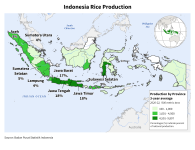
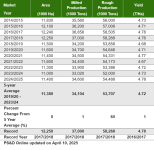
According to government data, the State Logistics Agency (Bulog) currently holds around 1.8 million tons in government rice reserves. Meanwhile, the Agriculture Ministry projects national rice production will reach 32 million tons in 2024, with a surplus of nearly 10 million tons anticipated by the end of 2025.

The administration of President Prabowo Subianto has set an ambitious target to halt imports of not only rice but also sugar and salt beginning next year, as part of a broader push toward agricultural independence.


Earlier this month, Agriculture Minister Andi Amran Sulaiman also expressed optimism, stating that Indonesia is on course to record a 12 million ton rice surplus “in the not-so-distant future.”


Indonesian President Prabowo greenlights rice export amid rising production​


  • Thursday, 24 Apr 2025
  • 9:51 PM MYT

JAKARTA: President Prabowo Subianto has authorised rice exports to countries in need, reversing an earlier statement by Agriculture Minister Andi Amran Sulaiman, who had insisted on prioritising domestic reserves.

Speaking during a visit to South Sumatra on Wednesday (April 24), Prabowo said the country could share its rice surplus with others without seeking high profits, in the spirit of “humanity,” as long as the basic production, logistics and administrative costs were covered.


“I have received reports from the agriculture minister and the coordinating food minister that several countries have requested rice imports from Indonesia. I approved it. I ordered that rice be sent to them,” Prabowo declared.

According to the President, rice production reached record highs over the past four months.

However, the surplus has created a new logistical challenge, as government storage facilities are nearing full capacity.

To address the issue, Prabowo ordered a swift, short-term solution by repurposing idle land owned by the government, military and police as makeshift storage sites.

“I’ve asked government agencies, state-owned enterprises [SOEs], the Army and the police to join forces. I’ll allocate special funding to build temporary storage facilities that won’t be too costly to construct,” he said.

He also pointed to the state-backed Red and White Village Cooperative program as a longer-term solution for managing distribution.

With plans to establish 80,000 cooperatives nationwide, each will be equipped with a warehouse, cold storage and one or two trucks.

“These cooperatives will safely store our harvests until the time is right to sell,” Prabowo said, emphasising the importance of building food resilience amid external pressure.


The government previously said that such cooperatives may hire unemployed graduates with bachelor’s degrees from villages that may be living in cities and retirees with professional experience.

The announcement comes just days after the government rejected a request from Malaysia to import rice from Indonesia.

Agriculture Minister Amran cited the need to safeguard domestic supply.

“It was interesting, [Malaysia] asked earlier whether [they] could import rice from Indonesia,” he said during a press conference after a meeting with Malaysian Agriculture and Food Security Minister Mohamad Sabu in Jakarta on Tuesday, Bisnis reported.

“I said, for the time being, we will maintain the [domestic] stocks. We will assess the climate [conditions first],” he said.

A shortage of supply had driven prices up in Malaysia, Amran said, explaining that the country could only meet around 40 to 50 per cent of national demand.

He also said Japan’s Ministry of Agriculture, Forestry and Fisheries was scheduled to visit Indonesia on April 29 to discuss rice supply options.

Japan has seen a sharp rise in rice prices, which have climbed to between Rp 93,000 (US$5.52) and Rp 100,000 per kilogramme.

According to local media The Mainichi, rice prices in Japan have risen for 15 consecutive weeks, despite government efforts to stabilise the market by releasing stockpiled supplies.

As of now, Indonesia’s rice reserve stocks (CBP) at the State Logistics Agency (Bulog) stand at 3.3 million tonnes.

The government aims to increase the reserve to 4 million tonnes by May, the minister said. - The Jakarta Post/ANN

 
Discussion about how to increase Indonesia salt production

To view this content we will need your consent to set third party cookies.
For more detailed information, see our cookies page.
 

Indonesian Palm Oil Sector Books $916 Million Investment to Move Up Value Chain​


Jayanty Nada Shofa

April 30, 2025 | 1:55 pm


Jakarta. World’s largest palm oil producer Indonesia reported Tuesday that it had attracted investment worth hundreds of millions of American dollars in the first quarter of 2025 to capture more value out of its top commodity.


The resource-rich Indonesia is currently developing its refining and manufacturing industries to be able to export high-value products. The country is also open to both foreign and domestic investors who wish to help Indonesia move up the value chain. This grand plan to date is still heavily concentrated on nickel processing, although work is underway to develop the downstream industries in other commodities, including palm oil of which Indonesia is abundant.


Investment Minister Rosan Roeslani told a news conference on Tuesday that Indonesia recorded around Rp 15.26 trillion worth of realized investment in palm oil processing in January-March 2025. This is equivalent to around $916 million worth of fresh investments needed to help Indonesia turn palm oil into high-value products. The figures are still about a third of what the nickel processing sector secured in Q1 2025, which totaled Rp 47.82 trillion.

“Nickel and its derivatives have been dominating our industrialization investments. … However, we have long been developing our palm oil industries. We will continue to encourage the development of its derivatives, so we can capture more added value and create even more job opportunities,” Rosan told a news conference in Jakarta.


Q1 2025 data showed that palm oil was the most popular among investors who wish to develop Indonesia’s plantation and forestry sector. Followed by log wood (Rp 11.79 trillion) and rubber (Rp 3.08 trillion). Investors had put around Rp 990 billion in other plantation commodities (i.e. nutmegs, coconuts, cacao, and biofuel). Rosan did not say where these investors had come from. However, Malaysia had invested approximately $400 million in Indonesian downstream industry with about 54.5 percent going to the forestry sector.


Indonesia exported 2.2 million tons of palm oil in 2024, according to data compiled by the country’s producers. This marked a decline from the 2.5 million ton export recorded the previous year. The 2024 export was worth around $2.9 billion. Both Indonesia and Malaysia make up around 85 percent of the global palm oil supply.


Indonesia to Cultivate 300,000 Hectares of Sugar Palm to Power Bioethanol Push​


The Jakarta Globe

May 11, 2025 | 1:29 pm

1747014953286.webp
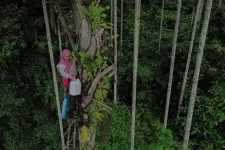
A woman taps the sugar palm in Lambaro Kueh Village, Lhoknga District, Aceh, on Thursday, May 8, 2025. (Antara Photo/Khalis Surry)


Jakarta. The Indonesian government plans to develop 300,000 hectares of sugar palm plantations as part of a national strategy to reduce reliance on fossil fuel imports by strengthening the country’s bioethanol industry.


Forestry Minister Raja Juli Antoni visited a sugar palm plantation in Garut, West Java, on Saturday to assess its potential in advancing Indonesia’s renewable energy goals. The initiative follows a directive from President Prabowo Subianto, who has declared sugar palm one of his favorite trees due to its multifunctional benefits.


“President Prabowo has long admired the sugar palm -- it’s a miraculous tree. Every part of it, from root to crown, has value,” Antoni said in a statement.


Sap extracted from the sugar palm can be processed into high-quality bioethanol, a sustainable fuel alternative. “With proper cultivation, one hectare of sugar palm can produce 24,000 liters of bioethanol. If we plant one million hectares, we can achieve energy self-sufficiency,” he explained.

The government has set a target for 23 percent of the nation’s energy consumption this year to come from renewable sources.

In a recent cabinet meeting, President Prabowo designated sugar palm development as a government priority program. “He instructed us to source high-yield seedlings and begin planting immediately. The target for this year alone is 300,000 hectares,” Antoni added.


Antoni was accompanied on the visit by his advisor, Willie Smits, a Dutch-born conservationist and forestry expert who has been an Indonesian citizen since 1985.


Smits emphasized the sugar palm’s economic and ecological value. “A single tree can generate up to Rp 2 million from its fiber. The fruit, kolang-kaling, also contributes to food security. Its deep roots make it drought-resistant,” he said.


Beyond its energy potential, sugar palm plantations are also seen as a nature-based solution to prevent erosion and landslides in hilly areas. The tree’s ability to retain groundwater helps maintain hydrological balance in drought-prone regions.

Indonesia is home to approximately 2 million hectares of existing sugar palm plantations, primarily used for producing palm sugar, fiber, and fruit. According to the Agriculture Ministry, national palm sugar output stands at about 30,000 tons per year.


Despite its promise, the sugar palm’s potential as a bioethanol feedstock remains largely untapped.

 
Reasons according to me ?

1. Blessing from Allah SWT who control weather and others, including economic factors
2. Current Government buy farmer rice with better price, import is halt. This motivates Farmers
3. Farmers have better conviction on current government to protect and improve domestic agricultural sector, this lead to more investment in the side of farmers
4. Jokowi period with infrastructure development in the rural areas, including building many dams and irrigation infrastructure
5. Loan to the farmers where 90 % soft loan to micro, small, and medium enterprises is provided by state owned banks particularly BRI bank
6. Others (farmer education level, communication infrastructure, etc)

----------------

Indonesia’s Rice Reserves Set to Hit Record 4 Million Tons​


Windarto
May 13, 2025 | 7:28 pm

3–4 minutes


Farmers harvest rice in North Luwu, South Sulawesi, on April 12, 2025. (Antara Photo/Arnas Padda)

Jakarta. Indonesia’s government rice reserves are on track to surpass 4 million tons -- setting an all-time high -- after reaching a new record of 3.7 million tons on Tuesday, government data shows.

As of May 13, the current reserve level marks the highest since the State Logistics Agency (Bulog) was established in 1969, reflecting a major milestone in the country’s efforts to strengthen food security.

Agriculture Minister Andi Amran Sulaiman praised the achievement, calling it the result of coordinated efforts among farmers, central and local governments, and Bulog’s proactive role in absorbing farmers’ harvests across the country.

“This is a historic moment for Indonesia’s food resilience. Our rice stock has reached 3.7 million tons -- the highest in 57 years. This is not just a number, but solid evidence of the government’s commitment to farmers and a food system that is becoming stronger from upstream to downstream,” Amran said in Jakarta.

The minister noted that the accomplishment is even more remarkable given global food crisis concerns and Indonesia’s growing population.

“Bulog’s absorption rate this year deserves recognition. Achieving this level of stock in less than five months is much faster than in previous years,” he said.

To support rice production, the government has ramped up fertilizer subsidies, distributed agricultural machinery, accelerated planting schedules, and introduced digital tools for farming.

In addition, the government raised the floor price of unhusked rice from Rp 5,500 to Rp 6,500 per kilogram to ensure price guarantees for farmers.

The previous record for rice reserves was set in September 1985 at 3 million tons, achieved over nine months. The current stock has surpassed that by nearly 700,000 tons, exceeding even the peaks of past food self-sufficiency eras.

Amran also highlighted the significance of this achievement in the context of a larger population -- 166 million in 1984 compared to 283 million today.

He stressed that ample reserves would serve as a strategic buffer to stabilize rice prices and bolster Indonesia’s position amid global food market volatility.

“A production surplus means little without proper absorption. If the government doesn't buy the farmers' harvests, they suffer. This stock will support national strategic reserves, food aid programs, and potentially even exports,” Amran stated.

To manage the rapid stock increase, the government has prepared emergency warehouses and designated 25,000 new storage sites nationwide to ensure safe absorption and distribution of harvested rice.

 
@Indos bro

Isn't sugar palm too labour intensive to be viable? Wouldn't Nipa be better?

Regards
 
@Indos bro

Isn't sugar palm too labour intensive to be viable? Wouldn't Nipa be better?

Regards

I dont know with that detail bro. But labor intensive is mostly in manufacturing industry, not in farming. Of course we need labor as well in agricultural sector
 

Exports of Indonesian Palm Oil Products are Dominated With Downstream Products, CPO Only 10%​


Sunday, May 18, 2025 / 18:19 WIB


KONTAN.CO.ID - JAKARTA. Chairman of the Indonesian Palm Oil Association (Gapki) Eddy Martono said, Indonesia's palm oil exports are now dominated by downstream products or products that have been processed further than raw materials.


According to Gapki's records, the total volume of palm oil exports in Indonesia in the period January to February 2025 reached 4.76 million tons.


Of these, the majority of Indonesian palm oil exports in the form of Refined Palm Oil (ROMA), which amounted to 3.52 million tons.


Also Read: Sri Mulyani's Letter, Gapki Asks For A CPO Export Levy To Be Delayed


RPO is a refined palm oil that is processed from crude palm oil (CPO) and has gone through the refining process.refining


Then after the RPO, the export of oleochemical products from Indonesia is also quite dominant. oleochemical exports in January-February 2035 reached 752,000 tonnes.


While the rest, exports in the form of CPO products (285,000 tons), Refined PKO (193,000 tons), Crude PKO (3,000 tons), and Biodesel (1,000 tons).


"Currently Indonesia's palm oil exports have been dominant in downstream products. While in the form of CPO only 10%, "explained Eddy to Kontan.co.id, Sunday (18/5).


Furthermore, the government has now officially raised the tariff of export levies (PE) of crude palm oil (CPO) and its derivative products, from 7.5% to 10% from May 17, 2025.


Also Read: CPO Export Levy Rises To 10%, ESDM Ministry: B50 Compensation Fund Is Sufficient


Gapki has asked the government to delay the increase in levies levies on crude palm oil (CPO) exports.


Indonesian coffee exports rise 76.33% to $1.6 Billion, most to U.S.-Russia


Shafira Cendra Arini - detikFinance
Wednesday, May 28, 2025 15:38 WIB

Jakarta -

The Central Statistics Agency (BPS) recorded Indonesia's trade surplus driven by non-oil and gas commodities. One of the leading commodities that contribute greatly is the coffee commodity, whose exports rose up to 76.33%.

Director of Distribution Statistics of BPS Sarpono said that Indonesia's coffee exports in 2024 amounted to US $ 1.64 billion, an increase of 76.33% compared to 2023 US $ 929 million. As for imports also rose 63.56%, from US$117 million to $186.7 million.

"Referring to the export-import data of coffee in HS 901 in Indonesia for example. In the period 2020-2024 this is seen to be a surplus because the value of exports is higher than the value of imports. That coffee exports increased 76.33% compared to 2023, "said Sarpono, Wednesday (28/05/2025).

Meanwhile, five major export destinations in 2024 include the United States (US) of US $ 307.4 million, Egypt US $ 142.5 million, Malaysia US $ 130.5 million, Belgium US $ 115.7 million, and Russia US $ 104.7 million.

Then 51.2% of the total exports of Indonesian coffee came from Lampung Province. A total of four provinces of the largest coffee export origin, among others in the first position there is Lampung, followed by North Sumatra (North Sumatra), then East Java (Jatim), and in the fourth position there is Aceh.

As for the five countries with major imports, namely Vietnam US $ 118.7 million, Brazil US $ 44.5 million, Malaysia US $ 5.6 million, Papua New Guinea US $ 5.2 million, and Switzerland US $ 3.1 million.

"More than 63% of the total Indonesian coffee imports came from Vietnam, especially in 2024," he said.


Danantara Will Spend Rp 26 T (1.7 billion USD) to Revitalize 20 Thousand Ha of Fish Pond​


Retno Ayuningrum - detikFinance

Wednesday, June 25, 2025
13:43 WIB

Jakarta -

The government plans to restore an area of 20 thousand hectares of pond in the North Coast area of Java (Pantura) this year. To work on the project, the Minister of Marine Affairs and Fisheries (MKP) Sakti Wahyu Trenggono said it needed a budget of Rp 26 trillion.

The man who is familiarly called Trenggono said the budget will be sourced from investment from Danantara and the State Budget (APBN). However, the portion will be a lot of Danantara.

“Investment from Danantara. The state budget is a little yes," Trenggono said in a Talkshow with Media event, in his office, Central Jakarta, Wednesday (25/06/2025).


Trenggono explained that the state budget will be used for the early stages of the construction of pond revitalization, such as mapping. The plan, Danantara will inject funds gradually in accordance with the pond cluster to be revitalized.

“Per cluster. The area is 20 thousand hectares. The estimated investment in our opinion is approximately Rp 26 trillion, "added Trenggono.

According to Trenggono, the project can create multiplayer effects in the future, including opening jobs to more than 100 thousand people. On the other hand, this project not only develops fisheries cultivation, but also improves the sea ecosystem in Pantura.

"Imagine the Pantura it has been damaged for more than 30 years of condition and then we revitalize to become a very valuable cultivation industry activity," explained Trenggono.

In addition, from the program will be created downstream of fisheries, ranging from upstream to downstream so as to create industrial areas. According to Trenggono, downstream in the program is much in demand by the private sector, both from abroad and domestically.

“The downstream will be done by the private sector. There are many private companies both from within and from abroad who want to be involved here to accommodate all the results rather than the cultivation that we will develop, "additional Trenggono.

For information, the plan to revitalize the Pantura pond will be implemented for the next two years, with a total of 78,550 hectares of pond candidates (Ha). This year, the government pursued the revitalization of the area of ponds 20,41325 hectares in four districts of West Java, namely Bekasi, Karawang, Subang, and Indramayu.

Of the total land, in Bekasi there are pond candidates covering an area of 8,88.49 hectares, in Karawang covering an area of 6,979.51 Ha, in Subang covering an area of 2,369,76 hectares, and in Indramayu covering an area of 2,875.48 Ha which is mostly owned by the state and included in the plan of pond candidates to be revitalized.

 
Sri Mulyani Reveals Village Funds Will Serve as Collateral for 'Kopdes Merah Putih' Financing


Anisa Indraini
3–4 minutes
Rabu, 09 Jul 2025

1752053820032.jpeg


Jakarta –


Finance Minister Sri Mulyani Indrawati revealed that village funds, which are part of the State Budget (APBN), will be used as collateral for financing Village/Urban Cooperative Units (Kopdes/Kopkel) Merah Putih.


Sri Mulyani stated that using village funds as collateral is meant to maintain prudence among banks in participating in rural economic development. This is because not all villages are already skilled or have the capacity to manage economic activities.


“If there are villages that are already skilled, that’s good; their economic activities will surely be sustainable. But if many villages still lack capacity, the banks will wonder what will happen if there are defaults,” Sri Mulyani said in a working meeting with Committee IV of the Regional Representative Council (DPD RI), Wednesday (July 9, 2025).


“That’s why we are trying to combine efforts to maintain a balance between banks’ prudence in helping develop the village economy and, on the other hand, using state budget instruments to act as a guarantor, with village funds serving as collateral,” she added.


The Ministry of Finance itself allocates around Rp 70 trillion (about USD 4.3 billion) per year in village funds. These funds are part of the Regional Transfers (TKD), intended to finance various activities in villages.


“We at the Ministry of Finance, through the allocation of around Rp 70 trillion per year for village funds, hope that these funds can serve as both a catalyst and a guarantor. That way, we expect better governance at the cooperative level in the villages—on one hand, there is affirmative action so the program can run, but on the other hand, it does not eliminate prudence from the banks that will lend,” she said.


Sri Mulyani mentioned that the government is currently discussing a structure for linking village funds with cooperatives so they can be owned by their members. This, she said, will provide assurance that the cooperatives will be well managed.


“Governance, or management, capacity building, financial reporting structures, and so on, are homework for our friends in the banking sector. They will assess whether the capacity is sufficient, and if not, they will determine who should assist first so the cooperative can truly operate well. But the cooperative itself must be built and established first,” Sri Mulyani explained.


According to Sri Mulyani, the Kopdes/Kopkel Merah Putih program is a shared responsibility with a good purpose. With the support of all parties, she hopes the program can run successfully.


“The initial idea is that villages have the capacity to own business units that can become sources of income and welfare for the villagers, since cooperatives are comprised of village residents. It’s a good idea,” Sri Mulyani added.

 
Central Java gov company makes factory to process salt for Industrial needs. It will absorb salt production from local salt farmer

To view this content we will need your consent to set third party cookies.
For more detailed information, see our cookies page.
 
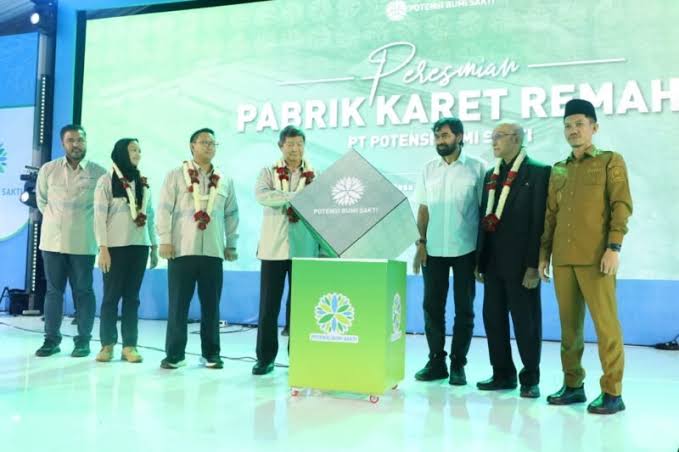
Hashim Djojohadikusumo’s Rubber Factory Officially Opens in West Aceh

1752548107415.jpeg

Konstruksi Media — Good news has arrived for rubber farmers in Aceh. PT Potensi Bumi Sakti, a subsidiary of the Arsari Group owned by national entrepreneur Hashim Djojohadikusumo, has officially begun operating a high-capacity crumb rubber factory in Woyla District, West Aceh Regency.


Built on a 25-hectare plot of land, this factory is now one of the largest rubber processing facilities in western Indonesia and is expected to reduce farmers’ reliance on markets outside the region.


Hashim Djojohadikusumo: Farmers No Longer Need to Ship to Medan


At the inauguration, which was attended by the Governor of Aceh, Wali Nanggroe Aceh, the Aceh Police Chief, the Head of Regional Intelligence, and the Iskandar Muda Military Commander, Hashim expressed his hope that the factory will directly improve the lives of local farmers.


"All this time, our rubber farmers have had to bear transportation costs and face uncertain price fluctuations. With this factory in our own region, the distribution chain will become more efficient and selling prices can be more competitive," said Hashim Djojohadikusumo, CEO of Arsari Group, (09/07/2025).


1752548141233.jpeg

Production Capacity: 100 Tons of Dry Rubber per Day


The factory is equipped with high-capacity machinery capable of processing 10 tons of wet rubber per hour, or about 5 tons of dry rubber. With a production target of 100 tons of dry rubber per day, the facility can absorb rubber from across Aceh while maintaining sustainable operations.


"The machinery and systems will continue to be developed in line with the needs for raw materials and market demand," Hashim explained.


A Project Completed After 12 Years


Construction of the rubber factory began in 2013, during the tenure of Muzakir Manaf (Mualem) as Deputy Governor of Aceh. After nearly 12 years, the factory has finally become fully operational.


"Building this factory took almost 12 years to bring to completion," Hashim said.


A Continued Wave of Industrial Investment in Aceh


Mualem stated that the factory’s construction is part of a growing wave of investments in Aceh. In addition to the rubber factory, he mentioned projects for a cigarette factory in North Aceh, a battery factory in Aceh Besar, and a steel factory in South Aceh.


"This is in line with our vision and mission to reduce unemployment. Now is the right time to create job opportunities for Acehnese youth," said Muzakir Manaf.


Users who are viewing this thread

Country Watch Latest

Latest Posts

Back
Top