Indonesia and Geopolitics

Status
Not open for further replies.

Japan to coordinate on energy with Indonesia as Iran war disrupts supplies​


To view this content we will need your consent to set third party cookies.
For more detailed information, see our cookies page.

Indonesia is a major liquefied natural gas exporter, with roughly a quarter of its shipments bound for Japan.


Published Mar 31, 2026, 01:07 PM


TOKYO – Japan and Indonesia have agreed to step up coordination on energy security, Japan’s Prime Minister Sanae Takaichi said on March 31, as the US-Israeli war on Iran squeezes oil and gas supplies vital to Asia.

“In light of the Iran situation, the strategic importance of resources and energy security is once again being recognised globally. Indonesia is a major resource-rich nation,” Ms Takaichi said alongside Indonesia’s President Prabowo Subianto after they met for talks in Tokyo.

The summit comes amid mounting concern over the widening Middle East conflict, which has disrupted shipments of oil and gas through the key Strait of Hormuz.

Indonesia is the world’s biggest exporter of thermal coal for power generation, supplying about half of global exports. It is also a major liquefied natural gas exporter, with roughly a quarter of its shipments bound for Japan.

Japan said on March 27 it will allow utilities to increase the use of coal-fired power plants from April to cushion any disruption to liquefied natural gas imports caused by the war in the Middle East.

Japan has also opened up its oil stockpiles, rolled out petrol subsidies and is seeking energy supplies beyond the Middle East.

Japan and Indonesia would “make their best efforts to convince all parties (in the Middle East) to de-escalate” the conflict, Mr Prabowo said.

He also invited “Japan’s participation” in the Indonesian economy, including in critical minerals, rare earths, industrialisation and nuclear energy.

Neither leader gave details of how the two countries would coordinate in economic security. REUTERS


Lee hails S. Korea-Indonesia partnership for KF-21 fighter jets as 'model' defense cooperation​


To view this content we will need your consent to set third party cookies.
For more detailed information, see our cookies page.


By Chae Yun-hwan

SEOUL, March 31 (Yonhap) -- President Lee Jae Myung has voiced hope for deeper bilateral ties with Indonesia, touting their joint development of the KF-21 fighter jet as a "model example" of global defense cooperation.


Lee made the remarks in an interview with the Indonesian newspaper Kompas released Tuesday, a day ahead of his summit talks with Indonesian President Prabowo Subianto in Seoul.


"Korean-Indonesian joint development of a next-generation fighter jet is a model example and potential global benchmark of international defense industry cooperation," Lee said.


"I hope that our mutual success will help us expand our defense cooperation in a wider range of areas, including naval vessels and air defense systems."


South Korea launched the KF-21 development program in 2015 to acquire a homegrown supersonic fighter, with Jakarta signing on as a partner.


The first production model of the jet rolled out on the tarmac last week, with Seoul planning to sign a deal to export 16 units to Indonesia.


Lee also noted the roles played by the two countries have become more "prominent" as established international norms and institutions are being challenged.

"The two countries, sharing the values of democracy, a rules-based international order and free trade, have served as important pillars, working together closely to advance multilateralism," he said.


Lee said his country's technologies and experience in economic development along with Indonesia's human and natural resources would enable them to prevent overdependence on specific markets and to diversify their economic structures.


He said the two countries plan to announce a road map for cooperation during Prabowo's state visit, which he said will serve as a new milestone in shaping the next decade of bilateral ties.
 

Korea, Indonesia elevate ties to ‘special comprehensive strategic partnership’ - The Korea Herald​


Ji Da-gyum

6–8 minutes


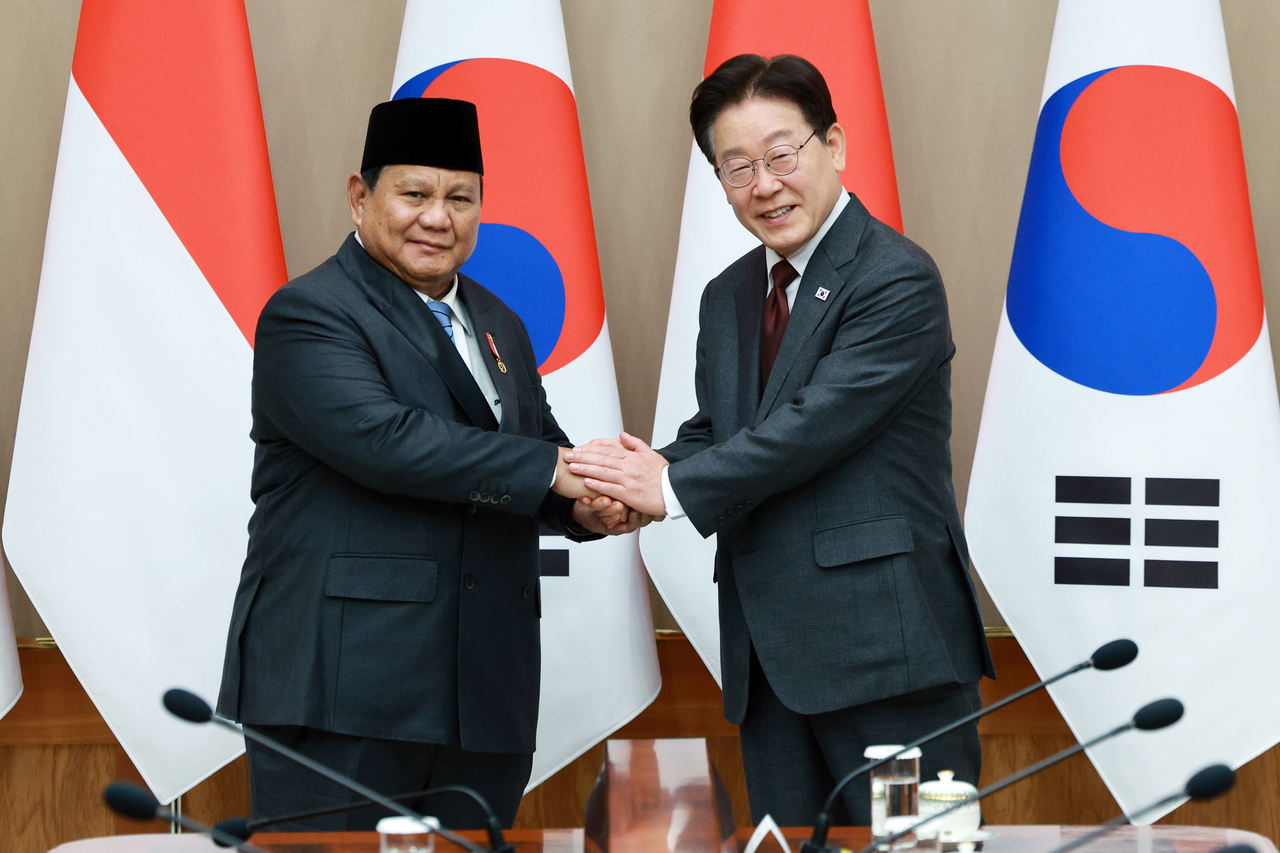
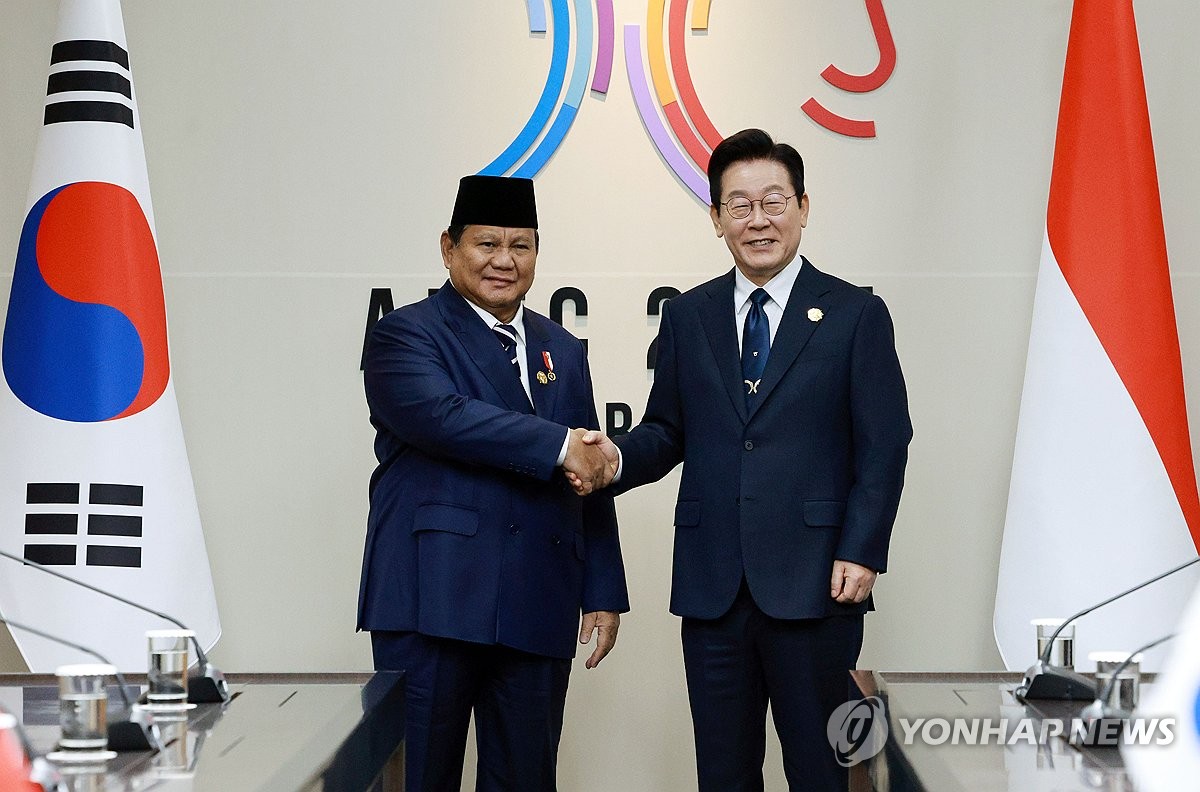
President Lee Jae Myung (right) shakes hands with Indonesian President Prabowo Subianto during their summit talks at Cheong Wa Dae in Seoul on Wednesay. (Yonhap)


South Korea and Indonesia elevated ties to a "special comprehensive strategic partnership" on Wednesday — the first of its kind for both countries — as they moved to deepen cooperation in future growth sectors such as critical minerals, shipbuilding and advanced technologies.

The outcome came as South Korean President Lee Jae Myung and Indonesian President Prabowo Subianto held their third summit at Cheong Wa Dae on Wednesday during Prabowo’s first state visit to South Korea at Lee’s invitation.

To view this content we will need your consent to set third party cookies.
For more detailed information, see our cookies page.


This marks the first time either South Korea or Indonesia has entered into a special comprehensive strategic partnership. The two countries formed a special strategic partnership in 2017, upgrading from a strategic partnership established in 2006 after forging diplomatic ties in 1973.

The upgrade of bilateral ties aims to "promote substantive strengthening of cooperation not only in advancing trade, investment, and defense and defense industry cooperation," senior presidential spokesperson Kang Yu-jung said in a press statement.

Kang further explained that the upgrade also seeks to expand cooperation in new growth sectors such as advanced technologies, including AI, infrastructure, shipbuilding, nuclear power, energy transition, and cultural and creative industries."
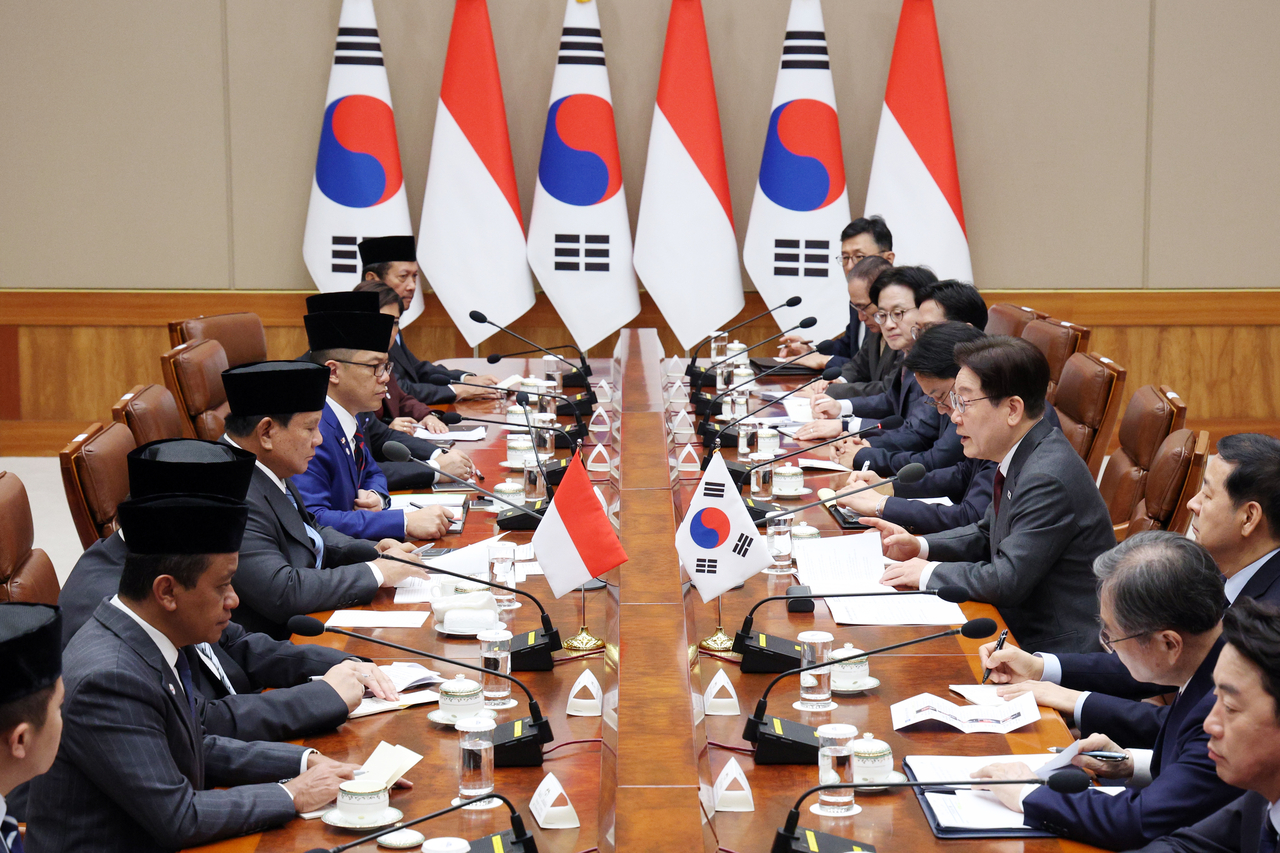
President Lee Jae Myung and Indonesian President Prabowo Subianto hold expanded summit talks at Cheong Wa Dae on Wednesday. (Yonhap)


Following the summit, Seoul and Jakarta issued a joint statement on the special comprehensive strategic partnership.

In the statement, Lee and Prabowo notably tasked their foreign ministers with establishing a new bilateral strategic dialogue mechanism — a "special comprehensive strategic dialogue" — to coordinate and oversee cooperation across various fields and underscored their commitment to convene the dialogue on an annual basis.

"The two leaders expressed their strong commitment to enhancing cooperation in strategic economic sectors that contribute to mutual economic growth and the long-term development of both countries," the statement read.

These sectors include advanced manufacturing; automobiles, including electric vehicles and the battery ecosystem; steel; machinery; semiconductors; critical minerals and rare earth elements; and the shipbuilding and maritime industries.

Kang noted in a separate written briefing issued later in the day that Seoul and Jakarta had revised the Memorandum of Understanding on Cooperation in Critical Mineral Partnership.

Kang elucidated that the revision aims to "establish an institutional framework to strengthen supply chain cooperation with Indonesia, which holds abundant reserves of key minerals essential for South Korea’s strategic industries, including secondary batteries, as the world’s largest producer of nickel and the second-largest producer of cobalt."

The two leaders also "resolved to actively identify and advance concrete cooperative projects in the shipbuilding sector," Kang added.

Seoul and Jakarta also newly signed or updated 16 memorandums of understanding aimed at institutionalizing cooperation across strategic sectors, digital development, AI-based health care, clean energy and carbon capture, intellectual property protection and strategic financing.
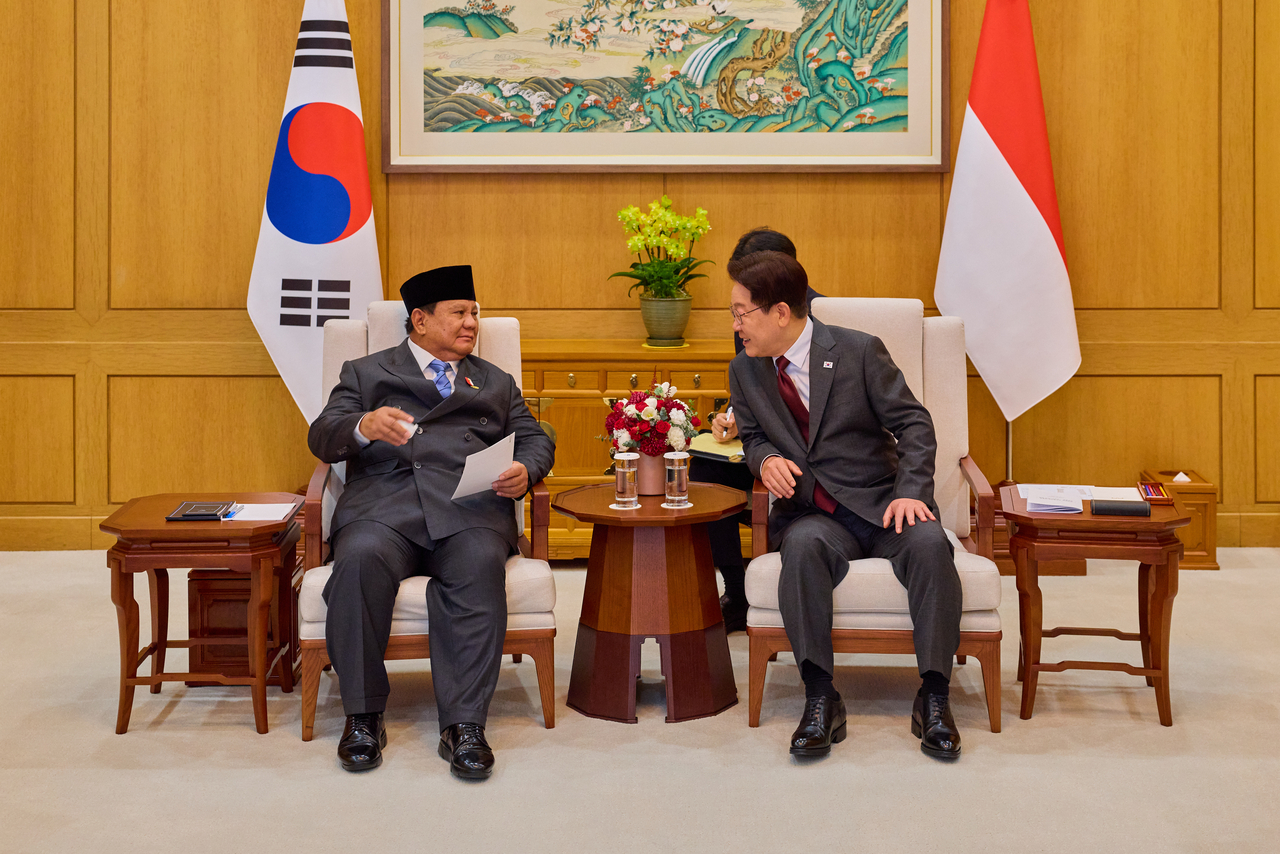
President Lee Jae Myung and Indonesian President Prabowo Subianto hold a closed-door one-on-one plus aides meeting at Cheong Wa Dae on Wenesday. (Cheong Wa Dae via Yonhap)


In his opening remarks at the summit, Lee underlined, "We have achieved the historic milestone of upgrading our relationship to a special comprehensive strategic partnership — the only one of its kind that the Republic of Korea maintains," referring to South Korea by its official name.

"I find this deeply meaningful. I am confident that today’s summit will demonstrate why our bilateral relationship is special, while at the same time providing important momentum to further deepen and elevate it."

Lee emphasized Indonesia’s role as a "stable supplier of key energy resources, including LNG (liquefied natural gas) and coal" during the summit, which came as South Korea was making all-out efforts to mitigate energy shocks stemming from the Middle East war.

"There is a strong need to further expand cooperation between our two countries on resource security to minimize the impact of this crisis on our economies and the livelihoods of our people."

Sharing the sentiment, Prabowo said, "It is regrettable that my state visit comes at a time of rising global uncertainty."

"That is precisely why I believe relations between Korea and Indonesia are becoming even more important. We must continue to deepen and expand our partnership," Prabowo told Lee through an interpreter.
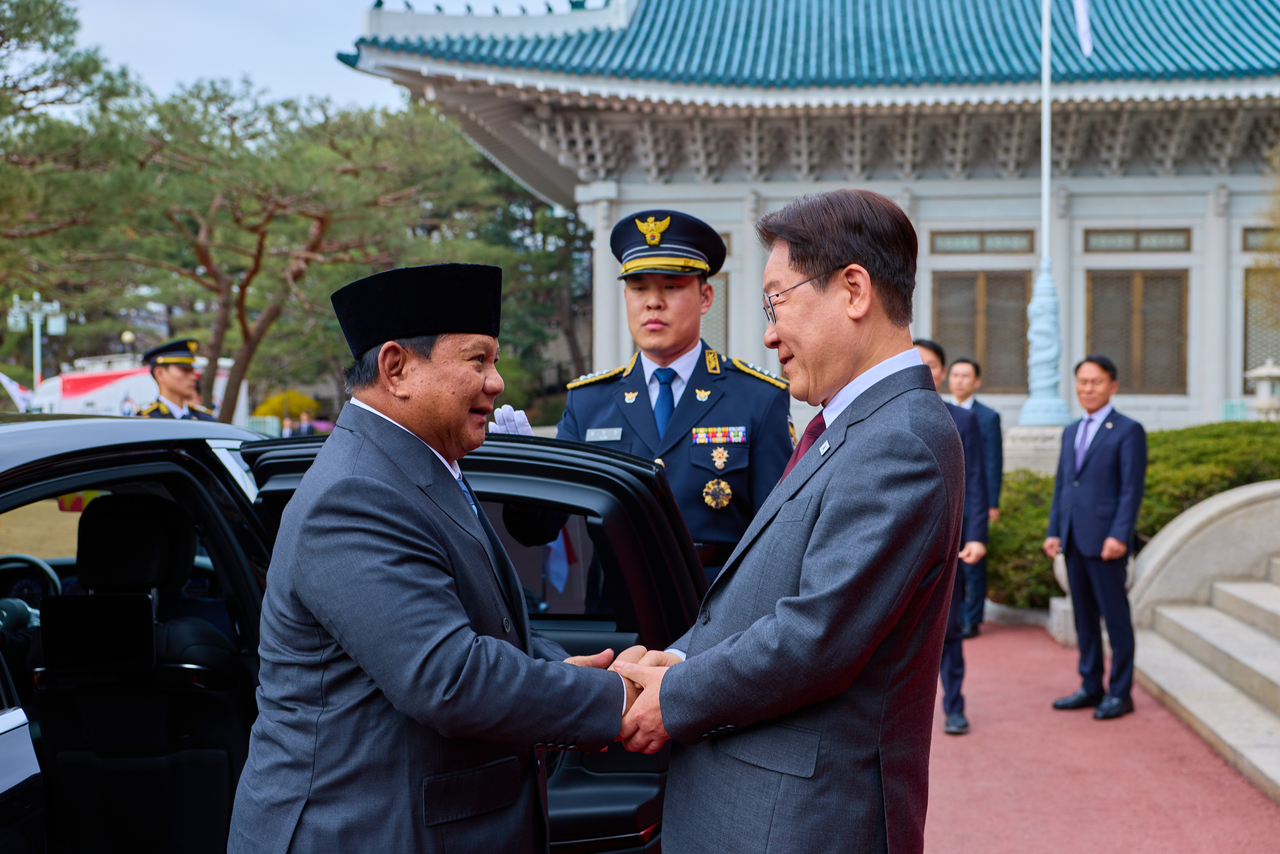
President Lee Jae Myung (right) welcomes Indonesian President Prabowo Subianto upon his arrival for a state visit at Cheong Wa Dae on Wednesday. (Cheong Wa Dae via Yonhap)

Lee also noted that "our two countries are very special to each other."

Lee portrayed Indonesia as a long-standing strategic partner for South Korea — from hosting the country’s first overseas investment to becoming a key partner in the defense industry and a growing base for Korean electric vehicle production.

Lee referred to South Korea’s first overseas investment in Kalimantan in 1968; defense exports including FA-50 light combat aircraft, T-50 trainer jets and submarines; ongoing discussions over the supply of 16 KF-21s, South Korea’s first homegrown fighter jets; and Hyundai Motor’s local production of the Ioniq 5 in Cikarang, Bekasi Regency, West Java.

"President Prabowo and I seek to create many more future-oriented projects that will bring even greater benefits to the people of our two countries, building on the successful results of our cooperation so far," Lee said. "I look forward to seeing what achievements the next steps we take together with Indonesia will bring."

The visit marked Prabowo’s second trip to South Korea, following last year’s Asia-Pacific Economic Cooperation summit in Gyeongju, North Gyeongsang Province, and his third meeting with Lee since their first two summits — at the Korea-ASEAN summit in October and the APEC summit in November last year.

[email protected]
 

Ranked: 2026 GDP Growth Forecasts for the World’s 20 Largest Economies​

April 20, 2026

1776758775264.png


To view this content we will need your consent to set third party cookies.
For more detailed information, see our cookies page.


To view this content we will need your consent to set third party cookies.
For more detailed information, see our cookies page.
 
To view this content we will need your consent to set third party cookies.
For more detailed information, see our cookies page.


This evening, I spoke with President @prabowo of Indonesia.

We discussed the conflict in the Middle East and the impact it’s having in our region. Australia and Indonesia are working together to support the flow of essential goods, and to make our energy supply chains more resilient for the future.

I thanked President Prabowo for helping secure more fertiliser for Australia.

Strong relationships in our region matter more than ever, and our two nations are the closest of friends.

 
Last edited:
To view this content we will need your consent to set third party cookies.
For more detailed information, see our cookies page.


Prabowo met with Vladimir Putin in Moscow, 13 April 2026

To view this content we will need your consent to set third party cookies.
For more detailed information, see our cookies page.


Prabowo met with Macron in Parish, 14 April 2026
 

Hegseth, Indonesian Counterpart Announce Defense Partnership​

April 13, 2026
By Matthew Olay, Pentagon News


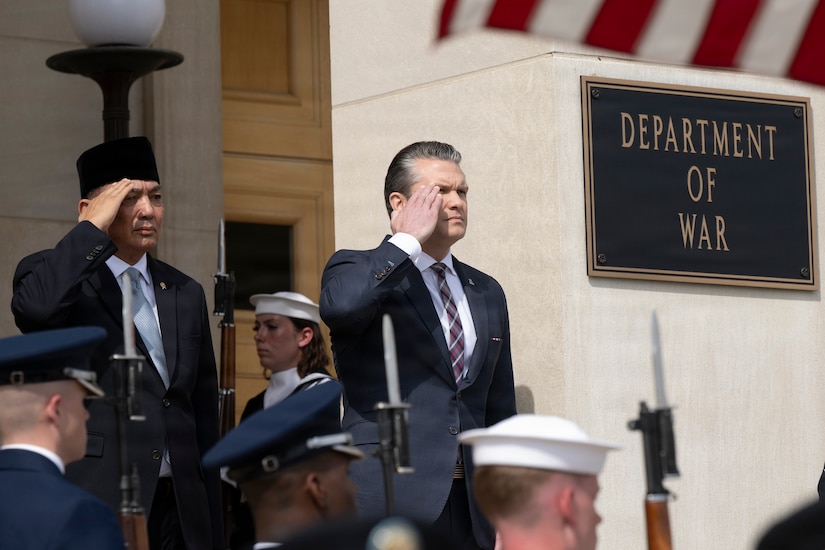
Secretary of War Pete Hegseth welcomed his Indonesian counterpart — Defense Minister Sjafrie Sjamsoeddin — to the Pentagon today, where the two men announced the establishment of the Major Defense Cooperation Partnership between the two countries.

Two people in business attire salute as they stand outside during daytime, with service members standing at attention nearby.


The partnership will serve as a framework to advance bilateral defense cooperation between the U.S. and Indonesia in order to maintain peace and stability throughout the Indo-Pacific region.

"Your visit demonstrates the importance that the War Department places on our growing security relationship — and it is active and growing — with Indonesia," Hegseth told Sjamsoeddin, just before noting that the two countries complete more than 170 military exercises together each year.

"This [partnership] signifies the strength and potential of our security relationship … bolsters regional deterrence, and advances our shared commitment to peace through strength," Hegseth added.

During his brief remarks, Sjamsoeddin affirmed Hegseth's sentiment regarding the strength of the U.S.-Indonesia relationship.

"Today, we are here as Indonesian delegates … with very great enthusiasm to continue to develop our defense relationship, [which] should be enduring for our next generation in Indonesia and the United States of America," Sjamsoeddin said. "We're working on behalf of mutual respect and mutual benefit to enhance [the] value of our national interests."

The new cooperation agreement features three "foundational pillars" that are based on each country's national sovereignty and mutual respect: military organization and capacity building; training and professional military education; and exercises and operational cooperation.

Under the framework of the agreement, both countries will work on exploring cutting-edge initiatives, "including codeveloping sophisticated asymmetric capabilities, pioneering next-generation defense technologies in the maritime, subsurface and autonomous systems domains, and cooperating on maintenance, repair and overhaul support to improve operational readiness," according to a joint statement on the new partnership.

The statement goes on to explain that both the U.S. and Indonesia have agreed to enhance joint special forces training, and that such engagements will make the bond between both countries' militaries stronger.

Additionally, Hegseth noted that Indonesia has been helpful to the U.S. with the recovery of fallen service members.

"I appreciate your continued support in helping the United States find, return and protect the remains of our soldiers who fought alongside Indonesians during World War II," Hegseth told Sjamsoeddin.

He added that the signing of the partnership memorandum will enable the War Department's Defense POW/MIA Accounting Agency to recover those aforementioned service members' remains in Indonesia.

Both Hegseth and Sjamsoeddin described the defense cooperation as a "line of departure" — a military term for setting off on a new mission — for their respective countries.

"So, here's to the next chapter and our new mission together for our great countries," Hegseth told Sjamsoeddin.

The U.S. and Indonesia have maintained formal diplomatic relations for more than 75 years, and established ties in 1949, just after Indonesia's war for independence from the Netherlands.

 
To view this content we will need your consent to set third party cookies.
For more detailed information, see our cookies page.
 
"The Senate Foreign Affairs and Defense Committee approves the free transfer of the GARIBALDI to Indonesia.

The measure must now be reviewed by the relevant House Committees."

To view this content we will need your consent to set third party cookies.
For more detailed information, see our cookies page.


To view this content we will need your consent to set third party cookies.
For more detailed information, see our cookies page.


To view this content we will need your consent to set third party cookies.
For more detailed information, see our cookies page.
 
To view this content we will need your consent to set third party cookies.
For more detailed information, see our cookies page.


Indonesian Defense Ministry: No Weapons Procurement Included in Defense Cooperation Arrangement with Japan​

Walda Marison
5 Mei 2026


JAKARTA — Indonesia’s Ministry of Defense stated that the recently signed Defence Cooperation Arrangement (DCA) with Japan does not include any agreement on weapons procurement.

Head of the Defense Information Bureau at the Indonesian Ministry of Defense, Brig. Gen. Rico Ricardo Sirait, said that:

“There has been no specific agreement related to any particular defense procurement.”
According to Rico, both countries are currently focused on cooperation in several strategic areas, including:

  • Military technology development
  • Maritime defense strengthening
He said these areas of cooperation are considered beneficial for Indonesia because they can help strengthen domestic defense technology capabilities and improve maritime security for both countries.

However, Rico did not rule out the possibility of future cooperation in defense procurement.

He emphasized that all forms of cooperation must continue to prioritize Indonesia’s national interests.

“All potential cooperation will continue to uphold constitutional mandates, national interests, and contributions to regional stability,” Rico said.
Previously, several areas of cooperation had been included in the Defence Cooperation Arrangement signed by Indonesia and Japan.

These include:

  • Defense technology development
  • Personnel exchanges
  • Military education and research
  • Joint exercises
  • Maritime security cooperation
  • Disaster management cooperation
The DCA was officially signed by Indonesian Defense Minister Sjafrie Sjamsoeddin and Japanese Defense Minister Shinjiro Koizumi at Indonesia’s Ministry of Defense in Jakarta on May 4, 2026.

 
Indonesian frigate seen in Cebu, Philippine, during ASEAN summit 2026 where ASEAN leaders gathering

To view this content we will need your consent to set third party cookies.
For more detailed information, see our cookies page.


To view this content we will need your consent to set third party cookies.
For more detailed information, see our cookies page.
 

Indonesia Deploys F-16 Jets and Navy Ships to Secure ASEAN Summit​


Dani Aswara
May 8, 2026

1778419178628.png


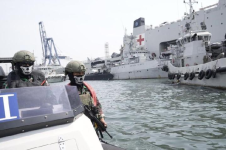
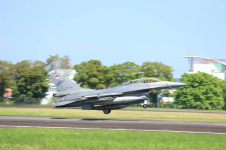
TEMPO.CO, Jakarta - The Indonesian National Armed Forces (TNI) conducted a readiness operation in the North Sulawesi region on Friday, May 8, 2026, as part of the security support for the High-Level Conference of ASEAN Summit in Cebu, the Philippines. The operation involved fighter jets, transport planes, and three warships.

1778472358578.png

The Head of Information Bureau of Defense at the Ministry of Defense's General Secretariat, Brigadier General Rico Ricardo Sirait, stated that the deployment of these military assets was part of the TNI's readiness operation to ensure regional stability during the ASEAN Summit. Rico mentioned, "There are five F-16 aircraft, Hercules, and A400M involved in this readiness operation. Three KRI (Ship of the Republic of Indonesia) ships were also deployed, namely Brawijaya, Siliwangi, and R.E. Martadinata," he said in his statement on Friday, May 8, 2026.

To view this content we will need your consent to set third party cookies.
For more detailed information, see our cookies page.


According to Rico, the readiness operation was conducted in North Sulawesi to ensure the security and smooth operation of the ASEAN Summit in Cebu. The operation involved ground, sea, and air elements in order to test the interoperability of the forces, the mobility of the personnel, the capabilities of the VVIP security, and the ability to respond rapidly to emergency conditions.

All activities, he said, were conducted in a measured and professional manner while still emphasizing the principles of caution and respect for the sovereignty of friendly nations. Indonesia also views the stability and security of the ASEAN region as a joint responsibility of Southeast Asian countries.

"The TNI's readiness in this context is part of Indonesia's contribution to supporting the creation of a safe, conducive regional situation and to the success of ASEAN's strategic agendas," said Rico.

President Prabowo Subianto attended the opening ceremony of the 48th ASEAN Summit on Friday, May 8, 2026. According to the Presidential Secretariat's written statement, Prabowo arrived around 09.04 local time and went directly to the event's foyer.

Upon arrival, Prabowo was greeted by Filipino President Ferdinand "Bongbong" Romualdez Marcos Jr. and his wife, Marie Louise Cacho Araneta Marcos. After the welcoming procession, the ASEAN leaders followed the opening sequence of the Summit, which serves as the main forum for discussing regional issues.

The ASEAN Summit 2026 carries the theme "Navigating Our Future Together." The forum provides ASEAN leaders with a space to discuss the region's direction amidst global geopolitical and economic pressures. Before the head of state meeting, the ASEAN foreign ministers first held preliminary agendas on Thursday, including the ASEAN Foreign Ministers' Meeting and the ASEAN Political-Security Community Council Meeting.

Ervana Trikarinaputri contributed to the writing of this article


To view this content we will need your consent to set third party cookies.
For more detailed information, see our cookies page.
 
To view this content we will need your consent to set third party cookies.
For more detailed information, see our cookies page.


To view this content we will need your consent to set third party cookies.
For more detailed information, see our cookies page.


To view this content we will need your consent to set third party cookies.
For more detailed information, see our cookies page.


Time spent together with Mr. Sugianto, who saved lives by helping evacuate the elderly during the forest fire in Yeongdeok-Gun, Gyeongbuk, last year, as well as Carmen, an Indonesian member of the group Hearts2Hearts.

Although our countries, languages, and cultures are different, our friendship and solidarity grow deeper. May this meeting become a momentum that brings Korea and Indonesia even closer.

--------------

From KF-21 Boramae to AI: Indonesia’s Foreign Ministry Reaffirms South Korea as a Long-Term Strategic Partner​

Indonesiainside.id
17 May 2026

To view this content we will need your consent to set third party cookies.
For more detailed information, see our cookies page.


Indonesiainside.id – Relations between Indonesia and South Korea have once again been reaffirmed as a long-term strategic partnership that extends beyond trade and investment, encompassing defense, artificial intelligence (AI) technology, and human resource capacity building.

The Director General for Asia-Pacific and African Affairs at Indonesia’s Ministry of Foreign Affairs, Santo Darmosumarto, emphasized that Seoul remains one of Indonesia’s key partners within the increasingly competitive Indo-Pacific architecture. From the Indonesian government’s perspective, South Korea is no longer merely an economic partner, but has evolved into a special strategic partner with increasingly broad and deep dimensions of cooperation.

The statement reflects how Indonesia’s diplomacy under the administration of Prabowo Subianto continues to place South Korea on the “front page” of Indonesia’s foreign relations priorities. This was evident in President Prabowo’s visit to Seoul, which carried a message of continuity in bilateral relations, particularly in industrialization, investment, and defense cooperation.

One of the clearest symbols of this strategic partnership is the joint development project of the KF-21 Boramae fighter jet. For Indonesia, the project is not merely about procuring defense equipment, but is part of a long-term effort to build national defense industry independence.

However, Santo reminded that Indonesia’s challenge is not simply expanding defense cooperation with various countries such as France, Turkey, and China. More importantly, all of these partnerships must be integrated into a cohesive and effective national defense system. Amid an increasingly multipolar world, Indonesia appears to be pursuing a strategy of diversifying partners without becoming trapped within any particular power bloc.

In the geopolitical context of the Indo-Pacific, Indonesia and South Korea are viewed as sharing a similar position as middle powers — medium-sized nations striving to maintain regional balance amid the rivalry between major powers such as the United States and China. The concept of middle-power cooperation was once represented by the acronym KIA (Korea, Indonesia, Australia), reflecting the shared interests of the three countries in maintaining regional stability.

Interestingly, discussions about Indonesia–South Korea strategic relations do not stop at military and economic issues. Santo also highlighted the importance of human intellectual creativity amid the rapid development of AI. According to him, no matter how advanced technology becomes, it still requires the courage to think non-linearly — an approach that has often produced major breakthroughs throughout history.

He cited the concept of nuclear deterrence, which was once considered paradoxical: how weapons of mass destruction could actually be believed to preserve world peace. Although seemingly contradictory to common logic, history has shown that the concept became one of the factors preventing major conflicts between nations during the Cold War.

This perspective serves as a reminder that in the AI era, humans still play the primary role in generating strategic ideas and policy innovations. Therefore, the strategic writing competition organized by Indonesia Strategic and Defence Studies is not merely an academic competition, but also a long-term intellectual investment for Indonesia’s future.

The CEO and Co-Founder of ISDS, Dwi Sasongko, believes that modern diplomacy can no longer rely solely on governments. Relations between countries are now also shaped by public involvement through people-to-people engagement. Public strategic literacy is becoming increasingly important so that society does not merely become a consumer of global information, but is also capable of producing constructive analysis and ideas regarding Indonesia’s position in the Indo-Pacific.

Amid global geopolitical uncertainty, relations between Indonesia and South Korea demonstrate that 21st-century strategic partnerships are no longer based solely on economics. Defense, technology, AI, education, and the exchange of ideas have become the new foundations of modern diplomacy — a relationship built not only between governments, but also between societies and a shared vision for the future.


What do Turkiye and Indonesia want from bilateral talks?​

Turkiye’s Foreign Minister Hakan Fidan travelled to Indonesia to cement the two states’ growing partnership.

4 Jun 2026

1780621974790.png


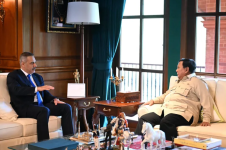
Turkiye and Indonesia aim to deepen cooperation in defence, energy and emerging technologies following high-level talks in Jakarta, as both countries push to expand economic ties in a bid to reach a $10bn bilateral trade target agreed in April last year.

Turkish Foreign Minister Hakan Fidan met Indonesian President Prabowo Subianto during an official visit to the capital on Wednesday, according to sources quoted in the Turkish press. Indonesian Foreign Minister Sugiono received Fidan on his arrival and held formal talks. Later, Subianto also hosted Fidan.

 
Status
Not open for further replies.

Users who are viewing this thread

Pakistan Defence Latest

Latest Posts

Back
Top