Indonesia and Geopolitics

Status
Not open for further replies.

BRICS Summit to Be Foreign Minister Sugiono’s First Overseas Assignment​

1729582853487.webp
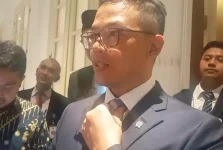
Foreign Minister Sugiono speaks to reporters shortly after a farewell party for his predecessor Retno Marsudi in Jakarta on Oct. 21, 2024. (JG Photo/Jayanty Nada Shofa)


Jayanty Nada Shofa


October 21, 2024 | 10:28 pm

Jakarta. The upcoming summit of the Russia-led economic bloc BRICS will be Foreign Minister Sugiono’s first overseas assignment, according to his deputy.


BRICS is an intergovernmental organization that originally brought together Brazil, Russia, India, China, and South Africa. The group now has new members: Iran, Egypt, Ethiopia, and the United Arab Emirates (UAE). Saudi Arabia has not formalized its membership.


Russia is holding this year’s BRICS rotating chairmanship and will host the summit in Kazan on Oct. 22-24.


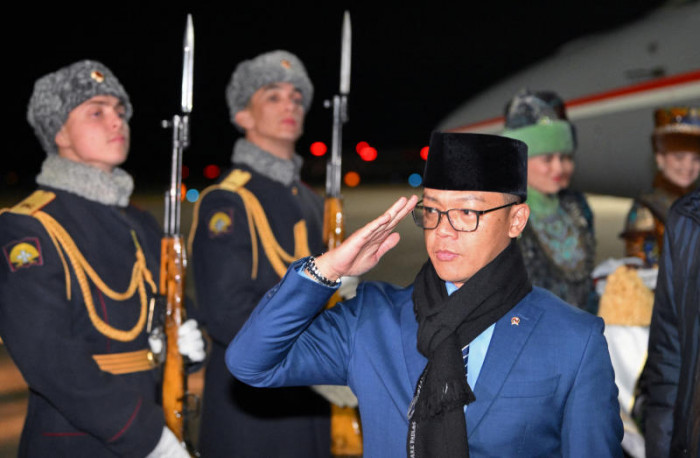
Deputy Foreign Minister Arif Havas Oegroseno revealed on Monday evening that Sugiono would fly to Kazan to represent Indonesia later this week.

1729583027046.webp
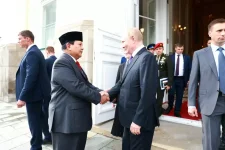
President Prabowo Subianto meets Russian President Vladimir Putin at the Grand Kremlin Palace on July 31, 2024. Prabowo at the time has not taken his oath of office. (Photo Courtesy of Defense Ministry)


According to media reports, the Russian Embassy in Indonesia said that President Prabowo Subianto had appointed Sugiono to join the BRICS Plus/Outreach talks. This outreach session -- which will take place on the summit’s final day -- is open to non-BRICS members. Representatives from nearly 40 countries will join the BRICS Plus talks.

The embassy also said that Prabowo would skip the summit as he had just assumed power on Sunday. This meant that Prabowo would not be meeting Russian President Vladimir Putin.

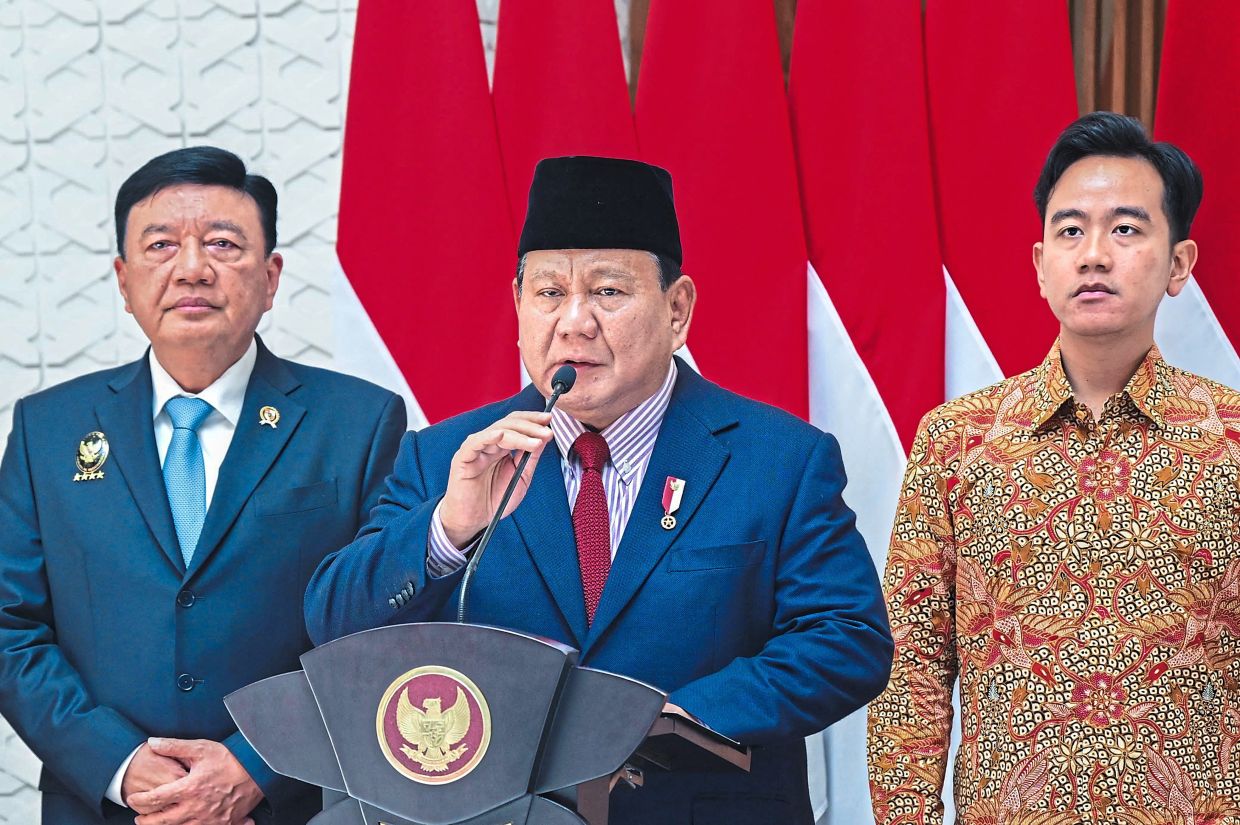
Earlier that evening, Sugiono revealed more details about his recent ministerial appointment. The senior Gerindra Party politician did not talk about BRICS but gave an overall overview of what Prabowo expected from him. Sugiono said: “[Mr. Prabowo] wants me to establish cooperation with all countries and see if there is any potential cooperation with our neighbors.”

BRICS Summit to Be Foreign Minister Sugiono’s First Overseas Assignment
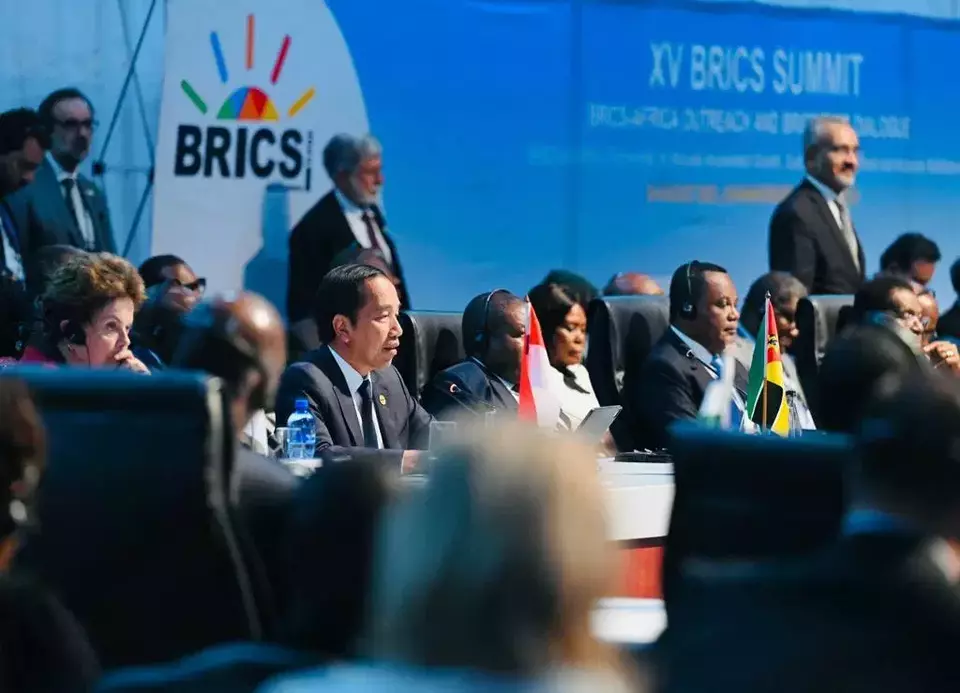
Then-President Joko 'Jokowi' Widodo attends the BRICS Summit in Johannesburg on August 24, 2023. (Photo Courtesy of Presidential Press Bureau)


Last year, then-President Joko “Jokowi” Widodo attended the BRICS summit in South Africa as the 2023 ASEAN chair. His attendance sparked assumptions that Indonesia would join BRICS. The government, however, immediately shot down the rumors, saying that Indonesia chose not to rush things, and was still “making the necessary calculations” before deciding to send a letter of interest.


Prabowo has said that he would seek a “good neighbor” approach in his foreign policy. Even though Jakarta wants to be everybody’s friend, Indonesia will keep its anti-colonialism stance, according to Prabowo in his inaugural speech over the weekend.


BRICS Summit to Be Foreign Minister Sugiono’s First Overseas Assignment​

View attachment 74091
Foreign Minister Sugiono speaks to reporters shortly after a farewell party for his predecessor Retno Marsudi in Jakarta on Oct. 21, 2024. (JG Photo/Jayanty Nada Shofa)


Jayanty Nada Shofa


October 21, 2024 | 10:28 pm

Jakarta. The upcoming summit of the Russia-led economic bloc BRICS will be Foreign Minister Sugiono’s first overseas assignment, according to his deputy.


BRICS is an intergovernmental organization that originally brought together Brazil, Russia, India, China, and South Africa. The group now has new members: Iran, Egypt, Ethiopia, and the United Arab Emirates (UAE). Saudi Arabia has not formalized its membership.


Russia is holding this year’s BRICS rotating chairmanship and will host the summit in Kazan on Oct. 22-24.


Deputy Foreign Minister Arif Havas Oegroseno revealed on Monday evening that Sugiono would fly to Kazan to represent Indonesia later this week.

View attachment 74092
President Prabowo Subianto meets Russian President Vladimir Putin at the Grand Kremlin Palace on July 31, 2024. Prabowo at the time has not taken his oath of office. (Photo Courtesy of Defense Ministry)


According to media reports, the Russian Embassy in Indonesia said that President Prabowo Subianto had appointed Sugiono to join the BRICS Plus/Outreach talks. This outreach session -- which will take place on the summit’s final day -- is open to non-BRICS members. Representatives from nearly 40 countries will join the BRICS Plus talks.

The embassy also said that Prabowo would skip the summit as he had just assumed power on Sunday. This meant that Prabowo would not be meeting Russian President Vladimir Putin.

Earlier that evening, Sugiono revealed more details about his recent ministerial appointment. The senior Gerindra Party politician did not talk about BRICS but gave an overall overview of what Prabowo expected from him. Sugiono said: “[Mr. Prabowo] wants me to establish cooperation with all countries and see if there is any potential cooperation with our neighbors.”

BRICS Summit to Be Foreign Minister Sugiono’s First Overseas Assignment
Then-President Joko 'Jokowi' Widodo attends the BRICS Summit in Johannesburg on August 24, 2023. (Photo Courtesy of Presidential Press Bureau)


Last year, then-President Joko “Jokowi” Widodo attended the BRICS summit in South Africa as the 2023 ASEAN chair. His attendance sparked assumptions that Indonesia would join BRICS. The government, however, immediately shot down the rumors, saying that Indonesia chose not to rush things, and was still “making the necessary calculations” before deciding to send a letter of interest.


Prabowo has said that he would seek a “good neighbor” approach in his foreign policy. Even though Jakarta wants to be everybody’s friend, Indonesia will keep its anti-colonialism stance, according to Prabowo in his inaugural speech over the weekend.


To view this content we will need your consent to set third party cookies.
For more detailed information, see our cookies page.
 

Why Indonesia matters​


economist-logo

The Economist

Indonesia is back on the map. In the next decade it will only become more important​


Nov 17th 2022


This week’s G20 meeting took place in Indonesia, the most important country that people routinely overlook. The last time its economy and politics were in the global spotlight was during the mayhem of the 1990s when a crony capitalist system collapsed amid the Asian financial crisis, causing the fall of the 32-year-long dictatorship of Suharto.

A quarter of a century on, Indonesia matters once again. It is the world’s largest Muslim-majority state, its third-biggest democracy and its fourth-most-populous country. With 276m people spread across thousands of islands that stretch from the Indian Ocean to the Pacific, it is caught up in the strategic contest between America and China. And like India and other emerging markets, it is adapting to a new world order in which globalisation and Western supremacy are in retreat.

Over the next quarter-century, the country’s clout could increase spectacularly. The economy is one reason. Indonesia is the sixth-biggest emerging market by GDP, and in the past decade has grown faster than any other $1trn-plus economy bar China and India. A source of dynamism is digital services, which are helping create a more integrated consumer market, with over 100m people collectively spending $80bn a year on everything from e-payments to apps for on-demand trucking.

Another economic catalyst is Indonesia-specific. With a fifth of global reserves of nickel, used in batteries, the country is a vital link in electric-vehicle (EV) supply chains. As the West, China and India increase subsidies to attract EV investment at home, Indonesia has spotted an opportunity. Rather than seeking to be the Saudi Arabia of the green-metal age, it is pursuing a policy of “downstream”, banning the export of raw materials to force global firms to build factories in Indonesia. This is unorthodox, but over $20bn of investment has been secured so far. Coal-fired power stations are being retired early, pushing these new industries to run on clean power.


The second reason for Indonesia’s strong prospects is that it has found a way to combine democracy with economic reform. Reflecting the traumas of the 1990s, a flawed but pluralist political system has developed that emphasises compromise and social harmony. Joko Widodo, the deceptively laid-back president since 2014, rules through a sprawling coalition which has co-opted many of his opponents. You might think this would lead to the lowest-common-denominator policies. But the public finances are tightly run. Incremental improvements include new infrastructure, the cleaning up of state firms and some modernisation of education and labour laws. Corruption is a problem, but the economy is more open than it was ten years ago.

The final reason for Indonesia’s growing clout is geopolitics. Its location, size and resources make it a key theatre in the superpower contest. Reflecting a tradition of non-alignment that goes back to the 1950s, it wants to be neutral. It solicits capital from both sides of the divide and is an arena in which Chinese and American digital firms and investors compete directly. In batteries catl, the Chinese champion, is investing in a $6bn project, but Jokowi, as the president is known, is also wooing Tesla. In diplomacy, he has sought to be a convener and peacemaker. Indonesia has criticised Western sanctions on Russia. Jokowi is one of the few people to have met presidents Joe Biden, Xi Jinping, Vladimir Putin and Volodymyr Zelensky this year.


If Indonesia stays on this path for the next decade, the country could become one of the world’s ten biggest economies. It would remain fairly resilient against shocks: its currency has outperformed several rich-world peers this year despite global financial turmoil. Living standards would rise: only 4% of people now live on $2.15 a day or less, three-quarters less than in 2012. Although Indonesia is unlikely to become a Chinese-style manufacturing miracle, a big middle class would emerge.


Inevitably, there are dangers. One is succession. Jokowi’s final term ends in 2024 and he has no obvious successor. Some supporters want him to fiddle with the constitution to remain in power. The succession could become a competition to appeal to devout voters by espousing chauvinist Muslim policies. Alternatively, the business figures and political clans who form part of Jokowi’s coalition could win power and lead a slide back to oligarchic rule. He has built plenty of roads and airports, but Jokowi has not strengthened the institutions that can guarantee continuity after he has left office.

Protectionism is another risk. The country has a long history of prickly resource nationalism. Downstreaming may work in nickel, in which Indonesia has market power, but backfires in other industries. Indonesia has yet to attract Apple’s supply chain as it shifts from China to other parts of Asia, in part because its labour market is still too rigid. If Indonesia pushes too hard, EV firms will try to find substitutes for its green metals.


The biggest danger is that geopolitics causes Indonesia to stumble. Even on its current path, it could drift into China’s orbit. For every dollar American firms have invested in Indonesia since 2020, Chinese firms have deployed nearly four. If tensions escalated, the costs would be high. A war over Taiwan could block the sea lanes upon which Indonesia relies, while Western sanctions might strike Chinese firms that Indonesia depends on. Jokowi’s diplomacy is humoured by Mr Biden and Mr Xi but so far the world’s non-aligned countries, including most members of the ASEAN South-East Asian group, are too diffuse to have much influence on the superpowers.

Growing up in a zero-sum world​

India and Indonesia are the bright stars of Asia. Both must satisfy electorates at home and find a way to grow, even as globalisation is in retreat. India is opting for tech- and manufacturing-led development, fuelled by subsidies, chauvinistic politics and decoupling from China. Indonesia is relying on resources, surgical protectionism, big-tent politics and neutrality. Both are giant bets. The superpowers will be watching closely—as will many other countries that want to get richer but would prefer not to pick sides. If it succeeds, Indonesia will improve the lives of a quarter of a billion people and spur on a growth-starved world. It could even alter the global balance of power.


Correction (November 30th 2022): The original version of this story stated that Jokowi may have been the only person to have met four presidents this year. This has been changed to say that he is one of the few people to have done so.


Which will grow faster: India or Indonesia?​


Both countries are pioneering new ways to get rich in a troubled world

1729745971266.jpeg
Mar 29th 2023

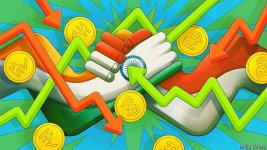
If You are looking for growth opportunities among the world’s 20 biggest economies, two stand out: India and Indonesia. The Asian giants, with a combined population of 1.7bn, are forecast by the imf to be the two fastest-growing top-20 economies in 2023, and over the next five years. Both are pioneering strategies for getting richer in an era of de-globalisation, fraught geopolitics, automation and energy shifts, even as they seek a political formula that wins elections and avoids social unrest. Whether they succeed matters not just for their people and the investors betting many billions of dollars on them. It will also set an example for scores of other countries searching for new and reliable ways to develop in the 2020s and beyond.

For decades developing countries have followed a trusted formula for growing wealthier. Move workers from fields to more productive manufacturing jobs in cities, have them make goods for export, and watch the rapid formalisation of the economy. It worked in South Korea and Taiwan. In China it saw 800m people escape poverty. But today this scheme no longer works well. Many countries are rowdy democracies, not authoritarian states (as South Korea and Taiwan were when they industrialised). Protectionism challenges export-led growth. Factories use more robots.

At first glance, India and Indonesia have much in common. Both are led by charismatic leaders first elected in 2014, and both will hold elections next year. Narendra Modi, India’s prime minister, and Joko Widodo (widely known as Jokowi), Indonesia’s president, cut their teeth in local politics and have a reputation for getting things done. They run vast (India has 1.4bn people and Indonesia 280m) and relatively young countries with myriad ethnicities and languages.

 
To view this content we will need your consent to set third party cookies.
For more detailed information, see our cookies page.


India and Indonesia: The Race to Becoming the Fastest Growing Economies​

 
To view this content we will need your consent to set third party cookies.
For more detailed information, see our cookies page.
 

Will Indonesia’s New President be a Statesman or a Strongman?​


If Indonesia is to continue shedding its historical straitjackets and keep its rise on course, the “new” Prabowo needs to show up more often than the “old” one.

1729752695241.jpeg

By Parker Novak

October 23, 2024

Indonesia, the world’s fourth-largest country by population, is a nation on the rise. With an economy projected to become the world’s sixth largest by 2027, this sprawling archipelago of 17,000 islands is poised to become an increasingly important international player by virtue of its growing economic heft and geographic proximity to waterways that are vital to trade and security.


Indonesia’s ascendance isn’t a foregone conclusion, however. Long derided as punching below its weight on the world stage, it is facing a host of challenges, from economic growth to climate change, that could derail its rise. If it is to effectively address them, it needs to continue shedding its historical economic protectionism and relative isolationism and embrace a more globally oriented outlook, albeit one with Indonesian characteristics.


Indonesia’s new president, Prabowo Subianto, symbolizes the choice facing his country. On one hand, the strong-headed former general embodies a prominent strand of Indonesian nationalism at the root of the protectionist and inward-looking tendencies evident in its political culture. On the other hand, as defense minister and a presidential candidate, he has softened his image and showcased himself as an active, internationally minded statesman.


These seemingly contradictory tendencies pose a crucial question for Indonesia’s future: Which Prabowo will win out as he assumes office? The “old” Prabowo with a hard-headed authoritarian mentality, the “new” Prabowo with the demeanor of a cuddly grandpa, or an amalgamation of both? In answering this, it is important to look not just at his current policy positions, but also his personality, psychology, and history.

Parker Novak​

Parker Novak is a nonresident fellow with the Atlantic Council’s Global China Hub and Indo-Pacific Security Initiative. He previously served as the Indonesia and Timor-Leste country director for an international non-governmental organization.


Indonesia Finally Seeks BRICS Membership​


Jayanty Nada Shofa

October 25, 2024 | 8:10 am

1729872966890.webp
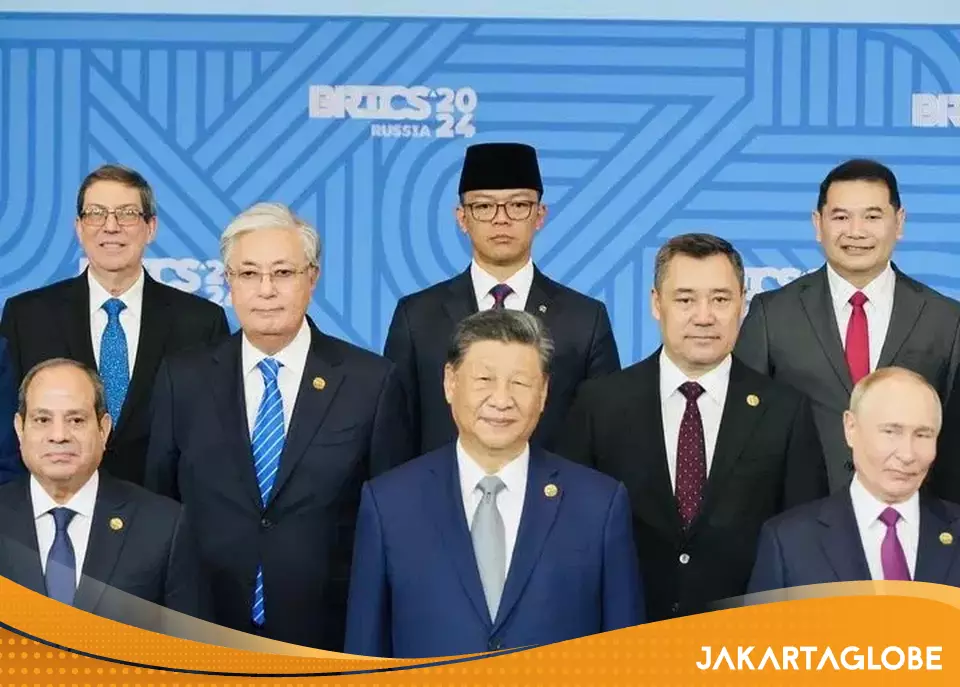
Foreign Affairs Minister Sugiono, who dons a cap (peci), takes a photo with world leaders at the BRICS Plus Summit in Kazan on Oct. 24, 2024. (Photo Courtesy of @sugiono_56 on Instagram)


Jakarta. Indonesia has just expressed its interest in joining the Russia-led group BRICS, marking the first major foreign diplomacy move out of the “good neighbor policy” that the freshly installed President Prabowo Subianto has proposed.


The BRICS alliance -- which first took shape to counter Western dominance -- originally brought together Brazil, Russia, India, China, and South Africa, hence the acronym. It has admitted new members Iran, Egypt, Ethiopia, and the United Arab Emirates. Saudi Arabia has yet to officially join BRICS despite having received the invitation from the group.


Foreign Affairs Minister Sugiono unveiled Indonesia’s desire for membership at the BRICS Plus Summit in Russia’s Kazan on Thursday local time. According to Sugiono, BRICS can become a vehicle to promote the interests of the “Global South”, a term that commonly refers to developing countries. Jakarta also denies that its possible BRICS membership means that it is taking sides, saying that it will continue to engage with other forums and advanced economies.

“Indonesia joining BRICS embodies the country’s active and free foreign policy,” Sugiono said in a press statement issued on Thursday night.

“It does not mean that we are joining a certain camp, but we actively participate in all forums. We see that BRICS priorities align with the Red and White Cabinet work programs. And that includes food and energy security, poverty eradication, as well as human capital development,” Sugiono said.


Sugiono’s statement came shortly after reports revealed that Indonesia was among BRICS’ 13 new partner countries. Three of them are fellow ASEAN members Malaysia, Vietnam, and Thailand. The partner country status does not mean they are full-fledged members.


The BRICS gathering came out with the Kazan declaration. The document stated that the summit welcomed the “considerable interest” by Global South countries in BRICS, while also endorsing what it calls “the modalities of partner country category”.


“We strongly believe that extending the BRICS partnership with EMDCs [emerging market and developing countries] will further contribute to strengthening the spirit of solidarity and true international cooperation for the benefit of all,” the Kazan declaration reads.


Jakarta’s intention to join BRICS became the first outcome of Prabowo’s so-called “good neighbor foreign policy”. When Prabowo took over as president over the weekend, the former army general said he wanted Indonesia to be friends with all countries, while keeping an anti-colonialism stance.


Indonesia previously chose to not rush with a BRICS membership under Former President Joko “Jokowi” Widodo. Last year, Jokowi flew to the BRICS Summit in Johannesburg as the rotating ASEAN chair. Jokowi said at the time Indonesia would like to weigh the pros and cons first before formally applying to BRICS. Analyst Yose Rizal Damuri said at the time that it would be best for Indonesia to not rush into joining the group, citing the group’s lack of clear economic benefits as a reason.

 
To view this content we will need your consent to set third party cookies.
For more detailed information, see our cookies page.


Indonesia Announces Plans To Join Brics​

 
To view this content we will need your consent to set third party cookies.
For more detailed information, see our cookies page.
 
In his speech at the Brics Plus Summit in Kazan, Sugiono underlined Indonesia's solidarity with Palestine and Lebanon, and reiterated calls for a ceasefire. "Indonesia cannot remain silent while these atrocities continue without anyone being held accountable," he said.

The worsening conflict in the Middle East continues to be a major issue for Indonesia, home to one of the world's largest Muslim populations.


To view this content we will need your consent to set third party cookies.
For more detailed information, see our cookies page.
 
To view this content we will need your consent to set third party cookies.
For more detailed information, see our cookies page.


إسرائيل فوق القانون؟ | الجانب الآخر​

 
Analyses

The case for an Indo-Pacific Economic Resilience Bank​


The world faces a multi-trillion-dollar financing gap to reinvigorate stalling global development and create diversified green supply chains to enable a secure clean energy transition for all countries.

By Michelle Lyons, Roland Rajah, Grace Stanhope
23 October 2024

1730525273549.webp

Key Findings

  • The world faces a triple crisis of economic insecurity, climate change, and stalled development, but there are deep tensions between the policy agendas being deployed to address them. We propose a new Indo-Pacific multilateral bank that can turn these tensions into complementarities.
  • The bank can accelerate clean energy funding by mobilising new public and private capital investments, primarily for projects in the Indo-Pacific’s developing economies. And it can create multilateral economic security by diversifying green supply chains to dilute the current excessive dependence on China.
  • The bank would create benefits for both developing and advanced economies, fostering new industries and diversified, resilient markets while helping build the multilateral cooperation and capabilities needed to construct a more secure and sustainable world.
Among Western democracies, China’s dominance of clean energy supply chains is viewed as a risk to economic security, with a growing array of policies designed to enhance their resilience to this dominance. Yet to the developing world, the emissions reduction and economic security objectives of Western democracies are often seen as coming at the expense of their economic advancement. Until that tension is resolved, Western democracies will continue to struggle with a lack of legitimacy among developing countries, including with important emerging powers such as Indonesia.

 
Prabowo will meet China, US, British Leaders in their respected countries. The journey started from meeting Xi Jin Ping. He is reported to meet Donald Trump as well in USA

He will go to Peru for APEC meeting and Brazil as well for G20 meetings


To view this content we will need your consent to set third party cookies.
For more detailed information, see our cookies page.


Prabowo accompanied by his only son, Didit, landed in China, he is also greeted by Indonesian citizens living in China

To view this content we will need your consent to set third party cookies.
For more detailed information, see our cookies page.
 

Jokowi Hopes Trump’s Victory Will Bring New Cooperation Opportunities​


Jayanty Nada Shofa

November 7, 2024 | 10:06 am

1731130795137.webp
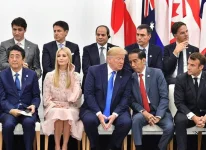
Then-President Joko "Jokowi" Widodo speaks with Donald Trump at the G20 Summit in Osaka on June 29, 2019. (Photo Courtesy of Presidential Press Bureau)


Jakarta. Former two-term president Joko “Jokowi” Widodo congratulated Donald Trump for winning the US election via his social media on Thursday, while hoping that his leadership could open up new cooperation opportunities with Indonesia.

Trump defeated the current US veep and the Democratic Party’s presidential nominee Kamala Harris in Wednesday’s election that the world had been watching closely. Trump’s victory prompted world leaders -- including Jokowi’s successor Prabowo Subianto -- to send the businessman-turned-politician congratulatory messages. Jokowi, too, offered his congratulations.

“Dear President-Elect Donald Trump, @realDonaldTrump: Congratulations on your election as President of the United States. I extend my best wishes for success in leading the nation and fostering progress and stability,” Jokowi wrote on the social media platform X.

“The longstanding friendship between Indonesia and the United States is built on shared values and mutual respect. I hope your leadership will bring new opportunities for cooperation that benefit both our nations and contribute to global peace and prosperity,” Jokowi said.

Trump secured over the required 270 electoral votes that he needed to return to the White House. The 78-year-old politician will take his oath of office as the US’ 47th president in January.

This will be Trump’s second term after the ex-property tycoon led the country from 2017-2021.

Trump also wrote a congratulatory letter when Jokowi got reelected in 2019.

In that letter, Trump congratulated Jokowi and the Indonesian people “for holding free, fair, and peaceful elections, and, for the first time, administering concurrent presidential and legislative polls."

Trump also told Jokowi at the time that Indonesia's democracy had significantly progressed over the past two decades.

 
Status
Not open for further replies.

Users who are viewing this thread

Pakistan Defence Latest

Back
Top