Indonesia Consumer Behavior Thread (Consumption Side of GDP)

Stalling Small Enterprises Lead to Drop in Eid Travelers: Analyst​


Harumbi Prastya Hidayahningrum

March 28, 2025 | 8:27 am

1743143515443.webp
Cars queue in front of the Cikupa tollgate in Tangerang, Banten, on March 28, 2025. Traffic is on the rise as Eid approaches. (Antara Photo/Putra M Akbar)


Jakarta. Indonesia is seeing fewer homecoming travelers this Eid holiday, and an analyst believes that the stalling small enterprises is what might have caused this drop.


Every Eid, countless Indonesians will go back to their hometowns, causing a massive exodus all over the country. The government estimates show that 146.48 million people will travel. While this is equivalent to 52 percent of the total population, it marks a 24 percent decline from the 193.6 million Eid travelers recorded last year. Fewer holidaymakers could mean a smaller Eid economy for Indonesia, which is trying to pursue an 8 percent annual growth within the next few years.


Bhima Yudhistira, the executive director at the think-tank Celios, said that people's income -- particularly the micro, small, and medium enterprises (MSMEs) -- is currently on a decline. As people earn less money, many decide to cancel their travel plans.


"People's income is decreasing, especially for the street vendors, informal traders, and MSMEs. When turnover drops, people feel that it is better not to travel during the Eid holidays," Bhima said on Thursday.

On the other hand, people working in the formal sector choose to save their Eid bonuses in case of layoffs. Indonesian workers typically receive a bonus equal to one month's wage during Eid. However, Indonesia is currently witnessing waves of layoffs across various sectors. The fewer Eid vacationers are set to take a toll on the businesses, particularly those in the hometowns, according to Bhima.


The expert warned that the decline in Eid travelers could affect Indonesia's annual growth.


Amid the weakening Eid economy, Bhima advised the government against making policies that may distort the people's purchasing power.


He went on to say how President Prabowo Subianto's budget austerity measures had led to dire consequences. Prabowo instructed his government to reduce spending by Rp 306.69 trillion (approximately $18.5 billion) for the current fiscal year. According to Bhima, the government should consider extending the electricity discounts. Indonesia should also make sure that its social assistance is going to the right people.


Nearly 1 Million Vehicles Leave Jakarta for Eid Homecoming, Peak Traffic on Friday​


Rino Fajar
March 27, 2025 | 11:03 pm

1743143772181.webp
Traffic flows smoothly on the Jakarta-Cikampek route at KM 15, Bekasi, West Java, on Thursday night, March 27, 2025. State-owned toll operator Jasa Marga reported that nearly 1 million vehicles have left Greater Jakarta during the 2025 Eid homecoming period. (Beritasatu.com/Rino Fajar)


Jakarta. State-owned toll operator Jasa Marga reported that nearly 1 million vehicles have left Greater Jakarta during the 2025 Eid homecoming period, with a significant surge in traffic heading east via the Trans-Java Toll Road.


Traffic monitoring on Thursday night showed smooth but busy conditions on the Jakarta-Cikampek route at KM 15 in Bekasi, West Java, with vehicles moving at an average speed of 70 kilometers per hour.


Lisye Octaviana, head of Corporate Communication & Community Development at Jasa Marga, said that from March 21 to March 27—five days before Eid—approximately 1 million vehicles had exited Jakarta.


“About 49 percent of vehicles are heading east, with 60 percent of them passing through the Cikampek Utama Toll Gate,” Lisye said on Thursday.

She added that the remaining traffic was distributed as follows: 21 percent traveled south through the Ciawi Toll Gate toward Bogor, while 29 percent headed west toward Merak Port in Banten, which serves as a gateway between Java and Sumatra.

Overall traffic volume has increased by 13 percent compared to normal conditions. At Cikampek Utama Toll Gate alone, vehicle flow has exceeded 70 percent of the usual volume, indicating a significant rise in holiday travel.


“The peak of the homecoming exodus is expected on Friday (March 28), with high volumes continuing through Saturday (March 29),” Lisye added.


The Transportation Ministry estimates that 146.48 million people will travel for Eid this year, a 24 percent decrease from last year’s 193.6 million travelers.

Jasa Marga is offering a 20 percent discount for travelers during the peak holiday season before and during the upcoming Eid al-Fitr celebrations. The discount will only be available for eight days on several sections of the Trans Java and Trans Sumatra toll roads.


Jakarta-Cikampek Toll road Tonight, people going back to their hometown using cars to West Java to celebrate Idul Fitri (Islamic Holidays)

To view this content we will need your consent to set third party cookies.
For more detailed information, see our cookies page.


While this is from Jakarta to Sumatra Island

To view this content we will need your consent to set third party cookies.
For more detailed information, see our cookies page.


Roads in West Java

To view this content we will need your consent to set third party cookies.
For more detailed information, see our cookies page.
 
2 days before Islamic Holidays Idul Fitri, traffic still seen in the toll road from Jakarta

The most celebrated Holidays in Indonesia is Idul Fitri, where many people want to celebrate it inside their home town, while seeing their parent.

To view this content we will need your consent to set third party cookies.
For more detailed information, see our cookies page.


To view this content we will need your consent to set third party cookies.
For more detailed information, see our cookies page.


To view this content we will need your consent to set third party cookies.
For more detailed information, see our cookies page.


To view this content we will need your consent to set third party cookies.
For more detailed information, see our cookies page.
 
Gold and Property as Safe Havens


As financial markets wobble, Indonesian investors are flocking to traditional safe havens. Gold has seen a resurgence, supported by strong demand from global central banks and institutional investors.


Luqyan Tamanni, Head of the BSI Institute, said gold could climb to $4,000 per troy ounce by 2026. “We’re witnessing a post-Eid surge in gold buying,” he said. “It reflects strong trust in gold’s value, especially amid inflation and currency risks.”


Tamanni advised allocating at least 10 percent of one’s portfolio to gold, citing a shift in spending patterns, especially among younger investors. “We’re seeing people cut back on daily consumption while still buying jewelry. That’s telling.”


Meanwhile, real estate continues to attract buyers. Clement Francis, Chairman of the Real Estate Brokers Association (AREBI), said housing demand remains resilient, even amid economic headwinds. “One developer in South Tangerang booked Rp700 billion in sales in just three months,” he said.


Francis noted that in Indonesia, buying property is deeply tied to life milestones. “It’s a cultural reflex: finish school, get a job, buy a house.” He sees potential for new buyers as prices begin to soften, advising a focus on landed homes and land investments over apartments.


Indonesia’s Property Market Stays Resilient Amid Escalating US-China Trade War​


Erfan Maruf, Bambang Ismoyo

April 17, 2025 | 3:33 pm


Jakarta. Despite escalating global trade tensions, Indonesia’s property market remains strong -- especially among middle- and upper-middle-class investors --according to industry insiders.


The ongoing trade war between the United States and China has cast a shadow over global economic stability. US President Donald Trump’s latest round of tariff hikes, including reciprocal duties reaching up to 32 percent on Indonesian goods, has been temporarily suspended under a 90-day truce. However, tariffs on Chinese imports remain in place, prolonging uncertainty across markets.


While many investors have taken a cautious, wait-and-see approach, the real estate sector has shown remarkable resilience. The Indonesian Real Estate Broker Association (Arebi) says property remains a favored asset class even in times of volatility.


“Amid global uncertainty, property investment continues to hold its appeal,” said Clement Francis, Chairman of Arebi, during a focus group discussion hosted by B-Universe Media Holdings in Pantai Indah Kapuk 2 (PIK 2) on Thursday.

Clement cited a recent success story to illustrate the point: “Before attending this event, I met with a developer in South Tangerang who managed to sell Rp 700 billion [approximately $41.6 million] worth of residential units in just the past three months.”

He attributed the sustained demand to Indonesia’s growing urban population and the increasing need for housing in major cities. “This clearly shows that real estate remains an attractive investment,” Clement added.


Government data supports the trend. According to the Investment Coordinating Board (BKPM), the property sector has consistently contributed more than 9 percent of total investment in Indonesia over the past five years.


Last year alone, domestic investors poured Rp 30 trillion ($1.8 billion) into property, said Rahmad Yulianto, BKPM’s Director of Development and Promotion, in a separate discussion in Jakarta.


“The sector has made a significant contribution, averaging 9.3 percent of total investments over the past five years,” he added.


Despite the challenging global outlook, Indonesia’s property sector appears to be weathering the storm—buoyed by local demand and long-term investor confidence.


1746626111016.png
1746626241622.png

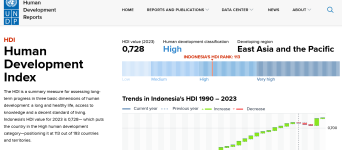
Human Development Index

The HDI is a summary measure for assessing long-term progress in three basic dimensions of human development: a long and healthy life, access to knowledge and a decent standard of living. Indonesia's HDI value for 2023 is 0,728— which puts the country in the High human development category—positioning it at 113 out of 193 countries and territories.

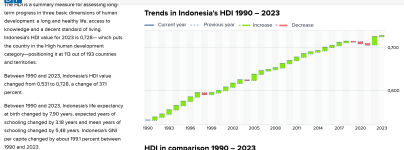
Between 1990 and 2023, Indonesia's HDI value changed from 0,531 to 0,728, a change of 37.1 percent.

Between 1990 and 2023, Indonesia's life expectancy at birth changed by 7,90 years, expected years of schooling changed by 3,18 years and mean years of schooling changed by 5,48 years. Indonesia's GNI per capita changed by about 199.1 percent between 1990 and 2023.


Indonesia’s economy grows 5.12% in second quarter of 2025​


Zetta Hannany, Kholid Rafsanjani
Aug 5, 2025 11:38 AM

JAKARTA – Statistics Indonesia (BPS) reported that the country’s economic growth or Gross Domestic Product (GDP) reached 5.12% year-on-year in the second quarter (Q2) of 2025, and 4.04% quarter-on-quarter.


Deputy for Balance Sheets and Statistical Analysis at BPS, Moh. Edy Mahmud, stated that Indonesia’s nominal GDP (at current prices) in Q2 2025 stood at IDR 5,947 trillion.


“Meanwhile, at constant prices, it reached IDR 3,396.3 trillion,” said Edy in a press conference today.


By business sector, the manufacturing industry was the main driver of GDP growth in Q2 2025, contributing 5.68% to the expansion.


The agricultural sector also supported economic growth, contributing 1.65%, followed by trade at 5.37%, construction at 4.98%, and mining at 2.03%.


From the expenditure side, household consumption remained the primary contributor to economic growth in Q2 2025, recording the highest increase at 4.97%.


This was followed by growth in Gross Fixed Capital Formation (GFCF) at 6.99%, exports at 10.67%, imports at 11.65%, and Non-Profit Institutions Serving Households (NPISH) at 7.82%.


Meanwhile, government consumption continued to contract by 0.33% in the second quarter of 2025.


Indonesia’s Q2 2025 economic growth outpaced consensus estimates, which had stood at around 4.8%.


For full-year 2025, the Indonesian government has set a target for annual economic growth at 5.2%. (KR/ZH)

 
Indonesians buy more on online shopping using e - commerce. It can be seen from 2022 data where Indonesian digital market has become 1/2 of all South East Asia Spending despite the population only 1/3 SEA, based on Singaporean research.

There is a change and migration on how people spending from offline into online. I believe it is also now a global phenomenon with the emergence of e commerce and ride hailing like Gojek/ Grab.

Dont understand with Bloomberg report, or other publication cant see it and see only on offline shop sales performance to asses Indonesian consumer spending duh......

Car sales is down ? Cars owner mostly witihin Greater Jakarta area with 30 million people. People now prefer public transportation than buying expensive cars for those in Greater Jakarta.

Houses price here also get skyrocketing while people dont like cheaper apartments. House owner mentality for Indonesian with families. Interest rate is also pretty high as The Fed interest rate still pretty hight that make Indonesia Central Banks also follow the course to defend Rupiah.

Go check which nations still has positive growth rate on its population and which is failing that is more on economic factor/ raising kids need money. A Hint, Indonesia fertility rate is still in growing rate, alhamdulillah.

Use your critical thinking before writing news and go back learning journalism first where a news should not be made one sided, go ask credible source that can answer your question on the news you write with one sided angle = AJ, Bloomberg, CNA Asia
 
Indonesian Consumer Confidence Rises, Highest in 3 Months


Hidayat Setiaji
08 August 2025, 10:17

1754638852090.jpeg

Bloomberg Technoz, Jakarta – Bank Indonesia (BI) has released the results of its July Consumer Survey, showing an improvement in consumer confidence.

On Friday (August 8, 2025), BI reported that the Consumer Confidence Index (CCI) for July stood at 118.1, up from 117.8 in June.

A CCI above 100 indicates that consumers are confident or optimistic about the economy over the next six months. July’s CCI marked the highest level in the past three months.

“The increase in consumer confidence in July 2025 was mainly supported by the rise in the Consumer Expectation Index (CEI). The July 2025 CEI was recorded at 129.6, higher than the previous month’s index of 128.9.

Meanwhile, the Current Economic Condition Index (CECI) for July 2025 was recorded at 106.6, relatively stable compared to the previous month’s index of 106.7,” BI’s statement said.

 
Does anyone really come to Indonesian threads? If we didn't have this 1 user, we would never know if Indonesia exists.

There's some serious testosterone deficiency in that region.
 
HSBC: Informal Sector Boosts Indonesia’s Economic Growth

Friday, August 8, 2025 – 14:12 WIB


Ipotnews – Indonesia’s economy recorded 5.12% growth in Q2 2025, the highest in the past two years. HSBC Global Research sees this increase as mainly driven by improved purchasing power in the informal sector, amid the easing of fiscal and monetary policies.

Pranjul Bhandari, Chief Economist for Indonesia and India at HSBC Global Research, said the post-pandemic growth recovery had been relatively slow due to tight fiscal and monetary policies over the past few years. However, 2025 marks a turning point.

“This year, Bank Indonesia has already cut interest rates by 100 bps and may lower them by another 75 bps over the next two to three quarters. The government has also increased the fiscal deficit from 1.6% of GDP in 2023 to around 2.8% in 2025,” Pranjul said during the virtual media briefing HSBC: Indonesia Economy Outlook H2-2025 on Friday (August 8).

HSBC noted that while formal sector indicators such as car and household appliance sales remain weak, the informal sector is strengthening. “Falling inflation, high agricultural output, and additional government social spending have boosted mass consumer purchasing power. Spending on food, beverages, clothing, and energy needs has risen significantly,” Pranjul explained.

BPS data shows that investment in Q2 grew by 7%, supported by government capital expenditure, while household consumption grew by 5%. However, HSBC believes this growth is still insufficient to close the output gap.

“We need higher and longer-lasting growth for the output gap to close. The key is to drive corporate investment,” Pranjul said.

According to HSBC, investment opportunities lie in the trade sector, especially from the shifting of global supply chains in mid-tech manufacturing industries and consumer goods such as textiles, footwear, and furniture.

“Indonesia is already producing these goods, but only on a small scale. If we expand capacity, improve infrastructure, sign more trade agreements, develop skilled labor, and simplify business procedures, Indonesia could attract more FDI within the next two to three years,” he concluded.


Holiday Travel and Festive Season Boost Mobility, Fueling Q2 Economic Expansion​


Prisma Ardianto

August 11, 2025 | 10:43 am


Jakarta. A wave of public holidays, religious celebrations, and school breaks in the second quarter of 2025 significantly boosted household consumption and intercity travel, driving a surge in domestic mobility that became a major force behind Indonesia’s strongest quarterly growth in two years, according to the Central Statistics Agency (BPS).


The Indonesian economy grew by 5.12 percent year-on-year in the second quarter.


BPS Chief Amalia Adininggar Widyasanti said the April–June period was packed with long breaks for Eid al-Fitr, Easter, Vesak Day, Eid al-Adha, and the Islamic New Year, alongside school holidays. This encouraged more Indonesians to travel across regions, boosting spending in key sectors.


“This has driven a remarkable increase in public mobility. Our data show domestic tourism grew by more than 20 percent in the second quarter,” Amalia said in an exclusive interview with Beritasatu TV.

BPS figures indicate that domestic tourist trips rose 22.32 percent year-on-year to 331.37 million visits during the quarter. The spike in movement was also reflected in Bank Indonesia’s digital transaction data, which recorded higher consumption, particularly in restaurants and transportation -- both closely tied to increased travel activity.


Amalia noted that relatively strong purchasing power was evident in the bustling scenes at train stations and airports, which were busier than usual.


“This shows the extraordinary movement of people from one city to another. Such spending and mobility not only drive economic activity but also create a significant multiplier effect,” she said.


The full interview with Amalia is scheduled to air on BTV at 12 p.m. and 8 p.m. on Monday.


BPS Chief Details Household Spending, Exports Behind Strong Q2 Growth​


Prisma Ardianto

August 10, 2025 | 9:00 pm

1754923659211.webpCentral Statistics Agency (BPS) Head Amalia Adininggar Widyasanti speaks in an interview with Beritasatu TV in Pantai Indah Kapuk 2, Tangerang, Banten, on Friday, Aug. 8, 2025.


Jakarta. Central Statistics Agency (BPS) Head Amalia Adininggar Widyasanti has elaborated key drivers behind the strong economic growth in the second quarter amid skepticisms from some analysts questioning the data’s accuracy.


Indonesia’s economy expanded by 5.12 percent year on year in the second quarter, its fastest pace in two years, according to BPS. The result exceeded all forecasts from economists and international research institutions.


BPS Head Amalia Adininggar Widyasanti said in an exclusive interview with Beritasatu TV that household consumption remains the backbone of the economy, contributing 54.25 percent to overall growth in the quarter. Household spending rose by nearly 5 percent from a year earlier.


She noted that purchasing power has remained resilient despite shifts in consumer habits.

“If we look deeper into household consumption, strong growth has been recorded in recreation, food and beverages -- especially dining out -- and transportation. All of these categories have grown by more than 6 percent,” Amalia said.

Investment was another key driver, with gross fixed capital formation expanding by almost 7 percent and accounting for 27.83 percent of GDP.


Exports also surged, rising 10.67 percent year on year and contributing 22.28 percent to GDP.


“Service exports accelerated due to a rise in international tourist arrivals, while goods exports saw robust growth, supported by crude palm oil and derivative products, which rose by 18.67 percent,” she said.


The manufacturing sector grew by 5.68 percent, contributing 18.67 percent to GDP. Amalia said this was consistent with Bank Indonesia’s assessment that the manufacturing industry is in expansion mode, with production volumes trending upward.

“BPS also conducted its own survey across special economic and industrial zones, which confirmed rising economic activity in the second quarter,” she added.


Other sectors also performed strongly, with accommodation and warehousing recording growth above 8 percent.


“Public transportation reaches its peak in the second quarter,” Amalia said.

The full interview will be aired by BTV at midday and 8 p.m. Jakarta time on Monday.


Here's the most recent household debt-to-GDP estimates for the ASEAN countries you mentioned — along with rankings (from highest to lowest)—based on available data:

Household Debt-to-GDP Ratios & Rankings​

RankCountryHousehold Debt-to-GDP (%)Period / Source
1Thailand~88.4%End-Q4 2024, Bank of Thailand (Reuters)
2Malaysia~84.3%End-March 2025, Finance Ministry / BNM (Malay Mail, BERNAMA)
3Singapore~51.9–52.0%Around Q4 2024, CEIC data (CEIC Data)
4VietnamN/ANo data found from IMF/CEIC — not publicly available
5Philippines~11.7%Q4 2024, CEIC data (CEIC Data)
6Indonesia~10.0%Q4 2024, CEIC data (CEIC Data)

Observations & Notes​

  • Thailand leads the pack with one of the highest household debt-to-GDP ratios in the region, at approximately 88.4% as of end-2024 (Reuters).
  • Malaysia follows with about 84.3% of GDP as of March 2025 (Malay Mail).
  • Singapore’s household debt stands at around 51.9%–52.0% of GDP as of late 2024 (CEIC Data).
  • Philippines and Indonesia have relatively lower levels (around 11.7% and 10.0%, respectively) (CEIC Data).
  • Vietnam currently lacks publicly accessible, recent household debt-to-GDP data.

Summary Ranking (by household debt-to-GDP)​

  1. Thailand – ~88.4%
  2. Malaysia – ~84.3%
  3. Singapore – ~52.0%
  4. Philippines – ~11.7%
  5. Indonesia – ~10.0%
  6. Vietnam – Data not available


Users who are viewing this thread

Latest Posts

Back
Top