Indonesia Leads EM Rally as Carry Appeal, Growth Lure Investors

Mitsubishi and Mitsui to expand Indonesia LNG project​

Development of new field will include CO2 reduction measures

SHIN WATANABE, Nikkei staff writer
November 23, 2024 02:08 JST


US Invests $67 Billion in Indonesia, But Local Content Rules Remain A Challenge​


Jayanty Nada Shofa

November 26, 2024 | 11:37 am

1732600941977.webp
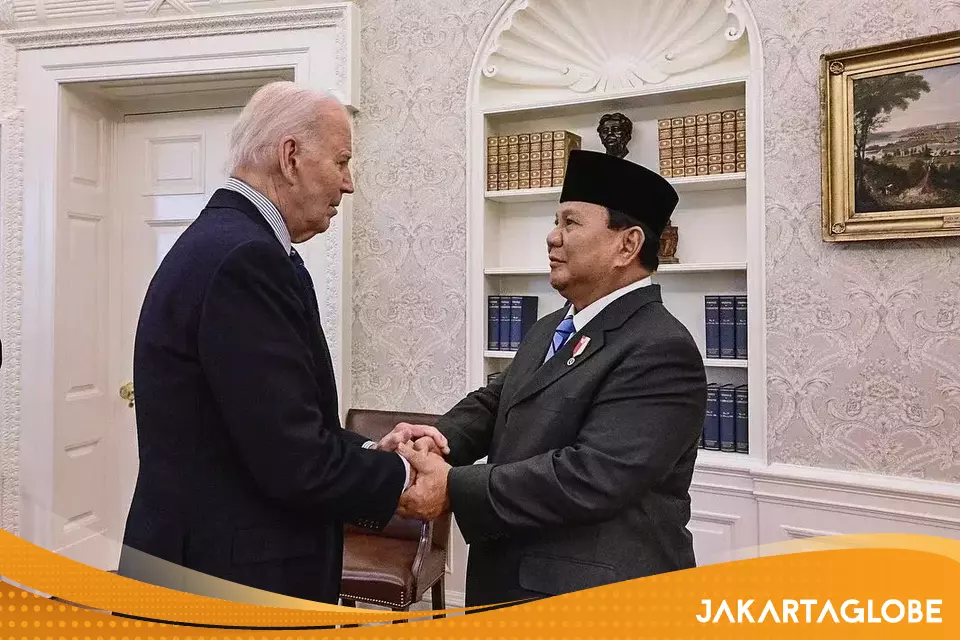
President Prabowo Subianto holds bilateral talks with his American counterpart Joe Biden at the White House in Washington on Nov. 12, 2024. (Photo Courtesy of @prabowo)


Jakarta. A freshly launched report shows that American businesses have invested $67 billion in Indonesia over the past decade, but Jakarta’s local content rules, among others, still remain a major deterrent to US investments.


Business lobbies AmCham Indonesia and the US Chamber of Commerce have just unveiled their latest bilateral investment report. US investments in Indonesia totaled $67 billion between 2014-2023, according to the report. The figures took into calculation upstream oil and gas investment, as well as mergers-and-acquisition activities. The investments had resulted in a $130 billion economic impact that goes beyond job creation. The numbers are also equivalent to the total costs needed to build 18 of the Jakarta-Bandung high-speed train projects.


Despite the impressive figures, American manufacturers -- particularly those requiring components that are still unavailable locally -- find Indonesia’s domestic content rules to be troublesome.


“Most companies are part of the global supply chain. If they can’t get the parts they need to manufacture their products here with the quality that they need, [the American investors] are not going to be comfortable coming and investing here,” Lydia Ruddy, the managing director of AmCham Indonesia, told the press in Jakarta on Tuesday.

Indonesia mandates manufacturers to have some parts of the components of its products to be domestically produced as a means to grow the economy and generate jobs. The government has blocked American tech giant Apple from selling iPhone 16 in Indonesia as the company cannot meet the 35 percent local content requirement for smartphones. Apple reportedly has proposed to make a $100 million investment in Indonesia to lift the ban.


Eric Hsu, the commercial counselor for the US Embassy in Indonesia, said that Jakarta should consider not taking a one-size-fits-all approach. Industries have different levels of needs, and some might not be able to rely on local inputs.


“The objective of the local content requirement is not bad. We understand the necessity. US companies are willing to partner with the Indonesian government on this area, which is ultimately the advancement of Indonesian industrial capacity development. But there are many approaches to that,” Hsu told reporters.


“The one-size-fit-all [approach] is not practical. It gets complicated in terms of the technical calculations, and on how to work on the local content. But this is something we look forward to working with the [Indonesian] government to simplify that,” Hsu said.

 
Financial (like transfer of asset/equity ownership) and Oil and Gas Investment is not included in Indonesia Foreign Direct Investment Calculation.

--------------------

Note:

1) Excluding of Oil & Gas, Banking, Non-Bank Financial Institution, Insurance, Leasing, Investment which lisences issued by technical or sectoral agency, Porto Folio as well as Household Investment

 
Jensen Huang with Indonesian journalist in Jakarta

To view this content we will need your consent to set third party cookies.
For more detailed information, see our cookies page.
 

Indonesian Rupiah Strengthens After Elections Eases Political Worries​

1732871062574.webp

Finimize Newsroom
about 24 hours ago

What’s going on here?

The Indonesian rupiah jumped 0.5% against the US dollar after local elections eased worries over political instability, with regional currencies reacting differently to changing economic climates.

What does this mean?

The rupiah’s rise showcases optimism for a stable political scene with President Prabowo Subianto-supported candidates likely securing key regional wins. An economist at Trimegah Securities links the currency climb to expectations of peaceful election results.

Bank Indonesia aims to keep assets appealing by supporting the rupiah, despite limited room for further rate cuts. On the flip side, Malaysia’s ringgit fell 0.1% amid a 2.4% decline in October’s producer price index – the sharpest drop since last June. Across Asia, the Thai baht had a slight uptick, while Singapore's dollar dipped. The South Korean won weakened due to the Bank of Korea's rate cuts to tackle economic stagnation and low inflation.

Why should I care?

For markets:
Asian currencies dance to a complex tune.

While Indonesia sees a rise in currency confidence, mixed signals are apparent across Asia. Malaysian equities are slightly down, and Thai factory output along with Philippine stocks have reached lows. Meanwhile, the South Korean won and Singapore dollar face pressures amid economic policy shifts. Investors should observe these broader economic trends as these currencies react to domestic and international pressures, providing clues for potential regional market movements.

The bigger picture: Global currency trends and economic policy collide.

Globally, currencies are influenced by intricate dynamics of politics and policy. Indonesia's political stability boosts the rupiah, contrasting with Malaysia and Korea's economic strategies. Meanwhile, outside Asia, the Mexican peso faces challenges amid geopolitical tensions triggered by US President-elect Donald Trump's proposed tariff hikes. Grasping these diverse movements is key for anticipating how such factors might reshape regional and global economic tactics.


Chinese firm plans to invest for around 25 billion USD in Batam Island (near Singapore)

This project is already prepared since 2023.....
 

Indonesia, Canada to Significantly Ease Trade Barriers in 2026​


Jayanty Nada Shofa
December 2, 2024 | 2:31 pm

1733205122679.webp

Jakarta. Indonesia and Canada are expected to ease a huge chunk of the tariffs on their bilateral trade in goods starting in 2026 as Jakarta hopes to narrow its trade deficit with Ottawa, according to a minister.


Both countries inked Monday a joint ministerial statement that marked the substantive conclusion of the Comprehensive Economic Partnership Agreement (CEPA) -- about three years after the trade deal negotiations began. There are still many steps ahead before the deal can enter into force, including the so-called legal scrubbing process in which lawyers would review the text. Both countries also need to sign and ratify the treaty for it to come into effect.

Trade Minister Budi Santoso told reporters that Indonesia and Canada would sign the CEPA in mid-2025 with a target to implement the trade pact the following year.

The CEPA deal will grant Indonesia a trade liberalization that covers up to 90.5 percent of the import tariffs for its goods entering the Canadian market. This is equivalent to $1.4 billion worth of trade. Bilateral trade in services will be subject to preferential treatment. The deal will also facilitate investments in agricultural and manufacturing sectors.


“The Indonesia-Canada CEPA will be implemented in 2026. Some Indonesian goods that will get prioritized access to the Canadian market include paper products, processed food, edible bird’s nest, and palm oil,” Budi told reporters in Jakarta.

 
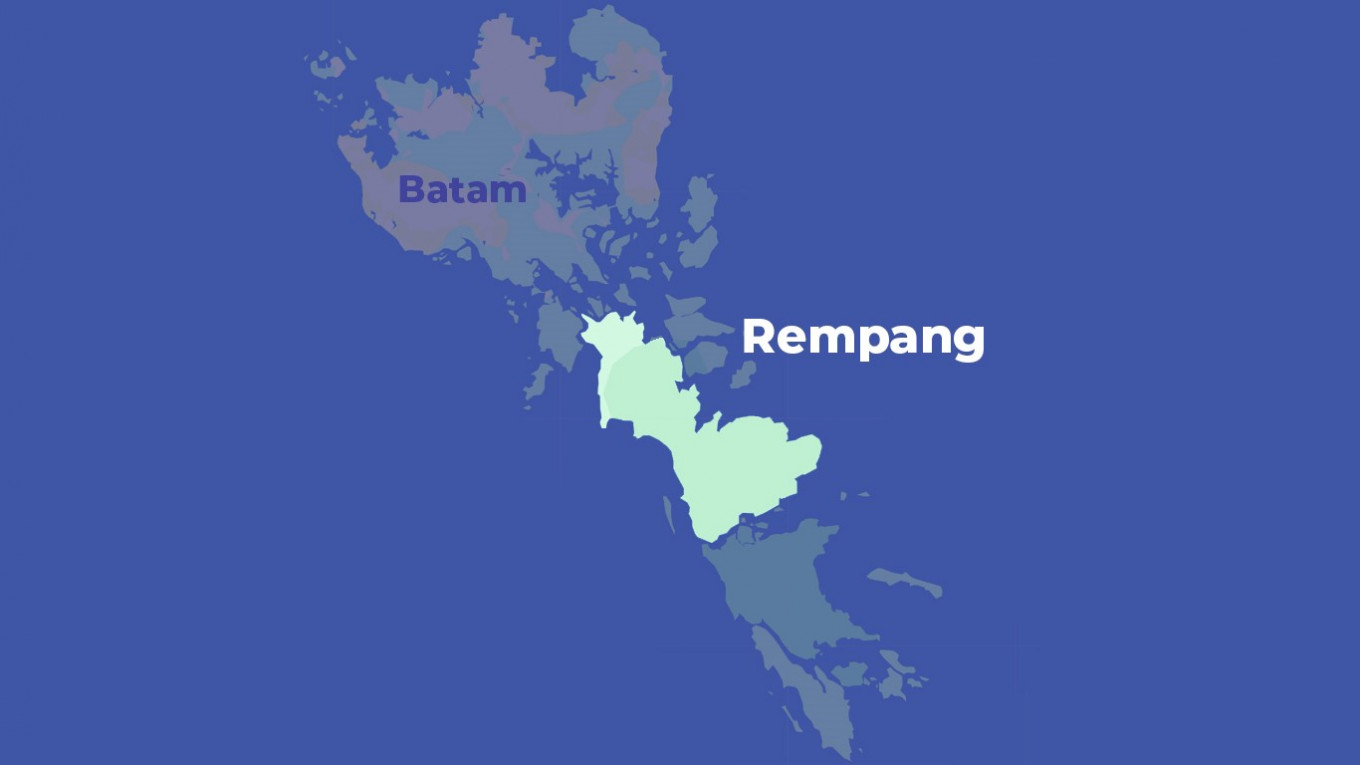
BP Batam ensures Rempang Eco City National Strategic Project proceeds smoothly

(The Jakarta Post)
Jakarta
Wed, October 9, 2024


1733205571426.jpeg

As the developer and manager of the Batam Free Trade Zone and Free Port (KPBPB), as well as the Special Economic Zone (SEZ), the Batam Development Agency (BP Batam) is tasked with improving investment competitiveness in Batam city.

This commitment is supported by the central government through the preparation of Rempang Eco City as a National Strategic Project (PSN), which is a realization of the cooperation between the Batam city administration, BP Batam and PT Makmur Elok Graha, established in 2004.


Rempang Eco City has been prepared as a new economic engine in Indonesia. In addition to being an industrial area, the region will also be prepared for the trade, residential and integrated tourism sectors.

The head of the Public Relations, Promotion and Protocol Bureau of BP Batam, Ariastuty Sirait, stated that during the process, the government was also ensuring the involvement of the local community in the dissemination of information about compensation for the affected areas.

This effort has been demonstrated by BP Batam through compensation payments for land clearing, crops and buildings to the community in accordance with applicable rules and regulations.

"BP Batam is also working with the government to develop local community empowerment programs to improve their living standards. One way is by providing job opportunities within the Rempang Eco City project," she said.

The preparation and development of Rempang Eco City have been carried out in a planned manner, including the preparation of an environmental impact analysis (AMDAL).

"The AMDAL is already completed. This is one of the key points of concern for the government. So, we are ensuring that everything is resolved properly," Ariastuty said.

Ariastuty added that the infrastructure and economic progress already felt by the residents of Batam Island must also be realized on Rempang Island, given that Batam city's economic growth in 2023 reached 7.04 percent, which surpassed the economic growth of both Riau Islands province and the national average.

"What we have built in Batam will also be built in Rempang. In fact, in the future, Rempang could become an even more advanced area than Batam," said Ariastuty.

She also requested support from all parties to ensure that this PSN runs smoothly and opens investment opportunities that will ultimately lead to comprehensive economic growth and community welfare.


Indonesia's 2024 budget deficit at 2.3% of GDP, smaller than expected​

By Stefanno Sulaiman and Gayatri Suroyo
January 6, 2025
11:52 AM GMT+7

JAKARTA, Jan 6 (Reuters) - Indonesia's unaudited budget deficit for the 2024 fiscal year was 507.8 trillion rupiah ($31.38 billion), or 2.29% of GDP, smaller than the finance ministry's earlier estimate but bigger than that of 2023, official data showed on Monday.

Southeast Asia's largest economy had previously estimated a budget gap of 2.7% of GDP for all of 2024. In 2023, it had a deficit of 1.61% of GDP.
The deficit forecast for 2025 is 2.53% of GDP.

In her presentation of the data, Finance Minister Sri Mulyani Indrawati described the 2024 deficit as "a foundation for an effective transition of government", as Indonesia inaugurated Prabowo Subianto as its new president in October.

"This was far better than what we had expected in the middle of last year," she said at a press conference, adding that tax revenues turned around to book positive growth in the final quarter, after a contraction in the first nine months of 2024.

The data showed there was 45.4 trillion rupiah of excess cash from higher debt issuance last year, which the government sometimes uses to reduce debt issuance plans in the following year.

Sri Mulyani said the smaller-than-expected deficit could also provide a strong foundation for the economy in 2025, which economists have cautioned could be an uncertain year due to changing policy in the United States under President-elect Donald Trump.

In Indonesia, financial markets have been monitoring the government's fiscal policy after Prabowo said he wanted to be more daring with debt to fund his flagship programmes, which include providing free school lunches and significantly expanding farmland.

The "Free Nutritious Meals" program, which has a budget of 71 trillion rupiah, was scheduled to begin on Monday.

In 2024, total revenues rose 2.1% from 2023 to 2,842.5 trillion rupiah. The government spent 3,350.3 trillion rupiah in total last year, up 7.3% from 2023.

Total expenditure planned for 2025 is 3,621.3 trillion rupiah.
Economic growth last year was estimated at around 5%, Sri Mulyani said, compared with 2023's growth of 5.05%.

($1 = 16,180. Rupiah)


Congratulations Mr. Prabowo, Foreign Investors Flooding the Market Again.​


CNBC Indonesia

06 January 2025 08:25

Jakarta, CNBC Indonesia - Foreign funds are observed to enter from the domestic financial market last week. Foreign investors began to enter Indonesia along with the widened gap between the yield of Indonesia’s 10-year tenor debt letter with the United States (US).

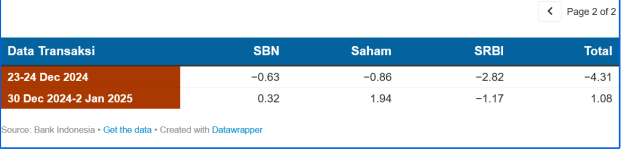
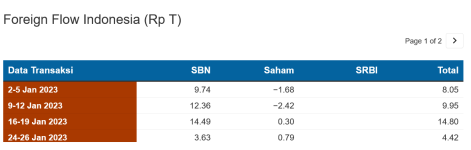
Bank Indonesia (BI) released transaction data 30 December 2024-2 January 2025, foreign investors were recorded to buy nets of Rp1.08 trillion, consisting of net buy Rp0.32 trillion in the stock market, buy nets of Rp1.94 trillion in the State Securities market (SBN), and sell nets of Rp1.17 trillion in Bank Indonesia Rupiah Sekuritas (SRBI).

The influeign of this foreign fund is good news for President Prabowo Subianto's government to enter 2025. The influeign of foreign funds can strengthen the stock market and the rupiah exchange rate.

During the year 2024, based on the setment data until December 31, 2024, foreign investors were recorded to buy nets of Rp15.74 trillion in the stock market, Rp34.59 trillion in the SBN market and Rp161.99 trillion in SRBI.
1736387863124.png
1736387907982.png

When compared to the fourth week of December 2024, foreign investors at that time were still selling nets of Rp4.31 trillion given the average difference in yield between SBN tenor 10 years with US Treasury tenor 10 years by 2.44%. While last week, the average difference in yields widened to 2.455%.
This is suspected to be an attraction for foreign investors to place their funds in the country.
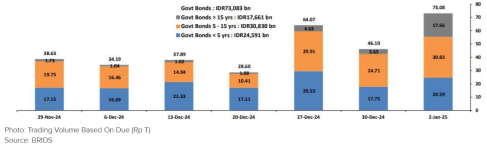
The volume of government bond trading on January 2, 2025 also appears to be quite high at least in the past month.
In the BRI Danareksa Securities report shows the volume of trading based on maturity on January 2, 2025 amounting to Rp73.08 trillion with dominance in tenor government bonds of 5-15 years of Rp30.83 trillion.
1736387970025.png

In the future, Indonesia’s debt securities will still offer attractive returns for all investors both domestic and foreign in the midst of the need for funding various programs throughout 2025.

The close synergy between fiscal and monetary policy in a sustainable manner is essential for maintaining fiscal stability, monetary stability in particular the stability of the rupiah exchange rate, and the Stability of the Financial System in order to support sustainable economic growth.

This coordination yielded a number of points. First, the government is committed to managing fiscal policies in a cautious and sustainable manner, which supports sustainable economic growth, through controlled management of the 2025 State Budget deficit and cautious financing strategies.

The APBN 2025 deficit is 2.53% of GDP or Rp616 trillion. The financing of the 2025 state budget deficit will be met through net debt financing of Rp775.8 trillion and net-non-distance financing of minus Rp159.7 trillion.

"This debt financing will be carried out through the issuance of global bonds, withdrawal of foreign and domestic loans, as well as the issuance of SBN in the domestic market," said Deny Surjantoro, Head of the Communications and Information Services Bureau of the Ministry of Finance, Friday (12/27/2024).

Second, BI directs monetary policy in 2025 to ensure inflation remains under control in the target of 2.5±1% and the maintenance of the stability of the rupiah exchange rate, to support sustainable economic growth.

Ramdan Denny Prakoso, Executive Director of the Bank Indonesia Communications Department, said the central bank continues to observe the movement of the rupiah exchange rate, the inflation outlook, and the dynamics of developing economic conditions, in utilizing the space of the decline of advanced policy interest rates.

Third, the Ministry of Finance and Bank Indonesia agreed that the issuance of SBN by the Government and the purchase of SBN from the secondary market by Bank Indonesia will be carried out based on the principles of pr corresponded fiscal and monetary policy and maintaining the discipline and integrity of the market (market discipline and integrity).

Finally, the Ministry of Finance and Bank Indonesia are committed that the issuance and purchase of SBN is carried out in a transparent, accountable, according to market mechanisms, and with strong governance.

Ramdan said further implementation was coordinated over time as it had been closely carried out, taking into account the dynamics of economic and financial market developments both domestically and globally.

CNBC INDONESIA RESEARCH

[email protected]


Indonesia Foreign Reserves at New High to Boost Rupiah War Chest​

By Grace Sihombing and Prima Wirayani
January 08, 2025 at 12:11AM EST

1736388451218.png

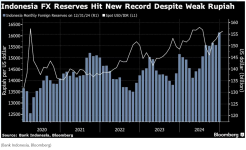
(Bloomberg) -- Indonesia’s foreign reserves rose to a fresh record of $155.7 billion in December, bolstering the central bank’s defenses to fight the relentless dollar strength and stabilize the rupiah.

Foreign reserves surged by $5.5 billion last month, the biggest gain in a year, Bank Indonesia data showed on Wednesday. The previous record was achieved in October. Higher receipts from taxes and services, oil and gas exports, and the government’s withdrawal of foreign loans helped increase the stockpile in December.

The record amount of Indonesia’s dollar stash came even as the central bank intensified efforts to stem the rupiah’s slump fueled by uncertainties in the US monetary policy and President Donald Trump’s planned tariff hikes. Last month, the currency tumbled past 16,000 level against US dollar to its weakest level since July, prompting Bank Indonesia to step up interventions in the markets.

The rupiah led declines among major Asian currencies on Wednesday, falling as much as 0.5% to 16,211 to the dollar in morning trading.

Bank Indonesia may see a higher need for intervention in the near future given “the lower chance of Federal Reserves’ rate cut would drive the greenback higher in the following months,” said Mingze Wu, a currency trader at StoneX Financial Pte Ltd in Singapore. “Having the warchest growing is always helpful for future intervention needs”.


Governor Perry Warjiyo reiterated during the Dec. 18 policy rate meeting that the focus of monetary policy remains directed at strengthening the stability of the currency. Monetary policymakers have kept the benchmark interest rate steady at 6% since October.

©2025 Bloomberg L.P.

 
AWS has invested 5 billion USD for Cloud Service in Indonesia in the form of data centers located in several locations in Greater Jakarta region. The fist cloud service investment is made in 2021.

To view this content we will need your consent to set third party cookies.
For more detailed information, see our cookies page.
 

Indonesia's Growth to Outpace Regional Peers Despite Global Economic Slowdown: World Bank​


Faisal Maliki Baskoro

January 17, 2025 | 7:12 pm

To view this content we will need your consent to set third party cookies.
For more detailed information, see our cookies page.

Jakarta Business district during rush hours


Jakarta. The World Bank’s latest Global Economic Prospects report projects global economic growth to remain steady at 2.7 percent in 2025 and 2026, mirroring the pace expected in 2024. This growth is largely driven by a gradual decline in inflation and interest rates.


For Indonesia, the World Bank estimates a 5 percent growth in 2024, with 5.1 percent in both 2025 and 2026, outpacing the 4 percent average growth forecast for developing economies. However, these projections still fall short of pre-pandemic growth rates and are considered insufficient to address the challenges of poverty alleviation and broader development goals.


"Alongside decelerating activity in China, export growth is likely to slow most in countries that experienced the strongest rebounds—particularly in highly export-oriented economies such as Malaysia. In contrast, where trade growth was slower last year and economic activity relies more on domestic demand, including in Indonesia, steadier trade growth is expected over the forecast horizon," the World Bank stated on Friday.


Developing economies, which account for 60 percent of global growth, are projected to finish the first quarter of the 21st century with their weakest long-term growth outlook since 2000. The World Bank stated that while these economies are growing more important to the global economy—now contributing 45 percent of global GDP compared to 25 percent in 2000—they face daunting challenges.


Indermit Gill, the World Bank’s Chief Economist, warns that “the next 25 years will be a tougher slog for developing economies than the last 25.” High debt burdens, weak investment, stagnant productivity growth, and the rising costs of climate change are now emerging as key obstacles.


“The forces that once aided their rise have dissipated,” Gill said, emphasizing the need for a new economic strategy. Developing economies, he suggests, must focus on domestic reforms to attract private investment, enhance trade relations, and optimize the use of capital, talent, and energy.


The report also highlights the importance of trade partnerships, particularly among developing economies, as a potential catalyst for growth. “In a world shaped by policy uncertainty and trade tensions, developing economies will need bold policies to seize untapped opportunities for cross-border cooperation,” said M. Ayhan Kose, Deputy Chief Economist at the World Bank.


Although the global outlook is clouded by high policy uncertainty, rising trade tensions, and persistent inflation, there is also potential for stronger-than-expected growth. Stimulus measures in China could boost demand, while robust household spending in the United States could benefit global growth, including that of developing economies.


The report emphasizes that while challenges abound, there are key opportunities for developing nations to improve their growth prospects. Addressing infrastructure deficits, accelerating the transition to a low-carbon economy, and investing in human capital can drive sustainable growth. Moreover, countries should collaborate to strengthen global trade governance, supported by multilateral institutions.

Developing economies, while facing significant hurdles, have a path forward if they pursue the right policies to turn challenges into opportunities.

 
To view this content we will need your consent to set third party cookies.
For more detailed information, see our cookies page.


Top 50 Economies by Real GDP Growth Rate 2025 | Top 50 Largest Economies 2025 | Facts Nerd / IMF Projection October 2024​


ExxonMobil to Invest Up to $15 Billion in Indonesian Carbon Storage, Petrochemical​


Jayanty Nada Shofa

January 22, 2025 | 3:58 pm

1737688015722.webp
Senior minister Airlangga Hartarto (second from left) and ExxonMobil Indonesia's President Carole J Gall (third from left) take a photo after the MoU signing in Jakarta on Jan. 22, 2025. (JG Photo/Jayanty Nada Shofa)


Jakarta. American oil giant ExxonMobil has agreed to invest up to $15 billion for carbon capture and storage or CCS as well as a petrochemical refinery in Indonesia.


The company and the Indonesian government inked a memorandum of understanding (MoU) on the project in Jakarta on Wednesday.


Senior minister Airlangga Hartarto told reporters that ExxonMobil’s petrochemical investment would support Indonesia’s push for value-added processing. The petrochemical facility is set to produce plastic. The CCS -- which captures emissions from industrial processes and stores them deep underground in geological formations -- will help Indonesia move the needle on sustainability.


“This project is expected to deliver a significant impact on various sectors in Indonesia. … It will create jobs and show the commitment to sustainability. This CCS technology is capable of absorbing 90 percent of the emissions [from industrial sources],” Airlangga said, shortly after the deal signing.


Airlangga’s aide Susiwijono Moegiarso revealed later that day that the initial investment would stand at around $10 billion before it finally totals $15 billion for both projects.


CCS facility is expected to store 3 million tons of carbon dioxide. Susiwijono claimed that it would also be the first large-scale CCS facility in Indonesia once operational. ExxonMobil has yet to decide on the location of both facilities. ExxonMobil is mulling setting up the CCS somewhere in the Sunda-Asri basin in the Java Sea. They are also still trying to find the best location for the petrochemical refinery, although it is likely to be situated on Java island.


“ExxonMobil is looking for a 500-hectare land for the petrochemical industry. We have some options around Java Island. Because they want the facility to be only 100 kilometers away from the CCS facility,” Susiwijono said.


The Indonesian government and ExxonMobil will also set up a joint task force to make sure everything goes well without a hitch.

1737687931444.webp
Former President Joko 'Jokowi' Widodo meets Exxon Mobil chairman Darren Woods in San Francisco on Nov. 13, 2023. (Photo Courtesy of Presidential Press Bureau)

Former President Joko “Jokowi” Widodo had previously hinted at ExxonMobil’s investment. In 2023, Jokowi met with ExxonMobil chairman Darren Woods in San Francisco. The two-term leader revealed that ExxonMobil was considering pumping $15 billion into a green petrochemical refinery and a CCS project in Indonesia. Jokowi at the time even claimed that the CCS facility would be the largest of its kind in Southeast Asia.


The government reported that Indonesia recorded $2.8 billion in foreign direct investment from the US in January-September 2024. This made the US as Indonesia’s fourth-largest source of FDI.


Users who are viewing this thread

Latest Posts

Back
Top