Indonesia Leads EM Rally as Carry Appeal, Growth Lure Investors

Indonesia Draws $58 Billion in H1 Investment, Fueled by Downstream Expansion​


Bambang Ismoyo

July 22, 2025 | 10:06 pm

1753238929296.webp
This aerial photo shows the nickel smelter belonging to the state miner Antam as seen in Southeast Sulawesi on May 10, 2024. (Antara Photo/Andry Denisah)


Jakarta. Indonesia attracted approximately Rp 950 trillion ($58.4 billion) in investment during the first half of 2025, marking a year-on-year increase from Rp 829.9 trillion recorded in the same period last year, Investment Minister Rosan Roeslani announced on Tuesday.


The figure represents nearly 50 percent of Indonesia’s full-year investment target of Rp 1,905.6 trillion ($117 billion), signaling continued investor confidence in the country’s industrialization agenda.


According to Rosan, about 30 percent of first-half investment flowed into downstream mining projects. This surge reflects the government’s aggressive push to ban exports of raw nickel ore and copper concentrate, and to develop value-added industries within Indonesia.


“Investment in downstream sectors has risen significantly. From the Rp 950 trillion realized in the first half, around 30 percent went into downstream industries,” Rosan said during a press briefing in Jakarta.

To further support this policy direction, the government has established a task force to accelerate downstream industrialization and strengthen energy resilience. The downstream drive not only focuses on the mining sector but also targets agriculture and fisheries.


Priority commodities for downstream development include coal, nickel, copper, gold, and crude palm oil (CPO), all central to Indonesia’s broader strategy to boost exports with higher value-added output.


Indonesia Cuts 1,000 Finance Ministry Jobs Amid Drive for Leaner Budget​


Akmalal Hamdhi, Bambang Ismoyo

July 22, 2025 | 5:05 pm

1753239274469.webp
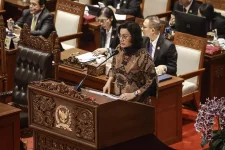
Finance Minister Sri Mulyani Indrawati delivers a speech before House of Representatives members at the national legislature complex in Jakarta, Tuesday, May 20, 2025. (Antara Photo/Dhemas Reviyanto)

Jakarta. Finance Minister Sri Mulyani Indrawati said Tuesday that nearly 1,000 civil servants at the Finance Ministry have been laid off as part of the government’s broader efforts to streamline spending and boost efficiency.


Speaking during a parliamentary hearing with the House Commission XI -- which oversees state finances and economic planning -- Sri Mulyani confirmed that the ministry had reduced its workforce by 1.26 percent, or 979 employees, despite an increasing workload related to state budget management.


“The number of Finance Ministry employees has dropped by almost 1,000, even though our responsibilities in managing the national budget have increased,” she said.


To offset the reduction in staff, the ministry has accelerated the adoption of digital systems across multiple functions, including travel administration, human resources, and budget operations.

“We're developing applications to support various administrative and operational needs,” Sri Mulyani added.


Read More:​

Sri Mulyani Warns of Major Shift in Global Trade Order Amid US Tariff Hikes


Despite the headcount reduction, Indonesia’s fiscal performance remained robust throughout 2024. The budget deficit stood at 2.29 percent of GDP -- narrower than the initial projection of 2.70 percent -- due to improved macroeconomic conditions in the second half of the year.


These improvements included a stabilizing rupiah, rising global prices for coal, nickel, and crude palm oil (CPO), all of which boosted state revenues. Government income rebounded from a 6.2 percent contraction in the first half to 2.1 percent growth in the second.


Inflation remained under control at 1.57 percent in 2024, while the economy maintained steady growth of around 5 percent. Investment rose by 4.6 percent, supported by sustained household purchasing power and government social assistance to cushion the impact of rising food prices.

“The state budget has effectively served as a shock absorber amid global economic turbulence,” Sri Mulyani said.


Indonesia Draws $58 Billion in H1 Investment, Fueled by Downstream Expansion​


Bambang Ismoyo

July 22, 2025 | 10:06 pm

View attachment 136611
This aerial photo shows the nickel smelter belonging to the state miner Antam as seen in Southeast Sulawesi on May 10, 2024. (Antara Photo/Andry Denisah)


Jakarta. Indonesia attracted approximately Rp 950 trillion ($58.4 billion) in investment during the first half of 2025, marking a year-on-year increase from Rp 829.9 trillion recorded in the same period last year, Investment Minister Rosan Roeslani announced on Tuesday.


The figure represents nearly 50 percent of Indonesia’s full-year investment target of Rp 1,905.6 trillion ($117 billion), signaling continued investor confidence in the country’s industrialization agenda.


According to Rosan, about 30 percent of first-half investment flowed into downstream mining projects. This surge reflects the government’s aggressive push to ban exports of raw nickel ore and copper concentrate, and to develop value-added industries within Indonesia.


“Investment in downstream sectors has risen significantly. From the Rp 950 trillion realized in the first half, around 30 percent went into downstream industries,” Rosan said during a press briefing in Jakarta.

To further support this policy direction, the government has established a task force to accelerate downstream industrialization and strengthen energy resilience. The downstream drive not only focuses on the mining sector but also targets agriculture and fisheries.


Priority commodities for downstream development include coal, nickel, copper, gold, and crude palm oil (CPO), all central to Indonesia’s broader strategy to boost exports with higher value-added output.


More detail

1. Naturally around half of the total investment comes from FDI
2. Investment in oil and gas, and also financial sector are not included in Indonesia investment figure

Indonesia's FDI at $55.3 bln in 2024​

By Reuters
January 31, 2025
9:21 AM GMT+7
Updated January 31, 2025


JAKARTA, Jan 31 (Reuters) - Indonesia's foreign direct investment last year was 900.2 trillion rupiah ($55.33 billion), up 21% on a yearly basis, the investment ministry said on Friday.

FDI in the fourth quarter was 245.8 trillion rupiah, a 33.3% increase from the same period a year earlier, versus the third quarter's growth of 18.6%. The data excludes investment in the financial and oil and gas sectors.


Sri Mulyani & DPR Agree on KEMPPKF 2026! Economy Set at 5.2-5.8%

Zahwa Madjid, CNBC Indonesia
22 July 2025 14:12


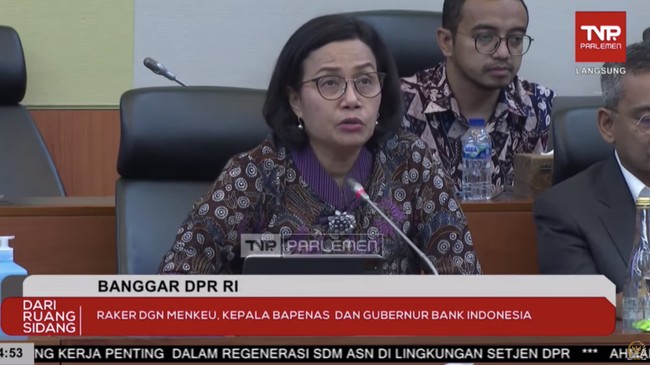
Jakarta, CNBC Indonesia – The Budget Committee (Banggar) of the House of Representatives (DPR) of the Republic of Indonesia and the government have agreed on the 2026 Macro Economic Framework and Main Fiscal Policy Points (KEMPPKF) on Tuesday (July 22, 2025).


The meeting was led by the Chair of the DPR Budget Committee, Said Abdullah. The government was represented by Minister of Finance Sri Mulyani Indrawati and Minister of National Development Planning/Head of Bappenas Rachmat Pambudy, along with their staff. Also present was Bank Indonesia Governor Perry Warjiyo.


“Ladies and gentlemen, regarding this current agreement which has been jointly decided, it will be presented in the Plenary Session on July 24 and will become the basis for the preparation of the 2026 Financial Note & State Budget Draft (RAPBN),” said Said after receiving approval from all meeting participants.


Sri Mulyani welcomed the agreement. Next, the government will prepare the Financial Note and the Draft State Budget Bill (RUU APBN) 2026, which will be directly presented by President Prabowo Subianto on August 15, 2025.


Details of the 2026 KEMPPKF


2026 Macroeconomic Assumptions


  • Economic Growth: 5.2-5.8%
  • Inflation: 1.5-3.4%
  • Exchange Rate: Rp16,500-16,900/US$
  • 10-Year Government Bond Interest Rate: 6.6-7.2%
  • Indonesian Crude Oil Price: US$60-80/barrel
  • Crude Oil Lifting: 605-620 thousand barrels per day
  • Natural Gas Lifting: 953-1,017 thousand barrels per day
  • Poverty Rate: 6.5-7.5%
  • Extreme Poverty: 0-0.5%
  • Gini Ratio: 0.377-0.380
  • Open Unemployment Rate: 4.44-4.96%
  • Human Capital Index: 0.57
  • Farmer Welfare Index: 0.7731
  • Proportion of Formal Job Creation: 37.95%

2026 Fiscal Posture


  • State Revenue: 11.71%-12.31%
  • Tax Revenue: 10.08-10.54%
  • Non-Tax State Revenue (PNBP): 1.63-1.76%
  • Grants: 0.002-0.003%
  • State Expenditure: 14.19-14.83%
  • Central Government Expenditure: 11.41-11.94%
  • Transfers to Regions: 2.78-2.89%
  • Primary Balance: (0.18)-(0.22)
  • Deficit: (2.48)-(2.53)
  • Financing: 2.48-2.53


Indonesia Targets 5.8% GDP Growth in 2026, Deficit Capped at 2.53%​


Akmalal Hamdhi

July 24, 2025 | 9:34 pm

1753408218649.webp
Finance Minister Sri Mulyani Indrawati, left, receives documents on the 2026 draft state budget from House Budget Committee Deputy Chair Jazilul Fawaid during a plenary session at the parliament building in Jakarta, Thursday, July 24, 2025. (Antara Photo/Dhemas Reviyanto)

Jakarta. Indonesia’s government and parliament have agreed on a 2026 economic growth target of between 5.2 and 5.8 percent, according to the preliminary 2026 draft state budget and national development plan endorsed in a plenary session on Thursday.


The macroeconomic assumptions include an inflation target of 1.5 to 3.5 percent and an exchange rate range of Rp 16,500 to Rp 16,900 per US dollar. The budget is designed to support Indonesia’s efforts to strengthen food and energy sovereignty while promoting economic resilience and long-term prosperity.


“These policies aim to build a resilient, self-reliant, and prosperous Indonesia, particularly in terms of food and energy security,” said House Budget Committee Deputy Chair Jazilul Fawaid.

The government also projects Indonesia’s crude oil price to average between $60 and $80 per barrel, with daily production set at 605,000 to 620,000 barrels in 2026.


On the social development front, the plan targets a poverty rate of 6.5 to 7.5 percent, with extreme poverty reduced to between 0 and 0.5 percent. The open unemployment rate is expected to fall within the 4.44 to 4.96 percent range.


Under the proposed budget, state revenue is forecast to reach 11.71 to 12.31 percent of gross domestic product (GDP), while government spending is projected at 14.19 to 14.83 percent of GDP. This places the projected fiscal deficit at 2.48 to 2.53 percent of GDP.

Finance Minister Sri Mulyani Indrawati and National Development Planning Minister Rachmat Pambudy attended the session. The 2026 budget deliberations began in early July, and the final proposals will be officially presented by President Prabowo Subianto in his state address to parliament on August 15.


Indonesia Sees 13.6% Jump in Investment in H1, Mining Among Top Sectors​


July 29, 2025 |

1753859087589.webp
Investment Minister Rosan P. Roeslani (Beritasatu.com/Bambang Ismoyo)


Jakarta. Indonesia recorded Rp 942.9 trillion (approx. $57.38 billion) in total investment realization during the first half of 2025, with domestic investment surpassing foreign direct investment (FDI), according to the Investment Ministry.


Investment Minister Rosan Roeslani said domestic investment (PMDN) reached Rp 510.3 trillion, outpacing foreign investment (PMA), which stood at Rp 432.6 trillion. The combined figure represents a 13.6 percent increase compared to the same period last year.


"Investment realization for the first half reached Rp 942.9 trillion, up 13.6 percent. This aligns well with our projected plans," Rosan said at a press briefing in Jakarta on Tuesday.


For the second quarter alone (April–June), investment realization amounted to Rp 477.7 trillion. This brings the first-half achievement to 49.5 percent of the government's full-year investment target of Rp 1,905.6 trillion.

Investment outside Java amounted to Rp 476 trillion, slightly higher than Java’s Rp 466.9 trillion, reflecting continued momentum in regional development. The investments created around 1.25 million jobs during the first six months of the year, Rosan said.


"Job creation remains a key indicator. We’ve generated 1.25 million jobs in just six months," he added.

Mining Sector Among Top Investment Draws


Mining remains one of the top sectors attracting both domestic and foreign investors. The sector ranked third in investment realization with Rp 102.2 trillion in the first half of the year.


The metal processing industry led the rankings with Rp134.4 trillion, followed by the transport, warehousing, and telecommunications sector at Rp 110.7 trillion. Other leading sectors include miscellaneous services (Rp 85.7 trillion) and housing, industrial estates, and offices (Rp 75 trillion).


"Mining continues to be a strong contributor, followed by other services and property-related sectors," Rosan said.


Despite strong activity in extractive industries, Rosan reaffirmed Indonesia’s commitment to its energy transition and net-zero emission (NZE) goals. He highlighted the government's long-term power supply plan with state utility firm PLN, which targets the addition of 69.5 GW of generation capacity by 2034 --76 percent of which will come from renewable sources and storage systems.


This includes 42.6 GW from renewables such as solar, wind, and geothermal, 10.3 GW from storage, and 16.6 GW from fossil-based sources.


"We’re fully committed to achieving net zero emissions by 2060. Preparations for this transition are already underway," Rosan concluded.


Indonesia’s Q2 GDP Grows 5.12% on Strong Manufacturing, Trade, and Tourism​


Arnoldus Kristianus

August 5, 2025 | 11:58 am

1754402085485.webp

Jakarta. Indonesia’s economy expanded by 5.12 percent year-on-year in the second quarter of 2025, slightly accelerating from 5.05 percent in the same period last year, according to data released by the Central Statistics Agency (BPS) on Tuesday. Compared to the previous quarter, the economy grew 4.04 percent.


“Economic growth in Q2-2025 outpaced last year’s Q2 performance,” said Moh. Edy Mahmud, BPS Deputy for Economic Statistics, in a press briefing in Jakarta. “All business sectors grew positively on a year-on-year basis.”


In the second quarter, five key sectors contributed nearly two-thirds, or 63.59 percent, of Indonesia’s gross domestic product. Manufacturing remained the largest contributor with an 18.67 percent share, growing by 5.68 percent year-on-year. Agriculture accounted for 13.83 percent of GDP, growing by 13.53 percent, followed by trade at 13.02 percent, which expanded by 5.37 percent. Construction made up 9.48 percent of the economy, while the mining sector contributed 8.59 percent, growing modestly by 1.0 percent.


Growth in the manufacturing sector, the largest contributor, was driven by domestic and external demand. In particular, the food and beverage industry rose 6.15 percent, supported by rising exports of palm oil, cooking oil, and processed foods. The basic metals industry posted the highest growth within the sector at 14.91 percent, fueled by strong demand for iron and steel exports. Meanwhile, the chemicals and pharmaceuticals segment grew 9.39 percent as both domestic and overseas demand surged for pharmaceutical goods and chemical products.

The miscellaneous services sector saw the highest growth rate at 11.31 percent, thanks to a boost in domestic tourism during school holidays, national religious celebrations, and joint leave periods. This segment contributed 2.15 percent to overall GDP.


The information and communications sector, contributing 4.38 percent to GDP, expanded by 7.92 percent, boosted by rising data traffic and electronic transactions by businesses and households.


The construction sector grew 4.98 percent, in line with rising construction activity funded by both private investors and households. BPS noted higher imports of construction materials and increased cement procurement as supporting factors.


Trade, which accounts for 13.02 percent of GDP, grew 5.37 percent due to rising domestic and imported goods to meet household consumption. “Increased production activities in other sectors have also fueled trade,” Edy said.


Analysts Warn of Lingering Risks


Despite the strong Q2 performance, some economists had forecast more modest growth. Yusuf Rendy Manilet, an economist at the Center of Reform on Economics (CORE) Indonesia, had projected growth of 4.7 percent, citing external and domestic challenges.


“External pressures such as the US's 19 percent tariff policy and ongoing geopolitical tensions continue to weigh on our economy,” he said. “At the same time, weak household purchasing power and delayed government spending have hindered stronger growth.”


Many households, he added, have been forced to dip into savings to cover basic needs.

 
Several economic related ministers, including Finance Minister, Investment Minister, Planning Minister etc do press conference and talking about Indonesia Q2 2025 economic growth

To view this content we will need your consent to set third party cookies.
For more detailed information, see our cookies page.
 
Indonesian Bonds Predicted to Lead Asia as the Fed Lowers Interest Rates

Dwi Nicken Tari - Bisnis.com
Kamis, 7 Agustus 2025 | 13:43

1754553036250.webp

Bisnis.com, JAKARTA — Indonesian bond assets are expected to benefit the most in Asia amid expectations of interest rate cuts by the US Federal Reserve (The Fed).


Monetary easing in the US will generally benefit emerging market assets, but rupiah-denominated bonds are projected to deliver the best performance, as they currently offer the highest yields in Asia. The yield on 10-year Indonesian government securities (SBN) is now declining toward 6.5%.


As a central bank that prioritizes exchange rate stability, Bank Indonesia also has the room to capitalize on the weakening US dollar to further ease monetary policy without triggering a depreciation of the rupiah.


GAMA Asset Management Portfolio Manager Rajeev De Mello stated that local currency-denominated bonds in Asia, particularly Indonesia, are in a very advantageous position under a scenario of a weakening US dollar.


“Indonesia is a significant allocation in our position for local currency-denominated emerging market bonds,” said De Mello, as quoted by Bloomberg, Thursday (August 7, 2025).


A weakening greenback is expected to bolster the rupiah and further reduce Indonesian bond yields. This is occurring as the movement of the US dollar–rupiah exchange rate has become increasingly parallel with Indonesia’s 10-year bond yields, with their 30-day correlation now at its highest since July 2024.


According to Bloomberg data, the yield on Indonesia’s 10-year bonds fell by nine basis points on Monday (August 4, 2025), marking the largest decline among emerging Asian markets. This drop followed a decline in US bond yields of the same tenor on Friday (August 1, 2025), after weaker-than-expected US jobs data increased the likelihood of a Fed rate cut next month.


Rupiah bonds have also become more sensitive to increases in US Treasury yields because the yield spread has narrowed. The yield spread between Indonesian and US 10-year bonds currently stands at around 220 basis points, about 1.1 standard deviations below the five-year average.


“A rally in rupiah bonds could occur, but it requires US Treasuries as the trigger,” noted strategists from Goldman Sachs Group Inc., including Danny Suwanapruti and Xinquan Chen.


Although expectations of a wider fiscal deficit remain a pressure point for Indonesian bonds, hopes for Bank Indonesia (BI) rate cuts could help offset some concerns.


The rupiah’s strengthening in August, after its biggest monthly drop since February, also paves the way for BI to lower interest rates in the future. Bank Indonesia Governor Perry Warjiyo reaffirmed last week that the central bank still sees room for further rate cuts, after having already reduced the benchmark rate by a total of 75 basis points so far this year.


De Mello believes that the Fed’s monetary easing cycle will also give BI more flexibility to follow suit. “We expect there will be at least two more BI rate cuts of 25 basis points each before the end of the year,” he said.

 
Rupiah Strengthens Ahead of Indonesia’s Independence Day, U.S. Dollar Exchange Rate Drops to IDR 16,100


By Elvan Widyatama,
CNBC Indonesia
14 August 2025 15:10

Jakarta, CNBC Indonesia – The rupiah closed stronger against the U.S. dollar in Thursday’s (August 14, 2025) trading.


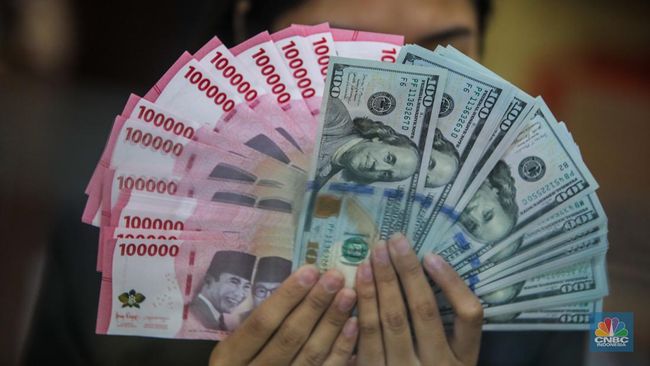
According to Refinitiv data, the rupiah strengthened significantly by 0.56% to IDR 16,100 per US$. Intraday, it even touched IDR 16,080 per US$ at the opening before easing slightly by the close. This marks the rupiah’s strongest level since January 1, 2025.


Meanwhile, the U.S. dollar index (DXY) was seen slightly weakening by 0.02% to 97.86 at 3:00 PM WIB.


The rupiah’s appreciation today reinforces its current upward trend against the U.S. dollar. This movement aligns with increasing market expectations that the Federal Reserve (The Fed) will cut its benchmark interest rate in September.


Based on the CME FedWatch Tool, the probability of a 25-basis-point cut that month has risen to 95.8%. Optimism grew after July’s U.S. inflation data came in lower than expected, accompanied by signs of weakness in the U.S. labor market.


Several economists project the rupiah’s strengthening trend could continue for the rest of the year, supported by both global sentiment and solid domestic factors.


Ahmad Mikail, Senior Economist at Sucor Sekuritas, said the rupiah could strengthen further to IDR 15,500–15,800 per US$ this year, based on the projection that the Fed will cut rates by up to 150 basis points in 2025. He noted that some Wall Street players even expect an aggressive 50-basis-point cut in September.


“If U.S. interest rates drop sharply, our export surplus funds parked overseas will return to Indonesia,” he told CNBC Indonesia.


Similarly, Rully Wisnubroto, Economist at Mirae Asset Sekuritas Indonesia, said global factors are the main drivers of the rupiah’s current gains. He highlighted the market’s 100% conviction that the Fed will cut the Fed Funds Rate in September, either by 25 or 50 basis points.


“For year-end, we predict the rupiah will be around IDR 16,150 per US$,” Rully said.


Breaking! JCI Sets Record, Just Steps Away from 8,000


By fsd

14 August 2025 12:40


Jakarta, CNBC Indonesia – The Jakarta Composite Index (JCI) soared in the first trading session on Thursday (August 14, 2025), marking a new all-time intraday high.


The JCI jumped 0.93% or 73.07 points to 7,965.98, setting the highest intraday trading record. During the session, it briefly touched 7,973.98. Blue-chip stocks and shares owned by major conglomerates remained the main drivers of today’s index movement.


For reference, the highest closing record for the JCI was 7,905.39 on September 19, 2024, while the previous intraday record was also on that date at 7,910.56.


A total of 336 stocks gained, 263 declined, and 198 remained unchanged. Trading activity was relatively brisk, with IDR 10.14 trillion in transactions involving 23.39 billion shares across 1.22 million trades. Nearly all sectors strengthened, led by technology, energy, and utilities, while the financial and property sectors saw declines.


DCI Indonesia (DCII), which had previously weighed on the index after a suspension and its placement on the special monitoring board, was the top contributor today, adding 32.96 index points after surging 10% to IDR 336,675 per share. This was followed by Sinar Mas Group’s coal mining company DSSA, which rose 5.02% to IDR 92,975, contributing 17.15 points.


State-owned telecom giant Telkom Indonesia (TLKM) gained 5.66% to IDR 3,360, contributing 20.51 points. Other major movers included Prajogo Pangestu’s BREN and BRPT, Salim Group’s ICBP and AMMN, as well as EMTK (technology & media), KLBF (pharmaceuticals), and UNVR (consumer goods).


The JCI’s rally has been fueled by renewed foreign capital inflows. Yesterday, foreign investors posted a net buy of IDR 1.52 trillion in the regular market. This week, foreign inflows have resumed after a period of continuous net selling.


In the broader region, Asia-Pacific markets traded mixed on Thursday amid expectations that the U.S. Federal Reserve will cut interest rates next month. Investors were also awaiting the release of Australia’s labor market data.


Japan’s Nikkei 225 fell 0.31% from its record close the previous session, while the broader Topix index dropped 0.64% as of 8:05 a.m. Singapore time. South Korea’s Kospi gained 0.39% and the Kosdaq was flat. Australia’s S&P/ASX 200 rose 0.49%.


Domestically, ahead of Indonesia’s 80th Independence Day celebrations, sentiment remains upbeat. The JCI is now just shy of its all-time high, supported by strong foreign inflows. The index ended yesterday at 7,892.11, up 1.30% in a four-day rally, edging closer to its record closing high from September 19, 2024, at 7,905.39.


Indonesia Aims for 5.4 Pct Growth Next Year, No Deficit by 2028​


Jayanty Nada Shofa
August 15, 2025 | 5:29 pm

1755263997981.webp
President Prabowo Subianto hands over the 2026 budget document to House Speaker Puan Maharani at the parliamentary complex in JAkarta on Aug. 15, 2025. (Antara Photo/Dhemas Reviyanto)


Jakarta. President Prabowo Subianto has officially set the 2026 annual economic growth target at 5.4 percent, higher by 0.2 percentage points than what the country had aimed for this year.


The Indonesian leader also unveiled an ambitious plan of shrinking deficit down to zero within three years. Prabowo had just delivered the 2026 annual budget speech on Friday, the first of its kind since he rose to power last October. This much-awaited speech gave the public an overview of the economic targets that the country had set for the coming year.


“With sound fiscal management, coupled with effective economic transformation and improved public welfare, we are aiming for an economic growth of 5.4 percent or higher in 2026,” Prabowo said at the parliamentary complex in Jakarta.


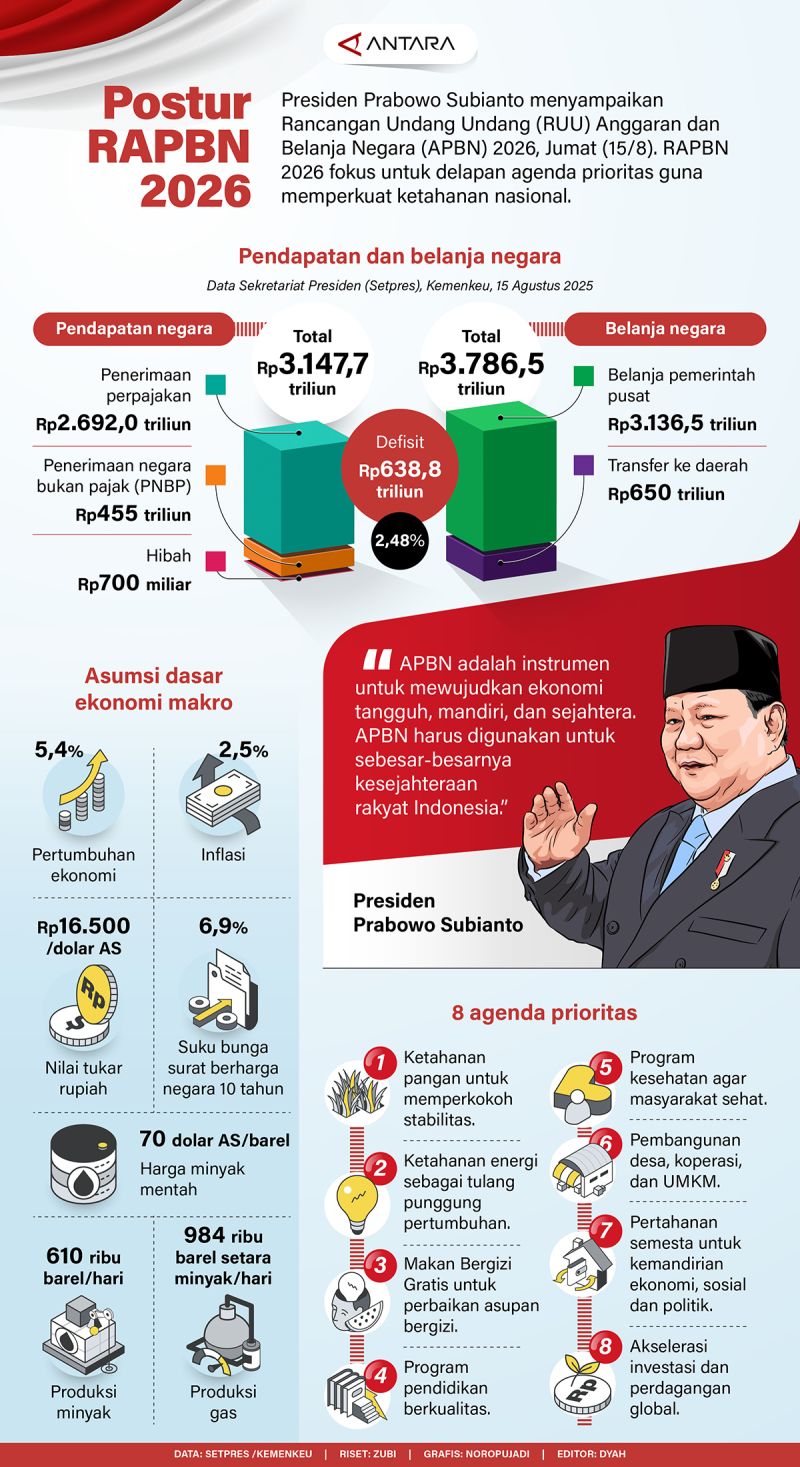
Southeast Asia’s largest economy intends to keep its inflation rate at 2.5 percent. Rupiah trading is expected to average at around Rp 16,500 per US dollar throughout 2026.

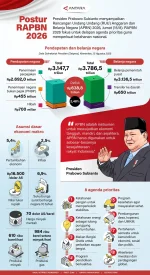
The government plans to spend no more than Rp 3,786.5 trillion (around $234 billion) next year. It aims to amass Rp 3,147.7 trillion in state revenue throughout 2026, up by 9.8 percent from 2025 figures.


Prabowo wants to keep the deficit at 2.48 percent of the gross domestic product (GDP), equivalent to around Rp 638.8 trillion. This is lower than the 2025 fiscal deficit forecasts of 2.78 percent. To keep deficits at a minimum, Prabowo will continue his budget austerity measures, further instructing ministries and government agencies to keep cutting non-essential spendings, including business trips. The retired army general is even upbeat about being able to balance the state budget by 2028.


“My dream is that I shall stand at this podium -- perhaps in 2027 and 2028 -- to announce that we have succeeded in achieving no deficit,” Prabowo said.


Prabowo’s 2026 State Budget Pours Trillions Into Energy, Food, and Education​


5–6 minutes


To view this content we will need your consent to set third party cookies.
For more detailed information, see our cookies page.

President Prabowo Subianto delivers his first state address at the parliamentary complex in Jakarta on August 15, 2025. (B Universe Photo/Joanito de Saojao)


Jakarta. President Prabowo Subianto on Friday laid out a 2026 state budget blueprint that aims to shrink the fiscal deficit, ramp up spending on energy security and food resilience, and accelerate the country’s transition to renewable power, while committing hundreds of trillions of rupiah to a nationwide free nutritious meals program.

Presenting the 2026 annual budget speech before the parliament, Prabowo said government spending in 2026 is projected at Rp 3,786.5 trillion ($234 billion), with revenues expected at Rp 3,147.7 trillion. This leaves a planned deficit of Rp 638.8 trillion, or 2.48 percent of GDP. To keep deficits at a minimum, Prabowo will continue his budget austerity measures, further instructing ministries and government agencies to keep cutting non-essential spending, including business trips. The retired army general is even upbeat about being able to balance the state budget by 2028.

“My dream is that I shall stand at this podium -- perhaps in 2027 and 2028 -- to announce that we have succeeded in achieving no deficit,” Prabowo said.


Energy Spending and Production Targets

The 2026 plan allocates Rp 402.4 trillion for energy security, nearly double this year’s Rp 203.1 trillion, largely to fund energy subsidies. Prabowo stressed subsidies must be “fair and targeted” and not enjoyed by those who can afford to pay market rates.

Indonesia’s oil output target is set at 610,000 barrels of oil per day, up from 605,000 this year, as part of a broader push to strengthen energy sovereignty. The government will also boost natural gas production and expand renewable energy capacity, aiming for 100 percent renewable-based electricity within 10 years, far ahead of the nation’s formal 2060 net-zero commitment.

“We will accelerate our clean energy transition,” Prabowo said, citing solar, hydro, and geothermal power as key sources. Indonesia’s installed renewable capacity reached 15.2 GW, or 14.5 percent of national generation, as of mid-2025.

Nationwide Free Nutritious Meals Program

The 2026 budget dedicates a massive Rp 335 trillion to Prabowo’s flagship free nutritious meals program (MBG), which aims to combat stunting and improve human capital. The program will target 82.9 million beneficiaries, including pregnant women, toddlers, and schoolchildren, and will require the construction of nutrition service facilities across the archipelago.

Prabowo argued the initiative will boost not only public health but also local economies by supporting farmers, fishermen, and small businesses. “This is not merely a social program; it’s a foundation for a healthy, smart, and productive generation,” he said, claiming Indonesia has achieved in seven months what other countries, such as Brazil, took over a decade to accomplish.

Education and Human Capital

The education budget will total Rp 757.8 trillion in 2026, with Rp 401 trillion flowing directly to students and teachers. This includes Rp 17.2 trillion for college scholarships under the KIP Kuliah program, Rp 15.6 trillion for the Indonesia Smart Program, Rp 15 trillion in LPDP postgraduate scholarships, and the Rp 335 trillion MBG program. Another Rp 150.1 trillion will fund school and university construction, while Rp 178.7 trillion will go toward teacher and lecturer salaries.

Food Security Investments

Finance Minister Sri Mulyani Indrawati said Rp 164.4 trillion has been earmarked for food security, covering production, distribution, and consumption.

On the production side, Rp 114.1 trillion will fund fertilizer subsidies for 9.62 million tons, development of 550,000 hectares of farmland, irrigation for 104,000 hectares, and fishing and aquaculture facilities. Distribution spending includes Rp 29.9 trillion for farm roads, fishery port infrastructure, and national food reserves, while Rp 6.4 trillion will go to consumer subsidies, cheap food programs, and price stabilization.

Parliament will now deliberate on the proposal ahead of its expected passage later this year.

Tags:


Bank Indonesia front-loads easing amid growth concerns​


Bank Indonesia (BI) delivered a surprise second consecutive rate cut, signalling a clear focus on growth despite recent strong data. With inflation still below target and US Federal Reserve easing expected from September, we now see BI front-loading its final 25bp cut to the fourth quarter of this year

1755741363044.webp
Jakarta, Indonesia


20 August 2025

1755741558890.png

BI cuts policy rate again to support growth​


Bank Indonesia has lowered its policy rate by 25 basis points to 5.00%, marking a second consecutive surprise cut. While we had expected BI to hold off on further easing until the fourth quarter – given the recent strength in GDP and CPI data, as well as weak transmission to lending rates – the move signals BI’s increasing concern over the growth outlook.

The decision also suggests that BI is taking advantage of periods of Indonesian rupiah (IDR) strength to ease policy without risking currency instability. Despite headline inflation ticking higher, it remains well below BI’s upper target of 3.5%, giving the central bank room to act pre-emptively to support domestic demand.


Second quarter GDP surge likely to reverse in the second half of 2025​


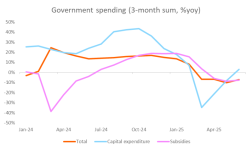
The stronger-than-expected GDP growth in Q2 was largely driven by a sharp pickup in investment, which rose 7% year-on-year compared to just 2.1% in Q1. This momentum appears to have been fueled by a significant jump in government capital expenditure, which surged 18% YoY in June 2025. However, we believe this pace is unlikely to be sustained. The revised 2025 budget projects a 3% decline in government capex for the full year.

Combined with subdued consumer spending and a projected slowdown in exports in the second half, we expect GDP growth to moderate, in line with our full-year forecast of 4.8% YoY.


Government capital spending surge appears to be a one-off​

1755741425711.png

Food-driven CPI spike likely temporary, but 2H CPI range to be higher​


BI appeared largely unconcerned by the rise in headline CPI inflation to 2.4% YoY in July, indicating that it does not view the increase as a threat to longer-term inflation expectations. While we’re also not concerned by the July print, we expect inflation to stay above 2% in the second half of 2025 – up from 1.2% in the first half – due to reflecting seasonal trends and the fading of favourable base effects.

That said, this level of inflation remains comfortably below BI’s upper target of 3.5%, and is unlikely to derail further rate cuts.


IDR stability will need continued foreign inflows as current account weakens​


Although there were signs of export frontloading and a modest rebound in Q2, Indonesia’s overall trade balance deteriorated compared to Q1. This points to a likely widening of the current account deficit – not just in Q2, but also through the second half of the year – as global demand softens and terms of trade become less favourable for commodity exporters like Indonesia.

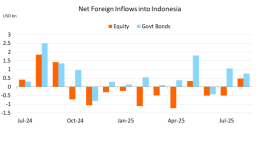
However, BI’s commitment to currency stability and foreign inflows in both government bonds and equity markets has helped IDR stabilise in a narrow range since June.


Foreign inflows recovered in July​

1755741476907.png

BI likely to continue easing amid weak domestic backdrop​


Given the soft domestic growth outlook and our expectation that the Fed will begin cutting rates from September 2025, we believe Bank Indonesia is not yet done with its easing cycle. While the timing of the next move remains uncertain, BI may opt to front-load further rate cuts to address growth concerns, especially amid ongoing weakness in global trade and domestic consumption.

Reflecting this view, we are revising our forecast and now expect BI’s final 25bp rate cut to be brought forward from the first quarter of 2026 to the fourth quarter of 2025.


Users who are viewing this thread

Pakistan Defence Latest

Back
Top