Indonesia state owned enterprise super-holding will be started with asset at 1 trillion USD (2024)

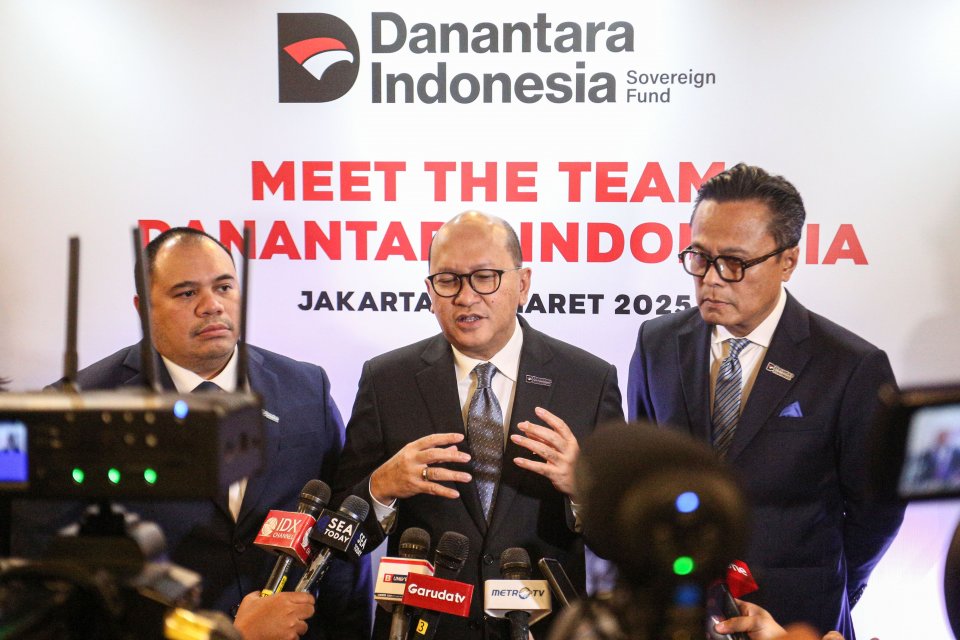
Danantara CEO Rosan Targets 2025 SOE Dividends to Reach IDR 140 Trillion (~USD 8.75 Billion)


Newswire, Anggara Pernando
20 October 2025

1760951501897.jpeg

Bisnis.com, JAKARTA — Chief Executive Officer (CEO) of Danantara, Rosan Roeslani, is optimistic that dividends from state-owned enterprises (SOEs) in 2025 will reach around IDR 140 trillion (~USD 8.75 billion).


“Our dividends this year, although received gradually, are estimated to reach around IDR 140 trillion (~USD 8.75 billion),” said Rosan, quoted from Antara on Monday (October 20, 2025).


According to Bisnis records, Minister of Finance Purbaya noted that Danantara collected approximately IDR 90 trillion (~USD 5.63 billion) in dividends in 2024. The large sum came mainly from seven major SOEs — including those in banking, telecommunications, and mining — which are also publicly listed companies.


Rosan stated that Danantara currently manages assets worth USD 1 trillion (or around IDR 16 quadrillion), making it the fifth-largest sovereign wealth fund (SWF) in the world.


“This is just the beginning. We know these assets come from the transformation of SOEs that were previously owned by the Ministry of Finance but managed by the Ministry of SOEs. Now, both ownership and management fall under Danantara,” he explained.


Five-Year Investment Target


In the next five years, Rosan aims for Danantara to raise and invest up to USD 40 billion (≈ IDR 640 trillion).


“That’s without using leverage — entirely from equity capital. If I use leverage four or five times, I could have about USD 250 billion (≈ IDR 4 quadrillion) available for investment,” he said.


To strengthen its investment capacity, Danantara is also forming co-investment funds with several global sovereign wealth funds. Partnerships have already been established with the Qatar Investment Authority (QIA) and China Investment Corporation (CIC), with similar collaborations being explored with the United Arab Emirates and Saudi Arabia’s Public Investment Fund (PIF).


SOE Restructuring Agenda


In addition to investment management, Rosan highlighted the major SOE restructuring agenda. He noted that the current number of approximately 1,000 SOE entities will be consolidated into about 200 entities.


Ending Manipulative Financial Reporting


At the same event, Rosan reaffirmed Danantara’s commitment to ensuring transparency and accountability in SOE financial governance.


“Under Danantara and my leadership, no SOE will engage in ‘beautifying’ their financial reports or showing large profits but then needing to borrow money just to pay dividends,” he said.


According to Rosan, the practice of beautifying — and even manipulating — financial reports was common in the past.


“‘Beautifying the books,’ as in putting ‘makeup’ on the financial statements to make them look better, sometimes even reaching the level of fraud by reporting false data — that’s what we will correct,” he stated.


He emphasized that Danantara would audit and correct several SOE financial reports deemed inaccurate or misleading.


“Next year, I will correct several financial reports from SOEs — including large ones — because their reporting is inconsistent or false,” he stressed.


Governance Reform Through New Policy


As part of this governance reform, Danantara has issued Circular Letter No. S-063/DI-BP/VII/2025, regarding the policy on granting bonuses, incentives, and/or other income for SOE directors and commissioners as well as subsidiaries.


The policy emphasizes that incentives must be based on actual company performance, as reflected in accurate financial statements — not on manipulated accounting results.


Rosan explained that this step ensures every incentive, whether short-term or long-term, reflects real contributions to business sustainability and good governance.


Note: All USD equivalents are calculated using an exchange rate of IDR 16,000 = USD 1 for clarity and illustration.


Telkom Signs $2 Billion Spin-Off Deal to Sharpen Focus on Fiber Infrastructure​


Thresa Sandra Desfika

October 21, 2025 | 10:04 am

To view this content we will need your consent to set third party cookies.
For more detailed information, see our cookies page.


Jakarta. Telkom Indonesia (TLKM) has signed a conditional spin-off agreement with its subsidiary Telkom Infrastruktur Indonesia (TIF) as part of a corporate restructuring and business transformation plan aimed at sharpening its focus on wholesale fiber connectivity.


The agreement, signed on October 20, carries a transaction value of Rp 35.78 trillion ($2.16 billion). The spin-off will involve the transfer of a portion of Telkom’s wholesale fiber connectivity assets and operations to TIF.

Telkom said the transaction is designed to streamline its business, boost efficiency, and optimize the use of its extensive fiber-optic network. The move is also expected to reinforce the company’s position as Indonesia’s leading connectivity infrastructure provider.

“This transaction supports the national agenda to accelerate digital equity, expand fixed broadband penetration, and ensure reliable and high-quality connectivity across the country,” the company said in a disclosure to the Indonesia Stock Exchange on Tuesday.


Following the transaction, Telkom’s ownership in TIF will stand at 99.9999997 percent. The company emphasized that, given TIF’s status as a consolidated subsidiary, the spin-off will not have a material impact on Telkom’s financial position.


Pertamina’s Oil and Gas Production Reaches 1.04 Million Barrels per Day

By Heri Purnomo

To view this content we will need your consent to set third party cookies.
For more detailed information, see our cookies page.


Jakarta —
PT Pertamina Hulu Energi (PHE) recorded total oil and gas production of 1.04 million barrels of oil equivalent per day (MMBOEPD) as of August 2025. This consists of 556,000 barrels of oil per day (MBOPD) and 2.8 billion standard cubic feet of gas per day (BSCFD).


According to Hermansyah Y. Nasroen, Corporate Secretary of Pertamina’s Subholding Upstream, the achievement was supported by massive upstream activities, as reflected in various key operational indicators. Subholding Upstream reported 580 exploitation wells drilled, 836 workover wells, and 25,514 well-service activities completed.


“Subholding Upstream Pertamina not only maintains the stability of national oil and gas production but also carries out expansion, innovation, and transformation toward more sustainable operations to support national energy security,”
— Hermansyah Y. Nasroen, Corporate Secretary of Subholding Upstream Pertamina

The Subholding Upstream also continues to strengthen reserves by acquiring new energy resources through 3D seismic surveys covering 652 square kilometers and 15 exploration wells drilled.


As a result, Subholding Upstream gained additional contingent resources (2C) with a validated 2C realization of 804 million barrels of oil equivalent (MMBOE) and added 105 million barrels of proven reserves (P1).


Hermansyah emphasized that these results stemmed from portfolio optimization, drilling acceleration, and technology implementation to improve the recovery factor of existing fields.


“Through these strategies, PHE reinforces its role as the backbone of national energy security and a key contributor to Indonesia’s energy transition,”
he said.


Strategic Projects Boosting Production


Hermansyah noted that national oil and gas production and reserves will grow stronger with the completion of several strategic projects, including:


  • Development of the Akasia Bagus Gathering Station (SP ABG) EP,
  • The Sisi Nubi Project,
  • The CEOR (EOR with chemical methods) Minas Field Area A Stage-1 Project, and
  • The OO-OX Field Project under PHE ONWJ.

“We are committed to maintaining sustainable production growth while ensuring that safety and environmental aspects remain top priorities,”
Hermansyah affirmed.


Exploration and Governance Initiatives


PHE continues to evaluate new venture opportunities and sharpen potential exploration initiatives through several ongoing joint studies and new venture projects, projected to expand its exploration portfolio.


The company will also continue investing in upstream operations and business management aligned with Environmental, Social, and Governance (ESG) principles. PHE maintains a Zero Tolerance on Bribery stance by preventing fraud and ensuring a clean, transparent corporate environment.


“One of our key efforts is the implementation of the Anti-Bribery Management System (SMAP) certified under ISO 37001:2016,”
said Hermansyah.


KPK Warns Expat BUMN Leaders Still Bound by Indonesia’s Anti-Graft Rules​


Yustinus Paat

October 16, 2025 | 8:46 pm


1761051555732.webp
KPK spokesperson Budi Prasetyo (right) delivers a statement at the KPK's Merah Putih Building in Jakarta, Monday, June 23, 2025. (ANTARA/Rio Feisal)


Jakarta. The Corruption Eradication Commission (KPK) said on Thursday that foreign nationals appointed to lead state-owned enterprises (SOEs) are still required to submit wealth reports and remain under its jurisdiction if implicated in corruption cases.


The statement came after President Prabowo Subianto announced that his administration had revised regulations to allow expatriates to serve in top management roles at state enterprises.


KPK spokesman Budi Prasetyo said that even if a state firm is led by a foreign citizen, the individual must comply with Indonesia’s rules for public officials, including the mandatory filing of a State Officials’ Wealth Report (LHKPN).


“Every state official has an obligation to declare their assets and wealth through the LHKPN system,” Budi said at the KPK headquarters in South Jakarta. “If a foreign national is appointed to such a position, they must also comply with this requirement.”


Budi said the anticorruption watchdog retains full authority to investigate corruption allegations involving state-owned enterprises, regardless of the nationality of those involved.


“If there is suspected fraud or corruption in a state-owned enterprise, the KPK can still investigate it,” he said. “State firms manage state funds, and their officials, whether local or foreign, are considered public administrators under the law.”


President Prabowo announced the policy during a discussion with Steve Forbes, Chairman and Editor-in-Chief of Forbes Media, at the St. Regis Hotel in Jakarta on Wednesday. “I have changed the regulation, now expatriates, non-Indonesians, can lead our state-owned enterprises,” Prabowo said.

To view this content we will need your consent to set third party cookies.
For more detailed information, see our cookies page.

St. Regis Tower, Jakarta


He added that the move was part of a broader effort to professionalize SOE management and raise competitiveness to international standards. “You can recruit the best minds, the best talents,” Prabowo told the management of BPI Danantara, a state investment holding company.


Prabowo Ally Glenny Kairupan Appointed as Garuda Indonesia CEO

The policy shift was reflected in recent appointments at Garuda Indonesia, the national flag carrier, where two foreign nationals were named directors during an extraordinary general shareholders’ meeting on Wednesday.


The new directors include Neil Raymond Nills, Director of Transformation, and Balagopal Kunduvara, Director of Finance and Risk Management.


Pandu Sjahrir, Chief Investment Officer at BPI Danantara, said the appointments were intended to strengthen Garuda’s corporate governance and align its management with global aviation standards. “You’ve seen that many major airlines, such as Emirates, have foreign nationals in their top leadership,” Pandu said during a public forum on Thursday.


Indonesia’s Antam Gold Sells Out Amid Rush to Hedge Against Rising Prices​


Martin Bagya Kertiyasa

October 22, 2025 | 6:38 pm

1761190759962.webp
An employee displays gold bars at Aneka Tambang (Antam)'s Setiabudi One Gold Store in Jakarta, Wednesday, October 15, 2025. (Antara Photo/Reno Esnir)


Jakarta. A sharp rise in gold prices has triggered a buying frenzy in Indonesia, leading to a shortage of gold bars produced by state-owned miner Aneka Tambang (Antam).


The current gold rush underscores Indonesians’ continued reliance on physical gold as a safe-haven asset amid global market uncertainty, inflationary pressures, and a weakening rupiah.


According to Antam’s official website Logam Mulia, a gram of gold is priced at Rp 2.31 million ($139) on Wednesday, but all sizes of gold bars were marked “currently unavailable.”


Ibrahim Assuaibi, Director of Laba Forexindo Berjangka, said that Antam’s gold supply has run dry at several official outlets, including Antam galleries and Pegadaian branches, as speculators move to hoard bullion.

1761190897936.webp
A trader displays a gold brooch at a jewelry shop in Banda Aceh, Aceh Province, on Monday, October 13, 2025. (Antara Photo/Irwansyah Putra)


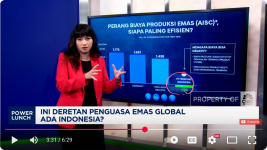
PT Freeport Indonesia whose ownership in majority is own by Danantara has the lowest operating cost where its gold reserve is among top ten biggest in the world and it also has the second highest copper reserve in the world.

The operating cost can be even minus because the mine has several minerals like chopper, gold, and silvers. Gold (and likely silver as well) is the side effect of mining chopper in PT Freeport Indonesia.

1761191936378.png
To view this content we will need your consent to set third party cookies.
For more detailed information, see our cookies page.


PT Freeport Indonesia smelter in East Java

To view this content we will need your consent to set third party cookies.
For more detailed information, see our cookies page.
 
Danantara Adds a New C-Level Structure, Appoints a Chief Technology Officer

By Ira Guslina Sufa
(3–4 minutes)


To view this content we will need your consent to set third party cookies.
For more detailed information, see our cookies page.

Pandu Sjahrir, Danantara CIO


The Indonesia Investment Authority (BPI) Danantara has undergone a structural change at the executive (C-Level) level with the creation of a new position — Chief Technology Officer (CTO).

With this addition, Danantara now has four top executives, led by Chief Executive Officer (CEO) and Head of BPI Danantara Rosan P. Roeslani.


According to information obtained by Katadata, President Prabowo Subianto has approved this new C-Level structure with the addition of the CTO position. “It’s only a matter of time before the announcement is made,” said a source familiar with the process to Katadata earlier this week.


The source said that the CTO position will be filled by Sigit Puji Santosa, who currently serves as President Director of PT Pindad.
As Danantara’s Head of Technology, Sigit brings extensive experience in the technology sector and is a first-class honors graduate of the Faculty of Mechanical and Aerospace Engineering, Bandung Institute of Technology (ITB).


Before serving as President Director of Pindad, Sigit was Director of Technology and Development. Under his leadership, Pindad launched more than 40 defense equipment (alutsista) products, including several variants of the Maung vehicle, such as the Maung Garuda Limousine, which serves as the official vehicle of the President of Indonesia.


He also worked as Executive General Manager at General Motors Co. in the United States for three years, where he was involved in the development of electric vehicle (EV) products.


Sigit’s appointment brings a new dynamic to Danantara’s leadership team. With this new position, Danantara’s executive lineup now consists of:


  • CEO: Rosan Roeslani
  • COO: Dony Oskaria
  • CIO: Pandu Sjahrir
  • CTO: Sigit Puji Santosa

Along with the new CTO post, Sigit will be supported by three new Managing Directors (MDs):


  • Dwi Susanto – MD of Technology Advancement
  • Ardy Muawin – MD of Industrialization
  • Ricardo Irwan Rei – MD of Strategic Technology Initiatives

 
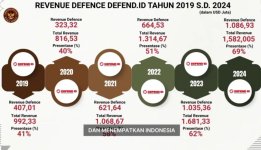
Defense ID revenues 2019 - 2024

Defense ID is a group of companies inside Danantara superholding that produce military equipments and products.

Defense ID has both military and civilian products

Revenue 2024 for defense related products in Defense ID has already been more than 1 billion USD.

It is around 70 % of total revenue from products sales that include civilian products as well. Total revenue last year at around 1.6 billion USD.


Note: There is different on the use of coma and point to show number in Indonesia, it is in reverse compared to English system


Defense ID revenues in million USD
1761539857541.jpeg
To view this content we will need your consent to set third party cookies.
For more detailed information, see our cookies page.

1761539971163.webp
 
Will R80 program get funded by Danantara ? The possibility in my opinion pretty high after 2030

To view this content we will need your consent to set third party cookies.
For more detailed information, see our cookies page.

To view this content we will need your consent to set third party cookies.
For more detailed information, see our cookies page.

Zackia Arfan, Metro TV jurnalist, interviewed Ilham Akbar Habibie


MetroTV: The Story Behind Habibie’s N250 and the Unfinished Dream of Indonesia’s National Aircraft


339,198 views | July 10, 2023

The N250 Gatotkaca aircraft, designed by the late B.J. Habibie, marked a groundbreaking moment for Indonesia’s aerospace ambitions during the era of President Soeharto. The aircraft successfully took to the skies for its maiden flight, symbolizing the country’s technological progress and engineering potential.

However, the Asian financial crisis of 1998 brought the program to an abrupt halt. One of the conditions in the agreement between the Indonesian government and the IMF required Jakarta to terminate the N250 project, citing budget constraints and the urgent need to prioritize economic recovery.

Despite this setback, Habibie remained undeterred. He launched a new design — the R80, a next-generation turboprop aircraft intended as an evolution of the N250, featuring modern avionics and improved efficiency. After his passing, the R80 program was continued by his eldest son, Ilham Akbar Habibie.

Unfortunately, the project faced another major setback when the R80 was removed from Indonesia’s National Strategic Projects list, effectively freezing its government-backed development.

As of today, the dream of seeing an Indonesian-built passenger aircraft soaring once again — a dream that began with Habibie’s vision — remains unfulfilled. Whether that dream will be revived in the future remains uncertain.
 
Will R80 program get funded by Danantara ? The possibility in my opinion pretty high after 2030

To view this content we will need your consent to set third party cookies.
For more detailed information, see our cookies page.

To view this content we will need your consent to set third party cookies.
For more detailed information, see our cookies page.

Zackia Arfan, Metro TV jurnalist, interviewed Ilham Akbar Habibie


MetroTV: The Story Behind Habibie’s N250 and the Unfinished Dream of Indonesia’s National Aircraft


339,198 views | July 10, 2023

The N250 Gatotkaca aircraft, designed by the late B.J. Habibie, marked a groundbreaking moment for Indonesia’s aerospace ambitions during the era of President Soeharto. The aircraft successfully took to the skies for its maiden flight, symbolizing the country’s technological progress and engineering potential.

However, the Asian financial crisis of 1998 brought the program to an abrupt halt. One of the conditions in the agreement between the Indonesian government and the IMF required Jakarta to terminate the N250 project, citing budget constraints and the urgent need to prioritize economic recovery.

Despite this setback, Habibie remained undeterred. He launched a new design — the R80, a next-generation turboprop aircraft intended as an evolution of the N250, featuring modern avionics and improved efficiency. After his passing, the R80 program was continued by his eldest son, Ilham Akbar Habibie.

Unfortunately, the project faced another major setback when the R80 was removed from Indonesia’s National Strategic Projects list, effectively freezing its government-backed development.

As of today, the dream of seeing an Indonesian-built passenger aircraft soaring once again — a dream that began with Habibie’s vision — remains unfulfilled. Whether that dream will be revived in the future remains uncertain.


ITB Supports Strengthening of Indonesia’s Aerospace Ecosystem Through the Formation of IAAI

To view this content we will need your consent to set third party cookies.
For more detailed information, see our cookies page.

To view this content we will need your consent to set third party cookies.
For more detailed information, see our cookies page.


The Indonesian Aeronautics and Astronautics Association (IAAI) was officially launched on Friday (October 17, 2025) at Wisma Habibie Ainun, Kuningan, South Jakarta. The launch marks a significant milestone in establishing a national collaborative platform for Indonesia’s aerospace sector, initiated by leading figures and academics from across the nation.


The IAAI aims to strengthen synergy among academia, industry, and research institutions in advancing aerospace science and technology. The organization is chaired by Ilham Habibie, with Prof. Dr. Ir. Tatacipta Dirgantara, M.T., Rector of the Bandung Institute of Technology (ITB), serving as Vice Chair, and Prof. Ir. Lavi Rizki Zuhal, Ph.D., ITB’s Vice Rector for Research and Innovation (WRRI), serving as Secretary.


The event brought together the association’s founders and new members who share a collective vision to advance Indonesia’s aerospace ecosystem. In addition to the formal inauguration, the gathering also featured discussions on IAAI’s strategic direction, the selection of an official logo, and the formulation of cross-sector collaboration agendas.


As its first international initiative, IAAI plans to participate in the 35th ICAS Congress to be held in Sydney, Australia.


“This participation is expected to strengthen Indonesia’s position in the global aerospace arena while opening new opportunities for international collaboration in aviation and space research and innovation,”
said Prof. Lavi.

The launch of IAAI represents a historic moment for Indonesia’s aerospace community. Through this platform, the country seeks to reaffirm its commitment to developing high-competitiveness aerospace science, technology, and industry on the global stage.
 
Who Owns Vale — the Nickel Giant in Sulawesi? Is It Really Brazilian?


By Muhammad Idris | 4–5 minutes | Kompas.com
30/10/2025


KOMPAS.com —
PT Vale Indonesia Tbk (INCO)
is one of the largest nickel mining companies in Indonesia. Along with Antam, it ranks among the top two nickel producers in the country.


Originally known as PT International Nickel Indonesia (PT Inco), the company still uses the stock code INCO on the Indonesia Stock Exchange (IDX).


The company was established in 1968, following the signing of a First Generation Contract of Work (CoW) between the Government of Indonesia and International Nickel Company of Canada (INCO Limited) — then one of the world’s biggest nickel producers.


Currently, Vale operates under an amended Contract of Work that was converted into a Special Mining Business Permit (IUPK) on May 13, 2024, valid until December 28, 2035.


Ownership of PT Vale Indonesia


According to the company’s official website, PT Vale Indonesia manages nickel mining concessions covering 118,017 hectares, distributed as follows:


  • South Sulawesi: 70,566 ha
  • Central Sulawesi: 22,699 ha
  • Southeast Sulawesi: 24,752 ha

Vale operates its largest smelting facility in Sorowako, East Luwu, South Sulawesi. The processing plant began operations in 1978, marking the start of nickel production in the form of nickel matte — an intermediate product containing about 78% nickel.


The company officially changed its name to PT Vale Indonesia Tbk in 2011, following the global rebranding of its parent company, Vale S.A., a mining giant based in Rio de Janeiro, Brazil, which operates in over 30 countries worldwide.


Vale S.A. controls Vale Indonesia through its subsidiary, Vale Canada Limited (VCL).


Divestment and Current Shareholders


Initially, VCL held the largest ownership stake in Vale Indonesia. However, due to divestment obligations under Indonesia’s Mining Law (IUPK Law), its shareholding was gradually reduced.


MIND ID (Mining Industry Indonesia), the state-owned mining holding company, originally held 20% of Vale Indonesia’s shares. In July 2024, MIND ID acquired an additional 14% stake, becoming the largest shareholder (though still under 50%).


The 14% stake was acquired for US$300 million (approximately IDR 4.69 trillion).
The purchase was made from Vale Canada Limited, which sold 10.4%, and Sumitomo Metal Mining, which sold 3.6%.


After the divestment process, the current ownership structure of PT Vale Indonesia is as follows:


  • MIND ID: 34%
  • Vale Canada Limited: 33.88%
  • Sumitomo Metal Mining Co. Ltd: 11.48%
  • Public shareholders: 20.64%


Operations and Export Markets


PT Vale Indonesia’s main business activities include mining and processing lateritic nickel ore into nickel matte, an intermediate product with a nickel content of around 78%.


The product is mainly exported to international markets, especially Japan and other countries with advanced downstream nickel-processing industries.


In addition to mining, PT Vale also operates three hydroelectric power plants (Larona, Balambano, and Karebbe) that supply electricity to its nickel processing facilities in Sorowako.


(All USD conversions calculated at IDR 16,000 = USD 1.)
 

BRI Reports Rp 41 Trillion Net Profit as MSME Lending Tops Rp 1,150 Trillion​


The Jakarta Globe

October 30, 2025 | 11:16 pm

To view this content we will need your consent to set third party cookies.
For more detailed information, see our cookies page.


Jakarta. Bank Rakyat Indonesia (BRI), Indonesia’s largest lender by assets, recorded a consolidated net profit of Rp 41.2 trillion ($2.5 billion) as of the third quarter of 2025, according to the bank’s financial statement released on Thursday.


The result marked a 9.1 percent decrease from Rp 45.36 trillion in the same period last year. Interest income rose modestly by 2.9 percent to Rp 110.99 trillion.


As of September, BRI’s total loans amounted to Rp 1,438.11 trillion, an increase of 6.26 percent year-on-year. Of that amount, about 80 percent or Rp 1,150.73 trillion was disbursed to micro, small, and medium enterprises (MSMEs) -- a segment that remains central to the bank’s lending portfolio. The lender’s total assets stood at Rp 2,123.45 trillion at the end of the quarter.

In a press statement, President Director Hery Gunardi elaborated on the use of government funds placed in state-owned banks, including BRI, to stimulate growth.


“Of the Rp200 trillion allocated to the banking sector through the Ministry of Finance, BRI received Rp 55 trillion,” Hery said. “We have distributed these funds to promote economic recovery – Rp 28.08 trillion for micro loans, Rp 11.07 trillion for corporate financing, Rp 10.13 trillion for commercial credit, and Rp 6.58 trillion for consumer lending.”


Supporting National Programs
Throughout 2025, BRI has actively supported government initiatives aimed at improving welfare and reducing poverty. Hery emphasized that BRI’s extensive 1.2 million BRILink agents across the country are helping strengthen local cooperatives and expand access to financial services.


“Through BRILink, we are ready to assist over 80,000 cooperatives nationwide,” he said.


BRI has also contributed to the ‘Three Million Homes’ program by extending Rp 15.07 trillion in housing finance to more than 110,000 low-income borrowers, ensuring broader access to affordable housing.


Read More:​

Government Injects Rp 55 Trillion to Strengthen BRI’s MSME Lending

In addition, the bank has played a key role in implementing social-aid programs. It disbursed Rp 2.25 trillion in wage subsidies to 3.7 million recipients across four phases to help maintain purchasing power amid economic challenges.


Hery added that BRI is also participating in the government’s free-nutrition program, providing banking access to over 3,800 community kitchens serving nutritious meals to schoolchildren and vulnerable groups.


“This reflects BRI’s continued commitment as an agent of development -- ensuring that our banking services support inclusive growth and community welfare,” Hery said.


Foreign Professionals Welcome in SOEs, Danantara Says​


Bambang Ismoyo

October 31, 2025 | 4:39 pm

1761967834052.webp
This undated photo shows Danantara Indonesia's office in Jakarta. (Photo Courtesy of Danantara Indonesia)


Jakarta. Sovereign wealth fund Danantara has defended the appointment of foreign nationals as directors in state-owned enterprises (SOEs), saying their inclusion is based on professional merit rather than political considerations.

Rohan Hafas, Managing Director for Stakeholder Management and Communication at Danantara, said on Friday that expatriates serving on SOE boards are selected for their proven expertise in their respective fields.

“Basically, they are professionals,” Rohan told reporters at Wisma Danantara in Jakarta. “As long as they are not state officials or policymakers, their presence is not an issue because they are not involved in political or national decision-making.”

He added that foreign professionals could serve as role models through their successful career experience and credibility in global business practices.


Indonesia: Financial Sector Assessment Program-Financial System Stability Assessment​

Publication Date:

August 8, 2024

Electronic Access:

Free Download. Use the free Adobe Acrobat Reader to view this PDF file

To view this content we will need your consent to set third party cookies.
For more detailed information, see our cookies page.

Business district where Danantara HQ located

Summary:


The financial system appears to be broadly resilient, has strong capital and liquidity buffers but remains relatively small and dominated by banks, especially few state-owned banks. Household and corporate indebtedness and public debt are low.

The macroprudential policy framework features both financial stability and development objectives. The recently passed Financial Sector Omnibus Law (FSOL) will make notable reforms to the financial sector.


Danantara Wants More Indonesian State Firms in Fortune Global 500​


Jayanty Nada Shofa
November 19, 2025 | 8:43 pm


To view this content we will need your consent to set third party cookies.
For more detailed information, see our cookies page.

Jambaran Tiung Biru Project, One of Pertamina gas production fields in East Java.


Jakarta. Sovereign wealth fund Danantara wants more Indonesian state firms to crack into the Fortune Global 500, a closely watched list comprising the world’s largest companies by revenue.


Every year, business magazine Fortune draws up a list of the world’s largest corporations by revenue, but so far, only two Indonesian state-owned enterprises (SOEs) managed to secure a spot, according to Danantara’s chief investment officer, Pandu Sjahrir. They are the utility firm PLN and oil producer Pertamina.


“We only wish for one thing. That is how we can make our SOEs improve, but become champions not just at the national level, but also regionally. We even hope they can thrive globally. We only have two companies in Fortune Global 500, but we believe there should be more,” Pandu told a business forum in Jakarta on Wednesday.


Pertamina ranks 171st in the 2025 Fortune Global 500 list. The energy giant -- whose subholdings also operate in marine logistics and refining -- is the third-largest company by revenue in Southeast Asia. Its revenue reached approximately $75.3 billion last fiscal year, according to Fortune.

PLN secured the 469th place at the 2025 Fortune Global 500, marking the first time for the company to join the list. Short for Perusahaan Listrik Negara, PLN is the only electricity provider in Indonesia, and boasted $34.4 billion in revenue in the previous fiscal year.


The fund is also setting this ambitious target amidst major overhauls of SOEs. Danantara is looking to slash the number of state businesses from the current 1,000 to just above 200, among others, by merging similar companies. As a case in point, Danantara is mulling consolidating the flag carrier Garuda Indonesia and Pertamina’s commercial airline subsidiary Pelita Air -- a plan that remains under review.


BP BUMN, the regulatory agency for Indonesian SOEs, also gave more details on the possible merger of the construction engineering firms. They would reportedly include Waskita Karya, Hutama Karya, and Wijaya Karya, among others.


“We are still evaluating the merger of construction firms, but it should be done in December,” BP BUMN’s deputy head Aminuddin Ma’ruf told reporters later that day.


Danantara is now in charge of all SOEs, many of which are offering similar services. Danantara’s senior official, Febriany Eddy, described the intense competition between SOEs as “cannibalism”. These companies would even go to great lengths to drop their prices as low as possible in public procurement tenders, regardless of the profit margin, to take out other SOEs and secure the project.


Users who are viewing this thread

Pakistan Defence Latest

Country Watch Latest

Latest Posts

Back
Top