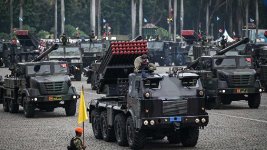
Indonesian Army/Marine/Police Paramilitary

To view this content we will need your consent to set third party cookies.
For more detailed information, see our cookies page.


Indonesia is now want to have four elite force with total of 160,000 troops. Elite qualification, elite equipment.

Previously only Kostrad (regarded as elite troops with modern hardware like Leopard tank, commando and airborne capability) that is lead by three star general with 40,000 troops. Now Kopassus, Kopasgat, and Marine will be lead by three star general and possibly will be enlarged into 40,000 troops each. At the mean time Kopassus and Marine for instant lead by two star General with 8000 troops each.

To view this content we will need your consent to set third party cookies.
For more detailed information, see our cookies page.

Kostad troops

News source will be followed
 
Under new Prabowo policy, Indonesia is poised to have 160,000 Special Force elite troops.

Larger Defense Budget is set and put to enlarge Indonesian Armed Force both in quality and huge special force quantity

Kostrad : already lead with three star General = current force is 40,000 troops with modern equipment like leopard tanks, commando and airborne capability

Kopassus : Will be lead by three star General and most possible enlarged from current 8000 troops into 40,000

Kopasgat: Will be lead by three star General

Marine Force: Will be lead by three star

To view this content we will need your consent to set third party cookies.
For more detailed information, see our cookies page.
 
Elite Troops Led by Three-Star General, TNI Urged to Be More Responsive to Threats


August 8, 2025, 14:50 WIB


1754745385927.jpeg
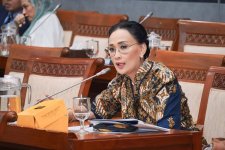
Member of Commission I of the Indonesian House of Representatives (DPR RI) from the Nasdem Party, Amelia Anggraini, during a working meeting with Commission I’s counterparts. (Documentation of DPR RI Public Relations)


JAKARTA – Member of Commission I of the Indonesian House of Representatives (DPR) from the Nasdem Party, Amelia Anggraini, stated that the promotion of the leaders of three elite TNI forces — Kopassus, the Marine Corps, and Kopasgat — should be understood as part of changes in the global security landscape.


Amelia called on the TNI to be more strategic and responsive in addressing future threats.


“The promotion in the three main TNI commands — Kopassus, the Marine Corps, and Kopasgat — should be seen in the context of changes in the global security landscape. This step is part of the TNI’s organizational validation to be strategic and responsive to both current and potential threats,” Amelia said on Friday (August 8, 2025).


She assessed that awarding the three-star general rank to the corps leaders was an effort to strengthen synergy among land, sea, and air forces within a more effective joint operations framework. It is also aimed at improving readiness for modern warfare, such as hybrid warfare and other asymmetric threats.


“Commission I of the DPR, as an oversight partner, is observing several key aspects, including the potential increase in defense budget efficiency and accountability, continuity of doctrine and command structure, interoperability among branches, human resources readiness, and balanced modernization of defense equipment alongside structural expansion,” she said.


Amelia emphasized that the TNI’s organizational validation should not stop at administrative or symbolic aspects. She urged the TNI to become an adaptive, professional force with strong deterrence capability.


“In the midst of increasingly complex geopolitical dynamics, including potential escalation in the Indo-Pacific region, the South China Sea, and conflicts in the Middle East and Eastern Europe, Indonesia needs to strategically strengthen its defense posture,” she said.


“Commission I supports the strengthening of the TNI but will maintain its oversight function to ensure that every defense policy is in line with good governance principles and supports the TNI’s main mission of safeguarding the integrity and sovereignty of the Republic of Indonesia,” she added.


It is known that the three elite forces of the Indonesian National Armed Forces (TNI) — the Army’s Special Forces Command (Kopassus), the Navy’s Marine Corps, and the Air Force’s Rapid Reaction Force Command (Kopasgat) — will soon undergo major changes in leadership structure.


For the first time, these elite combat units from all three branches will be led by high-ranking officers holding the rank of three-star general (lieutenant general, lieutenant general [Marines], and air marshal).


This change is regulated under Presidential Regulation No. 84 of 2025 on the Organizational Structure of the TNI, signed on August 5, 2025.


The title “Commander,” which has traditionally been attached to the top leadership of these units, will be changed to “Panglima” (Commander-in-Chief).


Thus, the positions will become Panglima Komando Pasukan Khusus (Pangkopassus), Panglima Korps Marinir (Pangkormar), and Panglima Komando Pasukan Gerak Cepat (Pangkorpasgat).


This change symbolizes the strengthening of the organization and the elevated status of these three forces within the TNI command structure.


Not only elite troops are enlarged significantly, territorial defense troops (KODAM/Military Regional Command) are also added.

Source will follow

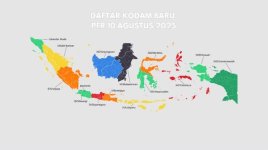
List of New Military Regional Commands (Kodam) Established on August 10, 2025, Along with Their Command Areas

Published: Friday, August 8, 2025, 23:14 WIB


1754749766009.jpeg


Quoted from Kompas.com, the Indonesian Army (TNI AD) is currently discussing plans to add 22 new Military Regional Commands (Kodam), increasing the total from the current 15.


Army Chief of Staff General Maruli Simanjuntak explained that this move aims to create a balance of forces in every province.


According to him, the proposal is in line with the times and the dynamics of regional governance.


----------------

Example of Kodam

Video of Cavaleri Batalion of Kodam II Sriwijaya

To view this content we will need your consent to set third party cookies.
For more detailed information, see our cookies page.


Each Kodam also has one Raider batalion with 750-1000 troops. Raider is special force unit within Kodam

To view this content we will need your consent to set third party cookies.
For more detailed information, see our cookies page.
 
To view this content we will need your consent to set third party cookies.
For more detailed information, see our cookies page.


To view this content we will need your consent to set third party cookies.
For more detailed information, see our cookies page.


To view this content we will need your consent to set third party cookies.
For more detailed information, see our cookies page.


To view this content we will need your consent to set third party cookies.
For more detailed information, see our cookies page.
 
Intelligent unit of Indonesian Police catch killers (working as debt collectors) who previously killed a bank manager due to personal debt problem

Central Java. The case get nationwide coverage after a week ago a body of a death man found. In here we have very few homicide crime, so founding a death body will always trigger nationwide media coverage

To view this content we will need your consent to set third party cookies.
For more detailed information, see our cookies page.


Mountain region in Papua, Indonesia

To view this content we will need your consent to set third party cookies.
For more detailed information, see our cookies page.


To view this content we will need your consent to set third party cookies.
For more detailed information, see our cookies page.


Indonesian Marine force

To view this content we will need your consent to set third party cookies.
For more detailed information, see our cookies page.


Marine attack OPM camp in Papua

To view this content we will need your consent to set third party cookies.
For more detailed information, see our cookies page.
 
To view this content we will need your consent to set third party cookies.
For more detailed information, see our cookies page.


To view this content we will need your consent to set third party cookies.
For more detailed information, see our cookies page.


-------------


To view this content we will need your consent to set third party cookies.
For more detailed information, see our cookies page.


To view this content we will need your consent to set third party cookies.
For more detailed information, see our cookies page.


Indonesia Special Operations Command - Komando Operasi Khusus TNI​

 
To view this content we will need your consent to set third party cookies.
For more detailed information, see our cookies page.


Wars and Conflicts Involving Indonesia​


  1. Indonesian National Revolution (1945–1949)
    • Combatants: Republic of Indonesia ✦ vs Netherlands, British, British Indian Army
    • Winner: Republic of Indonesia
    • Losers: Netherlands & allies (British/Indian forces withdrew by 1946)
    • Resolution: Transfer of sovereignty in 1949 after Round Table Conference.
  2. Darul Islam Rebellion (1949–1962)
    • Combatants: Republic of Indonesia ✦ vs Darul Islam insurgents
    • Winner: Indonesia
    • Loser: Darul Islam
    • Resolution: Military suppression.
  3. Invasion of Ambon (1950)
    • Combatants: Republic of Indonesia ✦ vs Republic of South Maluku (RMS)
    • Winner: Indonesia
    • Loser: RMS
    • Resolution: Military victory.
  4. PRRI / Permesta Rebellion (1958–1961)
    • Combatants: Republic of Indonesia ✦ vs PRRI/Permesta rebels
    • Winner: Indonesia
    • Loser: PRRI/Permesta
    • Resolution: Military campaign & reconciliation.
  5. Operation Trikora (1961–1962)
    • Combatants: Republic of Indonesia ✦ vs Netherlands (West New Guinea)
    • Winner: Indonesia (gained Papua)
    • Loser: Netherlands
    • Resolution: Dutch withdrawal under UN/US-brokered deal.
  6. Indonesia–Malaysia Confrontation (1963–1966)
    • Combatants: Indonesia (under Sukarno) ✦ vs Malaysia + Commonwealth (UK, Australia, New Zealand)
    • Outcome:
      • Malaysia preserved federation.
      • Indonesia ended conflict in 1966 after Suharto replaced Sukarno and shifted policy.
    • Resolution: Political settlement, not battlefield defeat.
  7. Indonesian Invasion of East Timor (1975–1976)
    • Combatants: Indonesia ✦ vs East Timorese independence forces (FRETILIN)
    • Winner: Indonesia (initially occupied territory)
    • Loser: FRETILIN
    • Resolution: Military occupation.
  8. Indonesian Occupation of East Timor (1976–1999)
    • Combatants: Indonesia ✦ vs East Timorese independence groups
    • Outcome: UN-supervised referendum (1999) → independence in 2002
    • Resolution: Political settlement
  9. Insurgency in Aceh (1976–2005)
    • Combatants: Indonesia ✦ vs GAM (Free Aceh Movement)
    • Outcome: Peace agreement (Helsinki, 2005)
    • Resolution: Aceh granted special autonomy.
  10. Papua Conflict (1962–present)

  • Combatants: Indonesia ✦ vs OPM (Free Papua Movement) & other separatists
  • Outcome: Ongoing conflict
  • Resolution: No final settlement yet.

  1. War on Terror / Anti-Terror Operations (1981–present)
To view this content we will need your consent to set third party cookies.
For more detailed information, see our cookies page.


  • Combatants: Indonesia (esp. Detachment 88 police unit) ✦ vs extremist groups (JI, MIT, ISIS-linked cells)
  • Outcome: Most terror networks dismantled; operations ongoing
  • Resolution: Continuous counter-terror campaign, not a conventional war.

 
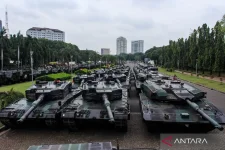
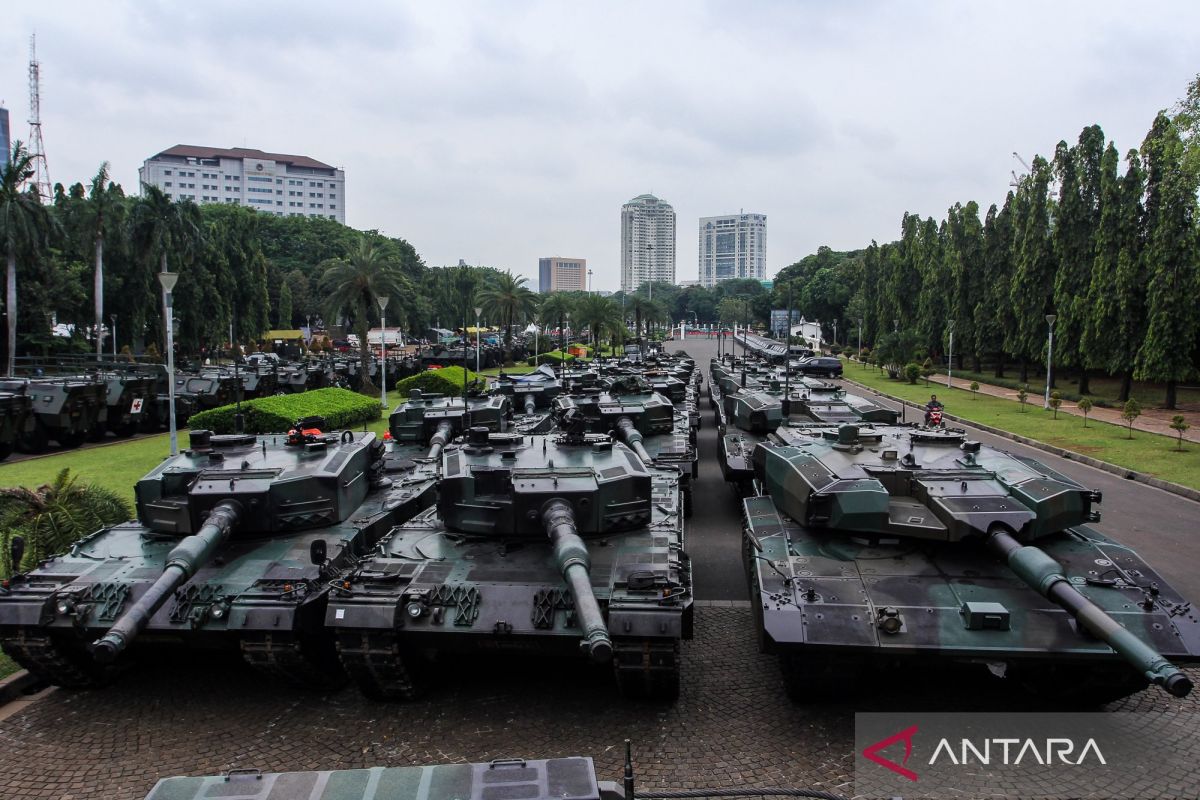
133, 000 troops are prepared for Armed Force Celebration Day, several days from now. It also will display 1000 military equipments.

It celebrates the day Indonesian Armed force is formed in 1945 to fight against Dutch and its allies (British and British Indian Armed Forces)

In August 1945 Indonesia announce its independence, and in October 1945 Indonesian Armed Force is formed.


To view this content we will need your consent to set third party cookies.
For more detailed information, see our cookies page.


TNI to hold final rehearsal for 80th anniversary in early October​

September 27, 2025 12:37 GMT+700

1759483283711.webp

1759557690728.jpeg
The Indonesian National Armed Forces (TNI) will deploy 133,000 personnel and 1,047 main weapon systems (alutsista). This will be the largest deployment for a TNI Anniversary celebration in recent years. In addition, President Prabowo Subianto is scheduled to personally lead the ceremony.

 
To view this content we will need your consent to set third party cookies.
For more detailed information, see our cookies page.


To view this content we will need your consent to set third party cookies.
For more detailed information, see our cookies page.


To view this content we will need your consent to set third party cookies.
For more detailed information, see our cookies page.


To view this content we will need your consent to set third party cookies.
For more detailed information, see our cookies page.


To view this content we will need your consent to set third party cookies.
For more detailed information, see our cookies page.
 
To view this content we will need your consent to set third party cookies.
For more detailed information, see our cookies page.


If not because of war of revolution, Indonesia is very likely not united and separated between many Sultanates (Kingdomship like Malaysia/Brunei) - as Indonesian Islands are actually controlled by Dutch with cooperation of many Sultanates - if it is handed peacefully like happening in many countries

The only Sultanate that still has power in Indonesia is only in Jogjakarta, and it still has power in Jogjakarta because it is the only Sultanate that sided with Revolution during War of Independence

Jogjakarta Province in Central Java is ruled by Sultanate. No local election there, Governor is picked within and by the Sultan families


=======================

Kings from Outside Java in the Java War

By Petrik Matanasi |
1760449236227.png
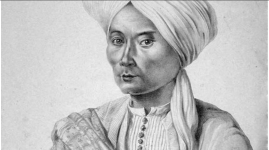
Prince Diponegoro


During the Dutch colonial period, making peace or cooperating with the rulers of the Dutch East Indies was not uncommon among local nobles or community leaders who chose not to oppose the colonial government. This cooperation took many forms, including becoming military allies in times of war. One notable example was the Java War (1825–1830), when the Dutch military sought reinforcements to confront Prince Diponegoro.


When the Java War broke out, the rulers of the four Mataram courts in Surakarta and Yogyakarta could not openly side with Diponegoro. The Dutch demanded that they provide troops to fight Diponegoro’s followers, and these requests had to be obeyed. The Pakualaman Legion from Yogyakarta and the Mangkunegaran Legion from Surakarta became part of the auxiliary troops (Hulptroepen) from Java — meaning, tragically, they fought against fellow Javanese.


When Dutch forces under Captain Roeps attacked Diponegoro’s followers led by Djojo-Mongolo (Joyo Menggolo) in the hills east of Yogyakarta, the Dutch army included the Mangkunegaran Legion and the Sumenep Regiment.


“Unarmed except for his kris, the brave Javanese sergeant Soerio-Dento climbed the giant tree by its roots, and others followed his example enthusiastically, though many tried in vain and fell down the steep slope,” wrote A.G. van Poelje in Nederlanders in Indië.

The Sumenep Regiment was an auxiliary force from Madura, forming part of the Madura Corps.


Beyond Java and Madura, there were also auxiliary troops from North Sulawesi and North Maluku. From Minahasa, the Resident of Manado, Daniel Francois Willem Pietermaat, persuaded tribal leaders to form the Tulungan Troops.


“They departed by sea for Java on March 29, 1829,” wrote Jessy Wenas in Sejarah dan Kebudayaan Minahasa (History and Culture of Minahasa).

The Tulungan Troops were commanded by Herman Dotulong, who held the rank of major, with several captains from major districts in Minahasa serving under him. One of them was Captain Benjamin Thomas Sigar, a prominent figure whose grave in Langowan was later visited by Prabowo Subianto before he became President of Indonesia.


The Tulungan Troops enjoyed great prestige. According to Het Nieuws van den Dag voor Nederlandsch-Indië (September 6, 1939), Diponegoro reportedly wished to surrender only to the Tulungan Troops. However, what actually happened was that Diponegoro was captured during a visit to General de Kock in Magelang.


From Gorontalo, which at that time was still part of the Manado Residency under Pietermaat, more auxiliary troops were sent. In the 19th century, local leaders in North Sulawesi and Maluku were generally persuaded to ally with the Dutch without direct conflict, leading these regions to be regarded as loyal partners of the colonial administration.


“The people of Gorontalo and Manado are very loyal to the Dutch. Among the nations of the Indonesian archipelago, they are far from the most uncivilized; they are open in nature and generally known for their fighting spirit,” wrote Hendrik Merkus de Kock and August Wilhelm Philip Weitzel in De Oorlog op Java van 1825 tot 1830.

The Gorontalo troops were led by Hassan Monwarfa, the eldest son of the King of Gorontalo.


From Southeast Sulawesi, the Dutch also received support from the Sultan of Buton, who sent his brother, Raja Hadji Suleiman, holding the rank of major, along with 700 men.


“(The Sultan of Buton) sent his brother, Raja Hadji Suleiman, ranked major, leading 700 of his people,” wrote de Kock and Weitzel.

They were transported by ship to Semarang, arriving on August 1, 1828, before being sent to the battlefield.


“The Butonese are dark brown-skinned, small in stature, and fierce-looking; they are said to be ambitious and, when insulted, bloodthirsty. They were sent to Bagelen, where, armed with spears, axes, or rifles, they performed excellently as light infantry,” noted de Kock and Weitzel.

The Sultan of Tidore also sent 285 troops, most of whom were Alfur (Alifuru) warriors from Maluku. They landed in Semarang on August 9, 1828, armed with bows, arrows, spears, swords, shields, and rifles. Many of them were known as skilled marksmen and fought bravely in close combat.


Tidore’s rival, the Sultan of Ternate, likewise dispatched 502 troops under Koelabath, Ahkim Senghadji, and Adipati Agung Ternate Sabtoe (ranked major). They arrived in Semarang on June 24, 1828, and also included Alfur warriors.


“They were strong and muscular men who wore no clothing except a bark loincloth and a cloth on their heads. They were assigned to the 2nd column under Captain Ten Have and stood out particularly as light infantry. Though fierce in appearance, they were kind-hearted, easily adapted to military discipline, and proved themselves in battle,” recorded de Kock and Weitzel.

These auxiliary troops, who fought alongside Dutch forces under General de Kock, were paid by the colonial government. Their pay varied by rank and the number of men they commanded.


According to de Kock and Weitzel:


  • The Major of Buton received 500 guilders, while the Ternate and Tidore commanders were paid 300 guilders.
  • Captains commanding around 100 men, whether from Buton or Ternate–Tidore, earned 115 guilders.
  • Lieutenants leading 20–40 men received 20–40 guilders.
  • Assistant lieutenants earned 8 guilders.
  • Ordinary riflemen received 5–6 guilders, while spear bearers earned only 2 guilders.

 
Latest, 14 rebel death

To view this content we will need your consent to set third party cookies.
For more detailed information, see our cookies page.


To view this content we will need your consent to set third party cookies.
For more detailed information, see our cookies page.


------------

Previously reported

Police Paramilitary (Brimob) get ambushed by Papuan Rebel

To view this content we will need your consent to set third party cookies.
For more detailed information, see our cookies page.


Assault against rebel after rebel is reported burned health facility in remote Papua areas

To view this content we will need your consent to set third party cookies.
For more detailed information, see our cookies page.


Papuan Rebel burn school, Indonesian Armed Force/Police Paramilitary rush to the scene and kick them out

To view this content we will need your consent to set third party cookies.
For more detailed information, see our cookies page.
 
To view this content we will need your consent to set third party cookies.
For more detailed information, see our cookies page.


Visiting remote areas in Papua


--------------


To view this content we will need your consent to set third party cookies.
For more detailed information, see our cookies page.


Some clashes with Papuan rebel


---------------

To view this content we will need your consent to set third party cookies.
For more detailed information, see our cookies page.
 

Indonesian Army to Build 750 Combat Battalions by 2029​


Antara

November 2, 2025 | 6:49 pm

To view this content we will need your consent to set third party cookies.
For more detailed information, see our cookies page.


Jakarta. The Indonesian Army plans to establish 750 combat battalions across strategic and conflict-prone regions, including border areas, by 2029 as part of a broader effort to strengthen national defense.


“There are currently 105 territorial combat battalions. Next year, more battalions will be established using Army-owned land,” said Army Information Service Chief Colonel Donny Pramono, as quoted by Antara on Sunday.


Special forces personnel of the Indonesian National Armed Forces are preparing kamikaze/surveillance drones that use a fiber optic system as a "medium" between the drone and the controller to enable "unlimited" "communication" (according to the length of the cable) and resistance to jamming.

The rifle carried is a submachine gun of the Beretta PMX type in 9x19mm caliber, and this training/simulation is conducted at the Shooting Range of the 1st Airborne Brigade Command, Halim Perdanakusuma, East Jakarta, in front of President Prabowo and King Abdullah II.

To view this content we will need your consent to set third party cookies.
For more detailed information, see our cookies page.
 
Last edited:
Papua operation


TNI/Armed Force


To view this content we will need your consent to set third party cookies.
For more detailed information, see our cookies page.


Joint Force, TNI - Brimob/Police ParaMilitary

To view this content we will need your consent to set third party cookies.
For more detailed information, see our cookies page.


To view this content we will need your consent to set third party cookies.
For more detailed information, see our cookies page.


Social Interaction

To view this content we will need your consent to set third party cookies.
For more detailed information, see our cookies page.


To view this content we will need your consent to set third party cookies.
For more detailed information, see our cookies page.
 

Users who are viewing this thread

Latest Posts

Back
Top