Indonesian International Commercial Trade Thread

To view this content we will need your consent to set third party cookies.
For more detailed information, see our cookies page.


Chairman of Indonesian Airline Association

1. We need 50 more planes since Indonesia Airlines can operate planes like where they do before Covid period (During Covid period, Garuda Indonesia, especially, cut many of its leasing planes and dont follow their previous plan to buy 50 new planes)

2. Good for tourism industry and other industries associated to airline industry (like MRO, Airport, aircraft component industries)

To view this content we will need your consent to set third party cookies.
For more detailed information, see our cookies page.


Context

KPPU 'Unloads' Causes of Skyrocketing Prices of Domestic Airfare​

The high price of domestic flight tickets is a concern for the public and the attention of the government, including the KPPU. Suppressing various component costs is a step that needs to be done by the relevant authorities.

Mochamad Januar Rizki
26 September 2024

 
To view this content we will need your consent to set third party cookies.
For more detailed information, see our cookies page.


Lower U.S. tariffs hopefully can avoid potential layoffs in Indonesia's labor intensive industries​

 
As part of the deal, Garuda Indonesia is now preparing to finance the buying of 50 Boeing jets

Two financing scheme :

1. Internal Financing (with the backing of Danantara SOE Superholding)
2. Investors

To view this content we will need your consent to set third party cookies.
For more detailed information, see our cookies page.
 

Indonesia Sees 25% Surge in H1 Trade Surplus, Driven by Exports to US and India​


Heru Andriyanto

August 1, 2025 | 11:20 am

1754068130062.webp

Jakarta. Indonesia recorded a trade surplus of $19.48 billion in the first half of 2025, a 25 percent increase from the $15.58 billion posted during the same period last year, according to data released by the Central Statistics Agency (BPS) on Friday.


The country’s trade surplus has now continued for 66 consecutive months -- spanning the latter half of President Joko Widodo’s administration and into the first eight months of President Prabowo Subianto’s term.


Deputy Chief Statistician Pudji Ismartini said the strong performance was underpinned by a 7.70 percent year-on-year increase in exports, which totaled $135.41 billion in the first six months of 2025, up from $125.73 billion in the same period last year.


“The most notable increases in processed exports were seen in palm oil, base metals, agricultural products, semiconductors, and other electronic components,” Pudji said during a press conference in Jakarta.

Non-oil and gas exports rose by 8.96 percent to $128.39 billion, while oil and gas exports declined by 11.04 percent to $7.03 billion.


The United States, India, and the Philippines were Indonesia’s top three export destinations from January to June 2025, accounting for $9.92 billion, $6.64 billion, and $4.36 billion in exports, respectively.


On the import side, Indonesia saw a 5.25 percent year-on-year increase in the first half of the year, with total imports reaching $115.94 billion, up from $110.15 billion in H1 2024. The growth was driven primarily by purchases of capital goods.


China remained Indonesia’s largest source of imports, with goods worth $10.69 billion, followed by Australia at $2.39 billion and Brazil at $830 million.

For June alone, Indonesia posted a monthly trade surplus of $4.10 billion. Exports for the month rose 11.29 percent year-on-year to $23.44 billion, while imports increased by 4.28 percent to $19.33 billion, led by consumer and capital goods.


US Eyes Indonesian Semiconductor Ecosystem After Tariff Deal​


Jayanty Nada Shofa

August 16, 2025 | 11:15 am

1755340471048.webp
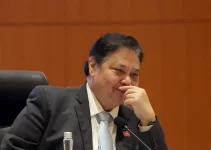
Chief Economic Affairs Minister Airlangga Hartarto speaks to reporters regarding the 2026 budget plan in Jakarta on August 15, 2025. (B Universe Photo/Joanito de Saojao)


Jakarta. The United States is looking to take part in developing Indonesia’s semiconductor ecosystem following a tariff deal meant to balance bilateral trade, according to senior minister Airlangga Hartarto.


Indonesia and the US not long ago reached a deal that saw Washington slashing its reciprocal tariffs from 32 percent to 19 percent, which officially kicked in on Aug. 7. The tariff cuts did not only give Indonesia some relief as they were the same as several other ASEAN counterparts, but had also brought good news for Jakarta’s dream for a homegrown semiconductor production, Airlangga told a presser on Friday evening.


“Now that we have clinched the deal, the US is interested in promoting the semiconductor [industry] in Indonesia. We [Indonesia] are currently working on the ecosystem,” Airlangga said in Jakarta.


The details of Washington backing the Indonesian semiconductor dream remain scarce. This includes whether the partnership is limited to human capital development or if there are plans for an American investor to set up a manufacturing plant.

But shortly before heading home, Airlangga told reporters that Indonesia had prepared some special economic zones (SEZs) across the country for semiconductor development. Any investor who puts their money in SEZs gains an array of incentives, including tax holiday and duty-free treatment. The minister revealed that the tariff deal could possibly revive some talks to the International Technology Security and Innovation (ITSI) Fund, created by the CHIPS Act of 2022.


“We have had talks about the ITSI Fund, but discussions [on this fund] stalled after [US President] Donald Trump returned to power. Now that we have reached a tariff deal, they [the US] want to pick up the discussion,” Airlangga said.


Indonesia comes with natural advantages of substantial reserves of minerals key in semiconductor production.


The US first unveiled its intentions of possibly backing Indonesian human capital development via the ITSI Fund last November. Trump’s predecessor Joe Biden was hosting President Prabowo Subianto who had jetted off to the US for a state visit.


The ITSI Fund provides the government $500 million ($100 million annually over five years, starting in 2023) to facilitate collaboration with US partners on enhancing the global semiconductor supply chain security. The US is also open to having collaborations involving American universities for this human capital development.


When Indonesia reached the deal in mid-July, US President Donald Trump couldn’t contain his excitement about Indonesian copper. This red metal is a mainstay ingredient in the production of advanced semiconductor chips.


According to a White House joint statement, Indonesia agreed to lift its export restrictions on critical minerals in exchange for the lower-than-promised 19 percent tariff. Airlangga had clarified that this did not mean Jakarta would lift its export ban on unprocessed ores. However, Indonesia would stick to its stance of only exporting processed minerals to spur its economy.


Investment Minister Rosan Roeslani also recently revealed that the US had agreed to drop the tariffs on Indonesian copper down to 0 percent.


Indonesia says US agrees tariff exemption for its palm oil, cocoa and rubber​


By Stefanno Sulaiman and Gibran Naiyyar Peshimam
August 26, 2025
11:32 AM UTC

  • US fuel storage investment in Indonesia discussed
  • Indonesia wants to attract investors into industrial parks
  • Focus on silica sand processing for solar panels, semiconductors

JAKARTA, Aug 26 (Reuters) - The United States has agreed in principle to exempt Indonesian exports of cocoa, palm oil and rubber from the 19% tariff imposed by President Donald Trump since August 7, Indonesia's top trade negotiator said on Tuesday.

The exemption will take effect once both sides reach a final agreement, but no timeline has been set because the U.S. is busy in tariff talks with other countries, Airlangga Hartarto, who is also the chief economic minister, told Reuters.

The two countries also discussed potential U.S. investment in fuel storage in Indonesia in partnership with the Southeast Asian nation's sovereign wealth fund Danantara and state energy firm Pertamina, Airlangga said in an interview.

"We are waiting for their response, but during the meeting, basically, the principal (exemption) has been agreed for products not produced in the U.S., such as palm oil and cocoa and rubber ... it will be zero or close to zero," he added.

The U.S. embassy in Jakarta did not immediately respond to a request for comment.

Indonesia is the world's biggest exporter of palm oil and a major rubber supplier.

CERTAINTY ON TARIFFS​

Indonesia, the region's largest economy, was among the first nations to strike a tariff deal with Trump in July, but Jakarta ended up facing the same rate as some other countries, such as Thailand and Malaysia, and just below Vietnam's figure of 20%.

During the talks, Indonesia offered billions of dollars worth of investment in the U.S. and purchases of American crude, LPG, planes and farm products. It also promised zero tariffs on almost all U.S. goods entering its market.

Airlangga said certainty over U.S. tariffs and recent progress in talks about a free trade agreement with the European Union could boost Indonesia's economic growth, helping the government reach a 5.4% target for 2026, up from an estimate of about 5% this year.

"They bring an optimistic perception from the global market since most investors are looking for certainty and Indonesia is one of the countries that provide global certainty," he said.

Jakarta wants to draw foreign investors to help develop industrial facilities, particularly in the processing of its key commodities, Airlangga said, replicating the success the country has seen in bringing Chinese investment into nickel projects.

Airlangga said the government is also keen to boost investment in silica sand processing, including the production of solar panels and wafers for semiconductors.


Indonesia Extends 63-Month Positive Streak with $4.17 Billion Surplus​


Jayanty Nada Shofa


September 1, 2025 | 1:55 pm


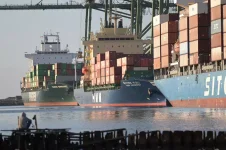
Unloading activities as seen in Tanjung Priok Port in Jakarta on August 26, 2025. (B Universe Photo/Joanito de Saojao)

Unloading activities as seen in Tanjung Priok Port in Jakarta on August 26, 2025. (B Universe Photo/Joanito de Saojao)


Jakarta. Indonesia announced Monday that it had extended its surplus streak for the 63rd month following a $4.17 billion positive trade balance in July.

According to the Central Statistics Agency (BPS), Indonesia’s non-oil and gas segment had recorded a $5.75 billion surplus that month. Energy importer Indonesia posted a $1.58 billion deficit in July’s non-oil and gas trade.

The statistics bureau reported that iron and steel, alongside crude palm oil and coal, continued to largely drive Indonesia’s exports. The resource-rich country has been enjoying surpluses since May 2020 and is now pursuing new trade agreements to boost shipments.


“Our overall trade surplus reached $23.65 billion between January and July, up by $7.40 billion from the same period in 2024,” Pudji Ismartini, a deputy at BPS, told a virtual press conference.

Trade with the United States remained the most advantageous as Indonesia’s overall surplus totaled $10.49 billion in the first seven months of 2025. The latest report did not take into account recent US tariff hikes on Indonesian goods. The US had only begun charging a 19 percent import tax on Indonesian goods starting August 7, but a 10 percent baseline tariff had already kicked in since early April.

“Electrical machinery and equipment were what had kept our trade balance with the US positive,” Pudji said as data showed such products made up $2.64 billion worth of surplus.

Indonesia is struggling to shrink its trade imbalance with China. The gap even widened from $6.91 billion (January-July 2024) to at least $12.07 billion the following year. In non-oil and gas commerce, the deficit with the Asian superpower totaled $13.21 billion as of July 2025.

BPS revealed that vehicles and autoparts had added about $2.71 billion to Jakarta’s non-oil and gas deficit with Beijing. Some Chinese brands have already shipped their cars in completely built-up forms -- in other words, their parts are already put together before shipment. According to local media reports quoting automotive association Gaikindo’s data, the local arm of the Shenzhen-based automaker BYD made up the lion’s share of Indonesia’s fully assembled car imports in July.

BPS’ latest announcement became a breath of fresh air amidst waves of protests striking Indonesia’s major cities, including Jakarta. These nationwide rallies centered on public dissatisfaction after lawmakers had their financial perks dramatically raised. The tragic death of an online motorcycle taxi driver by a police tactical vehicle later sparked further anger. Senior minister Airlangga Hartarto said that the Indonesian economy would remain robust despite the protests.


EU and Indonesia agree trade deal, FT reports​


Get ST's newsletters delivered to your inbox

PHOTO: AFP

Follow topic:​


Published Sep 17, 2025, 09:52 AM
Updated Sep 17, 2025, 09:52 AM


The European Union and Indonesia have finalised a trade agreement to be signed next week, the Financial Times reported on Sept 16, citing officials in Brussels and Jakarta.

EU Trade Commissioner Maros Sefcovic is set to visit Indonesia to sign it on Sept 23, said the report.

The EU Trade Office and Indonesia’s Ministry of Foreign Affairs did not immediately respond to requests for comments.

US President Donald Trump’s import tariffs on both accelerated the talks, according to the report.

Indonesia stated that the agreement will eliminate tariffs on 80 per cent of its exports within one to two years of implementation, the FT said.

In July, European Commission President Ursula von der Leyen said a political agreement had been reached to advance the EU-Indonesia free trade deal, known as the Comprehensive Economic Partnership Agreement. REUTERS


Trade deal with EU finalised after nine years​


Wednesday, 24 Sep 2025

THE European Union has finalised negotiations on a free trade agreement after more than nine year, reported German news agency dpa.

EU Trade Commissioner Maros Sefcovic and Airlangga Hartarto, Indonesia’s coordinating minister for Economic Affairs, signed a Comprehensive Economic Partnership Agreement (Cepa) and an Investment Protection Agreement in Bali.


This will result in customs duties on EU goods – including car parts and agricultural products – being almost entirely eliminated when imported into Indonesia.

“In today’s unpredictable global economy, trade relationships are not merely economic tools – they are strategic assets that signal trust, alignment and resilience,” Sefcovic said.

“Key EU sectors such as agri-food and advanced manufacturing will benefit from greater market access and predictability.”

“Likewise, by gradually removing Indonesia’s 50% car import tariff, the agreement creates fresh opportunities for EU automotive exports and electric vehicle investments,” Sefcovic continued.

“I am convinced that today’s conclusion of negotiations is just the beginning of an exciting new chapter.”

Airlangga spoke of an important milestone.

“We have made a commitment to double down on diversification and partnerships, to further support EU jobs and boost growth,” European Commission President Ursula von der Leyen said in a statement.

“Our deal with Indonesia creates new opportunities for businesses and farmers in a major and growing economy,” von der Leyen added.

“This also provides us with a stable and predictable supply of critical raw materials, essential for Europe’s clean tech and steel industry.”

The EU is looking to diversify its trade relations amid US President Donald Trump’s aggressive tariff policy and the threat to supply chains due to the conflicts in Ukraine and Gaza. — Bernama


Canada to Remove Tariffs on Over 90% of Indonesian Products under Landmark Trade Deal​


The Jakarta Globe

September 25, 2025 | 8:06 pm
1758876084030.webp
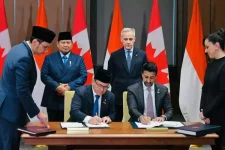
President Prabowo Subianto and Canadian Prime Minister Mark Carney witness the signing of the Indonesia-Canada Comprehensive Economic Partnership Agreement (CEPA) by Trade Minister Budi Santoso and Canadian Export Promotion and International Trade Maninder Sindhu at Parliament Hill in Ottawa, Canada, on Wednesday, Sept. 24, 2025. (Photo courtesy of the Presidential Press Bureau)


Jakarta. Canada has agreed to eliminate tariffs on more than 90 percent of Indonesian products under a landmark Comprehensive Economic Partnership Agreement (CEPA) signed on Wednesday in Ottawa.


Trade Minister Budi Santoso said the deal covers Indonesia’s key export products, including textiles, footwear, and processed foods. In return, Indonesia will remove tariffs on 85.54 percent of Canada’s priority exports, such as frozen beef, wheat, potatoes, seafood, and processed foods.


“This agreement opens broader market access and strengthens the competitiveness of Indonesian products and services in Canada,” Budi said in a statement Thursday.


Read More:
Indonesia Becomes First ASEAN Country to Strike Trade Pact with Canada


For Indonesia, the pact marks its first comprehensive trade agreement with a North American country. The tariff cuts will apply to 6,573 Indonesian product categories, including furniture, light electronics, and automotive goods.

Several Indonesian exports will immediately enjoy zero tariffs once the CEPA enters into force, among them processed foods, seafood, natural fiber handicrafts, household items, granite, and marble.


“This signing is only the beginning. Our next task is to ensure that this agreement delivers tangible benefits for our people, businesses, and investors,” Budi added.


Trade Snapshot
From January to July 2025, bilateral trade between Indonesia and Canada reached $2.72 billion, up nearly 30 percent from $2.09 billion in the same period last year. Despite the growth, Indonesia still ran a trade deficit, exporting $1.01 billion while importing $1.71 billion.


Indonesia’s main exports to Canada include natural rubber, footwear, cocoa, vegetable oils and fats, and textiles. Key imports from Canada are wheat, fertilizers, soybeans, chemical pulp, and gold.


Read More:​

Indonesia-EU Trade Deal Set to Boost Exports by 60% From 2027

The initial CEPA agreement was signed by Budi and Canadian counterpart Maninder Sindhu, witnessed by President Prabowo Subianto and Canadian Prime Minister Mark Carney in Ottawa.


The deal came just weeks after Indonesia concluded nearly a decade of CEPA negotiations with the European Union.


Indonesia Trade Surplus Largest in Near 3 Years​

Oct 1, 2025, 11:26 GMT+7


Indonesia’s trade surplus widened to USD 5.49 billion in August 2025, up from USD 3.23 billion in the same month a year earlier, and well above market forecasts of USD 3.99 billion.

It was the largest trade surplus since October 2022, as exports increased while imports declined.

Exports rose 5.78% year-on-year, easing from a 9.86% gain in July but exceeding market expectations of a 5% increase, despite the impact of new US tariffs.

Meanwhile, imports dropped 6.56% year-on-year, following a 5.86% decline in July.

This marked the second consecutive month of contraction and the steepest fall since May 2024, compared to market estimates of a 2% drop.

 
To view this content we will need your consent to set third party cookies.
For more detailed information, see our cookies page.


Indonesia's economic strategy is to 'date everybody': Ex-vice foreign minister​


Indonesia, South Korea Deepen Trade Ties to Boost MSME Exports Under IK-CEPA​


Martin Bagya Kertiyasa

October 24, 2025 | 11:34 am

1761289695337.webp
South Korea's Deputy Prime Minister Koo Yun Cheol meets with Deputy Trade Minister Dyah Roro Esti on the sidelines of an APEC forum, Thursday, Oct. 23, 2025. (Photo Courtesy of Dyah Roro Esti's Instagram @dyahroroestiwp)


Jakarta. Indonesia and South Korea are strengthening cooperation under the Indonesia–Korea Comprehensive Economic Partnership Agreement (IK-CEPA) to boost bilateral trade, investment, and MSME export capacity.


The agreement, which officially took effect on January 1, 2023, followed nearly eight years of negotiations since talks began in 2012 and was signed in 2020.


Deputy Trade Minister Dyah Roro Esti said on Friday that her meeting with South Korea’s Deputy Prime Minister Koo Yun Cheol in Jakarta focused on strategies to accelerate the utilization of IK-CEPA and support the ministry’s flagship export initiative, UMKM Bisa Ekspor (“MSMEs Can Export”).

“The IK-CEPA is not just a trade deal, it’s a comprehensive framework that strengthens collaboration in goods, services, investment, and human resource development,” Roro said.


The agreement also includes capacity-building programs in technology and innovation to improve competitiveness between both nations.


During the meeting, Roro presented Ijen coffee from East Java as a token of appreciation to Koo Yun Cheol, underscoring Indonesia’s readiness to expand its coffee exports.


“South Koreans love coffee, and this is our way of showing that Indonesian coffee meets international standards and is ready to go global,” she said.

 
Update

October Inflation : 2.86 % YoY, 0.28%Month on Month.

--------

1. September Trade Surplus : 4.34 billion USD

2. September export : raises at 11.41 % compared to previous year

3. September import : Increase at 7.17%

4. Trade Surplus for January-September 2025 : 33.5 billion USD
, which is an increase at 11.3 billion USD compared to Jan - September 2024 trade surplus

---------

My take on the latest data update

1. 2025 Jan- Desember trade surplus is expected at around 45 billion USD if we see the trend from Jan - Sept 2025

2. Inflation is low, thus give Indonesian Central Bank more room to lower interest rate

3. September import increases show economic improve much, both on domestic demand, export demand and overall industry expansion (include investment)

--------

Indonesia imports rise stronger-than-expected 7.17% y/y in September, data shows​

By Reuters
November 3, 2025
11:37 AM GMT+7

JAKARTA, Nov 3 (Reuters) - Indonesia recorded a trade surplus of $4.34 billion in September, official data showed on Monday, lower than the $4.79 billion forecast by economists in a Reuters poll, as both exports and imports came in above market expectations

Imports rose by 7.17% from a year earlier to $20.34 billion in September, beating economists' expectations of a 1% rise, and exports rose 11.41% to $24.68 billion in September, stronger than an expected 7.72% increase.


Prabowo, Trump to Sign Tariff Deal in Washington By End-January​


Jayanty Nada Shofa

December 23, 2025 | 10:13 am


To view this content we will need your consent to set third party cookies.
For more detailed information, see our cookies page.


Jakarta. President Prabowo Subianto will fly to Washington in January to finally ink the long-awaited reciprocal trade deal with his American counterpart Donald Trump, according to Indonesia’s chief negotiator.


Senior minister Airlangga Hartarto has just wrapped up his meeting with US Trade Representative Jamieson Greer in the latter’s office. Speaking at a virtual press conference on Tuesday morning Jakarta time, Airlangga said that the discussions, which primarily revolved around technical issues, had “gone well”. Their technical teams will meet again in mid-January to finalize the treaty text. Prabowo and Trump will sign the document by the end of the month.


“The US side is currently arranging a date to have the leaders meet for the signing. … This way, our countries can open up market access that will drive Indonesia's economic growth,” Airlangga told reporters.

The economic tsar signaled that Indonesia did not make further compromises beyond what was agreed on back in July.

Both governments at the time unveiled a framework agreement that saw Jakarta eliminating the import duties on 99% of US industrial and agrifood products, on top of scrapping non-tariff barriers and restrictions on its critical minerals. Trump also slashed the tariffs on Indonesian goods from 32% to 19% in return for the concessions.


Trump had already penned an executive order that exempted imported cocoa and coffee from the reciprocal tariffs back in November. Airlangga claimed that Washington had agreed to drop the tariffs on Indonesian palm oil based on the recent talks with Greer, a progress which should enable Jakarta to maintain its market dominance. Trump remains keen on Indonesian critical minerals, according to Airlangga.


He went on to say that the negotiations did not touch on political matters amid fears that Jakarta could end up trapped in a similar deal to that of its close neighbor Malaysia.


“The pact does not restrict Indonesian policies. It is a mutually beneficial commercial and strategic deal. … We didn’t discuss other things besides trade. This is purely an agreement on reciprocal trade,” Airlangga said.


He revealed that both sides had already reached a consensus on the content of the agreement.


"There should be nothing that can hinder the signing. ... If you ask me about what the dynamics were like over the past few days [of negotiations], it mainly revolved around the wording. This is nothing unusual in such negotiations."


Trump’s tariff wrath started with his concerns over the bilateral trade imbalance. The US reported that it had run a nearly $18 billion goods trade deficit with Indonesia in 2024.


Fellow ASEAN member and major palm oil supplier Malaysia already secured its US trade deal in late October, but the document has sparked concerns over Kuala Lumpur losing its economic sovereignty. The agreement obliges Malaysia to mirror US trade sanctions and not make a trade deal with a country that "jeopardizes essential US interests" — a move seen as Trump’s attempt to weaken Chinese influence in the region. The Indonesian government has denied reports that this poison pill clause has stalled the negotiations.


Users who are viewing this thread

Pakistan Defence Latest

Latest Posts

Back
Top