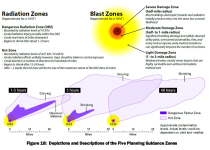
Zone 1, a 10 mile radius of the blast zone will result in 1,000+ rads/hr lasting 72 hours which means death in minutes due to unprotected exposure.
Incorrect! I already posted a [credible] source that refutes this. By 49 hours the DRZ is less than 1 mile! (For 10KT) And it’s not 1000+ rads! Where are you getting this information from?
Congress commissioned a study for the B61-11 titled "Effects of Nuclear Earth-Penetrator and other weapons" available to the public at the NRC website.
I don’t think you even read information to support your points
Conclusion 2. Nuclear earth-penetrator weapons (EPWs) with a depth of penetration of 3 meters capture most of the advantage associated with the coupling of ground shock. While additional depth of penetration increases ground-shock coupling, it also increases the uncertainty of EPW survival.
To hold at risk hard and deeply buried targets, the nuclear yield must be increased with increasing depth of the target. The calculated limit for holding hard and deeply buried targets at risk of destruction with high probability
using a nuclear EPW is approximately 200 meters for a 300 kiloton weapon and 300 meters for a 1 megaton weapon.
Continued….
Because the practical penetration depth for an EPW is a few meters—a small fraction of the depth for full containment—there will be blast, thermal, initial nuclear radiation, and fallout effects from use of an EPW.
National Academies of Sciences, Engineering, and Medicine. 2005. Effects of Nuclear Earth-Penetrator and Other Weapons. Washington, DC: The National Academies Press.
https://doi.org/10.17226/8873.
So again, beyond a few meters there is no guarantee the EPW survives. Even if it could somehow, it would need to be a very high yield weapon which to be frank, there is zero percent chance the U.S. will be detonating 300KT to 1 megaton nuclear weapons across Iran.
I’m all for theoretical debates, but these nuclear doomsday ones belong more in the realm of science fiction.
Fun fact:
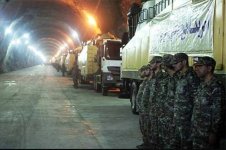
These missile bases are not small and have blast suppression tunnels carved throughout to prevent shockwaves from traveling deeper in as well as pressurized blast doors in the larger facilities along segments of faculty as redundancy to shockwaves or accidental detonation.