Navigation
Install the app
How to install the app on iOS
Follow along with the video below to see how to install our site as a web app on your home screen.
Note: This feature may not be available in some browsers.
More options
Style variation
You are using an out of date browser. It may not display this or other websites correctly.
You should upgrade or use an alternative browser.
You should upgrade or use an alternative browser.
Iran - Israel/US War: Israel-US declare war on Iran, Iran responds
- Thread starter Khorasan Black Flags
- Start date
More options
Who Replied?


BHAN85
Trusted Member

cyberattacks without real attacks it smells to false flags
very easy to change the origin of a cyberattack.


Professor Jiang
Registered Member


Watandar
Banned

I think China got what it wanted by supporting Russia and Iran economically and the exhausted US munitions stockpile makes China safe for the next 5-10 years. Notice the snarling at China by Americans has gone away.Americans are NOT stupid. They clearly don't take Chinese threat seriously, infact countries near China with virtually no economy don't take them seriously.
China first needs to retake that tiny little island before dreaming about going head to head with America. By the time that happens (if ever), US will have long recovered from its adventures in Middle East.
For the time being status quo continues, American defense contractors have never had it so good - billions upon billions of revenue rolling in daily. Their mainland is untouched. Its the poor folks that are suffering sadly.

clutch
Elite Member

cyberattacks without real attacks it smells to false flags
very easy to change the origin of a cyberattack.
The UAE and the Joos are going to have an interesting relationship where things will keep on blowing up for UAE thanks to the "Hamas" aka Mossad
observer2
Registered Member

UAE are experiencing the consequences of trusting yahudsThe UAE and the Joos are going to have an interesting relationship where things will keep on blowing up for UAE thanks to the "Hamas" aka Mossad

muhammed45
Elite Member
'Trump and US leaders'Well what evidence do you or the other guy have that Sharif, Munir, Erdogan, and MBS are in the Epstein list?
Please tell us where in that phrase you can see Munir, Erdogan or Sharif? Are you joking or something?

flyingorca
Trusted Member
Did you check and see which post I was responding to when you jumped in the conversation?'Trump and US leaders'
Please tell us where in that phrase you can see Munir, Erdogan or Sharif? Are you joking or something?

MS Sandhu
Registered Member
Just recently in may 2025, India went bonkers against Pakistan when its Fighter jets were shot right in its own skies.I don't think so. If an alliance of such nature would attack Irán, just a call from China and Pakistán will stop the coalition.
And Irán by definition never attacks first.
So US is desperated.
With every passing day, Indo-Pak theater is getting more and more serious.Pakistan with its weak economy can't sustain long war against India so obviously after May incident, Pakistan is seriously looking for alliances to get support in case India gets in war again.
In case, Iran or its proxies launch war against KSA or vice versa - Pakistan can extend its production facilities to support KSA war machinery and would expect similar things from Saudi Arabia also in case India gets cocky.
Turkey in equation further makes the things easier because of its extensive weapons industry.
It wouldn't be wise for Pakistan to wholly rely on Chinese for support against India.New Alliances make the things stable for Pakistan in long run.

Feroze
Trusted Member
News|US-Israel war on Iran
Listen (8 mins)
Save
Click here to share on social media
Share
Add Al Jazeera on Google

28:05
What are the challenges facing the Mecca agreement? | Inside Story

By Maziar Motamedi
Published On 9 Aug 20269 Aug 2026
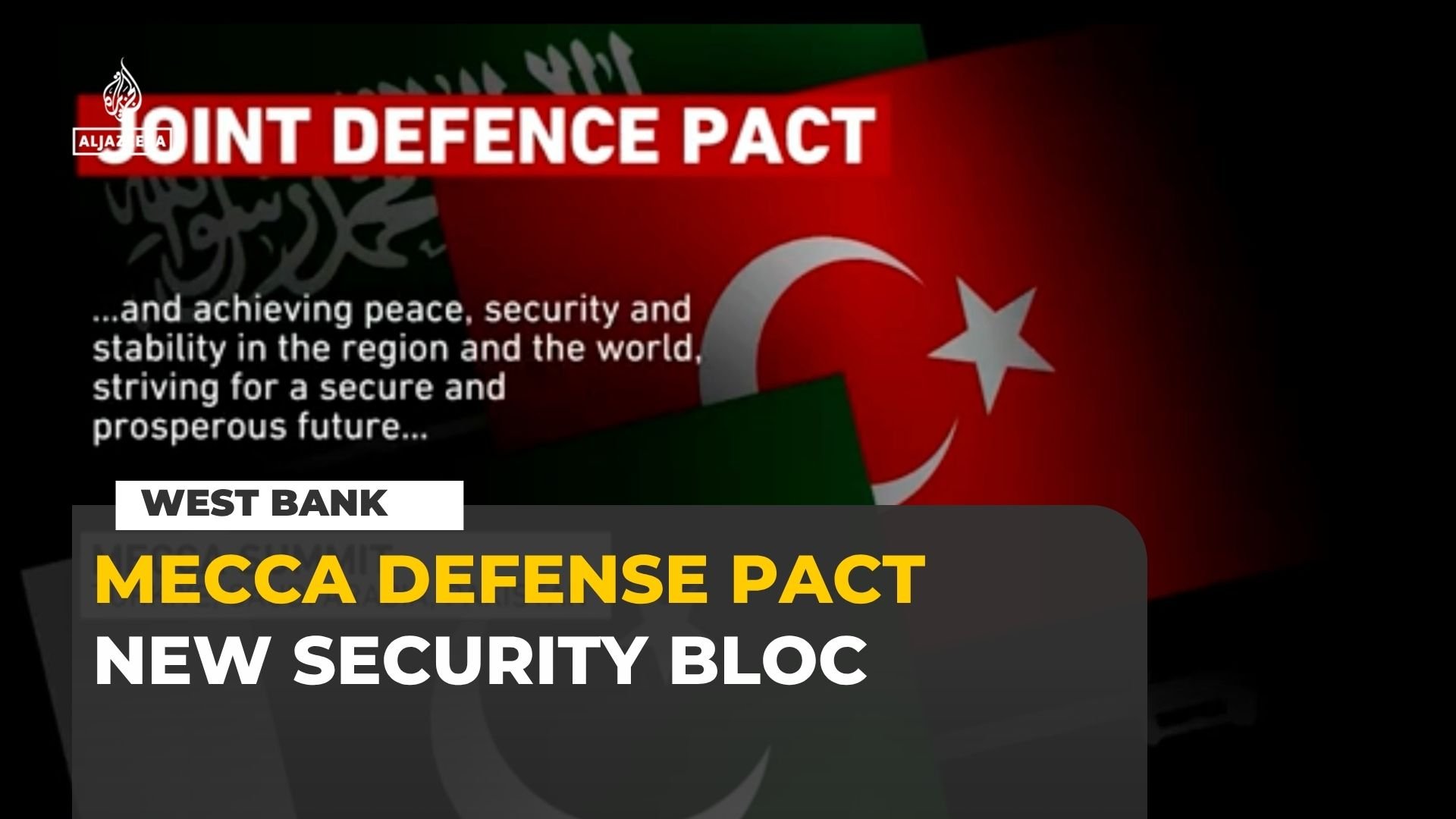
Tehran, Iran – Saudi Arabia and Pakistan have expanded their mutual defence pact to add Turkiye, raising questions about the emergence of a new security architecture at a time when the United States and Iran have yet to reach a final deal to end their war.
Under the agreement signed in Mecca on Friday, any external armed attack on either of the three countries will now be considered an attack on all.
list of 4 itemslist 1 of 4
The trilateral pact was announced more than five months after the US and Israel launched a bombing campaign against Iran, triggering a conflict that quickly spread to the Gulf and disrupted maritime traffic through the Strait of Hormuz.
Pakistan, Saudi Arabia and Turkiye, however, have been careful not to antagonise any regional or international actors while finalising what they said was the result of years of hard work and negotiations. They have stressed the pact, which does not identify a specific threat, is not targeted against any country – particularly Iran – and does not abrogate or replace any existing agreements with others.
In Tehran, the reaction has largely been subdued, with officials mostly focusing on aspects of regional and Muslim cooperation and what they perceive as a declining role for the US.
Iran’s Foreign Minister Abbas Araghchi said on Friday that when Muslims stand together, “we can face every challenge by malicious outsiders head-on”.
“Time to rely only on ourselves and embrace true brotherhood,” he wrote on X, without directly mentioning the trilateral agreement signed hours earlier.
Advertisement
But Iran certainly sees some reasons to be concerned in the long run, according to Hamidreza Azizi, a researcher and analyst on Iran and Middle Eastern geopolitical dynamics.
The associate at Clingendael Institute told Al Jazeera that the timing is important, since the agreement comes after months of a war in which Saudi Arabia has faced attacks from the Iran-aligned Houthis in Yemen and armed groups in neighbouring Iraq.
“From Tehran’s perspective, the concern is therefore not only that the pact could strengthen Saudi deterrence, but that it could eventually facilitate coordinated pressure on Iran in Yemen, Iraq, and even economically through Turkiye and Pakistan,” he said.
On Sunday, the Houthis claimed another successful drone strike on the Saudi Aramco refinery in Jizan. Saudi Arabia confirmed a fire was extinguished without inflicting casualties, but did not mention the cause.
Separately in Yemen, Houthi missiles and drones struck the Saudi-backed and internationally recognised government’s Red Sea port of al-Makha, with officials reporting at least seven people killed, 15 wounded and severe infrastructure damage. The Yemeni group, which has also been hitting or turning back Saudi-linked ships in the Red Sea over recent weeks, said it targeted weapons depots.
Hossein Noushabadi, a director general for parliamentary and legal affairs, told the state-linked ISNA news service that the ministry predominantly regards the agreement within the context of a diminishing direct US presence in the region.
The pact “is being viewed as the beginning of the collapse of US security hegemony in West Asia and the Persian Gulf”, said Noushabadi.
“It appears that, in the not-too-distant future, a new regional security order based on cooperation among regional states will replace the power structures imposed by extra-regional actors, heralding the end of the prevailing security and geopolitical paradigm and West Asia’s departure from the sphere of vital US interests,” added the official, who is a former Iranian envoy to Oman.
Play Video
2:36
Political scientist Vali Nasr said he does not believe the pact is currently a threat to Tehran.
“For now, these are all elements of a post-American security order in the Middle East,” the professor of international affairs and Middle East studies at Johns Hopkins University told Al Jazeera.
Advertisement
“This is also as much a balance to the Abraham Accords as a direct challenge to Tehran,” he added, in reference to the US-pushed regional normalisation effort with Israel, which US President Donald Trump last month tied with a civil nuclear deal sought by Saudi Arabia.
Mehran Kamrava, a professor of government at Georgetown University of Qatar, also agreed that decision-makers in Iran do not immediately feel threatened by the pact, especially since they have maintained cordial relations with both Pakistan and Turkiye even under trying circumstances.
“Ultimately, this pact is not that new, nor is it something that, at present at least, has a great deal of substance beyond its symbolic significance. For example, neither Turkiye nor Pakistan would be willing to get involved in Saudi Arabia’s war in Yemen despite recent Houthi attacks on the kingdom,” Kamrava told Al Jazeera.
Not all inside Iran are content with the pact, however, with some hardline lawmakers and media arguing that it could ultimately be directed against the “resistance front” of Tehran-backed armed forces across the region, and degrade Pakistan’s credibility as a main mediator between Iran and the US and others.
“It’s clear that Arab states finally understand security cannot be imported; it must be built within the region. However, a roadmap is still missing,” Ebrahim Azizi, a member of the Iranian parliament’s National Security and Foreign Policy Commission, said in a more hawkish viewing of the pact.
“Warning: Miscalculation is a historical mistake. Iran has proven that every error comes at a cost. Balance is the only way forward,” he wrote on X.
Ebrahim Rezaei, another member of the commission, also wrote on X that “a paper agreement with Turkiye and Pakistan” will not bring Saudi Arabia security, “just as years of one-sided dependence on the Americans did not bring them security”.
He said Tehran can also continue to emphasise its long-standing argument that regional security should ultimately be organised by regional states rather than external powers.
“If those states come to see the pact as providing meaningful protection against Iran or Iran-aligned groups, that would make Iranian membership even more difficult,” said Azizi. “Over the longer term, however, if the arrangement evolves from a balancing coalition into a broader regional security architecture, the question of Iranian participation could look quite different.”
Experts also said it could be a possibility that Iran itself would be seeking potential membership in the pact in a distant future, but that would mean a sustainable end to attacks in the Strait of Hormuz and across the region, while expansion to other regional Arab states seems more plausible in the near term. Egypt has already been floated as a candidate, but that could be a complex decision for Cairo to make.
Advertisement
Sanam Vakil, director of the Middle East and North African Programme at Chatham House, said the trilateral pact reflects both short- and long-term security concerns and opportunities for Riyadh, Islamabad and Ankara.
“They are driven together to forge greater diplomatic and defence cooperation in reaction to US unreliability, Israeli revisionism and Iranian retaliation,” she told Al Jazeera.

 www.aljazeera.com
Where does Iran stand on Saudi-Pakistan-Turkiye pact?
Iran is not immediately threatened by the pact, analysts say, with officials focusing on aspect of diminishing US security role.Listen (8 mins)
Save
Click here to share on social media
Share
Add Al Jazeera on Google
28:05
What are the challenges facing the Mecca agreement? | Inside Story
By Maziar Motamedi
Published On 9 Aug 20269 Aug 2026
Tehran, Iran – Saudi Arabia and Pakistan have expanded their mutual defence pact to add Turkiye, raising questions about the emergence of a new security architecture at a time when the United States and Iran have yet to reach a final deal to end their war.
Under the agreement signed in Mecca on Friday, any external armed attack on either of the three countries will now be considered an attack on all.
Recommended Stories
list of 4 itemslist 1 of 4
The post-American Middle East is beginning to take shape
list 2 of 4War on Iran: Phase II: Day 28
list 3 of 4Guns in the streets as US, Israel intensify month-long attacks across Iran
list 4 of 4Iran war updates: Trump says US ‘only semi-negotiating’ with Tehran
end of listThe trilateral pact was announced more than five months after the US and Israel launched a bombing campaign against Iran, triggering a conflict that quickly spread to the Gulf and disrupted maritime traffic through the Strait of Hormuz.
Pakistan, Saudi Arabia and Turkiye, however, have been careful not to antagonise any regional or international actors while finalising what they said was the result of years of hard work and negotiations. They have stressed the pact, which does not identify a specific threat, is not targeted against any country – particularly Iran – and does not abrogate or replace any existing agreements with others.
In Tehran, the reaction has largely been subdued, with officials mostly focusing on aspects of regional and Muslim cooperation and what they perceive as a declining role for the US.
Iran’s Foreign Minister Abbas Araghchi said on Friday that when Muslims stand together, “we can face every challenge by malicious outsiders head-on”.
“Time to rely only on ourselves and embrace true brotherhood,” he wrote on X, without directly mentioning the trilateral agreement signed hours earlier.
Advertisement
But Iran certainly sees some reasons to be concerned in the long run, according to Hamidreza Azizi, a researcher and analyst on Iran and Middle Eastern geopolitical dynamics.
The associate at Clingendael Institute told Al Jazeera that the timing is important, since the agreement comes after months of a war in which Saudi Arabia has faced attacks from the Iran-aligned Houthis in Yemen and armed groups in neighbouring Iraq.
“From Tehran’s perspective, the concern is therefore not only that the pact could strengthen Saudi deterrence, but that it could eventually facilitate coordinated pressure on Iran in Yemen, Iraq, and even economically through Turkiye and Pakistan,” he said.
On Sunday, the Houthis claimed another successful drone strike on the Saudi Aramco refinery in Jizan. Saudi Arabia confirmed a fire was extinguished without inflicting casualties, but did not mention the cause.
Separately in Yemen, Houthi missiles and drones struck the Saudi-backed and internationally recognised government’s Red Sea port of al-Makha, with officials reporting at least seven people killed, 15 wounded and severe infrastructure damage. The Yemeni group, which has also been hitting or turning back Saudi-linked ships in the Red Sea over recent weeks, said it targeted weapons depots.
‘A strong bloc’
Iran’s Ministry of Foreign Affairs has not released a formal statement about the Pakistan-Saudi-Turkiye deal, but a senior official outlined Tehran’s diplomatic thinking in an interview with local media on Saturday.Hossein Noushabadi, a director general for parliamentary and legal affairs, told the state-linked ISNA news service that the ministry predominantly regards the agreement within the context of a diminishing direct US presence in the region.
The pact “is being viewed as the beginning of the collapse of US security hegemony in West Asia and the Persian Gulf”, said Noushabadi.
“It appears that, in the not-too-distant future, a new regional security order based on cooperation among regional states will replace the power structures imposed by extra-regional actors, heralding the end of the prevailing security and geopolitical paradigm and West Asia’s departure from the sphere of vital US interests,” added the official, who is a former Iranian envoy to Oman.
Play Video
2:36
- Now Playing
02:36
Saudi Arabia, Turkey And Pakistan sign historic Mecca defense pact
- Next
01:02
Ben-Gvir posts AI video of starving Palestinian ahead of elections
- 03:23
War on Iran: Phase II: Day 30
- 01:18
Typhoon Dolphin slams Zhejiang and Shanghai, stranding travellers and residents
- 01:04
Gaza honours Al Jazeera’s Anas al-Sharif and Mohammed Qraiqea
Political scientist Vali Nasr said he does not believe the pact is currently a threat to Tehran.
“For now, these are all elements of a post-American security order in the Middle East,” the professor of international affairs and Middle East studies at Johns Hopkins University told Al Jazeera.
Advertisement
“This is also as much a balance to the Abraham Accords as a direct challenge to Tehran,” he added, in reference to the US-pushed regional normalisation effort with Israel, which US President Donald Trump last month tied with a civil nuclear deal sought by Saudi Arabia.
Mehran Kamrava, a professor of government at Georgetown University of Qatar, also agreed that decision-makers in Iran do not immediately feel threatened by the pact, especially since they have maintained cordial relations with both Pakistan and Turkiye even under trying circumstances.
“Ultimately, this pact is not that new, nor is it something that, at present at least, has a great deal of substance beyond its symbolic significance. For example, neither Turkiye nor Pakistan would be willing to get involved in Saudi Arabia’s war in Yemen despite recent Houthi attacks on the kingdom,” Kamrava told Al Jazeera.
Not all inside Iran are content with the pact, however, with some hardline lawmakers and media arguing that it could ultimately be directed against the “resistance front” of Tehran-backed armed forces across the region, and degrade Pakistan’s credibility as a main mediator between Iran and the US and others.
“It’s clear that Arab states finally understand security cannot be imported; it must be built within the region. However, a roadmap is still missing,” Ebrahim Azizi, a member of the Iranian parliament’s National Security and Foreign Policy Commission, said in a more hawkish viewing of the pact.
“Warning: Miscalculation is a historical mistake. Iran has proven that every error comes at a cost. Balance is the only way forward,” he wrote on X.
Ebrahim Rezaei, another member of the commission, also wrote on X that “a paper agreement with Turkiye and Pakistan” will not bring Saudi Arabia security, “just as years of one-sided dependence on the Americans did not bring them security”.
Is Iran missing out?
Clingendael Institute’s Azizi said Tehran’s priority will likely be to avoid turning the pact into an explicitly anti-Iranian coalition amid a war with regional repercussions, and that would mean preserving individual relations with each of the three countries.He said Tehran can also continue to emphasise its long-standing argument that regional security should ultimately be organised by regional states rather than external powers.
“If those states come to see the pact as providing meaningful protection against Iran or Iran-aligned groups, that would make Iranian membership even more difficult,” said Azizi. “Over the longer term, however, if the arrangement evolves from a balancing coalition into a broader regional security architecture, the question of Iranian participation could look quite different.”
Experts also said it could be a possibility that Iran itself would be seeking potential membership in the pact in a distant future, but that would mean a sustainable end to attacks in the Strait of Hormuz and across the region, while expansion to other regional Arab states seems more plausible in the near term. Egypt has already been floated as a candidate, but that could be a complex decision for Cairo to make.
Advertisement
Sanam Vakil, director of the Middle East and North African Programme at Chatham House, said the trilateral pact reflects both short- and long-term security concerns and opportunities for Riyadh, Islamabad and Ankara.
“They are driven together to forge greater diplomatic and defence cooperation in reaction to US unreliability, Israeli revisionism and Iranian retaliation,” she told Al Jazeera.
Where does Iran stand on Saudi-Pakistan-Turkiye pact?
Iran not immediately threatened by pact, analysts say, with officials focusing on aspect of diminishing US role.
muhammed45
Elite Member
Obviously, at this very moment Iran or other allies of Iran have no plan to attack KSA. If Sauds stop the blockade on Yemen, Ansarallah will also try to negotiate and ease the tensions in the respected area.
My own assessment is that USA is the main cause war on Yemen and KSA's control over Yemen's giant oil fields will be a God sent gift to American economy.
War on Yemen is absolutely an strategic mistake and wonderfully, Sauds never learn from past mistakes. On the contrary, they open the way for other countries to milk them.
My own assessment is that USA is the main cause war on Yemen and KSA's control over Yemen's giant oil fields will be a God sent gift to American economy.
War on Yemen is absolutely an strategic mistake and wonderfully, Sauds never learn from past mistakes. On the contrary, they open the way for other countries to milk them.
Pakistan Defence Latest


Country Watch Latest
-

-
-

-
China blocking sale of tunnel boring machines to India: Piyush Goyal to German minister (7 Viewers)
- Latest: Pioneer
-

Latest Posts
-
-
-

-
Alberta rejects a move toward independence from Canada in a victory for Carney (14 Viewers)
- Latest: AZ_HighCountry
-