Iran - Israel/US War: Israel-US declare war on Iran, Iran responds

The global oil supply crisis has begun

With the closure of the Strait of Hormuz, the destruction of the Saudi pipeline, and the closure of the Bab al-Mandab Strait, the amount of oil entering the world market has decreased sharply, and the continuation of this trend will have a severe impact on the world economy.

US Strategic Petroleum Reserve (SPR):

The United States is now on the verge of a critical point, and the SPR inventory has reached a dangerous limit:
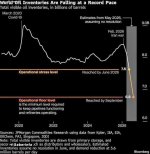
· Current inventory: About 289.7 million barrels, the lowest level since 1982.
· Critical point: Experts consider the threshold of 250 million barrels to be the minimum level for safe and sustainable operations.
· Forecast: With the final release of another 39 million barrels, the inventory will fall to about 243 million barrels, crossing the critical threshold.

Global Reserves: The Critical Point in September 2026

At the global level, analyses also show that the crisis will reach its peak this month (September):

· Forecast: JPMorgan had warned that if the Strait of Hormuz remains closed, global reserves will reach a critical level of 6.8 billion barrels in September 2026, which means the end point of the system's operational capacity.

· Current situation: Reports for September 2026 show that global reserves have decreased from 8.4 billion barrels in February to about 6.8 billion barrels, and this critical point has already been achieved.

Why and how is the crisis happening?

The logic of the crisis is different at the US and global levels:

US level (SPR): crossing the red line in about 2-4 weeks

The US Strategic Petroleum Reserve (SPR) currently stands at about 2.987 million barrels. According to the plan, the US must release another 39 million barrels of this stock to meet its commitments under the International Energy Agency (IEA) coordinated plan. With this release, the SPR stock will fall to about 2.43 billion barrels. This level falls below the 2.5 billion barrel threshold that experts consider the “minimum safe level for operations.” At the current rate of release, this will happen in about 2-4 weeks.

Global level: crossing the “operational floor” has already occurred

At the global level, JP Morgan has defined two thresholds: the “operational stress level” (7.6 billion barrels) and the “operational floor” (6.8 billion barrels). The September 2026 reports confirm that both predictions have come true: global reserves have fallen from 84 billion barrels in February to around 68 billion barrels in September, the “operational floor.” This means that the world has passed the tipping point.

What happens if the tipping point is crossed?

Crossing these thresholds has a cascade of catastrophic consequences that go beyond just price increases:

1. Physical collapse of infrastructure, not just oil shortages

The most important and dangerous consequence is the breakdown of the distribution system. When reserves reach the “operational floor,” pressure in pipelines drops, refineries cannot operate, and the physical distribution network begins to collapse. In this case, the price is no longer an efficient signal, because there is no product to buy or sell. JP Morgan likened this situation to “blood pressure” that, when it drops, the entire system fails.

2. Oil price jumps to critical levels ($150-200)

The price of oil is currently around $107, but analysts warn that as the last reserves are depleted, the price will jump to $150-200 per barrel. This price level will definitively trigger a global recession.

3. Global recession and debt crisis

Organizations such as the United Nations and the OECD have predicted that this crisis will reduce global economic growth to 2.5% (the lowest level since the Corona era) and push some economies into recession. Rising transportation and production costs will create a new wave of stagflation that traditional monetary and fiscal tools are ineffective at dealing with.

4. Rationing and social unrest

Fuel rationing will begin in vulnerable countries. Asian countries such as Indonesia, Vietnam, Pakistan, and the Philippines, which are heavily dependent on fuel imports, will face acute shortages within weeks. These shortages could quickly escalate into social and political unrest.
 

Attachments

  • IMG_20260914_234957_541.jpg
    IMG_20260914_234957_541.jpg
    109.3 KB · Views: 2
4. Rationing and social unrest

Fuel rationing will begin in vulnerable countries. Asian countries such as Indonesia, Vietnam, Pakistan, and the Philippines, which are heavily dependent on fuel imports, will face acute shortages within weeks. These shortages could quickly escalate into social and political unrest.

I dont get on many foreign journalist like maybe coming from Indian, Singaporean, etc working in Reuters, Bloomberg, etc

Saying Indonesia is vulnerable is baseless as they have said that since the start of the war

Indonesia still produce lot of oil, sufficient with gas and also main gas exporter in Asia Pacific, biggest coal exporter in the world, we also dont import diesel anymore due to our B50 biodiesel program (supported by palm oil supply)

-------------

Indonesia produces some 600,000 barrels of crude oil per day (bpd), but its consumption is far above that, at around 1.6 million barrels daily.

A lot of Indonesia's imports of crude oil have typically come from the Middle East. But the Iran war and the Strait of Hormuz disruption forced the biggest economy in Southeast Asia to look for alternative supply, including such from Russia.

"Indonesia's strategy to diversify its crude import basket with imports from Russia is backed by supply economics, refinery compatibility and medium-term energy security logic, not just opportunism around the Middle East crisis," Rystad Energy analyst Prateek Panday told the Business Times in April.

Around the same time, Indonesia's Deputy Minister of Energy, Yuliot Tanjung, said that the country would import 150 million barrels of crude from Russia this year.


Last edited:

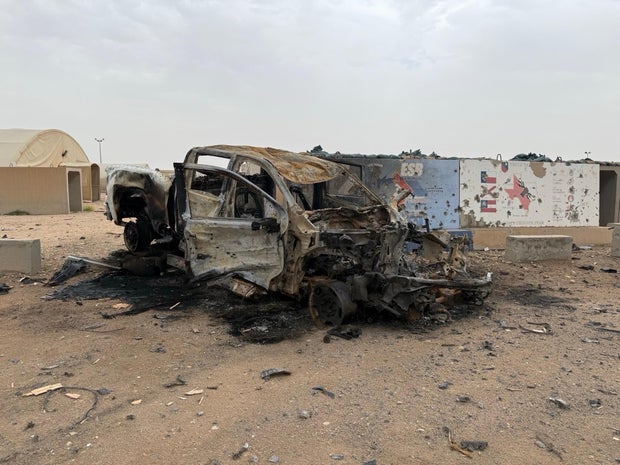
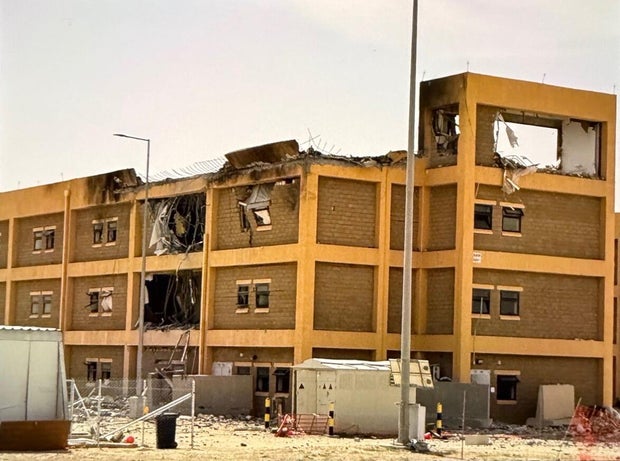
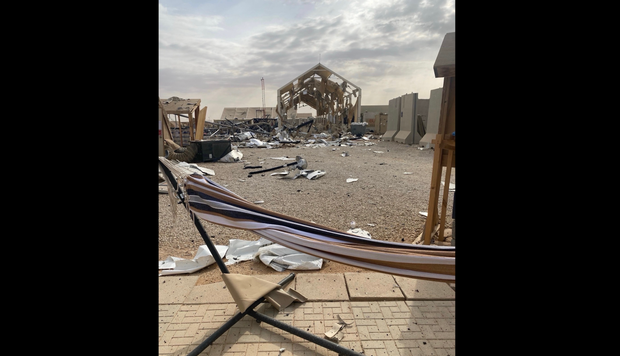
New photos show widespread damage at U.S. positions caused by Iranian missile, drone attacks​

By
Jonah Kaplan
Updated on: September 15, 2026 / 8:11 PM EDT / CBS News
Add CBS News on Google
New photos obtained exclusively by CBS News reveal for the first time the widespread damage and destruction of buildings and vehicles at multiple U.S. positions across the Middle East, as a result of Iranian missile and drone attacks.

The images were sent to CBS News by active service members on condition of anonymity because of rigid media restrictions within the military.

"This is major damage to our bases that hasn't been communicated to the American public," one deployed service member told CBS News. "We're standing there with our eyes closed getting punched in the face."

image-1-1.jpg
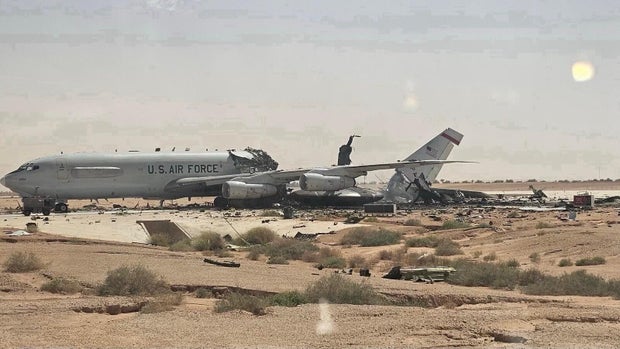
Undated photo of plane damaged by Iranian strikes at Prince Sultan AFB, Saudi Arabia.
One photo, taken at Prince Sultan Air Force Base in Saudi Arabia, shows a direct hit on the back half of a Boeing E-3 Sentry four-engine aircraft, its tail severed from the charred fuselage that also supported a rotating radar that is essential for collecting midair intelligence.

image-1-4.jpg
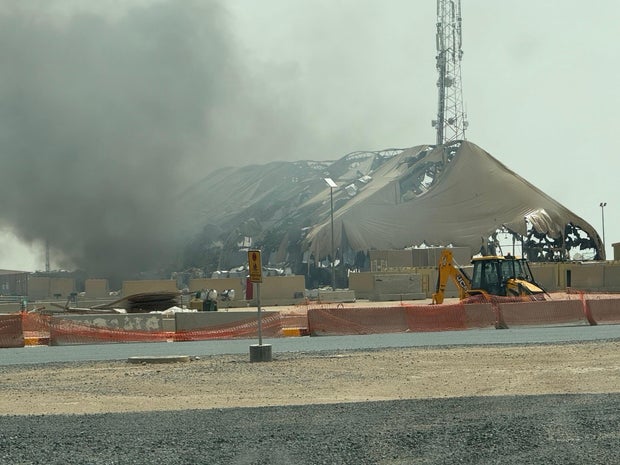
Aftermath of Iranian strike on Camp Buehring, Kuwait, undated photo
image-1-3.jpg
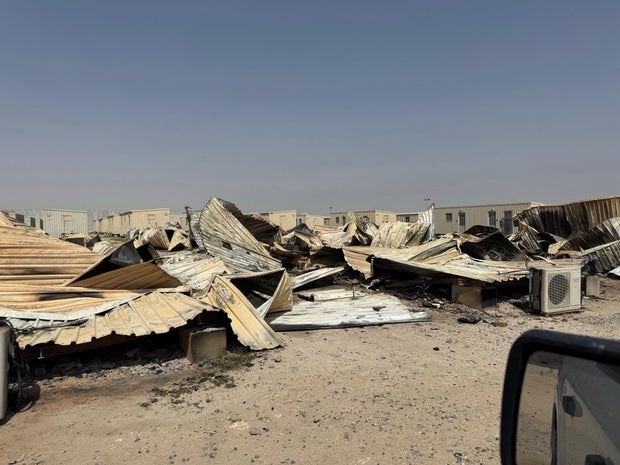
Undated photo of trailers destroyed by Iranian strike, Camp Buehring, Kuwait
Other photos taken from the base show hollowed-out buildings and barracks whose shells ironically stand next to unaffected cement "T-wall" structures, which were once regarded as critical fortifications against grenade and mortar attacks but proved critically ineffective against an aerial assault.

Similarly grim pictures were captured at Camp Buehring in Kuwait, a major staging area for U.S. Army ground troops, armored vehicles and some aircraft; the post is located in a remote desert region far northwest of Kuwait City.

image-1-6.jpg
Undated photo of car destroyed during U.S. conflict with Iran, Camp Buehring, Kuwait.
img-0005.jpg
Undated photo of building damaged by Iranian strike, Camp Arifjan, Kuwait
The Defense Department's inspector general this week released a fresh report on the war in Iran that revealed "equipment losses" worth up to $3.7 billion — including nearly 60 aircraft. In a first-of-its-kind mandatory report to Congress, the inspector general added that U.S. Central Command reported Iranian strikes at U.S. bases in Kuwait, Bahrain, Qatar, UAE, Saudi Arabia, Iraq, Oman and Jordan.

The Pentagon did not respond to a request for comment.

screenshot-2026-09-15-at-4-42-08-pm.png
Undated photo of aftermath following Iranian strike, Prince Sultan AFB, Saudi Arabia
"These are not 'squirters' getting through," the service member added, referencing language used by Defense Secretary Pete Hegseth after the deadly March 1 attack on Port of Shuaiba in Kuwait that killed six U.S. troops. "We're not defending these bases. We're just watching them get destroyed."

The War with Iran​


Users who are viewing this thread

Pakistan Defence Latest

Country Watch Latest

Back
Top