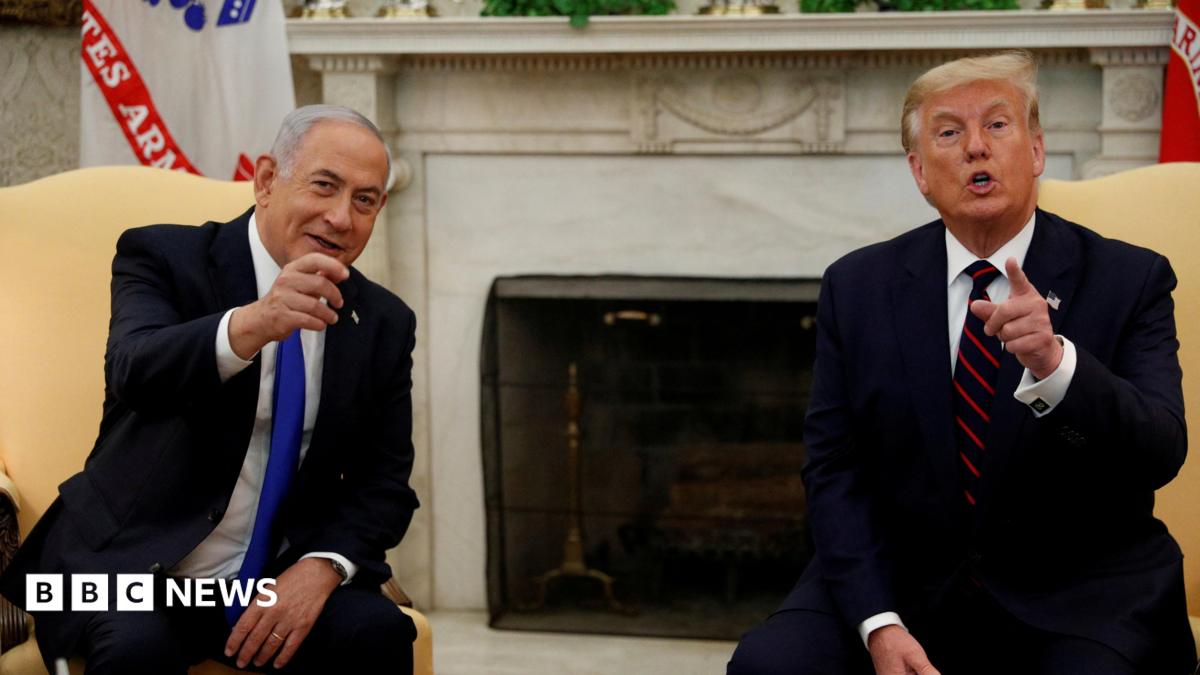
Iran - Israel/US War: Israel-US declare war on Iran, Iran responds

Iran is disclosing several underground facilities lately, it seems they are afraid of a Trump backed attack against them.
Because war in Lebanon and Gaza and previous wars since 40 years shown how important underground bases are, proofs are that Hezbollah underground facilities remains mostly untouched and protected from attacks, even if Lebanon is very close to Israel

So now Iran located at thousands of km from Israel, these bases will last in case of war, if Hezbollah ones lasted from Israeli relentless strikes, Iranian ones will also hold, add to this that Iranian bases are probably built with better materials and deeper than Hezbollah ones, and have way higher firepower

This is not "fear of Trump" that motivated Iran to move everything underground, this is a hard work that started decades ago

Hopefully everything will be moved to underground bases in the future
 
Are you obsessed with amplifying Israel? The real question is, why are you obsessed with exaggerating Israel's so-called success? Some of the authors write for the Jerusalem Post and Times of Israel.
I post iranian analysis of the attack, no amplification or exaggeration. neutrino is obviously not an author for Israeli papers lmao.
 
Israel is protected by a strong air defense network.
Israel didnt seem that protected from Hezbollah and Hamas drones rockets and missiles and TP 1 and 2, except you're in denial or missed the entire war.
For Iran to break through this barrier, it would have to use a large number of missiles and evasive maneuvering, which would greatly reduce the accuracy of the hit.
Iran can execute this succesfully, and we saw this in TP I and TP II- believing Iran can't today is just strong denial and ignorance, respectfully. Hamas and Hezbollah already beat up Israel so much, it obviously wont take that much military resources and strategy for iran to damage Israel in any new attack- did you not watch the damage small Gaza and Houthis and Hezbollah already did to Israel???
how can you say this crap after Israel's bad performance in fighting its neighboring enemies AGAIN
On the other hand, Israel, escorted by U.S. forces surrounding Iran, can approach right up to the border and attack from a short distance with highly accurate missiles that do not use evasive maneuvers.
Then why didnt Israel do this during its last strike on Iran? THis is theoretical and on paper, this possibility doesn't exist on paper. I mean, why has US(up until now at least) given up on strikes on Iran? If US has given u[ on striking Iran, that automatically means Israeli strikes on Iran wont achieve much ,and US knows it. but in your video games and theories everything is possible, i get that.
Iran has no chance in such an unfair battle, and that is the reality.
if Iran has no chance why haven't Israel and US attempted a large strike package on Iran?

Your theories-0
REALITY- 1
The presence of Hezbollah, which can counterattack from close quarters, was essential to remedy this unfairness, but it has been lost.
How has it been lost? i'm tired of your theories that are only correct in our dreams. I guess you fell for the propaganda that Israel's censorship created to make you think Istrael didnt take much losses from Hezbollah- but Israel and Hezbollah may go at it again soon, and if the last round was anything to go by, Israel wont be able to take this next round of damage.

I cant believe you dont realize what a paper tiger ISrael is today after all teh damage it took from militia groups!! Not even competent state military forces.
I don't believe that either Iranian officials or military personnel have any good ideas to break through this.
Yes, keyword b eing "believe"- but because you dont believe doesn't mean its not real or possible that Iran can damage Israel in another mass attack with missiles, drones etc. US is having some deterrent effect on Iran, which is helping Israel, but if Iran's pain threshold is crossed, that deterrence may not work.
 
Iran is disclosing several underground facilities lately, it seems they are afraid of a Trump backed attack against them.
I believe IRan is showing these underground facilities to signal to Trump that any attack on Iran or its interests (like the Soleimani assassination in Iraq) won't go unanswered. Iran is still hurt by the Soleimani assassination and wants revenge, so that complicates US- Iran dynamics these days (esp. with Trump as president).

Iran does not want a US strike on its territories, but US is unable to carry out a large. and full mobilization attack on Iran as of today.
 
I believe IRan is showing these underground facilities to signal to Trump that any attack on Iran or its interests (like the Soleimani assassination in Iraq) won't go unanswered. Iran is still hurt by the Soleimani assassination and wants revenge, so that complicates US- Iran dynamics these days (esp. with Trump as president).

Iran does not want a US strike on its territories, but US is unable to carry out a large. and full mobilization attack on Iran as of today.
On the record here, and I've said it a hundred times now, if Iran is getting 30%-40% of the ordnance thru the best defenses on this planet (using mass volleys/ salvos) to punch thru, with its own designed hardware and tactics, what chance do these middle tier countries have against the Western juggernaut?........lol

Let me answer this.........absolutely zero chance!
 
On the record here, and I've said it a hundred times now, if Iran is getting 30%-40% of the ordnance thru the best defenses on this planet (using mass volleys/ salvos) to punch thru, with its own designed hardware and tactics, what chance do these middle tier countries have against the Western juggernaut?........lol

Let me answer this.........absolutely zero chance!
more like 25% and impacting is just the first hurdle, impacting on something valuable is an entirely different question and the percentage for that seems to be < 5%
 
more like 25% and impacting is just the first hurdle, impacting on something valuable is an entirely different question and the percentage for that seems to be < 5%
I'm just saying bro.......If Iran having quite possibly the largest BM/ drone inventories on this planet all based in house manages 25% success (lets assume that)......what chance do these neighbors have to replicate this feat?........lol
 
I believe IRan is showing these underground facilities to signal to Trump that any attack on Iran or its interests (like the Soleimani assassination in Iraq) won't go unanswered. Iran is still hurt by the Soleimani assassination and wants revenge, so that complicates US- Iran dynamics these days (esp. with Trump as president).

Iran does not want a US strike on its territories, but US is unable to carry out a large. and full mobilization attack on Iran as of today.
I think the thing they fear is a Israel strike against Iran nuclear facilities, backed by USA.
 
Because war in Lebanon and Gaza and previous wars since 40 years shown how important underground bases are, proofs are that Hezbollah underground facilities remains mostly untouched and protected from attacks, even if Lebanon is very close to Israel

So now Iran located at thousands of km from Israel, these bases will last in case of war, if Hezbollah ones lasted from Israeli relentless strikes, Iranian ones will also hold, add to this that Iranian bases are probably built with better materials and deeper than Hezbollah ones, and have way higher firepower

This is not "fear of Trump" that motivated Iran to move everything underground, this is a hard work that started decades ago

Hopefully everything will be moved to underground bases in the future
I said they publicly disclosed due to Trump.

The media publication is due to Trump, not the underground bases creation, that obviously it started a lot before than Trump.

It seems likely that Trump will back a Israel first strike against Iran nuclear facilities, and Iran is trying to show some deterrence.

I dont know if it will work, Israel deep state doesnt give a shit about Israel people, if Iran retaliate and kill thousands Israelis, it's not a problem for Israel corrupt elite.

So I think a Israel/Iran war can start any day inside current Trump administration.

The clear collateral will be GCC and their customers: Europe and Japan.
 
Israel deep state doesnt give a shit about Israel people

Israel is a Western society which cares very much about their civilians and even their soldiers -- unlike Eastern countries. Russia, Iraq, Iran, all these countries lost hundreds of thousands of people and kept going, but the West will never tolerate such losses after WW2.

Look at Kim Jong Un of North Korea: he has got the entire US military stopped at a stalemate. That's because he doesn't care if he loses 10 cities, but the US does not want to risk even 1/10 of a city.

if Iran retaliate and kill thousands Israelis, it's not a problem for Israel corrupt elite

Iran knows that it cannot kill many Israeli civilians or the US will come thundering down. That is why Iran, Hezbollah and others mostly destroy empty buildings and only kill IDF on the combat frontlines.
 
I've been reflecting on some of the posters here. I don't wish to come across as paranoid however something doesn't feel right.....

Allow me to re-balance.

Think back to the early 2000s

The American "Hawks" (terrorists) were openly advocating for an attack on Iran. An attack akin to Iraq, but with more destruction.

Israel was constantly barking like a spoilt brat. We must attack.....well, who attack first? Could anyone imagine the scene's of TP2 in the early 2000s? It's taken 25 years to come where we are....where will we be in another 25?

Contrast to today:

- TP1, TP2. unprecedented BM attack on Israel by IRAN. The material damage was of course hidden but we saw plenty of secondary explosions. The psychological impact cannot be underestimated. The Jews were cowering like never before. Reality hit them. Their nation might not be so invincible after all!

- we were told that Iran wouldn't be able to hit Israel. It was the most heavily defended airspace on the planet. Iran pounded Israel for all to see. Some on this forum quickly changed their goalposts: yes Iran can hit but its no big deal. The damage was insignificant....they say with such authority. How can they be so sure?

- Israels response was delayed (unprecedented) and not to the scale we were expecting. Some posters here, for some reason unbeknownst to me, are attempting to rewrite history. Making it bigger than it was. Remember, Israel promised to change the face of the Middle East in response...

The world helped Israel defend itself during TP1. However they didn't bother defending them during TP2. Iran had free reign to do as it pleased.

The paradigm shift is clear. Have a memory greater than 2 years....
 

ISRAEL STRIKES BACK​

  1. Aviation Features
  2. ISRAEL strikes back


3rd February 2025
FEATURE


img_50-12.jpg

Babak Taghvaee gives a unique insight into the full extent of the Israeli Air and Space Forces retaliatory strike on Iran in 2024
The Israeli Air and Space Force (IASF) conducted its largest airstrike on Iran on October 26, 2024. Involving almost 100 fighter jets, Operation Days of Repentance was Israel’s response to the massive ballistic missile strike on Israel by the Islamic Revolutionary Guard Corps Aerospace Forces (IRGCASF) on October 1. On that day, the IRGCASF launched 200 medium-range ballistic missiles (MRBMs), causing limited damage in three Israeli districts. The Iranian attack was in retaliation to the elimination of Hassan Nasrallah, general secretary of Hezbollah in Beirut, by the IASF on September 27.

Iran’s true promise

On April 13, 2024, the IRGCASF carried out its first direct attack on Israel involving cruise missiles, one-way attack (OWA) drones and MRBMs during Operation True Promise. This was in response to the bombardment of the Iranian consulate building in Damascus on April 1 that killed several high-ranking generals of the IRGC Quds Force. While all cruise missiles and OWA drones were shot down by US, French and Israeli fighter jets over Jordan, some of the missiles passed through the Israeli Defense Forces’s (IDF) Ballistic Missile Defense (BMD system as its Arrow-2/3 systems failed to shoot them down due to their hypersonic speed. Based on the weaknesses of the IDF’s BMD on April 13, the IRGCASF chose to only use MRBMs in its Operation True Promise 2 on October 1, 2024.

On that day, Israel’s three Arrow-2and 3 ABM batteries in Baqa Jatt, Yavne and Bet Shemesh managed to launch only 27 interceptors at the 180 MRBMs of the IRGCASF that approached Israel (20

MRBMs failed in Iran, Iraq and Jordan). Most of these failed to shoot down the Iranian missiles before the separation of their Maneuverable Reentry Vehicle (MARV) from their first or second stages. Despite passing through Israel’s BMD, the majority of the MARVs didn’t hit military structures and did not cause significant damage. However, at Nevatim AB, they destroyed an aircraft hangar, a hardened aircraft shelter and two taxiways. This was enough for the Israeli political and military leadership to consider the strike an act of aggression that required retaliation.

In response to True Promise 1, the IASF conducted a symbolic airstrike on an S-300PMU-2long-range SAM site of the Iranian Air Defense Force (IRIADF) in the 8th Tactical Fighter Base (TFB) Babaei (Khatami) of the Iranian Air Force (IRIAF) on April 19, 2024. During that attack, F-15I Ra’am strike fighters of the IASF’s 69 ‘Ra’am’ Squadron from Hatzerim AB launched multiple Golden Horizon (Blue Sparrow) air-launched ballistic missiles at the SAM site, hitting its 30N6E Flap Lid B engagement/fire control radar, deactivating the battery.

img_51-1.jpg

An example of the large force employment exercise of the IASF for increasing readiness of its fighter squadrons was held on August 15, 2024, involving 12 F-35I Adir multirole fighter jets, 12 F-15A/B/C/D Baaz multirole fighter jets and three KC-707 tankers
Israeli Air and Space Force
Based on the successful use of Golden Horizon air-launched ballistic missiles by the IASF on April 19, 2024, the IDF authorized participants of Days of Repentance to use this missile, as well as its smaller brother, ROCKS, against targets in Tehran, Ilam, Khuzestan and Semnan.

According to an intelligence analysis report from the US National Security Agency (NSA) leaked by the Department of Defense (DOD) to the media on October 19, 2024, the IASF prepared for Days of Repentance by conducting two large-force employment exercises (LFEs) on October 13 and 15, 2024. These involved F-16Ds of 105 and 109 Squadrons from Ramat David, F-16Is of 119, 201 and 253 Squadrons from Ramon, F-16Is of 107

Squadron from Hatzerim and F-15Is of 69 Squadron from Hatzerim. During both exercises, three KC-707 tankers from the IASF’s 120 Squadron and one Gulfstream G-550 Nachshon Eitan airborne early warning and command (AEW&C) aircraft were involved.

According to the NSA files, during each exercise, participants carried 16 Golden Horizon and 40 ROCKS air-launched ballistic missiles (ALBMs), indicating a similar number of ALBMs would be used in the incoming airstrike on Iran. Despite the leak of sensitive information about the weapons selected, this did not result in its cancellation. In fact, the IASF didn’t carry out the airstrike until the US Army’s 62nd Air Defense Artillery Regiment (ADAR) from the 69th Air Defense Artillery Brigade (ADAB) at Fort Hood, Texas, deployed its Terminal High Altitude Area Defense (THAAD) ABM battery to Israel to reinforce the IDF’s BMD. After its deployment to Israel between October 14 and 20, the THAAD battery became operational at Site 512 in Negev on October 22, paving the way for the IASF to conduct its retaliatory airstrike four days later.

img_51-2.jpg

An F-15I Ra’am strike fighter of the IASF’s 69 Squadron ‘Ra’am’ which also took part in Operation Days of Repentance. This particular airframe, ‘220’, also took part in the IASF’s airstrike at an S-300PMU-2SAM battery of the IRIADF in Isfahan on April 19, 2024
Babak Taghhvaee
img_52-1.jpg

F-16I Sufa strike fighters of the IASF’s 107 Squadron ‘Knights of the Orange Tail’ at Hatzerim AB carried and used ROCKS ALBMs against an I HAWK SAM battery of the IRIADF in Mahshahr and a OTH radar site of the IRGCASF near Ilam on October 26, 2024
Babak Taghvaee
img_52-2.jpg

Fattah-1hypersonic MRBM of the IRGCASF posed a serious threat to Israel due to the inability of the Arrow-2/3 ABM systems of the IDF in shooting them down
Kamran Momayez
DEAD/SEAD phase

Days of Repentance was conducted in three phases, the first two for the destruction and suppression of enemy air defense (DEAD/SEAD), while the last was for the destruction of Iranian ballistic missile production infrastructure.

The operation began at 0145hrs with the launch of six Golden Horizon MRBMs by six IASF F-15Is over central Iraq. Less than ten minutes later, three SAM sites of the IRIADF in three locations near Tehran were hit by the missiles. As a result, a modernized I HAWK medium-range SAM battery, an S-300PMU-2long-range SAM battery and an S-200VE long-range SAM battery had their surveillance and target illumination radars destroyed in Nasir Abad (Hazrate Amir Brigade), Kahrizak and Ali Abad, respectively. The I HAWK battery also had one of its missile launchers loaded with three MIM-23B medium-range SAMs damaged by shrapnel. One of these missiles exploded, partially setting the site on fire.

After the end of the first phase, it took 30 minutes for the Iranian Armed Forces to realize it was an Israeli airstrike. Assuming it was the only phased strike, the IRIAF received orders to scramble four fighter jets across Iran to perform combat air patrol (CAP) starting at 0300hrs. They were a MiG-29B fighter interceptor armed with two R-27R semi-active radar homing (SARH) medium-range air-to-air missiles (MRAAMs) and two R-73E infrared guided short-range air-to-air missiles (IRSRAAMs) from the 11th Tactical Fighter Squadron (TFS) at 1st TFB Mehrabad in Tehran, one F-4E Phantom II multirole fighter jet of 31st TFS at 3rd TFB Nojeh (Shahrokhi) armed with two AIM-7E Sparrow SARH MRAAMs and two AIM-9J Sidewinder IRSRAAMs, one F-4E of 61st TFS at 6th TFB Yassini with a similar weapon load and an F-4E of 91st TFS at 9th TFB Abdolkarimi, again with a similar weapon load.

img_53-2.jpg


Equipped with a booster or first stage, the Khaybar Shekan has an engineless MARV that can reach an alleged maximum speed of Mach 5 at the point of impact
Kamran Momayez
img_53-3.jpg

One of three G-550 Nachshon Eitan AEW&C aircraft of the IASF’s 122 Squadron ‘Nachshon’ flew an airborne early warning and situational awareness mission over Israel on October 26
Babak Taghvaee
EMPLOYMENT OF PSYOPS BY THE IDF

Similar to Iran’s Islamic Regime Intelligence Services and Intelligence Protection Organizations, Israeli military intelligence enforces strong censorship to protect IDF operational security. This is accompanied by psychological operations (PSYOPS) conducted by the IDF and Mossad.

Israeli news media were restricted from accessing and sharing accurate information about Israeli airstrikes during Operation Days of Repentance. This was done to prevent Iranian intelligence organizations from obtaining precise details about the operations. Information released by the IDF regarding the airstrikes is very limited and when the Israeli media does report on them, the information is often mixed with misinformation and disinformation.

The existence of Golden Horizon (Blue Sparrow) and ROCKS ALBMs was kept secret in Israel until April 19, 2024, when the IASF launched them at an Iranian S-300PMU-2in Isfahan. The boosters of these missiles were discovered by Iraqi authorities and the Israeli news media was finally permitted by Israel’s censorship office to report on their existence.

Despite the IASF using ALBMs to target various SAM, radar and missile production sites in Iran on October 26, 2024, some Israeli media outlets spread disinformation about the airstrikes. This included reports suggesting that F-35I Adir stealth fighters were responsible for targeting Iranian missile production sites, when these aircraft were mostly involved in CAP missions over Israel and Jordan, or joined the F-16D/Is that conducted airstrikes at five weapon storage sites of the IRGC at Homs, Damascus, Tartus and Sweida in Syria at 0130hrs to 0200hrs that day.

A Pentagon source, speaking anonymously, confirmed that the USAF was not involved in Days of Repentance and did not refuel Israeli fighter jets over Iraq, Jordan or Syria. The USAF’s KC-135 Stratotankers that were airborne over the region on October 26 only refueled A-10Cs, F-15Es and F-16CMs of the USAF on patrol duties.
The MiG-29B returned to Mehrabad International Airport after just 15 minutes, while the F-4Es continued their flights for several more minutes until the IASF conducted the second phase of the airstrike, destroying multiple SAM systems near Iranian petrochemical plants such as the Gas Refinery of Ilam and Oil Refinery of Mahshahr in the southwest of Iran.

It is known that during this phase, one modernized I HAWK, known as Mersad, was targeted at the IRIADF’s SAM site in the north of Mahshahr, resulting in the death of its four operators: Captain Hamzaeh Jahandideh, Captain Sajjad Mansouri, Sergeant Mohammad-Mahdi Shahrokhi and Master Sergeant Mehdi Naqavi at around 0320krs. Delilah cruise missiles are believed to have been used for targeting this site.

img_54-1.jpg

One of the three KC-707 tankers of the IASF’s 120 Squadron ‘Desert Giants’ that refuelled the IASF’s fighters on CAP duty over Israel and Jordan during Operation Days of Repentance
Babak Taghvaee
During the second phase, an IRGCASF Sepehr over the horizon (OTH) early warning (EW) radar located on a mountain in the south of Ilam and a Ghadir OTH radar of the IRGCASF located within 15km of Ahvaz were also targeted and destroyed by the IASF using ROCKS and Delilah cruise missiles launched by the F-16I Sufa strike fighters from 107 Squadron.

The targeted OTH EW radars played an important role in the detection of aerial targets with low radar cross-sections, such as F-35I Adir jets in the west of Iran. Information gathered by the radars was fed to the integrated air defense network of the IRIADF’s Khatam Al-Anbiya HQ and transmitted to various SAM sites of the IRIADF and IRGCASF to increase their alertness levels for countering stealth targets such as Israeli F-35s. Because of their destruction, the airspace over the southwest of Iran was made safe for Israeli F-35Is to fly during future airstrikes.

img_54-2.jpg

Between Phase 1 and 2 of Operation Days of Repentance of the IASF, the IRIAF was ordered to scramble a MiG-29B and three F-4Es to perform symbolic CAP missions
Keyvan Tavakkoli
After the destruction of the radars, two F-35Is entered the Iranian airspace at around 0325hrs, with one or two precision guided bombs dropped on an empty oil reservoir in Abadan oil refinery near Mahshahr as a show of force to the Iranian regime.

Targeting the missile industry

Two tactical MRBMs from the IRGCASF’s Missile Command posed a serious threat to Israel during Operation True Promise 2.

These were the Khaybar Shekan, with a maximum range of 1,450km and equipped with a hypersonic glide vehicle (HGV) reaching a maximum speed of Mach 5 at the point of impact, and the Fattah 1, with a range of 1,400km and equipped with a rocket-motor equipped MARV reaching a maximum speed of Mach 10 at the point of impact.

Both of these missiles are products of the Shahid Bakeri Industrial Group (SBIG) of the Iranian Ministry of Defense and Logistics of Armed Forces (MODAFL). They were designed and developed in close co-operation with a research and development center of the IRGCASF’s Missile Command in Bidkaneh near Tehran and a similar facility at the IRGCASF’s Space Command in Shahroud. The rocket motor-equipped MARVs were designed, developed and manufactured by the IRGCASF at Shahroud, then shipped to the SBIG facility in Khojir to be installed on the Fattah-1s.

The involvement of SBIG and the two research and development centers of the IRGCASF in the design and development of the missiles that were fired at Israel on October 1 resulted in them being targeted by the IASF in the third phase of the operation at around 0400hrs. Six concrete buildings of the SBIG were hit by six Golden Horizon ALBMs within the Iranian MODAFL’s site in Parchin. The ALBMs created holes at the top of each structure, potentially damaging equipment and machines used for mixing and casting solid-propellant rocket motors for missiles manufactured by the SBIG and the IRGCASF. Among the six targets, at least one was the entrance to an underground high explosive test site used for the development and testing of nuclear warheads.

Simultaneously, Golden Horizon ALBMs launched by two F-15D/Is hit a ballistic missile production line and a research lab of the ballistic missile production line involved in the making of Fattah-1hypersonic MRBMs for the IRGCASF.

The IASF also launched a pair of ALBMs at the factory of Taksaz Industrial Innovators in Shamsabad industrial district, located near Hasanabad-Fashafuyeh village in the southwest of Tehran. The missiles destroyed half of the factory and killed a civilian security guard present at the site. According to the IDF, the privately owned company was involved in the construction and excavation of underground tunnels for Iranian missile bases.

img_55-1.jpg

The IRIAF’s 11th TFS at 1st TFB Lashgari has only six airworthy MiG-29s remaining. Four of them are MiG-29B single-seat fighter interceptors, including this one armed with four R-73E IRSRAAMs
Babak Taghvaee
img_55-2.jpg

The IRIADF had just three operational S-300PMU-2batteries. Two were in Tehran when the IASF conducted Operation Days of Repentance on October 26, 2024
Babak Taghvaee
CAP MISSIONS OVER JORDAN AND ISRAEL

On October 26, the IASF released multiple images of F-16I Sufa strike fighters of 119 Squadron ‘The Bat’ and 201 Squadron ‘The One’ at Ramon AB and F-15D Baz strike fighters of 133 Squadron ‘Knights of the Twin Tail’ at Tel Nof AB. These fighters had all been armed with air-to-air missiles such as AIM-120B AMRAAM, AIM-7F Sparrow SARH MRAAMs (F-15Ds only) and Python 5 SRAAMs. This indicated that they were some of the fighters involved in CAP sorties over Israel and Jordan.

Supported by three KC-707s and a G-550 Eitan, more than 40 fighter jets including F-35I Adirs performed CAP missions to protect Israel from any possible retaliatory attack of the IRGCASF using cruise missiles and OWA drones during and after Operation Days of Repentance. In addition, at-least eight F-15E Strike Eagles of the USAF, flown from Muwaffaq Al-Salti AB in Jordan, and eight F-16CM Block 40s of the USAF’s 510th FS, flown from Prince Sultan AB in Saudi Arabia, supported by KC-135R/T tankers, performed CAP missions over Jordan and Israel to counter any possible cruise and OWA drone strikes of the IRGCASF in the early hours of October 26.

According to the IDF, Days of Repentance ended with all the aircraft landing in Israel at 0600hrs on October 26, 2024, meaning the CAP sorties had lasted until at-least 0530hrs.
Targeting nuclear sites

Several days before the IASF carried out Operation Days of Repentance, the US government issued a warning to Israel, prohibiting them from conducting any attacks on Iranian nuclear sites. The key reason was to avoid escalation of the conflict, as it could have provided an excuse for the IRGCASF to carry out a similar attack on the Israeli Shimon-Perez nuclear research center in the Negev desert. Despite the warnings, the IASF targeted two sites related to Iran’s nuclear programs. The first was the tunnel entrance of an underground test site for nuclear explosions at Parchin, east of Tehran, and the other was a secret lab in the Taleghan 2 nuclear research facility.

img_56-1.jpg
 
Despite being more than five decades old, I HAWK medium-range SAM systems form the backbone of the IRIADF’s air-defence capability and most of them have been modernized to Mersad standard
Keyvan Tavakkoli
img_56-2.jpg

The IRIADF has at-least four Talash medium-range SAM systems that use both Sayyad 2 and 3 medium and long-range SAM
s Keyvan Tavakkoli
img_56-3.jpg

Launch of a Syyad-2medium-range SAM by a Talash SAM system of the IRIADF during an exercise in 2022
Keyvan Tavakkoli
While Israeli officials claim the airstrike at Taleghan 2 destroyed sophisticated equipment used to design plastic

explosives that surround uranium in a nuclear device, Pentagon officials believe this was an exaggeration and that the targeted lab had been emptied before the attack took place. The destruction of the tunnel entrance of the site in Parchin became known just a day after Operation

Days of Repentance, but it took 20 more days until high-resolution satellite images showed the destruction of the Taleghan 2 site.

Even though the loss of Taleghan 2 did not pose any harm to Iran’s militarized nuclear programs, it delivered a warning message to the Iranian Islamic Regime, showing the vulnerability of some of the nuclear sites to Israeli airstrikes. With the destruction of the components of the S-300PMU-2SAM systems of the IRIADF in Operation Days of Repentance, Iranian nuclear sites are even more exposed to future attacks.

Even if fully exposed to Israeli airstrikes, many Iranian nuclear sites, such as uranium enrichment facilities, are built underground, requiring the use of bunker buster bombs to destroy them. Without direct involvement of the USAF, it will be impossible for Israel to destroy them using air-launched ballistic missiles, as they lack the capability to penetrate several meters underground. Only heavy bunker busters, such as the 30,000-lb GBU-57/B dropped by B-2A Spirit stealth bombers, are capable of destroying them.

Degrading MRBM production

Satellite images taken after the strike did not show the level of destruction of solid-propellant casting equipment and planetary mixers in Parchin. In the case of total destruction of this equipment, the IDF estimates that the production of solid-propelled ballistic missiles in Iran would be halted for at least a year until the MODAFL replaced the damaged equipment.

Additionally, the mass production line of Fattah-1MRBMs targeted in Shahroud would not be easily re-established by the IRGC, resulting in a 12 to 18-month pause in production.

While the IASF avoided targeting Iran’s petrochemical plants at the request of the US government, the IRIADF and IRGCASF SAM sites and early warning radars near them were targeted by the IASF as a warning to the Iranian regime.

In total, the loss of components of an S-300PMU-2, an S-200VE and two I HAWK SAM batteries of the IRIADF was confirmed with the help of satellite images. There are also unconfirmed reports of the destruction of a second S-300PMU-2SAM battery of the IRIADF in Khavaran, southeast of Tehran, and a 15th Khordad medium-range SAM system of the IRIADF in the 4th TFB Vahdati of the IRIAF near Dezful. While it is difficult for the IRIADF to replace the components of its S-300PMU-2s, I HAWK and 3rd and 15th Khordad SAM batteries could be more easily replaced in a short period of time.

img_57-1.jpg

Radar systems of a S-200VE long-range SAM system of the IRIADF located in Shahriar, South of Tehran were targeted by means of the Golden Horizon ALBMs of the IASF
Keyvan Tavakkoli
img_57-2.jpg

Left: One of the F-15D Baaz multirole fighter jets of the IASF’s 133 Squadron can be seen carrying three external tanks, an ECM pod, an AIM-7F Sparrow SARH MRAAM, an AIM-120B AMRAAM and a Python 5 IRSRAAM for a CAP mission
Israeli Air and Space Force
img_57-3.jpg

Left: An F-16I Sufa of the 119 Squadron taxiing before take-off to perform a six-hour CAP over Israel on October 26, 2024
Israeli Air and Space Force
Despite the fact that the IASF used significantly fewer missile compared with the IRGCASF’s Operation True Promise 2, they inflicted severe damage on Iranian ballistic missile production facilities. They also degraded the capability of the IRIADF and IRGCASF in protecting these sites, as well as oil and gas facilities. Thanks to these actions, the Iranian regime was persuaded by Israel to refrain from retaliating against the operation and to halt conducting missile attacks on Israel in the short term.
 

Users who are viewing this thread

Country Watch Latest

Back
Top