Navigation
Install the app
How to install the app on iOS
Follow along with the video below to see how to install our site as a web app on your home screen.
Note: This feature may not be available in some browsers.
More options
Style variation
You are using an out of date browser. It may not display this or other websites correctly.
You should upgrade or use an alternative browser.
You should upgrade or use an alternative browser.
Iranian Foreign & Resistance Front Strategy & Operations
- Thread starter jauk
- Start date
More options
Who Replied?


Persian Gulf
INT'L MOD


RescueRanger
Meme Lord

"Open Source Intel" Added to the OSINT trash list in the pro-Israel section
Brother, Open Source Intel is a Pro-Israeli trashcan just check this "pinned post"... These accounts only peddle propaganda.
RescueRanger
Meme Lord
Hezbollah claims attack on Israeli army soldiers
The Lebanese group has claimed another attack on Israeli soldiers.
In a post on its Telegram channel, Hezbollah said the attack targeted soldiers while they were attempting to evacuate a military vehicle that the group claimed to hit a day earlier in the Metulla site.
Source: AJN Live.

Mehdipersian
Trusted Member
When all the goalkeepers can't catch the ball


Mehdipersian
Trusted Member
One of Iran's targets in the attack, which was not mentioned in the media



Cthulhu
Trusted Member
The ISW analysis:

 Download the PDF
Iran’s Attempt to Hit Israel with a Russian-Style Strike Package Failed...for Now
Brian Carter and Frederick W. Kagan
CORRECTION: A previous version of this piece said that Ukrainian air defenses have averaged interception rates of only about 46% of Russian ballistic missiles during recent large strikes. The actual ballistic missile interception rate is about 16%. Ukrainian air defenses have averaged a 46% interception rate of all Russian missiles during recent large strikes. This reinforces the point that the Iranians likely expected that Israeli rates would be higher than the Ukrainian rates, but not above 90%. We apologize for this error.
The Iranian April 13 missile-drone attack on Israel was very likely intended to cause significant damage below the threshold that would trigger a massive Israeli response. The attack was designed to succeed, not to fail. The strike package was modeled on those the Russians have used repeatedly against Ukraine to great effect. The attack caused more limited damage than intended likely because the Iranians underestimated the tremendous advantages Israel has in defending against such strikes compared with Ukraine. The Iranians will learn lessons from this strike and work to improve their abilities to penetrate Israeli defenses over time as the Russians have done in repeated strike series against Ukraine.
The strike consisted of approximately 170 drones, 30 cruise missiles, and 120 ballistic missiles.[1] The drones were launched well before the ballistic missiles were fired, very likely in the expectation that they would arrive in Israel’s air defense window at about the same time as the cruise missiles and drones. The Russians have used such an approach against Ukraine repeatedly.[2] The purpose of such a package is to have the slower cruise missiles and drones distract and overwhelm air defenses in order to allow the ballistic missiles, which are much harder to shoot down, to reach their targets. The Iranians very likely expected that few if any of the cruise missiles and drones would hit their targets, but likely hoped that a significantly higher percentage of the ballistic missiles would do so.
Only a few ballistic missiles penetrated Israeli air defenses and struck near Israeli military bases out of the 120 or so the Iranians fired.[3] Ukrainian air defenses have averaged interception rates of only about 16% of Russian ballistic missiles during recent large strikes. The Iranians likely expected that Israeli rates would be higher than the Ukrainian rates but not above 90% against such a large ballistic missile salvo—the Russians, after all, have never fired close to that many large ballistic missiles in a single strike against Ukraine. Ukraine frequently intercepts more than 75% of Russian cruise missiles and drones, but many of those interceptions occur within the air defense umbrella that is also occupied with ballistic missile defense. The Iranians thus likely expected that at least some of their drones and cruise missiles would interfere with Israeli targeting of incoming ballistic missiles, whereas apparently none did.
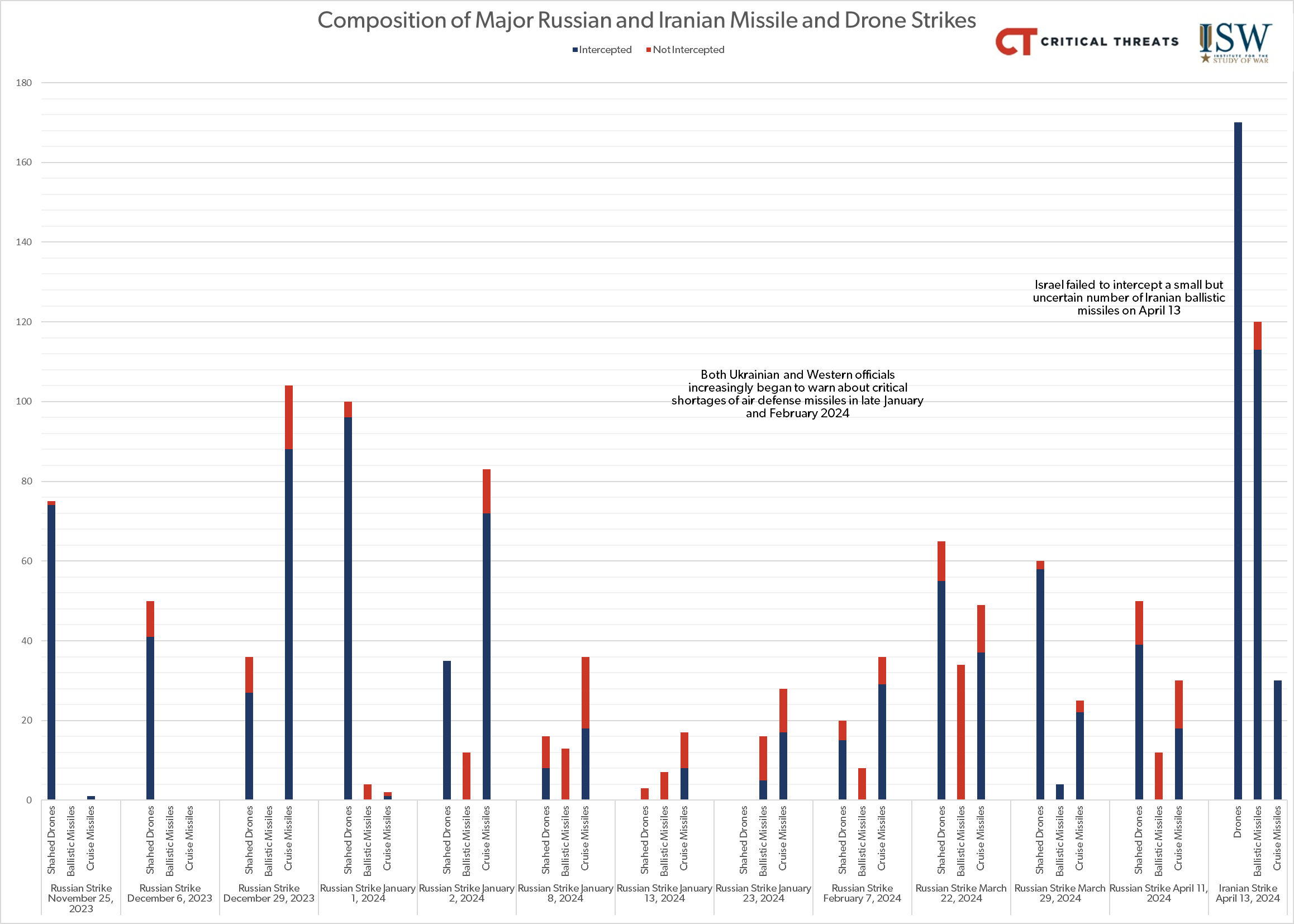
Source: The Institute for the Study of War and the Critical Threats Project at the American Enterprise Institute
Israel’s air defense system has a number of obvious advantages over Ukrainian air defense, but the full implications of some of those advantages might well have been unclear to Iranian strike planners. The Israel Defense Forces (IDF) and Israel’s allies have much larger and robust anti-missile and air defense systems and stocks of interceptors for them than Ukraine does—especially as Ukraine exhausts its supplies of interceptors while awaiting renewed US military assistance. Israel also benefits from the roughly 1,000 kilometers separating its borders from Iran’s. Israel and its allies used that distance to intercept all of the incoming drones and cruise missiles with ground-based air defense and combat aircraft before they even came within Israel’s own missile-defense umbrella. Israel and its allies employed hundreds of combat aircraft in this effort.[4] Ukraine lacks both of these advantages.[5] Iran also lacks access to the near-hypersonic missiles Russia has used to penetrate Ukrainian air defenses more reliably—at least for now.
Ukraine has, in particular, been unable to use combat aircraft to shoot down Russian drones and cruise missiles at scale, and Ukrainian President Volodymyr Zelensky recently observed that Kyiv will likely use the F-16s Ukraine will receive this summer in those roles.[6] It has long been known that both drones and cruise missiles can be shot down by combat aircraft, but the Ukraine war has not yet seen a concerted effort made by a large and modern air force to intercept drone and cruise missile strikes at scale, and it is very possible that the Iranians underestimated the effectiveness of that effort.
Iran will learn additional lessons from the failed April 13 attack that it can leverage to launch more successful attacks in the future. The lessons that Iran will draw from this attack will allow it to build more successful strike packages in the future. The attack probably helped Iran identify the relative strengths and the weaknesses of the Israeli air defense system. Iran will likely also share the lessons it learned in this attack with Russia. Russia will then use these lessons to improve its ability to defeat US- and NATO-provided air defense systems in Ukraine. Iran may be able to share lessons with Russia about the relative strengths and weaknesses of US-built aircraft and air-to-air missiles in intercepting these missiles and drones.
Iran’s ability to penetrate Israeli air defenses with even a small number of large ballistic missiles presents serious security concerns for Israel. The only Iranian missiles that got through hit an Israeli military base, limiting the damage, but a future strike in which several ballistic missiles penetrate Israeli air defenses and hit Tel Aviv or Haifa could cause significant civilian casualties and damage to civilian infrastructure, including ports and energy. Russian strikes on Ukraine have demonstrated that even a small number of precise strikes against key nodes in energy or other infrastructure can cause disproportionate effects. Israel and its partners should not emerge from this successful defense with any sense of complacency.

[1]
[2] https://isw.pub/UkrWar122923; https://www.understandingwar.org/backgrounder/special-report-russian-str...
[3] https://www.timesofisrael dot com/how-israel-foiled-irans-ballistic-missile-attack-that-focused-on-an-f-35-airbase/; https://www.washingtonpost.com/world/2024/04/14/mapping-wide-scale-irani...
[4] https://www.timesofisrael dot com/us-uk-and-jordan-intercept-many-of-the-iranian-drones-headed-to-israel/
[5] https://www.understandingwar.org/backgrounder/special-report-russian-str...
[6] https://isw.pub/UkrWar041324; https://www.understandingwar.org/backgrounder/russian-offensive-campaign...
 understandingwar.org
IRAN’S ATTEMPT TO HIT ISRAEL WITH A RUSSIAN-STYLE STRIKE PACKAGE FAILED...FOR NOW
Apr 14, 2024 - ISW Press
Download the PDFIran’s Attempt to Hit Israel with a Russian-Style Strike Package Failed...for Now
Brian Carter and Frederick W. Kagan
CORRECTION: A previous version of this piece said that Ukrainian air defenses have averaged interception rates of only about 46% of Russian ballistic missiles during recent large strikes. The actual ballistic missile interception rate is about 16%. Ukrainian air defenses have averaged a 46% interception rate of all Russian missiles during recent large strikes. This reinforces the point that the Iranians likely expected that Israeli rates would be higher than the Ukrainian rates, but not above 90%. We apologize for this error.
The Iranian April 13 missile-drone attack on Israel was very likely intended to cause significant damage below the threshold that would trigger a massive Israeli response. The attack was designed to succeed, not to fail. The strike package was modeled on those the Russians have used repeatedly against Ukraine to great effect. The attack caused more limited damage than intended likely because the Iranians underestimated the tremendous advantages Israel has in defending against such strikes compared with Ukraine. The Iranians will learn lessons from this strike and work to improve their abilities to penetrate Israeli defenses over time as the Russians have done in repeated strike series against Ukraine.
The strike consisted of approximately 170 drones, 30 cruise missiles, and 120 ballistic missiles.[1] The drones were launched well before the ballistic missiles were fired, very likely in the expectation that they would arrive in Israel’s air defense window at about the same time as the cruise missiles and drones. The Russians have used such an approach against Ukraine repeatedly.[2] The purpose of such a package is to have the slower cruise missiles and drones distract and overwhelm air defenses in order to allow the ballistic missiles, which are much harder to shoot down, to reach their targets. The Iranians very likely expected that few if any of the cruise missiles and drones would hit their targets, but likely hoped that a significantly higher percentage of the ballistic missiles would do so.
Only a few ballistic missiles penetrated Israeli air defenses and struck near Israeli military bases out of the 120 or so the Iranians fired.[3] Ukrainian air defenses have averaged interception rates of only about 16% of Russian ballistic missiles during recent large strikes. The Iranians likely expected that Israeli rates would be higher than the Ukrainian rates but not above 90% against such a large ballistic missile salvo—the Russians, after all, have never fired close to that many large ballistic missiles in a single strike against Ukraine. Ukraine frequently intercepts more than 75% of Russian cruise missiles and drones, but many of those interceptions occur within the air defense umbrella that is also occupied with ballistic missile defense. The Iranians thus likely expected that at least some of their drones and cruise missiles would interfere with Israeli targeting of incoming ballistic missiles, whereas apparently none did.
Source: The Institute for the Study of War and the Critical Threats Project at the American Enterprise Institute
Israel’s air defense system has a number of obvious advantages over Ukrainian air defense, but the full implications of some of those advantages might well have been unclear to Iranian strike planners. The Israel Defense Forces (IDF) and Israel’s allies have much larger and robust anti-missile and air defense systems and stocks of interceptors for them than Ukraine does—especially as Ukraine exhausts its supplies of interceptors while awaiting renewed US military assistance. Israel also benefits from the roughly 1,000 kilometers separating its borders from Iran’s. Israel and its allies used that distance to intercept all of the incoming drones and cruise missiles with ground-based air defense and combat aircraft before they even came within Israel’s own missile-defense umbrella. Israel and its allies employed hundreds of combat aircraft in this effort.[4] Ukraine lacks both of these advantages.[5] Iran also lacks access to the near-hypersonic missiles Russia has used to penetrate Ukrainian air defenses more reliably—at least for now.
Ukraine has, in particular, been unable to use combat aircraft to shoot down Russian drones and cruise missiles at scale, and Ukrainian President Volodymyr Zelensky recently observed that Kyiv will likely use the F-16s Ukraine will receive this summer in those roles.[6] It has long been known that both drones and cruise missiles can be shot down by combat aircraft, but the Ukraine war has not yet seen a concerted effort made by a large and modern air force to intercept drone and cruise missile strikes at scale, and it is very possible that the Iranians underestimated the effectiveness of that effort.
Iran will learn additional lessons from the failed April 13 attack that it can leverage to launch more successful attacks in the future. The lessons that Iran will draw from this attack will allow it to build more successful strike packages in the future. The attack probably helped Iran identify the relative strengths and the weaknesses of the Israeli air defense system. Iran will likely also share the lessons it learned in this attack with Russia. Russia will then use these lessons to improve its ability to defeat US- and NATO-provided air defense systems in Ukraine. Iran may be able to share lessons with Russia about the relative strengths and weaknesses of US-built aircraft and air-to-air missiles in intercepting these missiles and drones.
Iran’s ability to penetrate Israeli air defenses with even a small number of large ballistic missiles presents serious security concerns for Israel. The only Iranian missiles that got through hit an Israeli military base, limiting the damage, but a future strike in which several ballistic missiles penetrate Israeli air defenses and hit Tel Aviv or Haifa could cause significant civilian casualties and damage to civilian infrastructure, including ports and energy. Russian strikes on Ukraine have demonstrated that even a small number of precise strikes against key nodes in energy or other infrastructure can cause disproportionate effects. Israel and its partners should not emerge from this successful defense with any sense of complacency.
[1]
[2] https://isw.pub/UkrWar122923; https://www.understandingwar.org/backgrounder/special-report-russian-str...
[3] https://www.timesofisrael dot com/how-israel-foiled-irans-ballistic-missile-attack-that-focused-on-an-f-35-airbase/; https://www.washingtonpost.com/world/2024/04/14/mapping-wide-scale-irani...
[4] https://www.timesofisrael dot com/us-uk-and-jordan-intercept-many-of-the-iranian-drones-headed-to-israel/
[5] https://www.understandingwar.org/backgrounder/special-report-russian-str...
[6] https://isw.pub/UkrWar041324; https://www.understandingwar.org/backgrounder/russian-offensive-campaign...
Institute for the Study of War
The Iranian April 13 missile-drone attack on Israel was very likely intended to cause significant damage below the threshold that would trigger a massive Israeli response. The attack was designed to succeed, not to fail. The strike package was modeled

tsunset
The Legend

The ISW analysis:
IRAN’S ATTEMPT TO HIT ISRAEL WITH A RUSSIAN-STYLE STRIKE PACKAGE FAILED...FOR NOW
Apr 14, 2024 - ISW Press
Iran’s Attempt to Hit Israel with a Russian-Style Strike Package Failed...for Now
Brian Carter and Frederick W. Kagan
CORRECTION: A previous version of this piece said that Ukrainian air defenses have averaged interception rates of only about 46% of Russian ballistic missiles during recent large strikes. The actual ballistic missile interception rate is about 16%. Ukrainian air defenses have averaged a 46% interception rate of all Russian missiles during recent large strikes. This reinforces the point that the Iranians likely expected that Israeli rates would be higher than the Ukrainian rates, but not above 90%. We apologize for this error.
The Iranian April 13 missile-drone attack on Israel was very likely intended to cause significant damage below the threshold that would trigger a massive Israeli response. The attack was designed to succeed, not to fail. The strike package was modeled on those the Russians have used repeatedly against Ukraine to great effect. The attack caused more limited damage than intended likely because the Iranians underestimated the tremendous advantages Israel has in defending against such strikes compared with Ukraine. The Iranians will learn lessons from this strike and work to improve their abilities to penetrate Israeli defenses over time as the Russians have done in repeated strike series against Ukraine.
The strike consisted of approximately 170 drones, 30 cruise missiles, and 120 ballistic missiles.[1] The drones were launched well before the ballistic missiles were fired, very likely in the expectation that they would arrive in Israel’s air defense window at about the same time as the cruise missiles and drones. The Russians have used such an approach against Ukraine repeatedly.[2] The purpose of such a package is to have the slower cruise missiles and drones distract and overwhelm air defenses in order to allow the ballistic missiles, which are much harder to shoot down, to reach their targets. The Iranians very likely expected that few if any of the cruise missiles and drones would hit their targets, but likely hoped that a significantly higher percentage of the ballistic missiles would do so.
Only a few ballistic missiles penetrated Israeli air defenses and struck near Israeli military bases out of the 120 or so the Iranians fired.[3] Ukrainian air defenses have averaged interception rates of only about 16% of Russian ballistic missiles during recent large strikes. The Iranians likely expected that Israeli rates would be higher than the Ukrainian rates but not above 90% against such a large ballistic missile salvo—the Russians, after all, have never fired close to that many large ballistic missiles in a single strike against Ukraine. Ukraine frequently intercepts more than 75% of Russian cruise missiles and drones, but many of those interceptions occur within the air defense umbrella that is also occupied with ballistic missile defense. The Iranians thus likely expected that at least some of their drones and cruise missiles would interfere with Israeli targeting of incoming ballistic missiles, whereas apparently none did.
Source: The Institute for the Study of War and the Critical Threats Project at the American Enterprise Institute
Israel’s air defense system has a number of obvious advantages over Ukrainian air defense, but the full implications of some of those advantages might well have been unclear to Iranian strike planners. The Israel Defense Forces (IDF) and Israel’s allies have much larger and robust anti-missile and air defense systems and stocks of interceptors for them than Ukraine does—especially as Ukraine exhausts its supplies of interceptors while awaiting renewed US military assistance. Israel also benefits from the roughly 1,000 kilometers separating its borders from Iran’s. Israel and its allies used that distance to intercept all of the incoming drones and cruise missiles with ground-based air defense and combat aircraft before they even came within Israel’s own missile-defense umbrella. Israel and its allies employed hundreds of combat aircraft in this effort.[4] Ukraine lacks both of these advantages.[5] Iran also lacks access to the near-hypersonic missiles Russia has used to penetrate Ukrainian air defenses more reliably—at least for now.
Ukraine has, in particular, been unable to use combat aircraft to shoot down Russian drones and cruise missiles at scale, and Ukrainian President Volodymyr Zelensky recently observed that Kyiv will likely use the F-16s Ukraine will receive this summer in those roles.[6] It has long been known that both drones and cruise missiles can be shot down by combat aircraft, but the Ukraine war has not yet seen a concerted effort made by a large and modern air force to intercept drone and cruise missile strikes at scale, and it is very possible that the Iranians underestimated the effectiveness of that effort.
Iran will learn additional lessons from the failed April 13 attack that it can leverage to launch more successful attacks in the future. The lessons that Iran will draw from this attack will allow it to build more successful strike packages in the future. The attack probably helped Iran identify the relative strengths and the weaknesses of the Israeli air defense system. Iran will likely also share the lessons it learned in this attack with Russia. Russia will then use these lessons to improve its ability to defeat US- and NATO-provided air defense systems in Ukraine. Iran may be able to share lessons with Russia about the relative strengths and weaknesses of US-built aircraft and air-to-air missiles in intercepting these missiles and drones.
Iran’s ability to penetrate Israeli air defenses with even a small number of large ballistic missiles presents serious security concerns for Israel. The only Iranian missiles that got through hit an Israeli military base, limiting the damage, but a future strike in which several ballistic missiles penetrate Israeli air defenses and hit Tel Aviv or Haifa could cause significant civilian casualties and damage to civilian infrastructure, including ports and energy. Russian strikes on Ukraine have demonstrated that even a small number of precise strikes against key nodes in energy or other infrastructure can cause disproportionate effects. Israel and its partners should not emerge from this successful defense with any sense of complacency.
[1]
[2] https://isw.pub/UkrWar122923; https://www.understandingwar.org/backgrounder/special-report-russian-str...
[3] https://www.timesofisrael dot com/how-israel-foiled-irans-ballistic-missile-attack-that-focused-on-an-f-35-airbase/; https://www.washingtonpost.com/world/2024/04/14/mapping-wide-scale-irani...
[4] https://www.timesofisrael dot com/us-uk-and-jordan-intercept-many-of-the-iranian-drones-headed-to-israel/
[5] https://www.understandingwar.org/backgrounder/special-report-russian-str...
[6] https://isw.pub/UkrWar041324; https://www.understandingwar.org/backgrounder/russian-offensive-campaign...
Institute for the Study of War
The Iranian April 13 missile-drone attack on Israel was very likely intended to cause significant damage below the threshold that would trigger a massive Israeli response. The attack was designed to succeed, not to fail. The strike package was modeled
Westoid propaganda
Immortals
Elite Member
Planning for the Israeli strike in Syria started two months earlier, two Israeli officials said. The target was Mohammad Reza Zahedi, the commander for Syria and Lebanon of Iran’s elite Quds Force, a branch of the Revolutionary Guard.
About a week beforehand, on March 22, Israel’s war Cabinet approved the operation, according to internal Israeli defense records that summarized preparations for the strike and were viewed by The New York Times. The Israeli military did not comment on the internal assessment.
Those records also outlined the range of responses from Iran that the Israeli government expected, among them small-scale attacks by proxies and a small-scale attack from Iran. None of the assessments predicted the ferocity of the Iranian response that actually occurred.
From the day of the strike, Iran vowed retaliation, both publicly and through diplomatic channels. But it also sent messages privately that it did not want outright war with Israel — and even less so with the United States — and it waited 12 days to attack.
Initially, Israel’s military and intelligence services expected Iran to launch no more than 10 surface-to-surface missiles at Israel, an attack they code-named “Late Foliage.” By the middle of last week, they realized Iran had something much bigger in mind, and the Israelis increased their estimate to 60 to 70 surface-to-surface missiles. Even that turned out to be too low
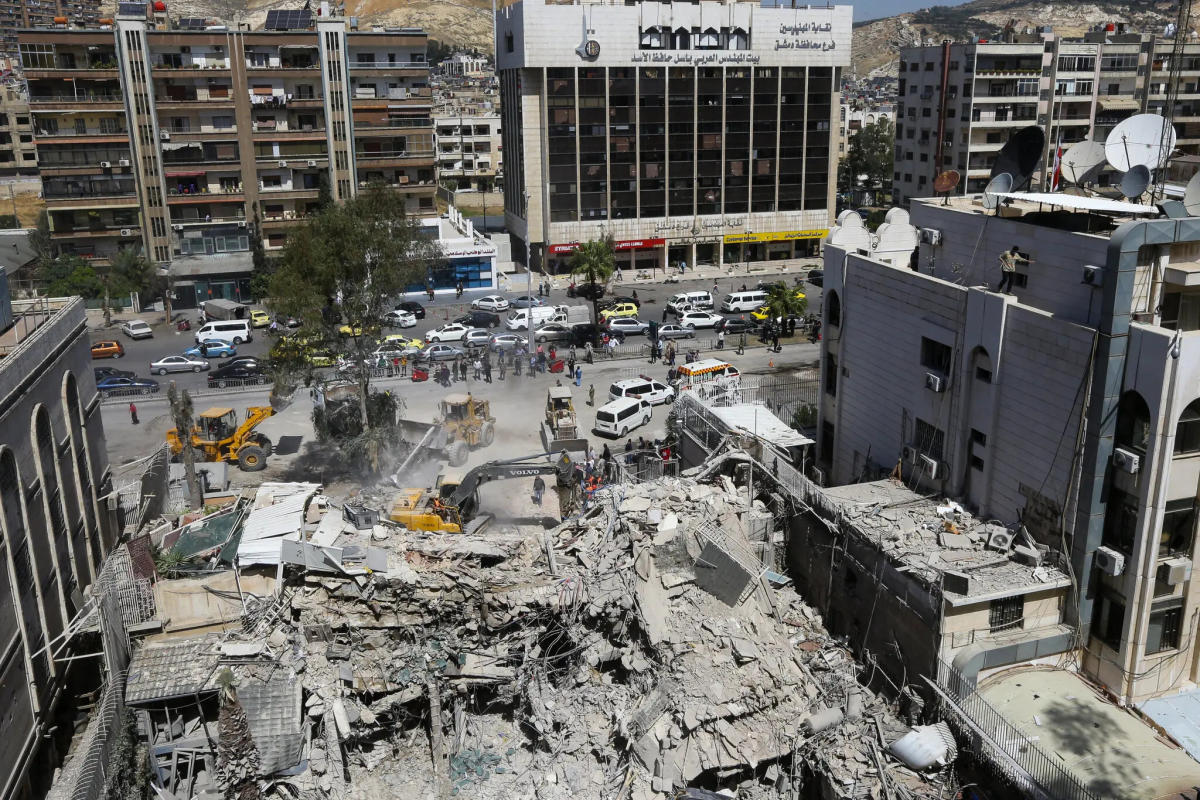
 www.yahoo.com
About a week beforehand, on March 22, Israel’s war Cabinet approved the operation, according to internal Israeli defense records that summarized preparations for the strike and were viewed by The New York Times. The Israeli military did not comment on the internal assessment.
Those records also outlined the range of responses from Iran that the Israeli government expected, among them small-scale attacks by proxies and a small-scale attack from Iran. None of the assessments predicted the ferocity of the Iranian response that actually occurred.
From the day of the strike, Iran vowed retaliation, both publicly and through diplomatic channels. But it also sent messages privately that it did not want outright war with Israel — and even less so with the United States — and it waited 12 days to attack.
Initially, Israel’s military and intelligence services expected Iran to launch no more than 10 surface-to-surface missiles at Israel, an attack they code-named “Late Foliage.” By the middle of last week, they realized Iran had something much bigger in mind, and the Israelis increased their estimate to 60 to 70 surface-to-surface missiles. Even that turned out to be too low
Miscalculation Led to Escalation as Israel and Iran Clash
TEL AVIV, Israel — Israel was mere moments away from an airstrike on April 1 that killed several senior Iranian commanders at Iran’s embassy complex in Syria when it told the United States what was about to happen. Israel’s closest ally had just been caught off guard. Aides quickly alerted Jake...
Pakistan Defence Latest
-

-
-

-
-
 Somalia Reportedly Agrees to Acquire Pakistan’s JF-17 Fighter Jets (3 Viewers)
- Latest: Hamartia Antidote


